Week 3 Sheet metal Bending challenge
Aim : To perform static structural analysis on Sheet metal bending operation.
Objectives :
Case 1 : Aluminium Alloy 1199, Copper Alloy NL and Magnesium Alloy NL. Find out the Equivalent stress, Equivalent elastic strain and Total Deformation in Y direction and compare the results for the three materials.
Case 2 : With the material as Aluminium Alloy, change the friction coefficient to 0.19 and run the analysis as mentioned in Case 1. Compare the results with that in case 1.
Case 3 : Refine the mesh on the plate such that it doesn't cross the academic limit. With Aluminium alloy as material, run the analysis as in Case 1 and compare the results.
Procedure :
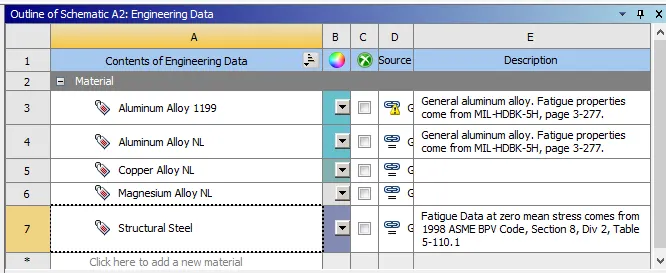
Engineering Data and Material setup :
- Open Engineering Data.
- Add aluminium alloy as material make duplicate of it.
- Enter the values for Aluminium Alloy 1199
- Similarly add other materials.
Geometry :
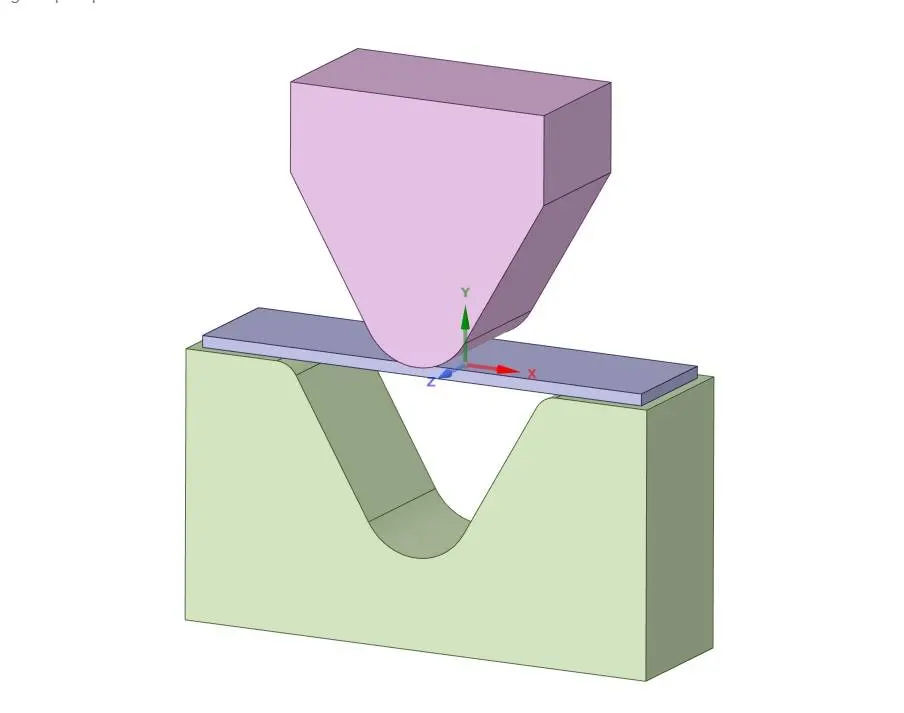
- Open spaceclaim and import the model.
- Check for abnormalities.
Model Setup :
- Open ANSYS mechanical.
- Go to geometry rename it as Punch, Die and Sheet.
Contacts :
- Delete default contacts.
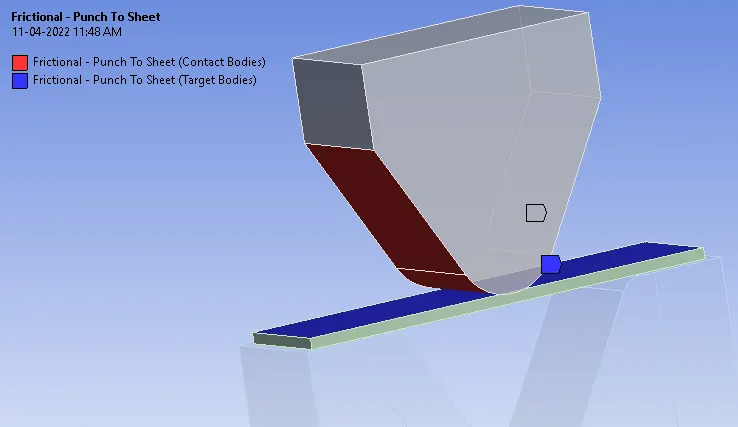
- Insert manual contact region, select 3 faces of punch and upper face of sheet.
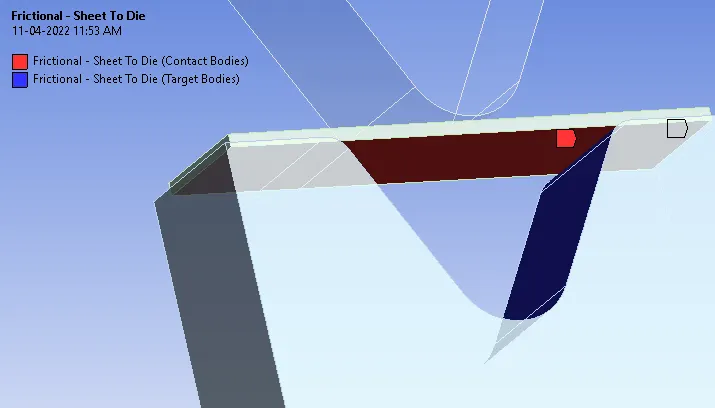
- Again insert contact region for lower face of sheet and faces of die.
- Select both contacts using CTRL key and give following parameters
Type = frictional
Friction Coefficient = 0.1
Behaviour = Auto Asymmetric
Normal Stiffness Factor = 0.1
Formulation = Augmented Lagrangian
Interface Treatment = Add Offset, Ramped Effects
Meshing :
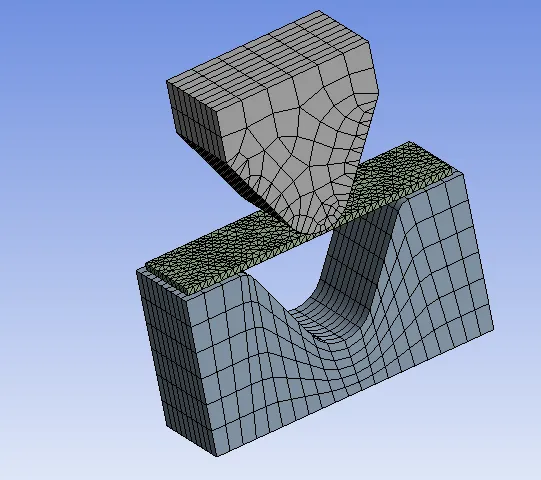
- Insert sizing for Punch and Die of size 4mm.
- Insert sizing for Sheet of size 1mm.
- Insert method as Tetrahedrons to mesh Sheet.
- Insert Face sizing for Punch and Die faces of size 1mm.
- Generate mesh.
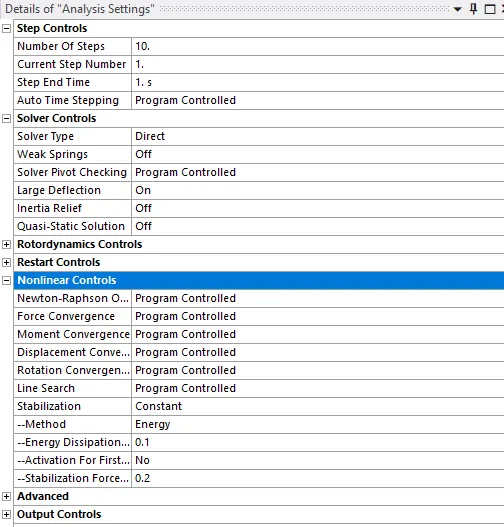
Analysis setting :
Displacement :
- Insert displacement for Punch
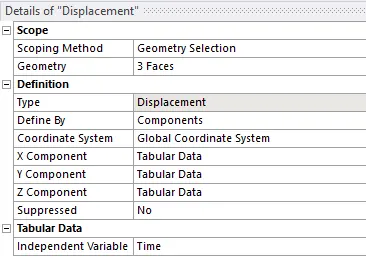
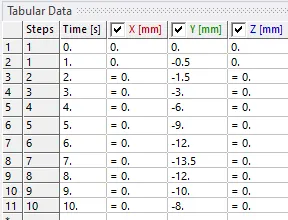
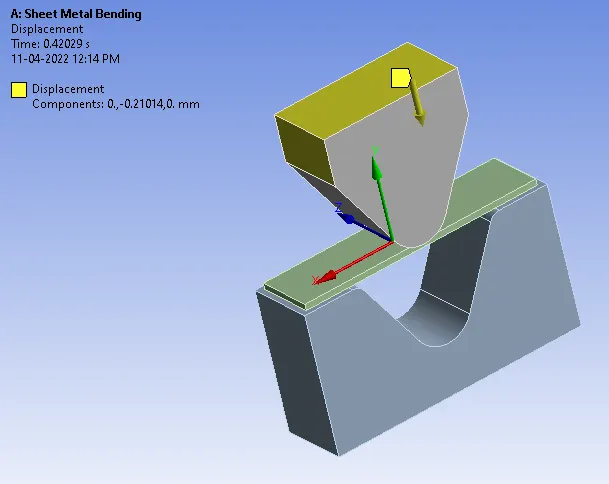
- Insert displacement for sheet to constrained motion along Z-direction.
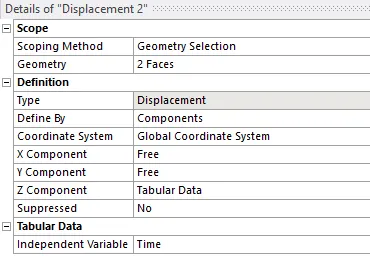
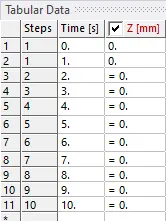
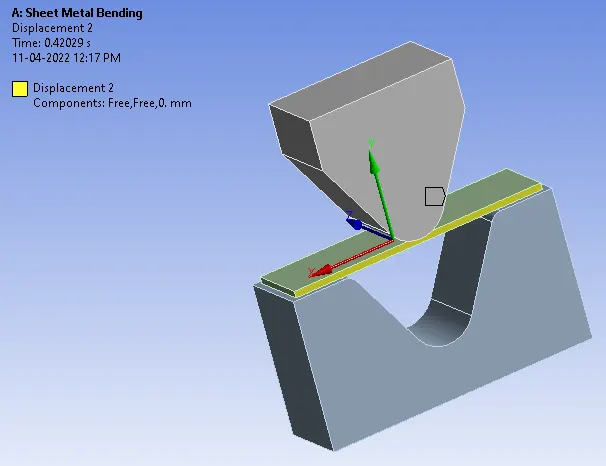
- Insert displacement for die.
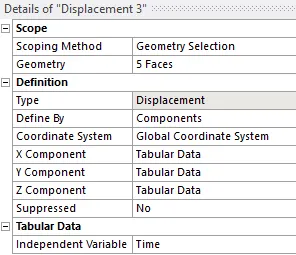
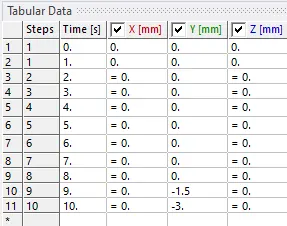
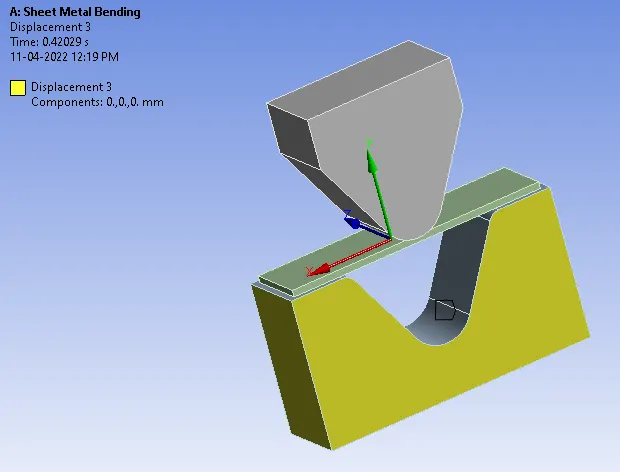
Solution :
- Insert directional deformation in y-axis.
- Insert equivalent stress and strain for complete model.
- Insert equivalent stress and strain for sheet.
Results :
Case 1 : Aluminium Alloy 1199, Copper Alloy NL and Magnesium Alloy NL. Find out the Equivalent stress, Equivalent elastic strain and Total Deformation in Y direction and compare the results for the three materials.
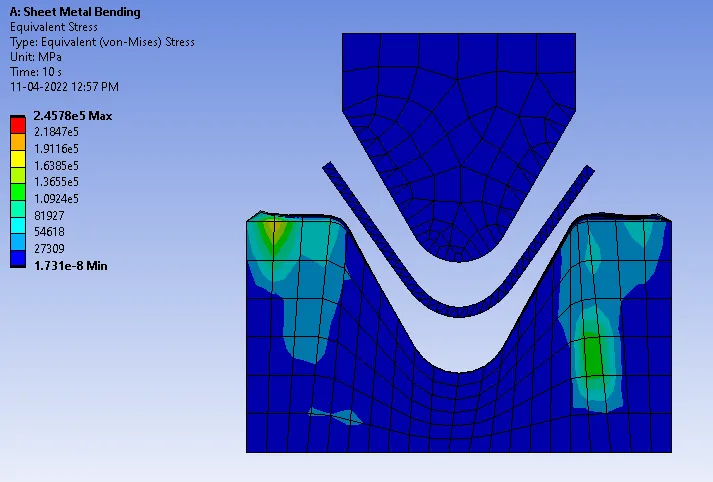
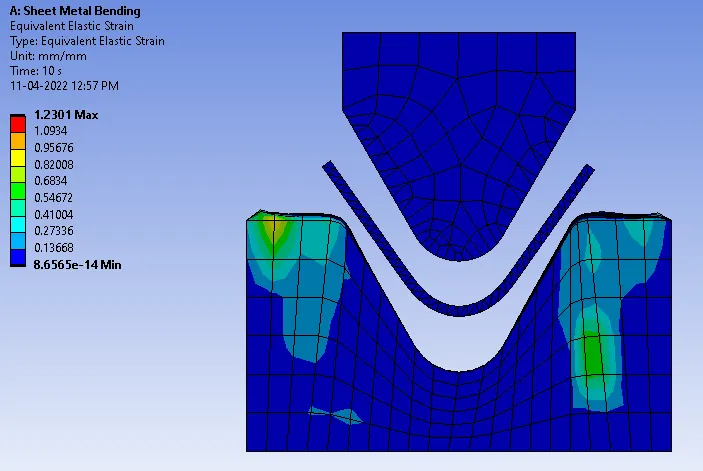
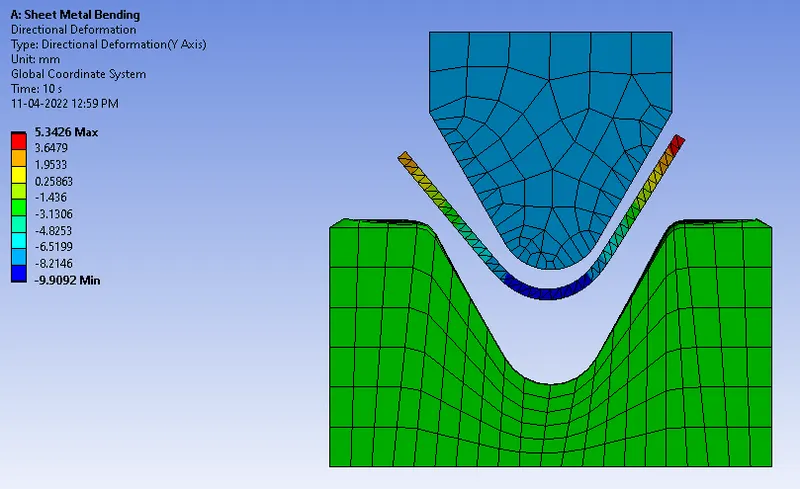
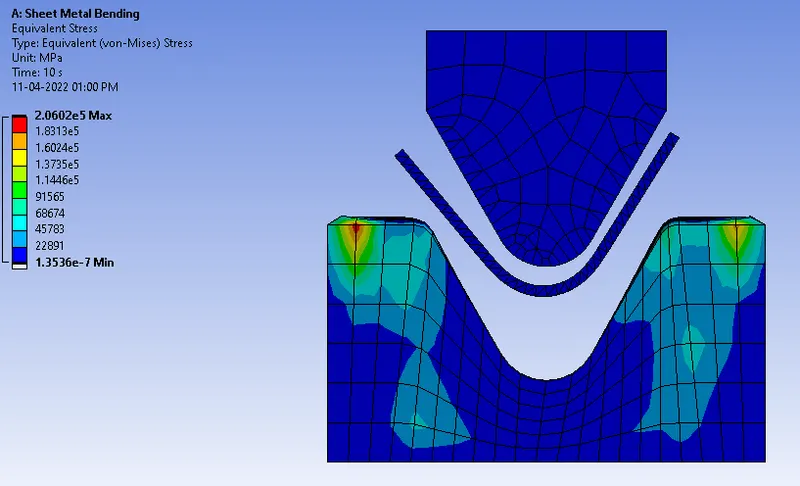
For Case 1 analysis three different materials are assigned to the plates, i.e, Aluminium Alloy 1199, Copper Alloy NL, Magnesium Alloy NL while structural steel is used for the punch and die.
A) Aluminium Alloy 1199
Directional deformation :
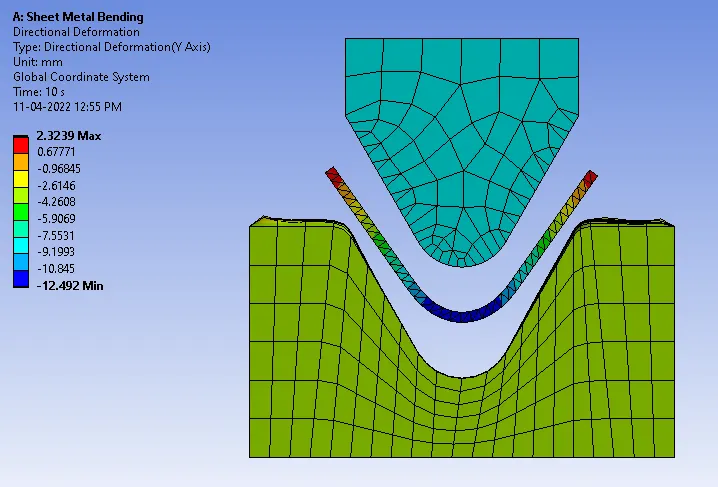
Eqivalent stress :
Equivalent strain :
B) Copper Alloy NL
Directional deformation :
Eqivalent stress :
Equivalent strain :
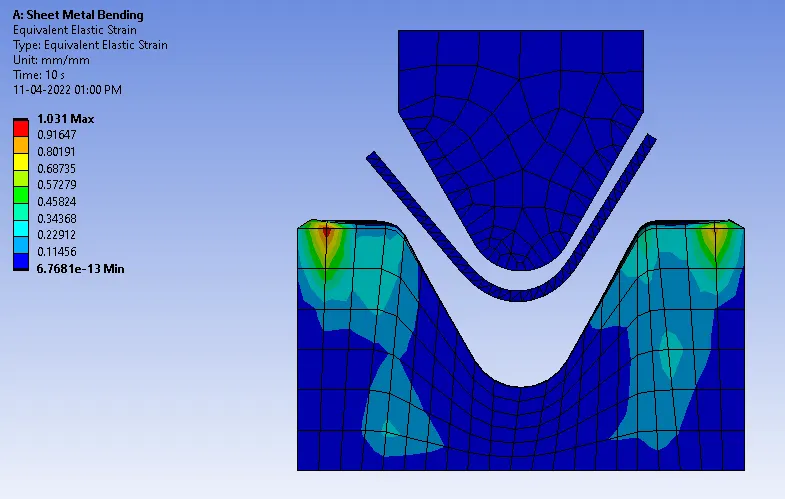
C) Magnesium Alloy NL
Directional deformation :
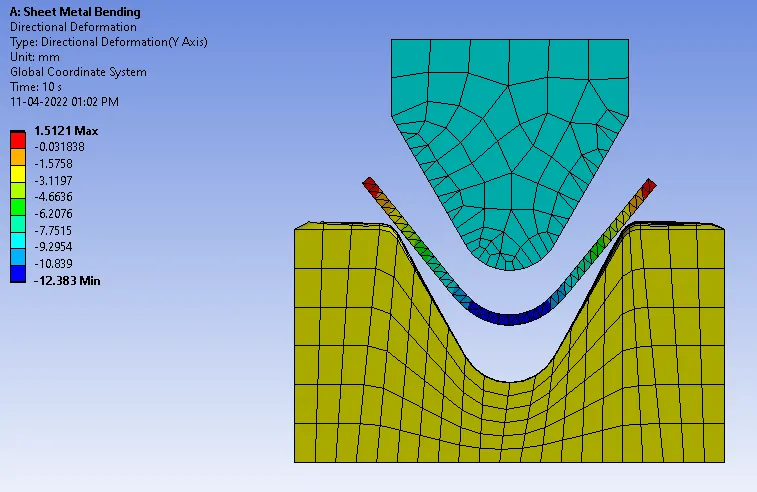
Eqivalent stress :
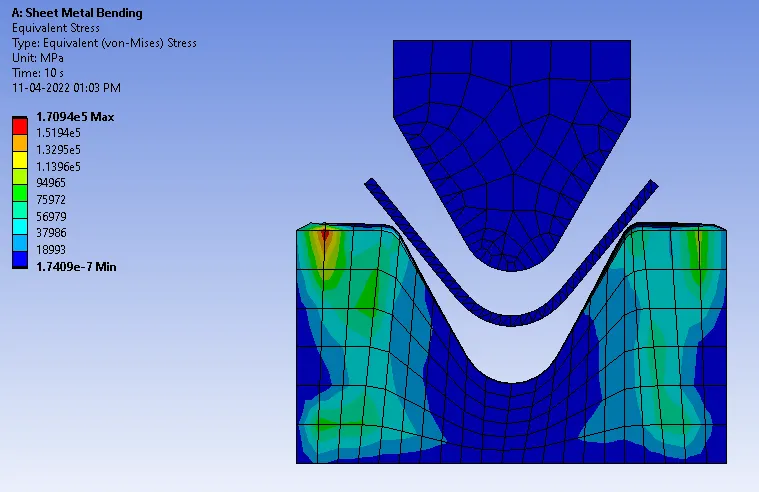
Equivalent strain :
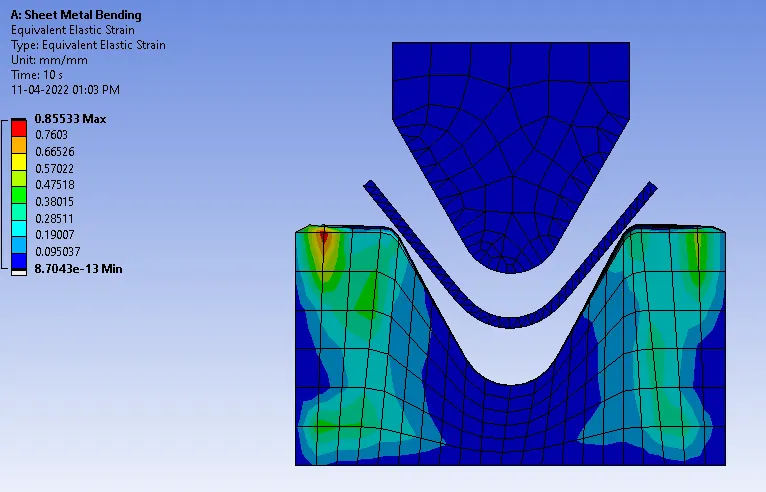
Comparison of results :
|
Sr.No. |
Results | Aluminium Alloy 1199 | Copper Alloy NL | Magnesium Alloy NL |
| 1 | Directional Deformation Maximum (mm) | 2.3238 | 5.3425 | 1.5120 |
| 2 | Directional Deformation Minimum (mm) | -12.4916 | -9.9092 | -12.3832 |
| 3 | Equivalent Stress Maximum (Mpa) | 2.4578 E+05 | 2.0602 E+05 | 1.7093 E+05 |
| 4 | Equivalent Stress Minimum (Mpa) | 1.7309 E-08 | 1.3536 E-07 | 1.7408 E-07 |
| 5 | Equivalent Strain Maximum | 1.2301 | 1.0310 | 0.8553 |
| 6 | Equivalent Strain Minimum | 8.6564 E-14 | 6.7681 E-13 | 8.7042 E-13 |
- For Aluminium Alloy 1199 we get more equivalent stress and strain values.
- For Copper Alloy NL we get more more directional deformation than others.
- For Magnesium Alloy NL we get less deformation, less equilvalent stress and strain values.
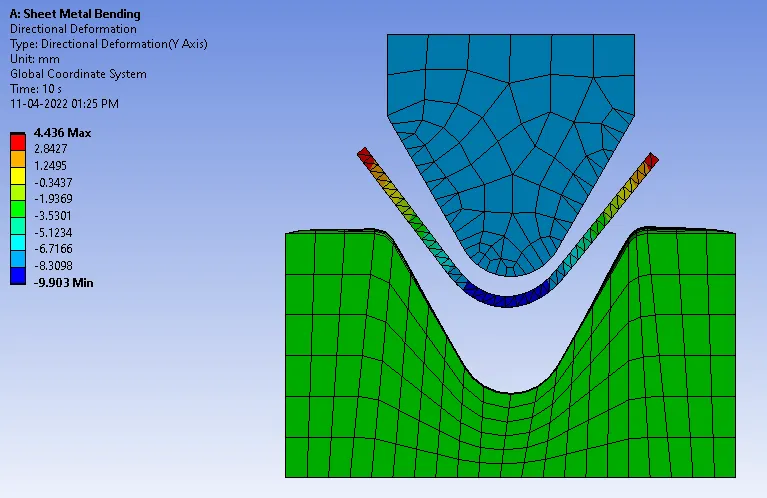
Case 2 : With the material as Aluminium Alloy, change the friction coefficient to 0.19 and run the analysis as mentioned in Case 1. Compare the results with that in case 1.
Directional deformation :
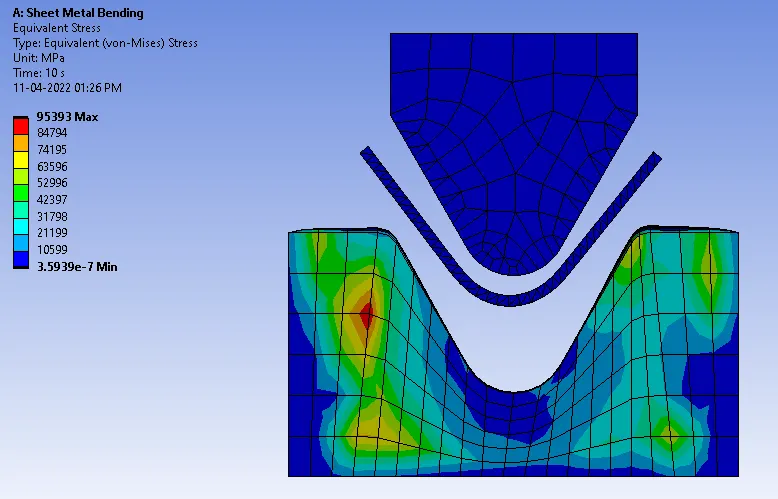
Eqivalent stress :
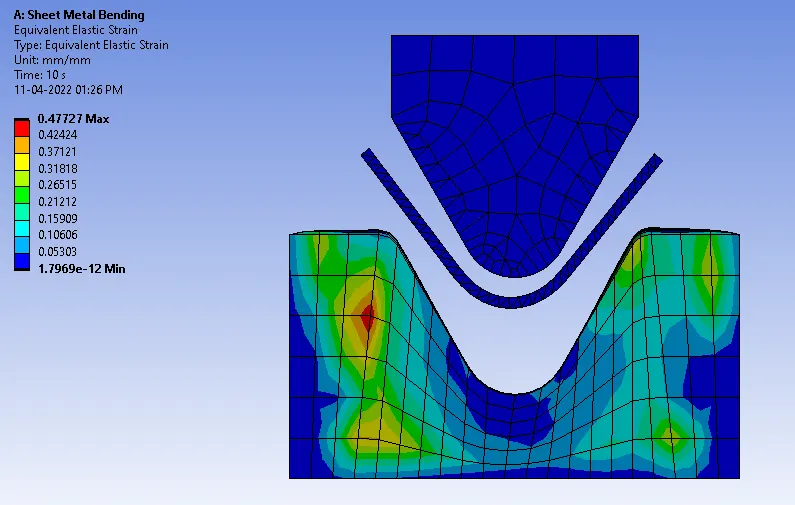
Equivalent strain :
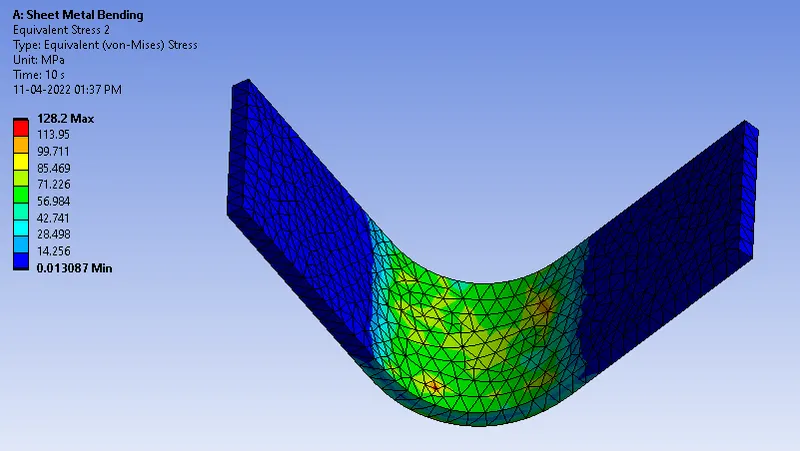
Equivalent stress in sheet :
Equivalent strain in sheet :
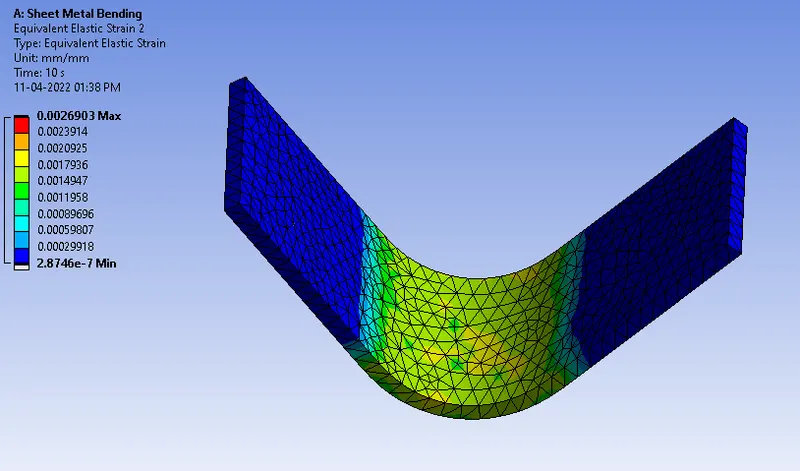
Comparison of results :
|
Sr. No. |
Results |
Aluminium Alloy 1199 Friction coeff = 0.1 |
Aluminium Alloy Friction coeff = 0.19 |
| 1 | Directional Deformation Maximum (mm) | 2.3238 | 4.4359 |
| 2 | Directional Deformation Minimum (mm) | -12.4916 | -9.9030 |
| 3 | Equivalent Stress Maximum (Mpa) | 2.4578 E+05 | 9.5393 E+05 |
| 4 | Equivalent Stress Minimum (Mpa) | 1.7309 E-08 | 3.5938 E-07 |
| 5 | Equivalent Strain Maximum | 1.2301 | 0.4772 |
| 6 | Equivalent Strain Minimum | 8.6564 E-14 | 1.7969 E-12 |
| 7 | Equivalent Stress in Sheet Maximum (Mpa) | 63.8755 | 128.1966 |
| 8 | Equivalent Strain in Sheet Maximum | 0.00154 | 0.00269 |
- From results for the increased coeff of friction we get more deformation values.
- Equivalent stress is also increased in Case 2.
- Equivalent stress in sheet is more in Case 2.
- Maximum Equivalent strain values are less in Case 2 compared to Case 1.
Case 3 : Refine the mesh on the plate such that it doesn't cross the academic limit. With Aluminium alloy as material, run the analysis as in Case 1 and compare the results.
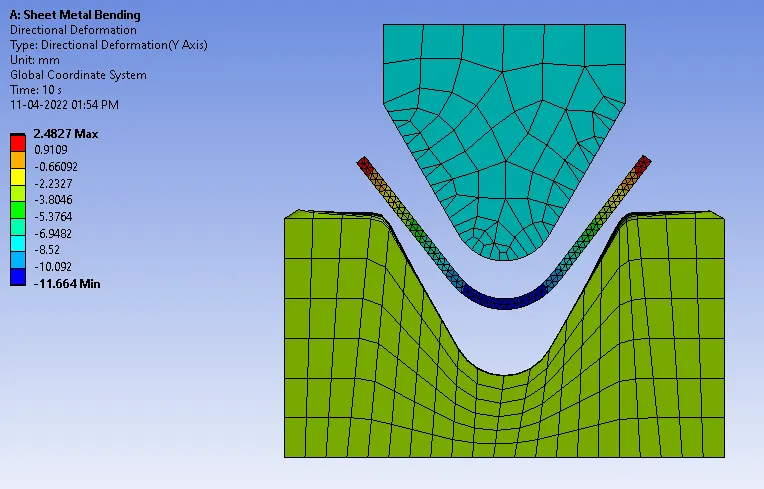
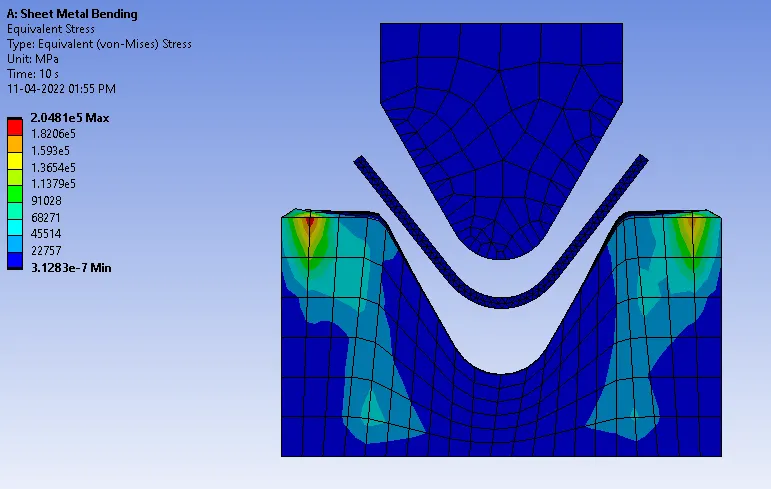
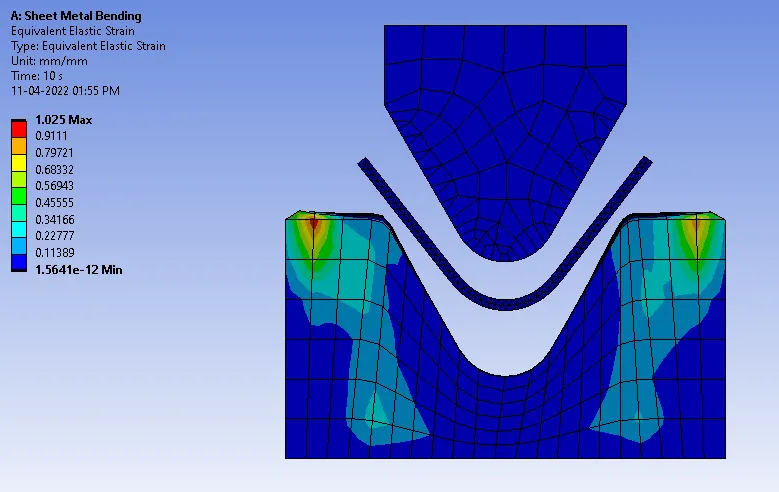
In this case, the material assigned to the plate is Aluminum Alloy and the mesh size considered for the plate is 0.7 mm.
Directional deformation :
Eqivalent stress :
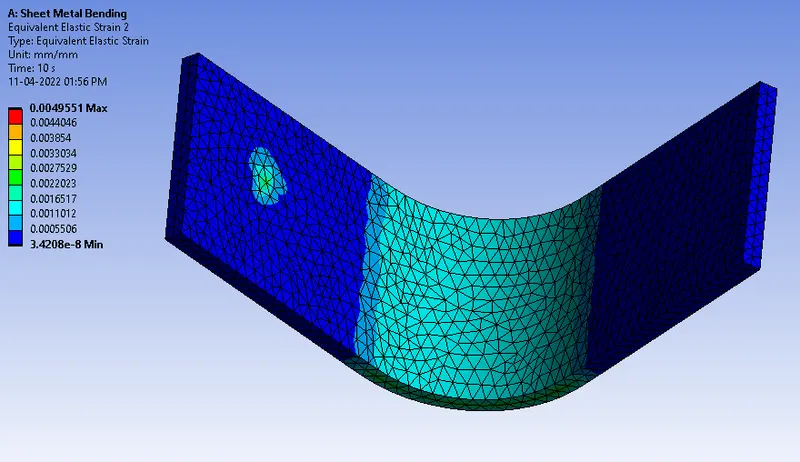
Equivalent strain :
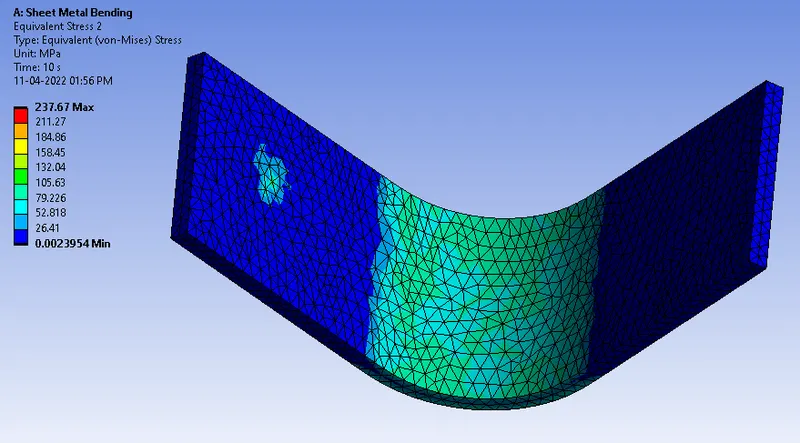
Equivalent stress in sheet :
Equivalent strain in sheet :
Comparison of results :
|
Sr. No. |
Results |
Aluminium Alloy 1199 Friction coeff = 0.1 |
Aluminium Alloy Friction coeff = 0.19 |
Aluminium Alloy Friction coeff = 0.1 Refine mesh |
| 1 | Directional Deformation Maximum (mm) | 2.3238 | 4.4359 | 2.4827 |
| 2 | Directional Deformation Minimum (mm) | -12.4916 | -9.9030 | -11.6636 |
| 3 | Equivalent Stress Maximum (Mpa) | 2.4578 E+05 | 9.5393 E+05 | 2.0481 E+05 |
| 4 | Equivalent Stress Minimum (Mpa) | 1.7309 E-08 | 3.5938 E-07 | 3.1282 E-07 |
| 5 | Equivalent Strain Maximum | 1.2301 | 0.4772 | 1.0249 |
| 6 | Equivalent Strain Minimum | 8.6564 E-14 | 1.7969 E-12 | 1.5641 E-12 |
| 7 | Equivalent Stress in Sheet Maximum (Mpa) | 63.8755 | 128.1966 | 237.6745 |
| 8 | Equivalent Strain in Sheet Maximum | 0.00154 | 0.00269 | 0.00495 |
When the mesh of the sheet is refined further it is observed that maximum stress occurs in the sheet while the stress, strain and deformation in other members, i.e, the die and punch are less as compared to Case-1 results.