Week 3 Sheet metal Bending challenge
Sheet metal Bending Stress analysis on Punch & Die System:
Case 1:
Aim: Performing Sheet metal bending stress analysis on three different materials of Aluminium alloy 1199,Copper alloy NL & Magnesium alloy NL and comparing the Total deformation,Equivalent Stress and Equivalent Strain on sheet.
Steps Followed:
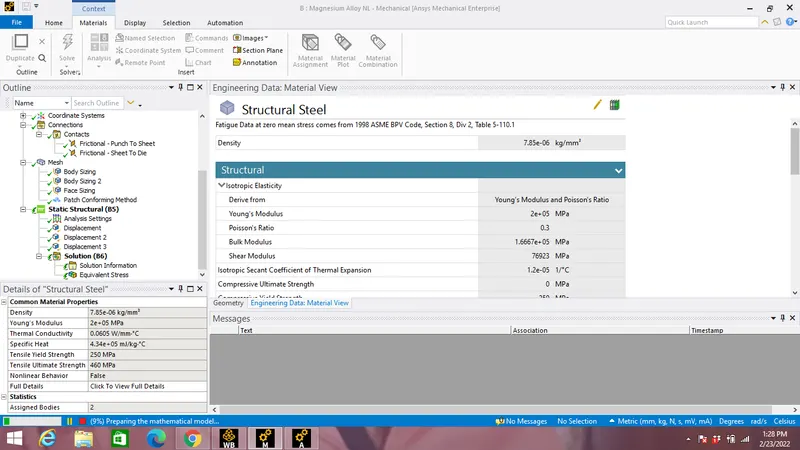
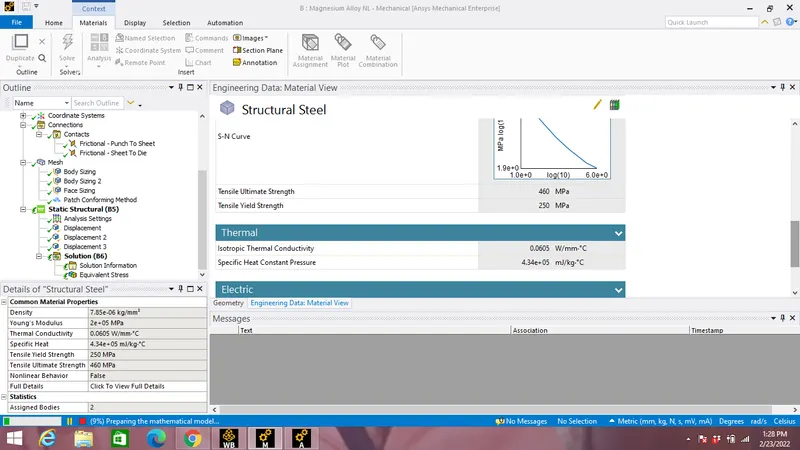
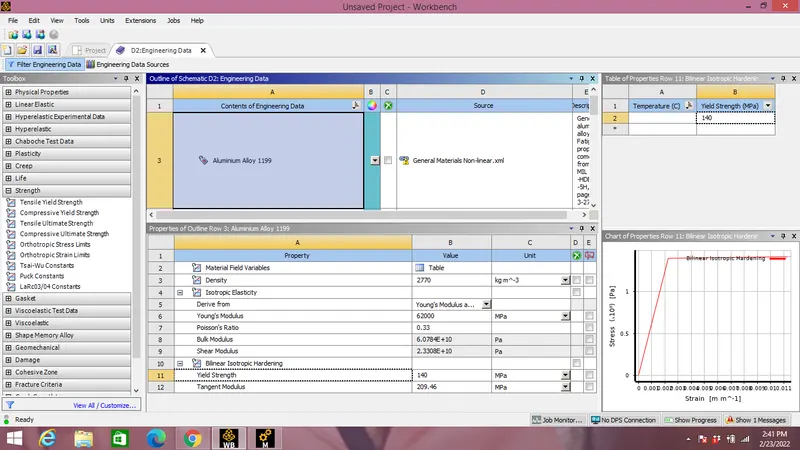
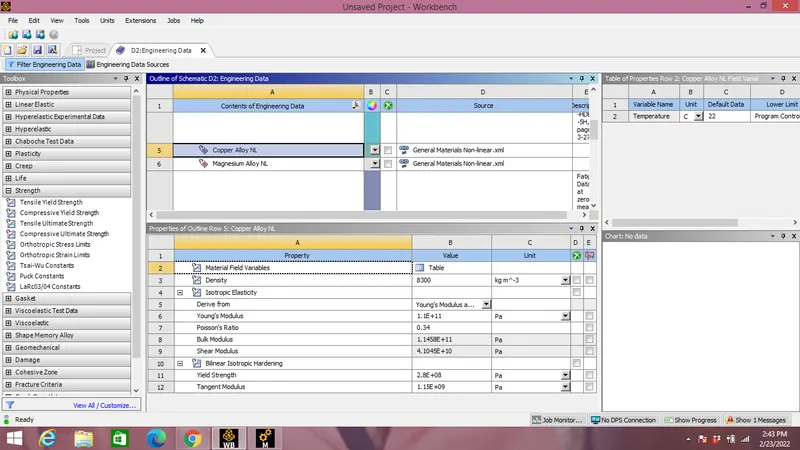
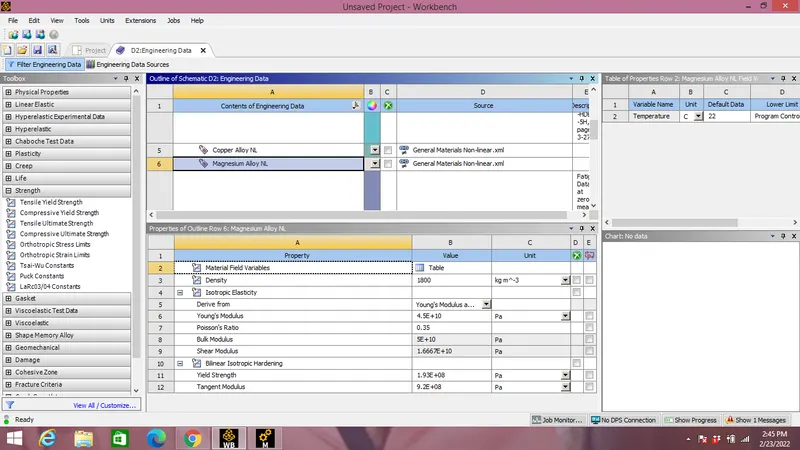
1) Material Selection with following properties:
Punch & Die made up Structural Steel.
Aluminium alloy 1199:
Copper alloy NL:
Magnesium alloy NL:
2)Meshing:
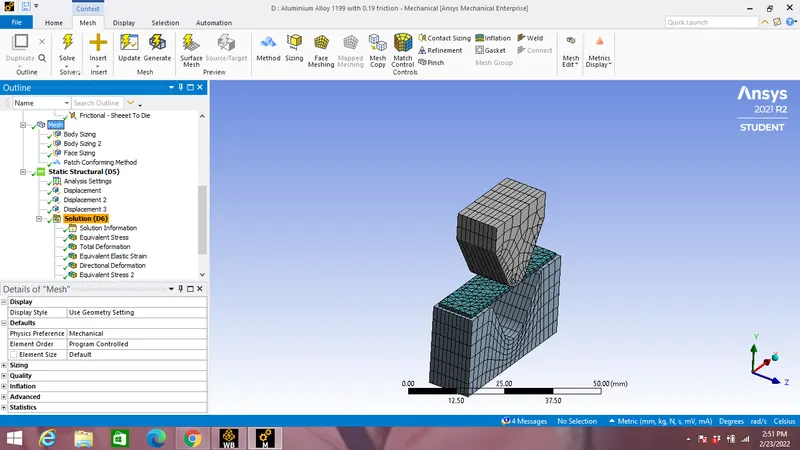
Meshing of the sheet is doen with Tetrahedron elements with patch conforming algorithms.Body sizing is provided to Punch & die of 4mm size and that for sheet element size of 1mm.Face sizing of Die & Punch contact area is doen with element size of 1mm.
3)Contacts:
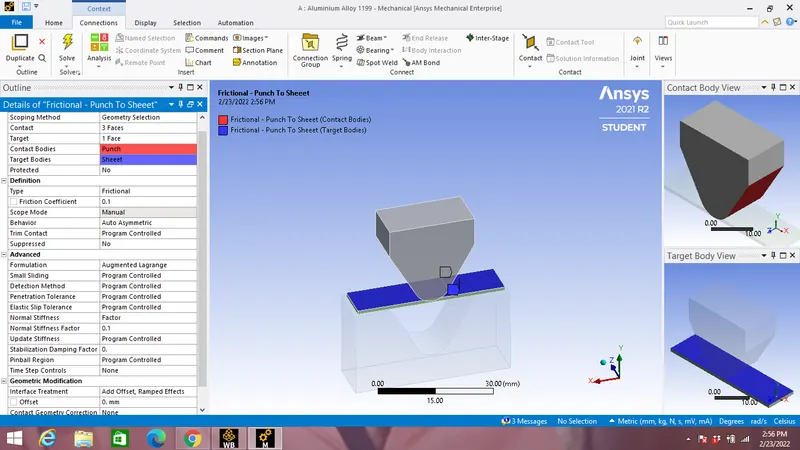
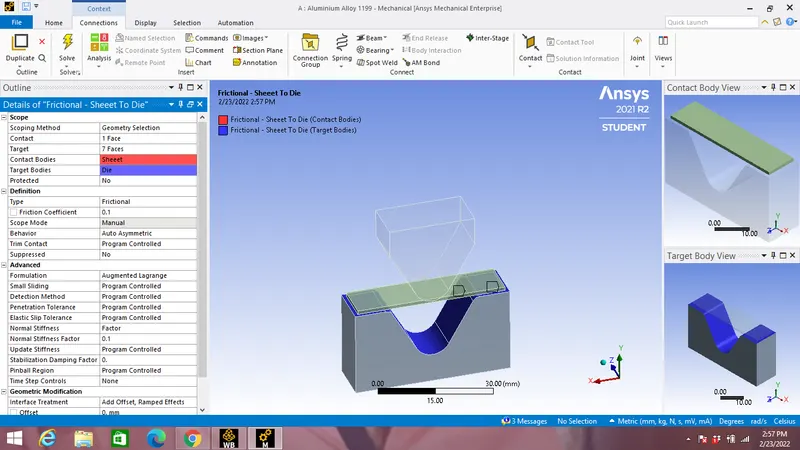
Frictional contact is provided at the interface of Punch & Sheet and at the other contact of Sheet & Die with frictional coefficient of 0.1 at each surface.
Punch & sheet contact:
Sheet & Die contact:
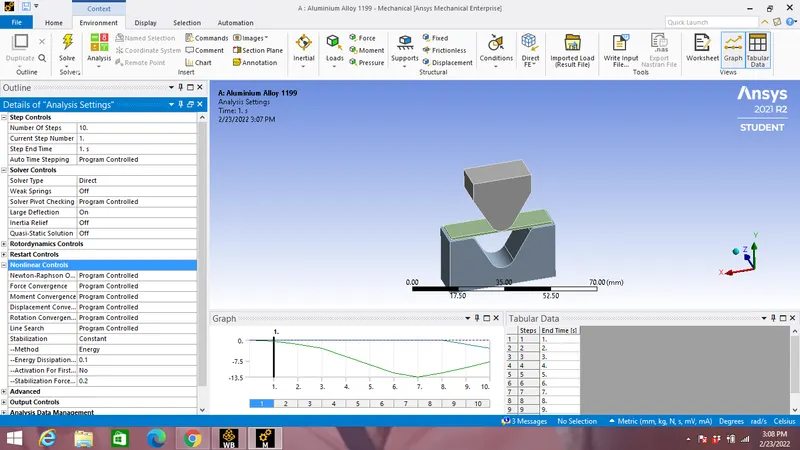
4) Analysis Settings:
Simulations is doen in 10 steps with Larger Deflections On & Solver type Direct.Non-Linear stablization techique is used to overcome non convergence diffculties.Dissipation ratio factor of 0.1 adds artificial dampers to all nodes.
5)Boundary candition:
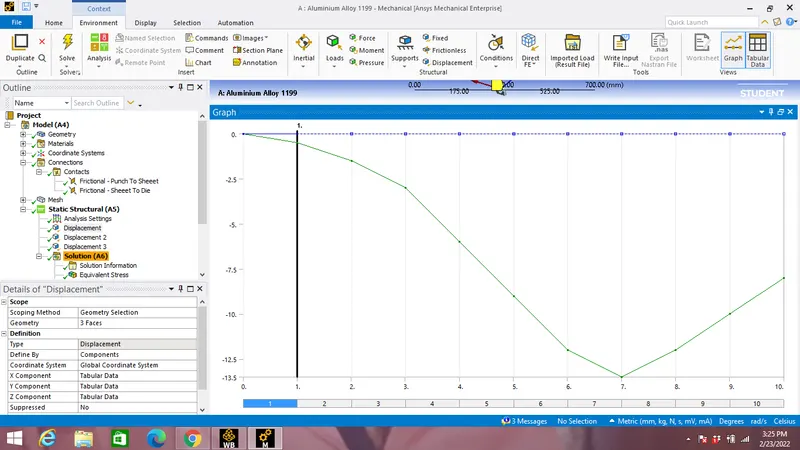
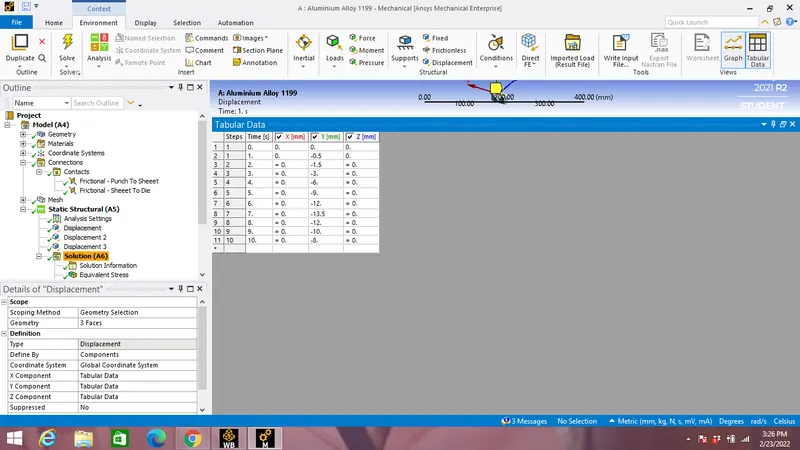
- Displacement Load is provided in the punch in negative Y direction.Punch will move down towards the sheet & after pressing it to a distance of 13.5,it will return back to intial postion in positive Y direction.
- Sheet is also kept fixed along Z direction using displacement load.During bending sheet will move along X & Y directions, that is reason of setting X&Y axis free.
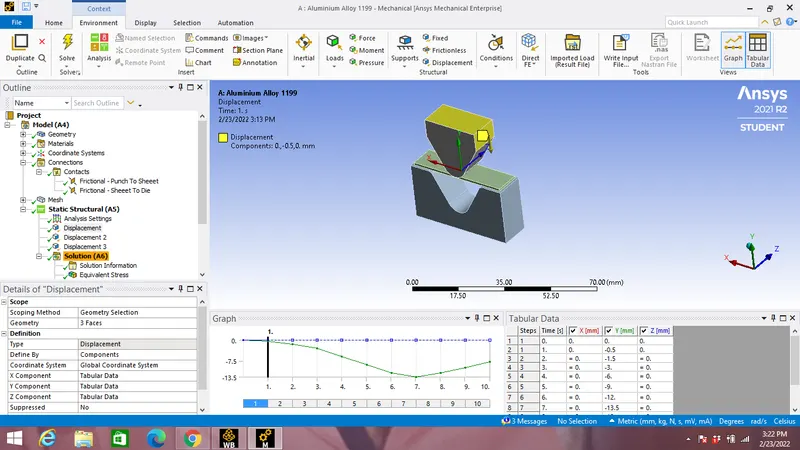
Displacement along Y axis:
Displacement vs Time Graph:
Displacement along Y axis vs Time Table:
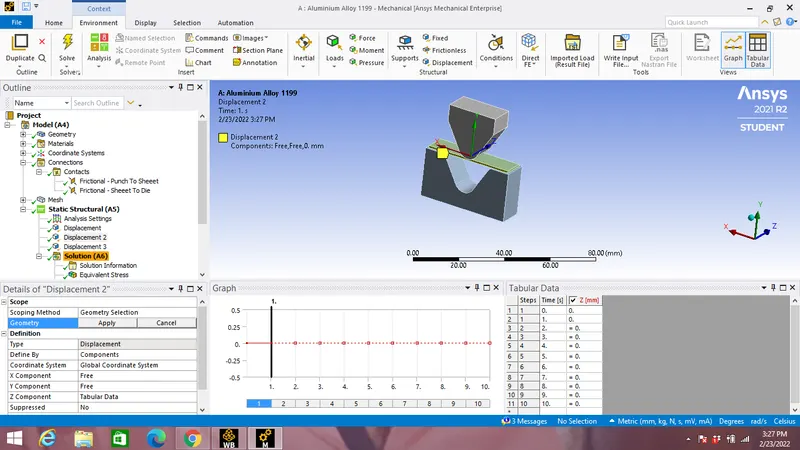
Displacement 2:
Provided by keeping faces of Sheet perpendicular to Z axis fixed.
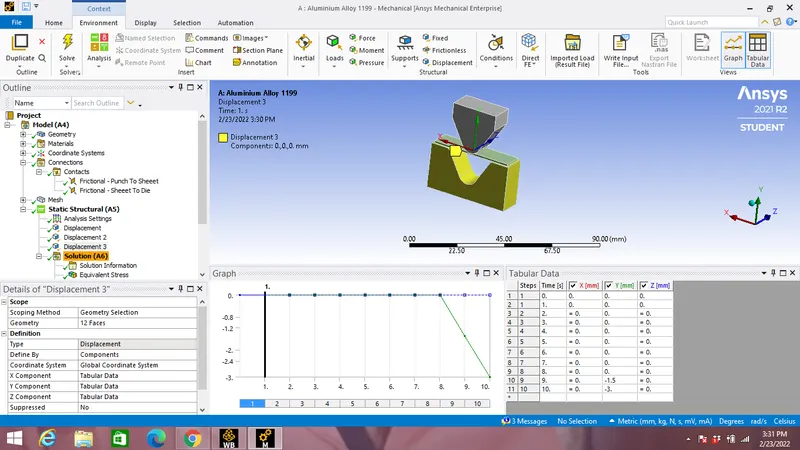
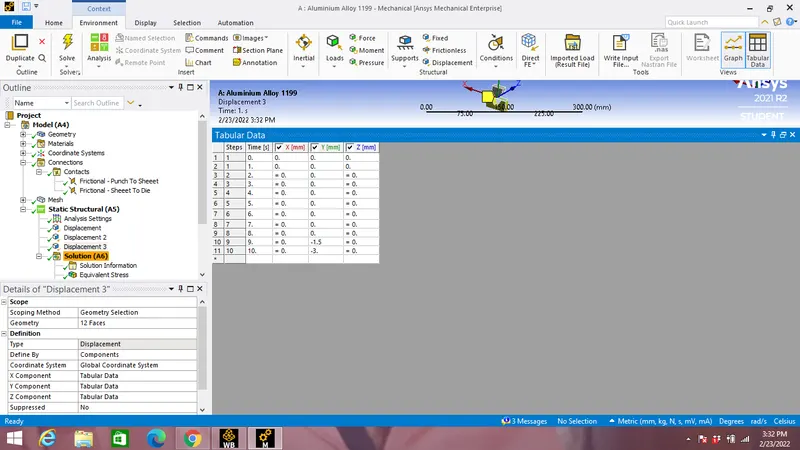
Displacement 3:
For the last two time steps Die is provided with displacement along negative Y direction of 1.5 mm & 3mm.
5)Results:
Aluminium 1199 Alloy as the material for the sheet:
a)Equivalent Stress for the sheet:
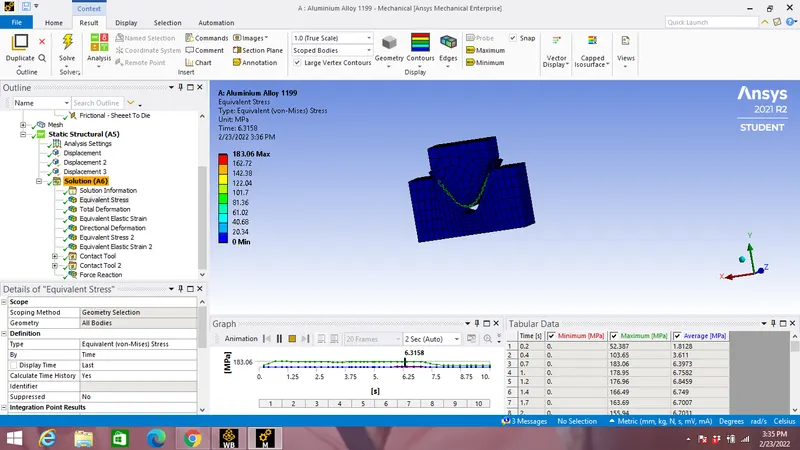
Maximum Equivalent Stress=183.06MPa
b)Equivalent Strain for the sheet:
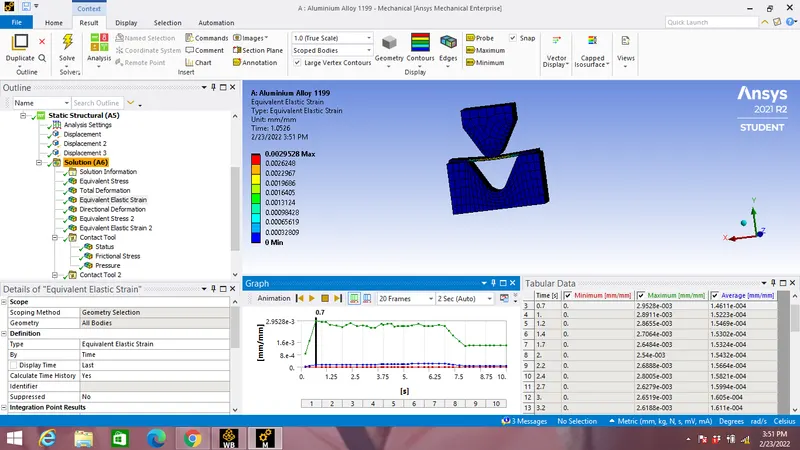
Maximum Equivalent Strain=2.9528e-3.
c)Total Deformation for the sheet:
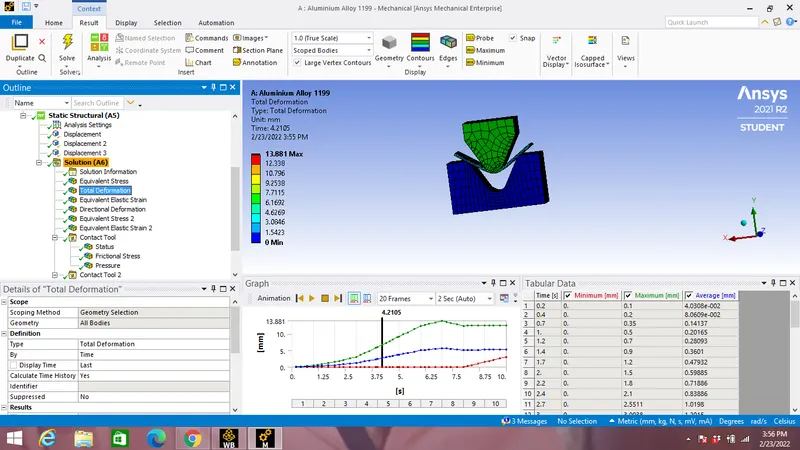
Maximum Total Deformation=13.881mm
d) Directional deformation for the Sheet along Yaxis:
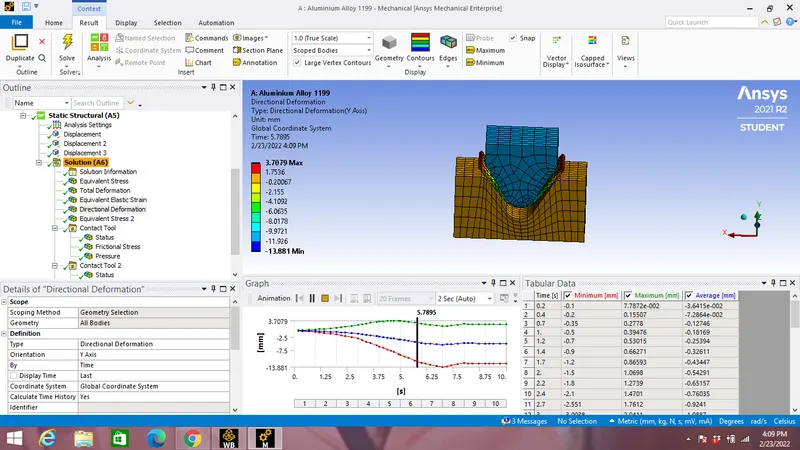
Max Directional Deformation along Y axis=3.7079mm.
Copper Alloy NL as the material for the sheet:
a)Equivalent Stress for the sheet:
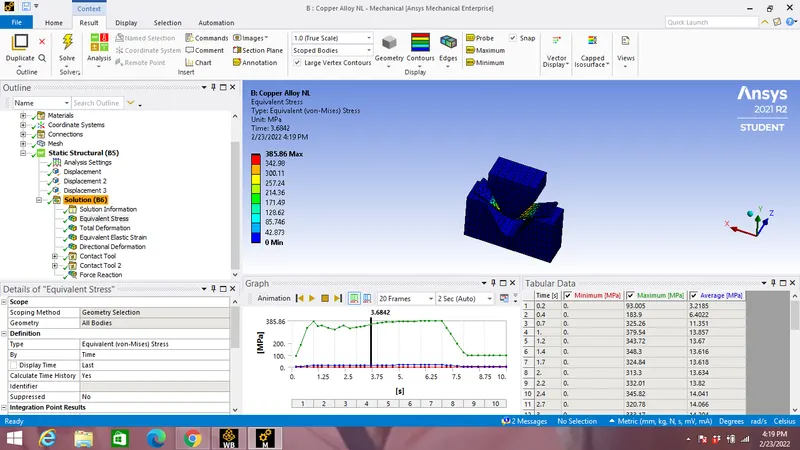
Maximum Equivalent Stress=385.86MPa
b)Equivalent Strain for the sheet:
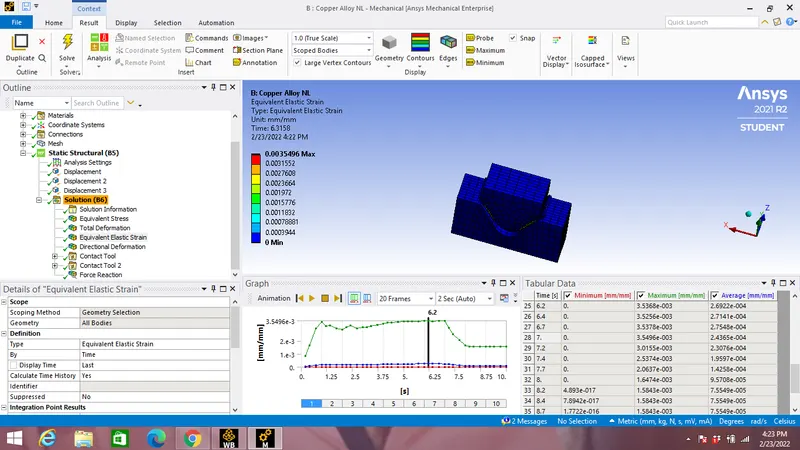
Maximum Equivalent Strain=3.5496e-3.
c)Total Deformation for the sheet:
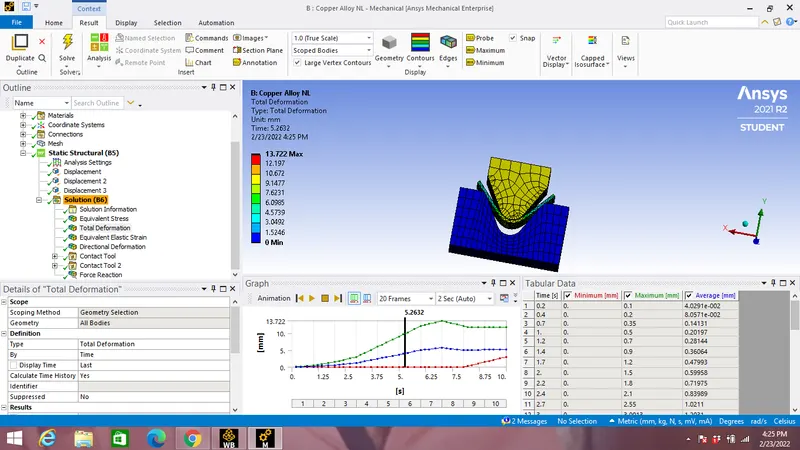
Maximum Total Deformation=13.772mm
d) Directional deformation for the Sheet along Yaxis:
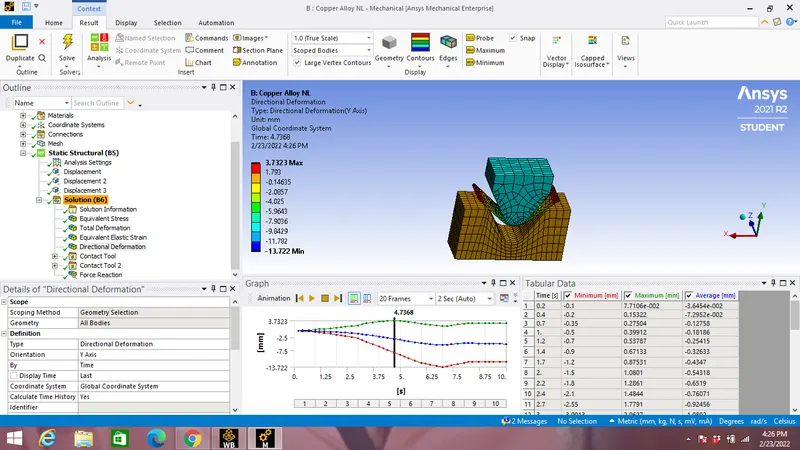
Max Directional Deformation along Y axis=3.7323mm.
Magnesium Alloy NL as the material for the sheet:
a)Equivalent Stress for the sheet:
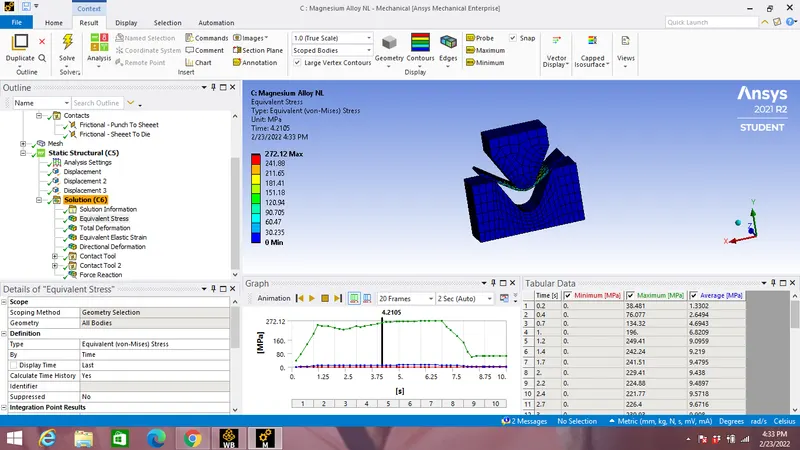
Maximum Equivalent Stress=272.12MPa
b)Equivalent Strain for the sheet:
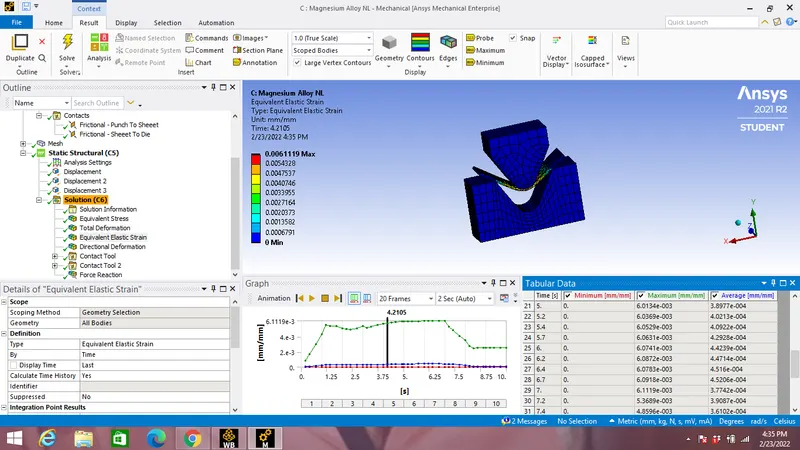
Maximum Equivalent Strain=6.1119e-3.
c)Total Deformation for the sheet:
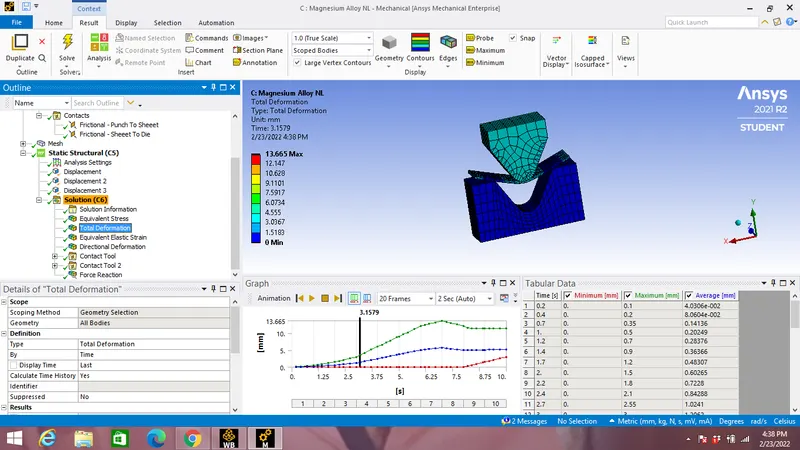
Maximum Total Deformation=13.665mm
d) Directional deformation for the Sheet along Y axis:
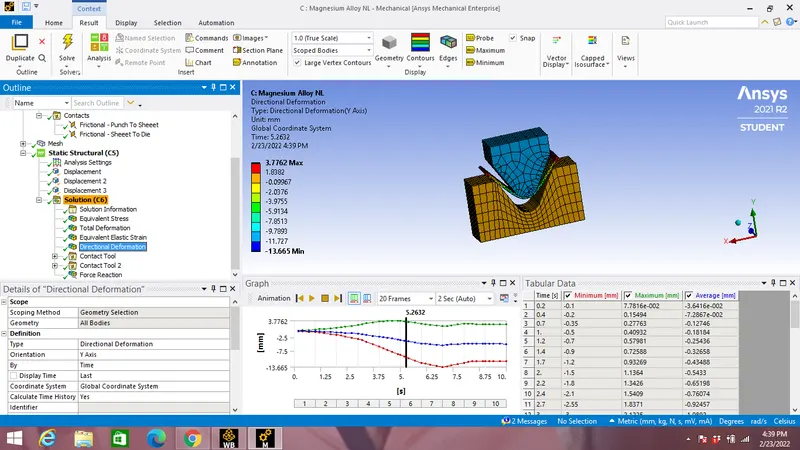
Max Directional Deformation along Y axis=3.7762mm.
Comparision of Equivalent Stress,Strain,Total Deformation & Directional Deformation along Y axis for three materials:
Table below represents comparision:
| Materials | Max Equivalent Stress(MPa) | Max Equivalent Strain | Max Total Deformation(mm) | Max Y Directional Deformation(mm) |
| Aluminium Alloy 1199 | 183.06 | 2.9528e-003 | 13.881 | 3.7079 |
| Copper Alloy NL | 385.86 | 3.5496e-003 | 13.772 | 3.7323 |
| Magnesium Alloy NL | 272.12 | 6.1119e-003 | 13.665 | 3.7762 |
It can be seen from the table above that Max Equivalent Stress occurs for Copper Alloy NL as it has highest Young's modulus of 1.1e+005MPa among all the three materials,so high internal restoring force acts on material made up with Copper Alloy NL during deformation, resulting in high Equivalent Stress,Maximum Y Directional Deformation occurs for Magnesium Alloy NL as it had least values of 45000 MPa of Young's modulus among three materials used so least tendency of restoring its orginal shape during deformation.
Case 2:
Aim: To compare Equivalent Stress,Strain,Total Deformation and Y Directional Deformation between Aluminium 1199 with 0.19 & 0.1 frictional coefficients.
Steps Followed:
Aluminium 1199 material is selected & all the steps of meshing,contacts,analysis settings & boundary canditions kept same as in case 1, however this time,frictional coefficient of 0.19 between Punch & sheet and Die & Sheet is kept.
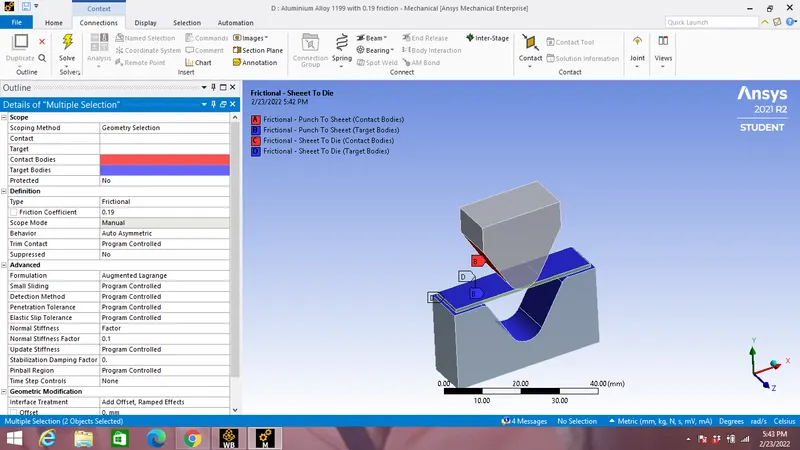
Results obtained:
Equivalent Stress:
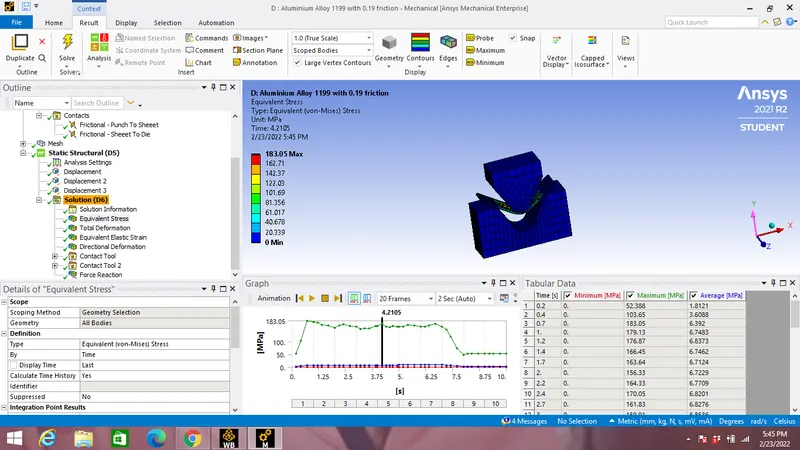
Maximum Equivalent Stress:183.05Mpa
Total Deformation:
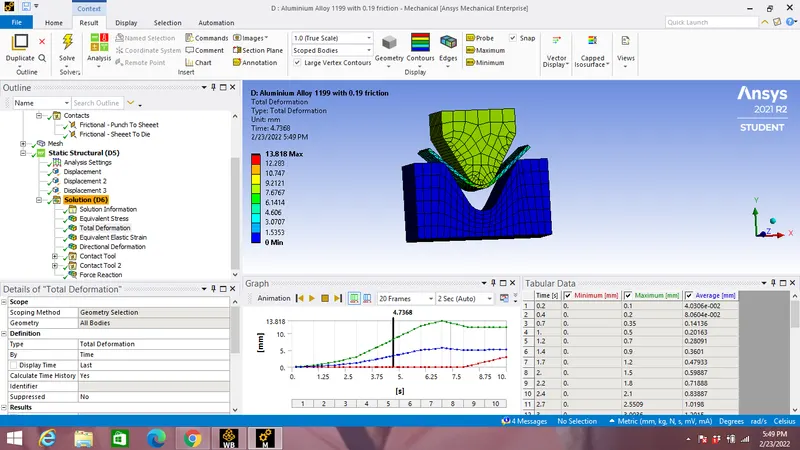
Max Total Deformation:13.818mm
Directional Deformation along Y axis:
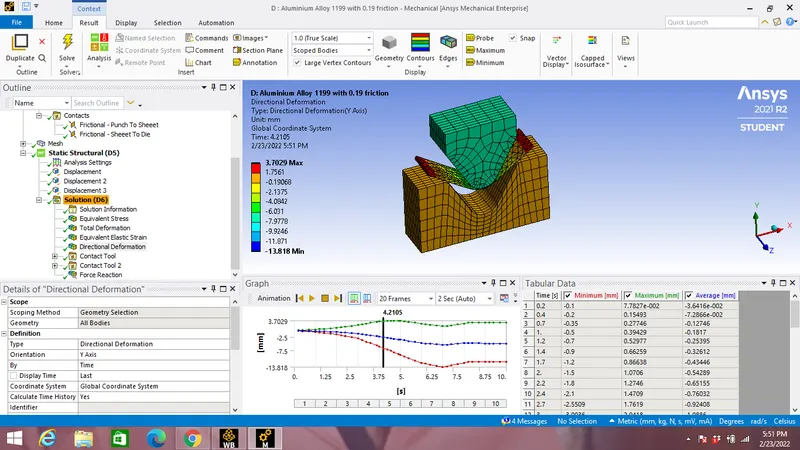
Max Directional Deformation:3.7029mm
Comparision between Frictional coefficients of 0.19 & 0.1 for Aluminium 1199:
| Friction Coefficient | Max Equivalent Stress(MPa) | Max Total Deformation(mm) | Max Y Directional Deformation(mm) |
| 0.1 | 183.06 | 13.881 | 3.7079 |
| 0.19 | 183.05 | 13.818 | 3.7029 |
Conclusion:With the increase in Friction coefficient from 0.1 to 0.19 Maximum Total Deformation and Maximum Y Directional Deformation decreases, beacause with same energy & loads input,frictional resistance required to be overcomed is more.So with same loads & 0.19 friction coefficient we get less Total & Directional Deformations during bending compared to that with 0.1 friction coefficient for Aluminium 1199 material.
Case 3:
Aim:Comparision of Equivalent Stress,Strain,Total & Directional Deformation between 0.8mm & 1mm meshes of sheet during Bending:
Steps Followed:
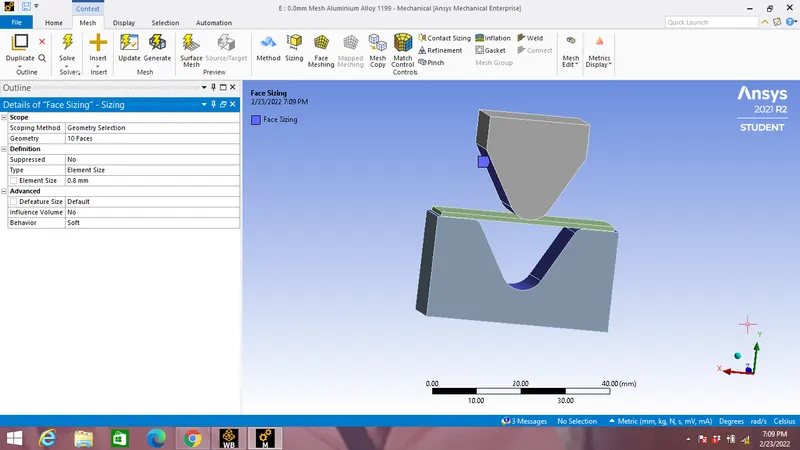
Aluminium 1199 material is selected & all Steps similar to case 1 was followed only Facing size of sheet during Tetrahedron meshing is changed to 0.8mm keping other settings fixed.
Fine Mesh of 0.8 mm of Sheet is shown below with Aluminium 1199 material:
Equivalent Stress with 0.8mm mesh size of sheet:
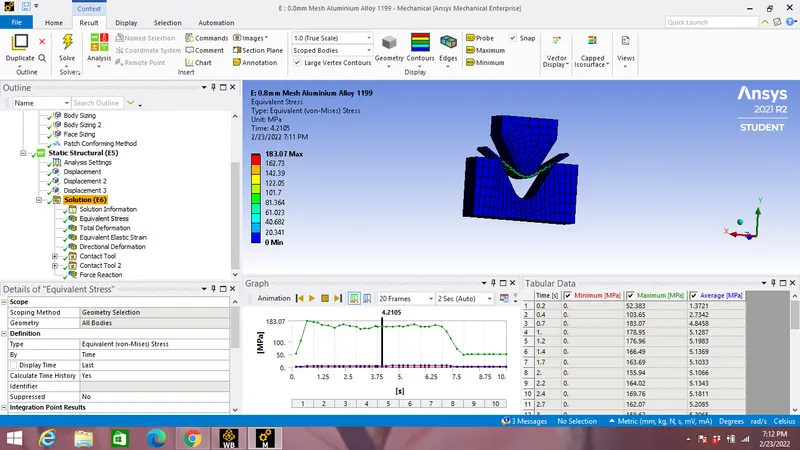
Max Equivalent Stress:183.07 MPa
Equivalent Strain with 0.8mm mesh size of sheet:
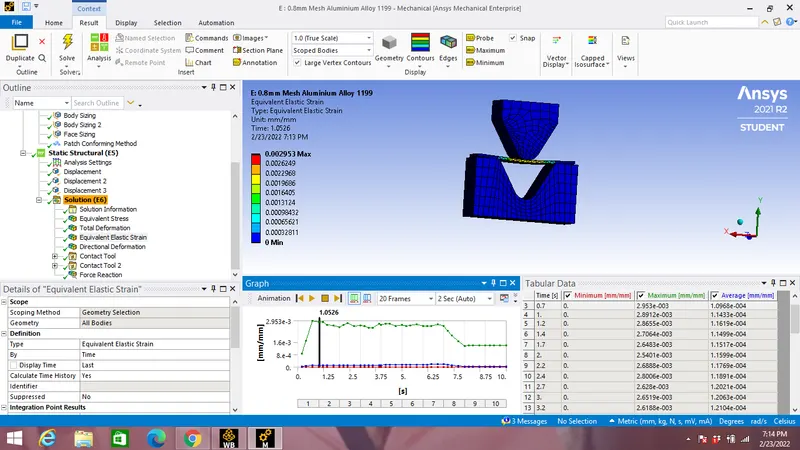
Max Equivalent Strain:2.953e-003
Total Deformation for 0.8 mm mesh size of sheet:
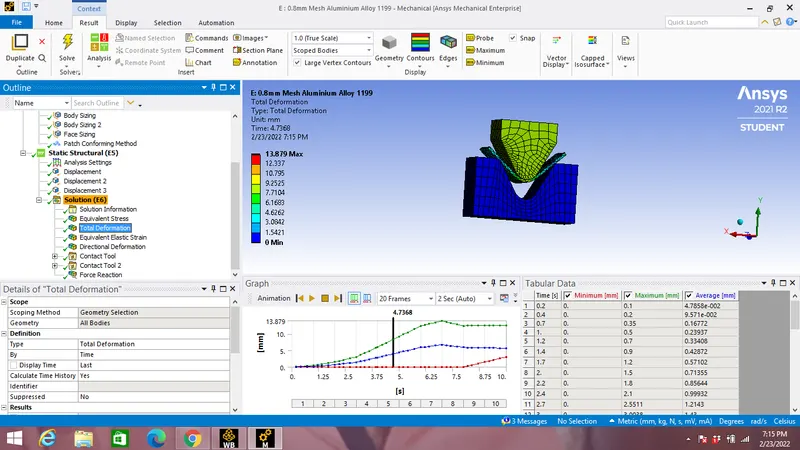
Max Total Deformation:13.879mm
Directional Deformation along Y axis for 0.8 mm mesh size of sheet:
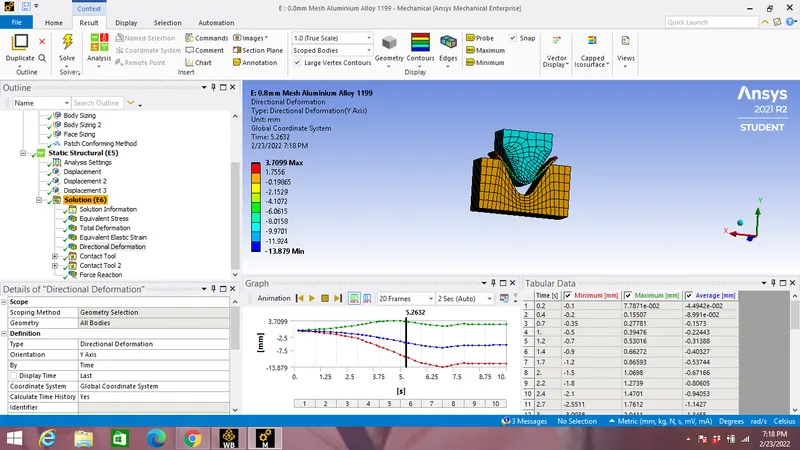
Max Y-Directional Deformation:3.7099mm
Aluminium 1199 material used with 0.8 mm & 1mm mesh size of sheet and comparision doen in table below:
| Sheet Mesh Size(mm) | Max Equivalent Stress(MPa) | Max Equivalent Strain | Total Deformation(mm) | Y-Directional Deformation(mm) |
| 0.8 | 183.07 | 2.953e-003 | 13.879 | 3.7099 |
| 1 | 183.06 | 2.9528e-003 | 13.881 | 3.7079 |
It can be seen from the table above that with refinement of meshes of sheet, Equivalent Stress,Strain,Total Deformation & Directional deformation values does not show much of significant changes.
Conclusion:
- With mesh refinement of sheets from 1mm to 0.8mm size we can get better approximation of results.Therefore it is necessary to use optimized size elements for better accuracy.
- With increase in Frictional coefficients between Punch & Sheet and Sheet & Die,we can see that Total & Directional deformation along Y axis decreases for same displacements input to Die,Sheets & Punch, because some amount of energy is lost in overcoming frictional losses.
- Of Aluminium 1199,Copper Alloy NL and Magnesium Alloy NL we can see that maximum equivalent stress occurs for Copper Alloy NL as it has highest Young's modulus of 1.1e+005MPa among all the three materials,so high internal restoring force acts on material made up with Copper Alloy NL during deformation, resulting in high Equivalent Stress.
- Maximum Y-Directional Deformation occurs for Magnesium Alloy NL as it had least values of 45000 MPa of Young's modulus among three materials used so least tendency of restoring its orginal shape during deformation.