Week 2 Railwheel and Track
Static structural analysis on Railwheel & Track Assembly:
Case 1:Static structural analysis on bearing loads on wheel hub of 100000N & 500000N:
Introduction: Railways are the one of the most transportation, that must be analysed properly so that it can provide service for the longer period of time without failures.Railwheel & tracks are the most important components of modern railway systems on which entire carriage & rail system stands, therefore their study becomes mandatory for the longer run.
Aim: To perform static structural analysis on Railwheel & Track assembly.
Case 1: Comparing the Total Deformation,Equivalent Stress & Fatigue life under Bearing loads of 100000 N & 500000 N.
Case 2: Implement User Defined Result & calculate Total Deformation and check if the values obtained are same as that by the Ansys Inbuilt system for bearing load of 100000 N.
Steps followed:
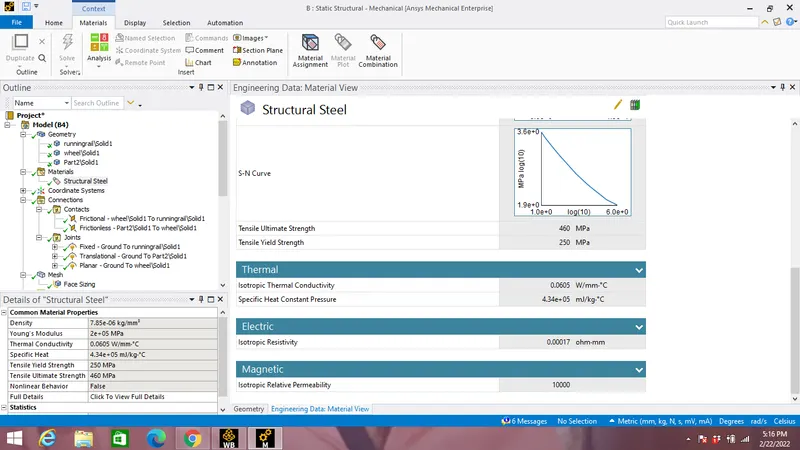
1)Material Selection: Structural Steel is choosen for the analysis of each & every component with the specifications shown in the image below.
Properites of Structural Steel: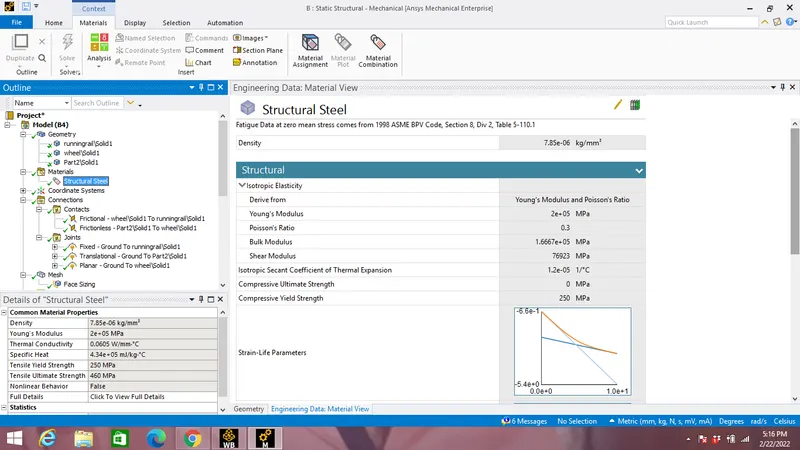
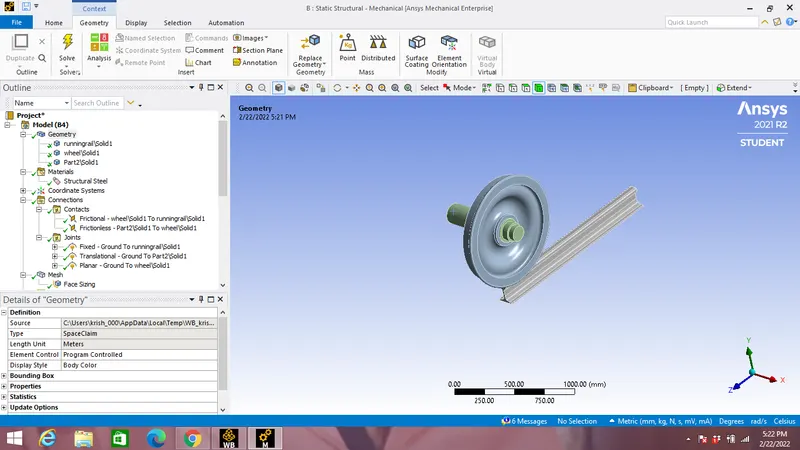
2)Geometry as Imported from the CAD file of Railwheel & Track Assembly.
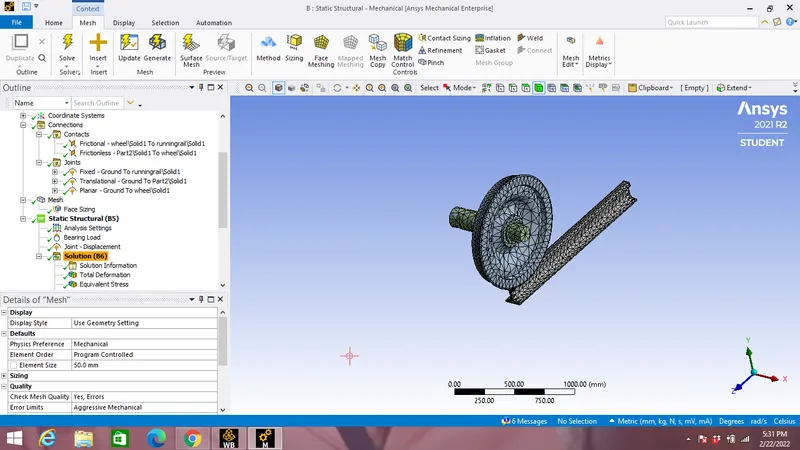
3) Meshing:
Meshing is doen with size of 50 mm & Face size of 35 mm at the point of contact.
No. of elements=6668
No. of nodes=13234
4) Boundary canditions setup:
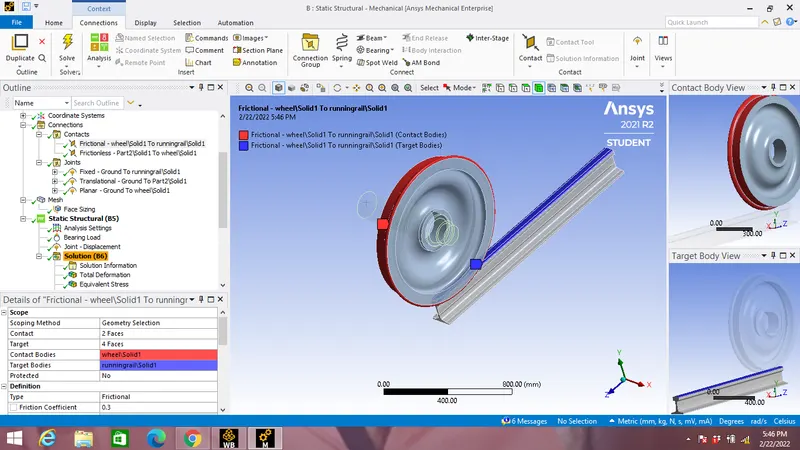
- Frictional contact is established between rail & wheel with frictional coefficient of 0.3.
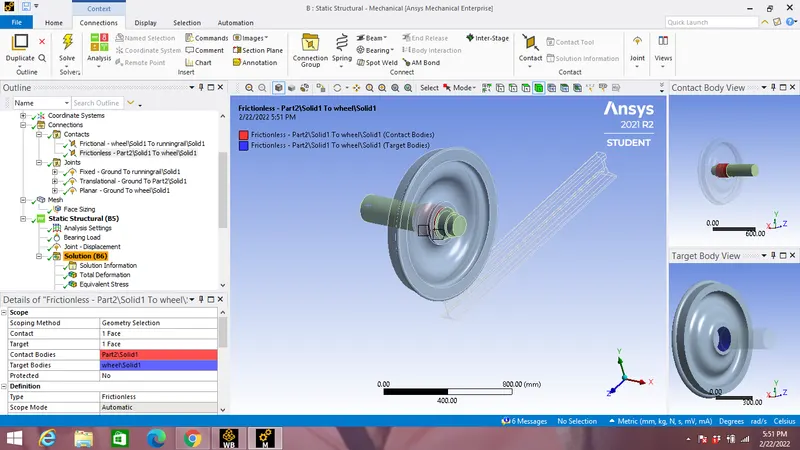
- Frictionless contact is established between shaft & wheel interface.
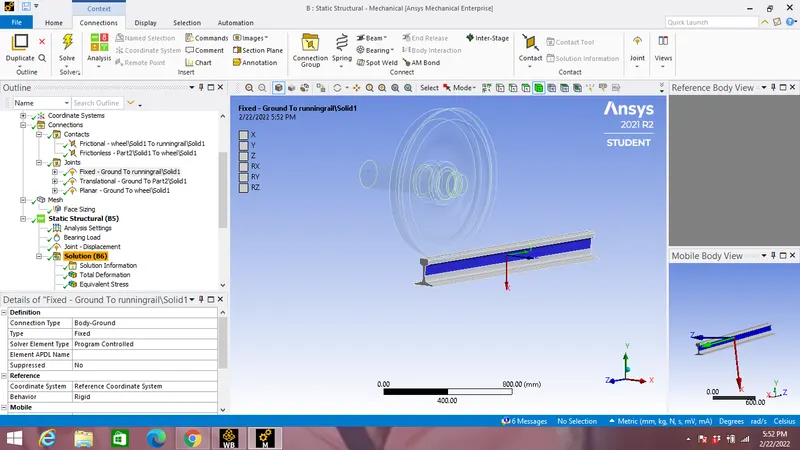
- Fixed joint is applied on the Track, so that it remains stable without any displacement.
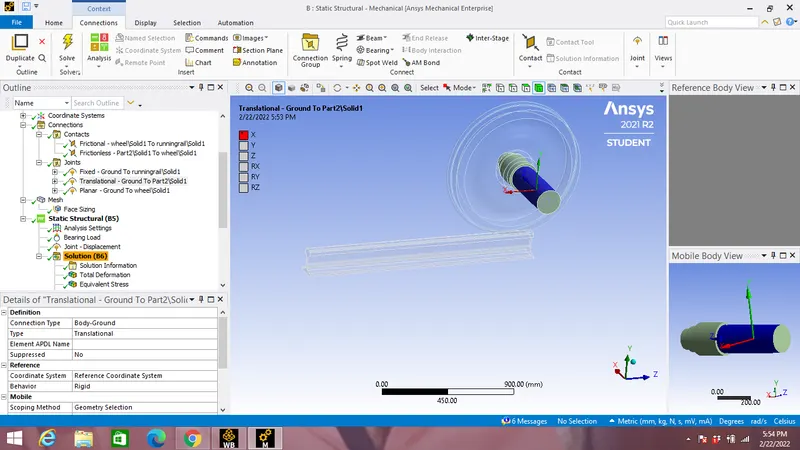
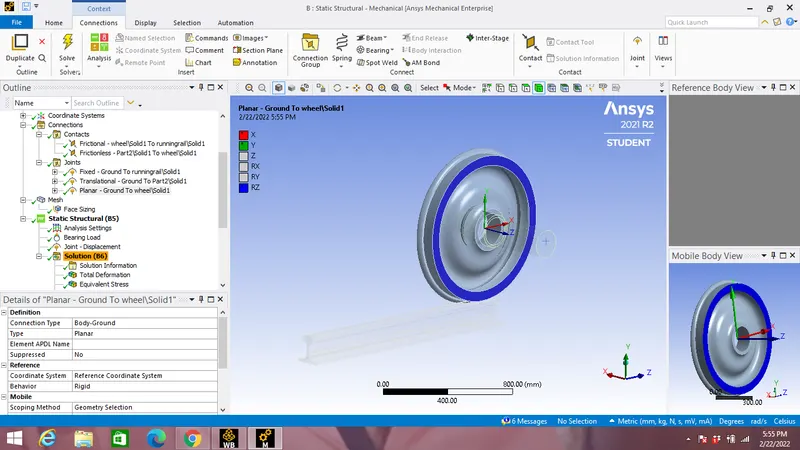
- Translational joint is applied on the shaft while Planar joint is applied on the wheel, thus constraining only rolling motion to Wheels.
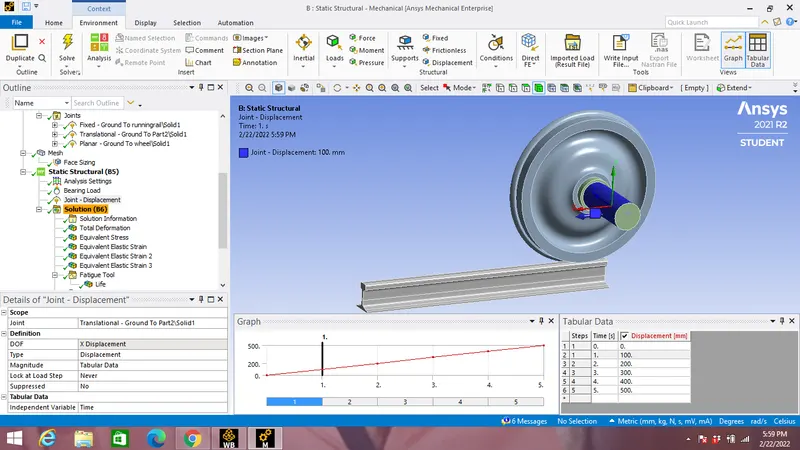
- Displacement boundary candition is applied on the shaft which has Translational joint imposed on it to allow movement in one axial direction.Displacement is given in gradual manner in 5 steps with 100 mm displacement in each time step.
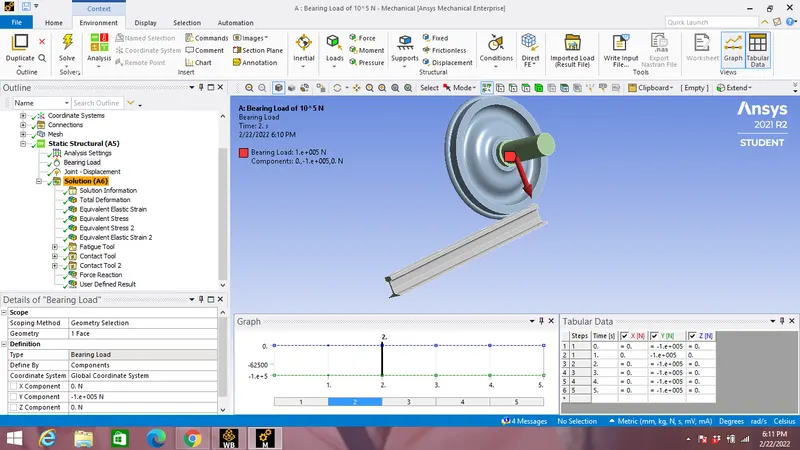
- Bearing Load is imposed on the inner surface of wheel hub. First results are computed for 100000 N and then for 500000 N.
Contact:
Frictional Contact between wheel & track shown below:
Frictionless Contact between wheel hub & shaft shown below:
Joints:
Fixed Joint of Track:
Translational joint of shaft:
Planar joint on wheel:
Loads Applied:
Displacement candition on shaft:
Bearing Loads of 100000 N & 500000 N are applied & values of Total Deformation,Equivalent Stress & fatigue life compared between both.
Bearing Load of 100000 N on wheel hub:
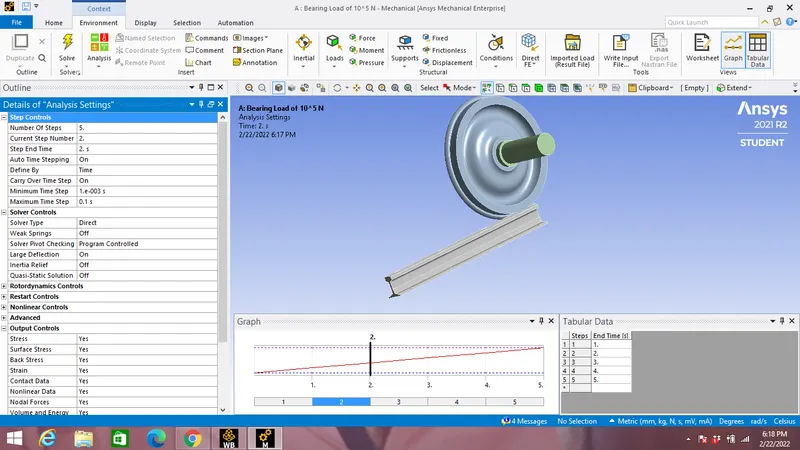
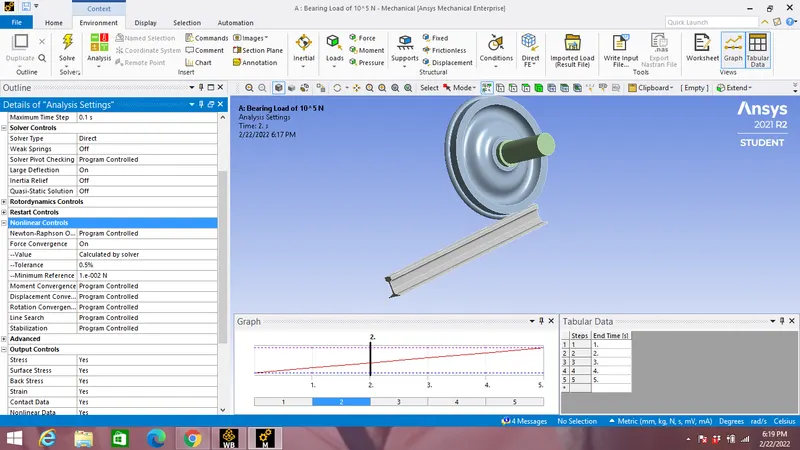
Analysis Settings:
The Analysis is doen on 5 time steps.Auto time stepping for each is switched to Programme controlled,while for rest of the steps it's switched ON with max time increment input of 0.1 s & min time increment of 0.001 s.
Results:
1) For Bearing Load of 100000N:
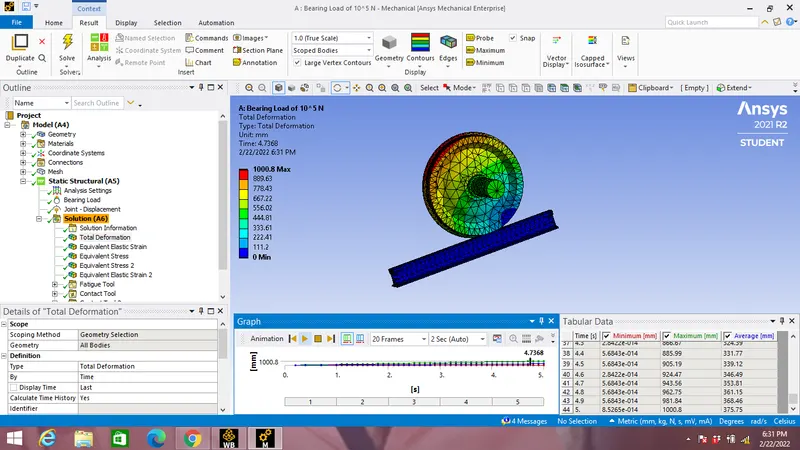
Total Deformation: It is the displacement in the shape & size of a material as a result of external load application on any solid structures resulting in stress in it.
Total Deformation for Bearing Load of 100000N:
Total Deformation vs Time Graph:
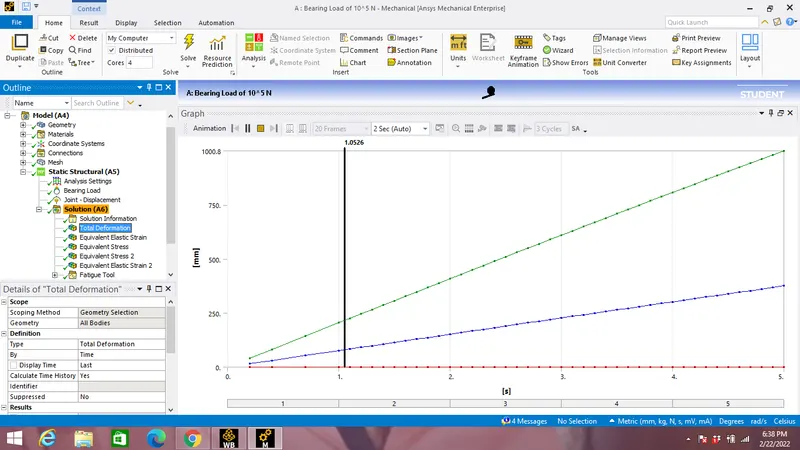
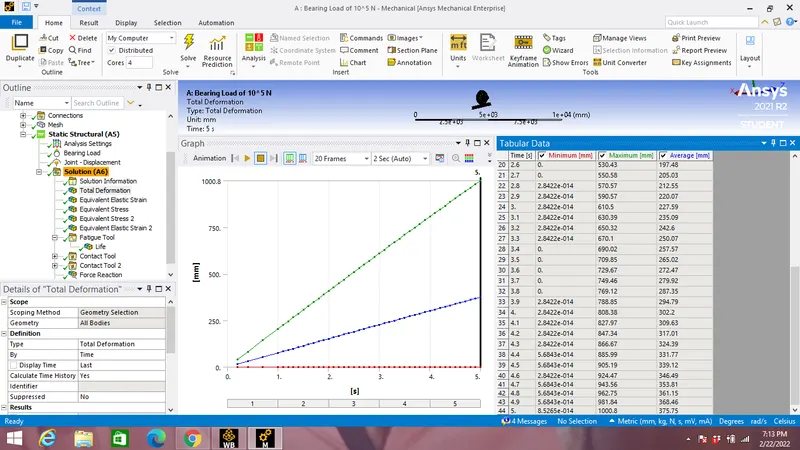
Maximum Total Deformation of 1000.08 mm.
Total Deformation for Bearing Load of 500000N:
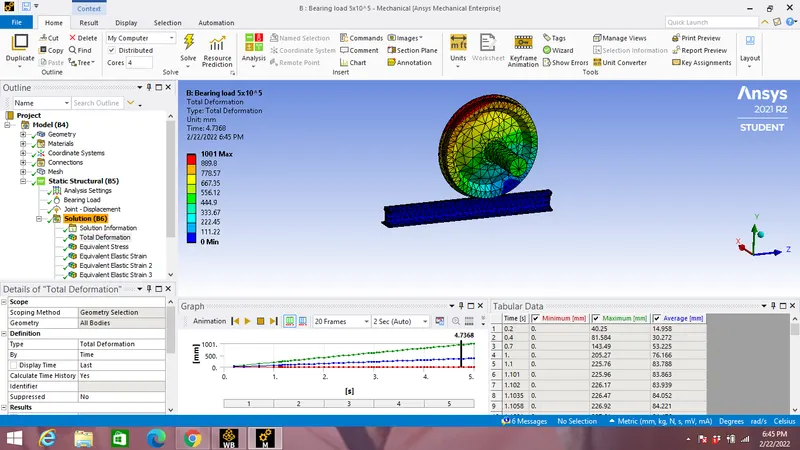
Total Deformation vs Time Graph:
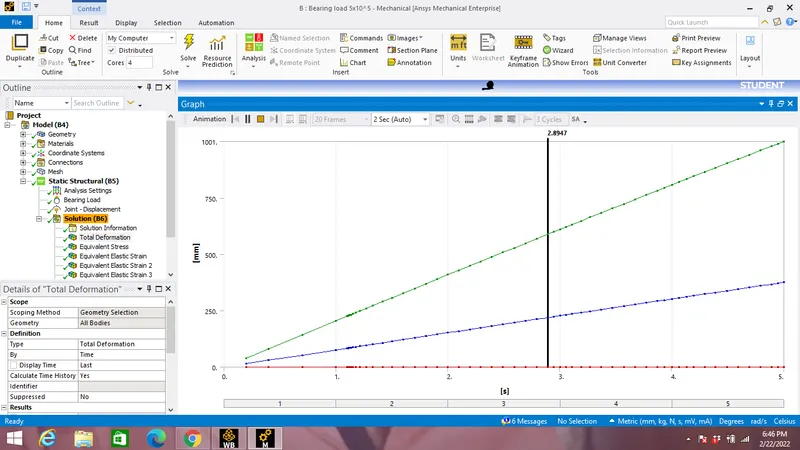
Maximum Total Deformation of 1001 mm.
Comparision for Maximum Total Deformation through Tables:
For 100000N loads:
For 500000 N loads:
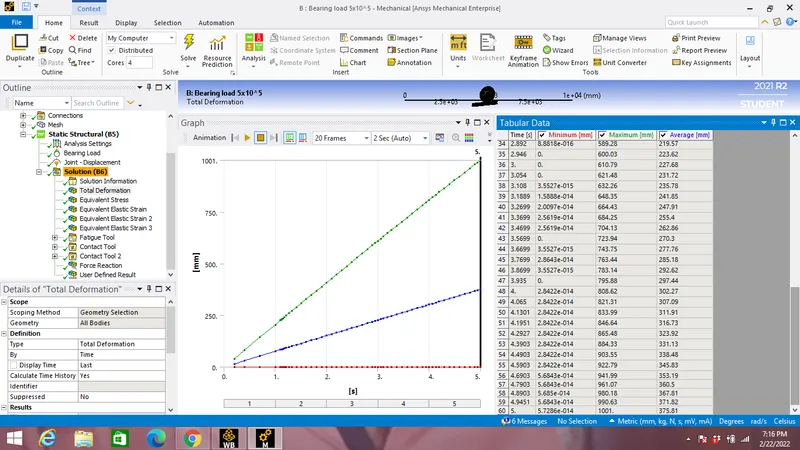
It can be seen that with increase in Bearing Load from 100000 to 500000 N Maximum Total Deformation also increases from 1000.08 mm to 10001mm.
Equivalent Stress:
1)For 100000N bearing load:
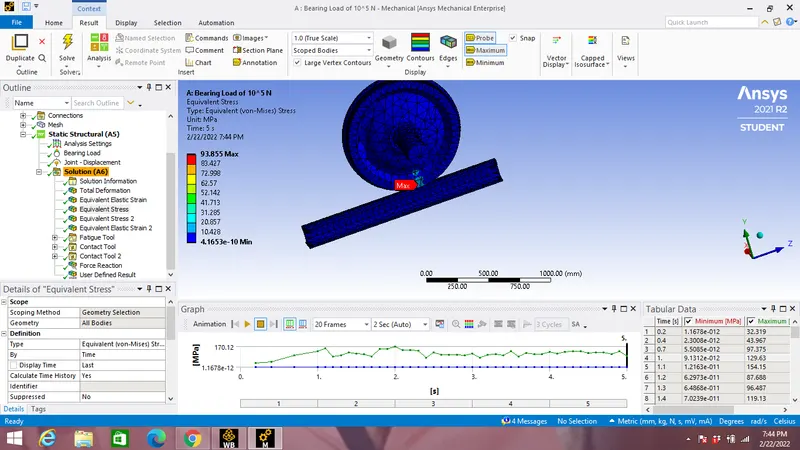
Equivalent Stress vs Time graph:
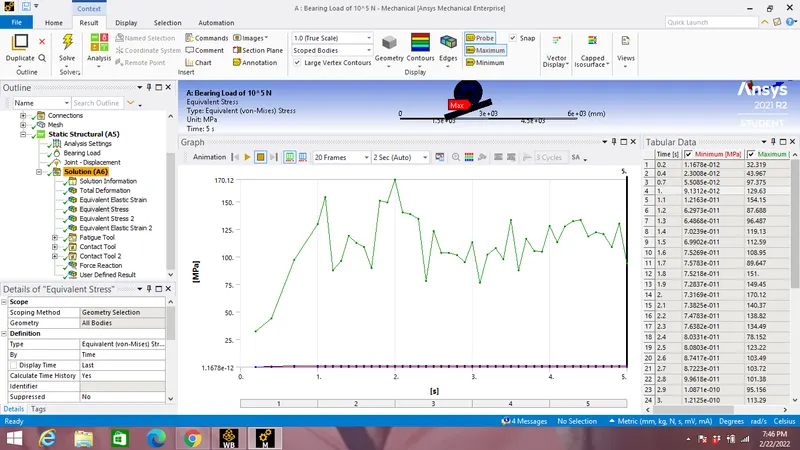
Maximum Eqiuvalent Stress with 100000N Bearing Load is 170.12 MPa.
2)For 500000N bearing load:
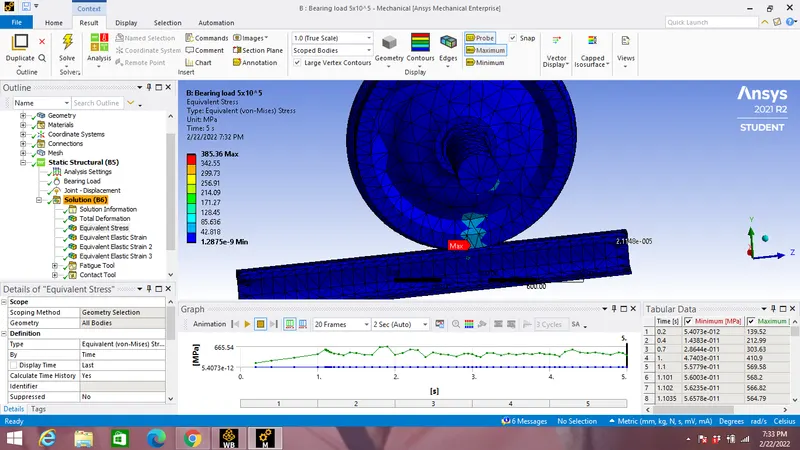
Equivalent Stress vs Time graph:
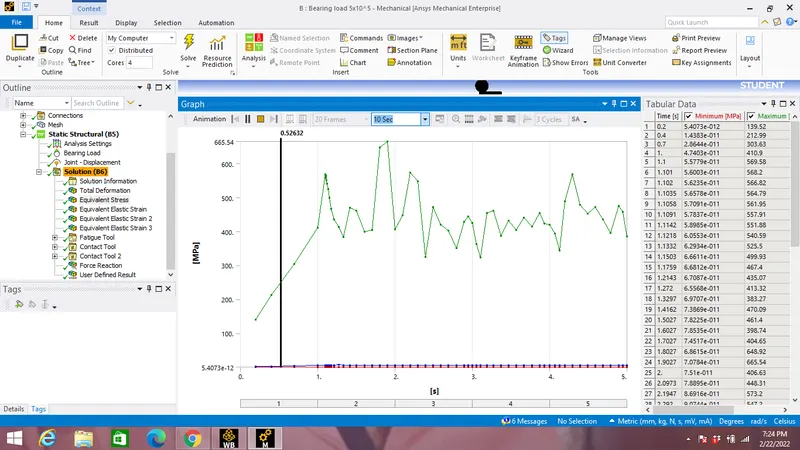
Maximum Eqiuvalent Stress with 500000N Bearing Load is 665.54 MPa.
Comparision of Maximum Equivalent Stress at 100000 N & 500000N Bearing Loads:
Maximum Equivalent Stress(MPa)
| Time(s) | 100000N Bearing load | 500000N Bearing load |
| 1 | 129.63 | 410.9 |
| 2 | 170.12 | 406.63 |
| 3 | 113.29 | 425.21 |
| 4 | 128.15 | 419.85 |
| 5 | 93.855 | 385.36 |
It is evident from the table above & maximum equivalent stress values for 2 cases that with increase in bearing loads, the value of maximum equivalent stress increases.
Fatigue Life:
1)For 100000N bearing load:
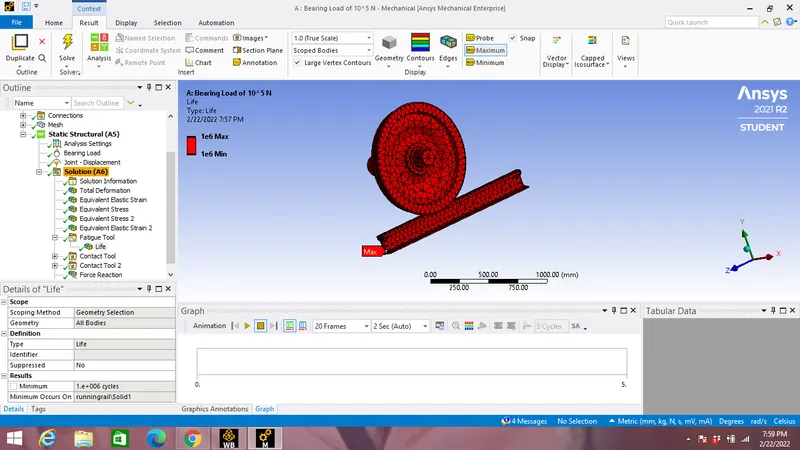
Maximum Fatigue Life of 1e+6 for 100000N bearing load.
2)For 500000N bearing load:
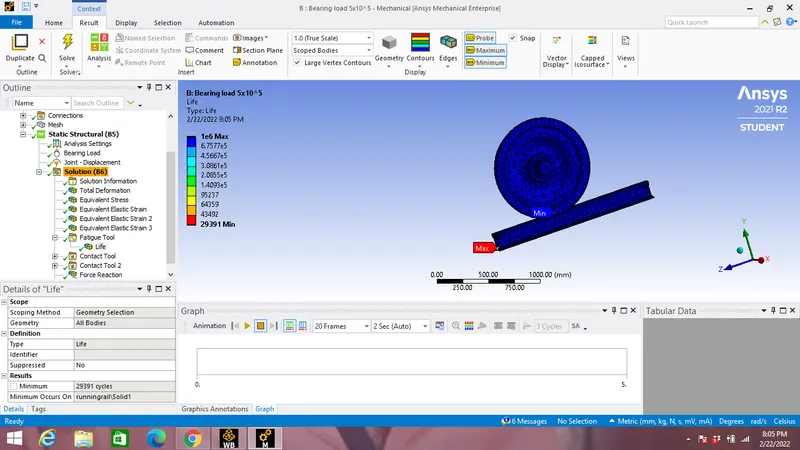
Maximum Fatigue Life of 1e+6 for 500000N bearing load.
Equivalent Elastic Strain:
1) For 100000N bearing Load:
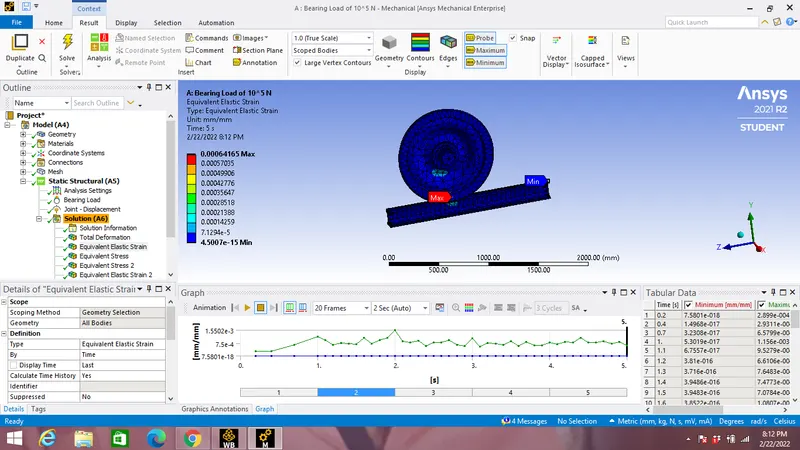
Strain vs Time graph:
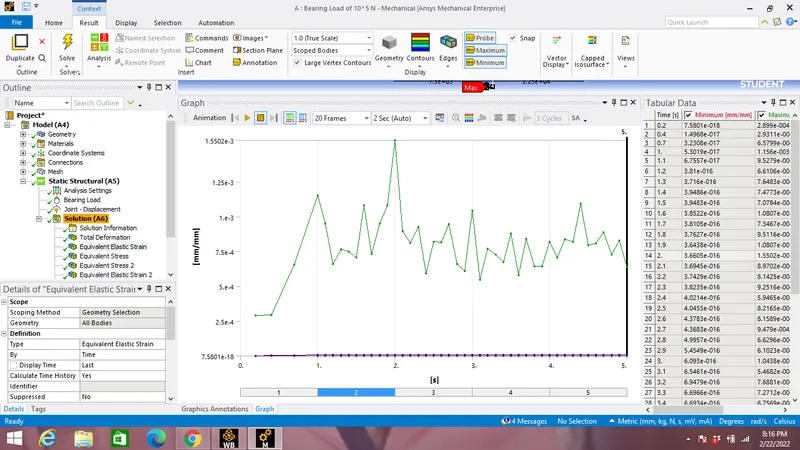
Maximum Equivalent Elastic Strain for 100000 N load:1.5502e-3
2) For 500000N bearing Load:
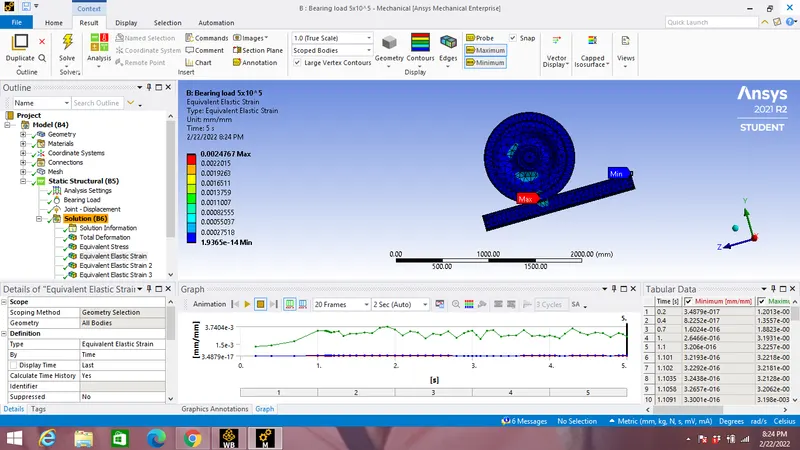
Strain Vs Time graph:
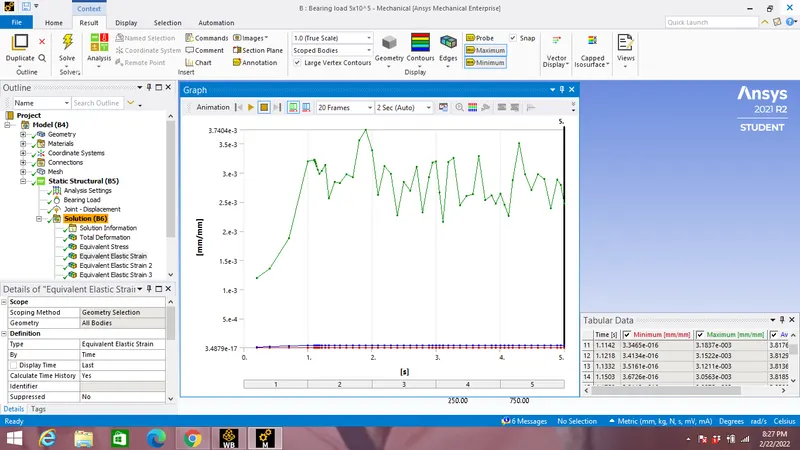
Maximum Equivalent Elastic Strain for 500000 N load:3.7404e-3
Comparision of Maximum Equivalent Strain at 100000 N & 500000N Bearing Loads:
Maximum Equivalent Strain(mm/mm)
| Time | 100000N bearing load | 500000N bearing load |
| 1 | 1.156e-3 | 3.1931e-3 |
| 2 | 1.5502e-3 | 3.3885e-3 |
| 3 | 1.0438e-3 | 3.2e-3 |
| 4 | 8.215e-4 | 2.6741e-3 |
| 5 | 6.4165e-4 | 2.4767e-3 |
Similar rise in elastic strain was seen as that was in case of Stress.Therefore Elastic Strain increases with the increase in bearing load from 100000 to 500000N.
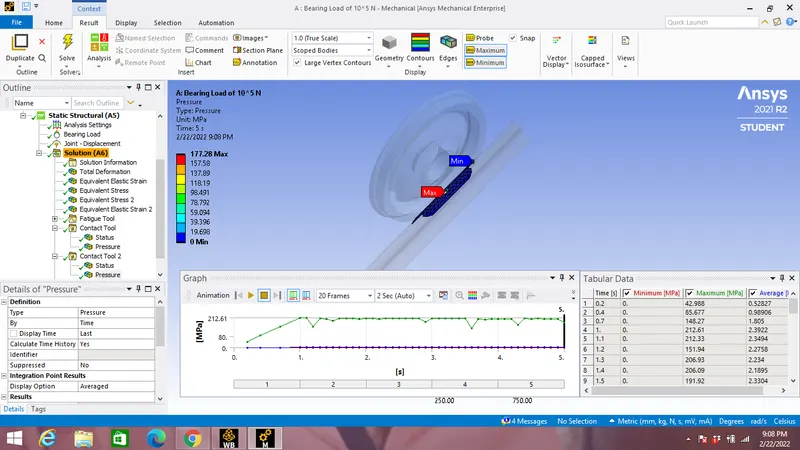
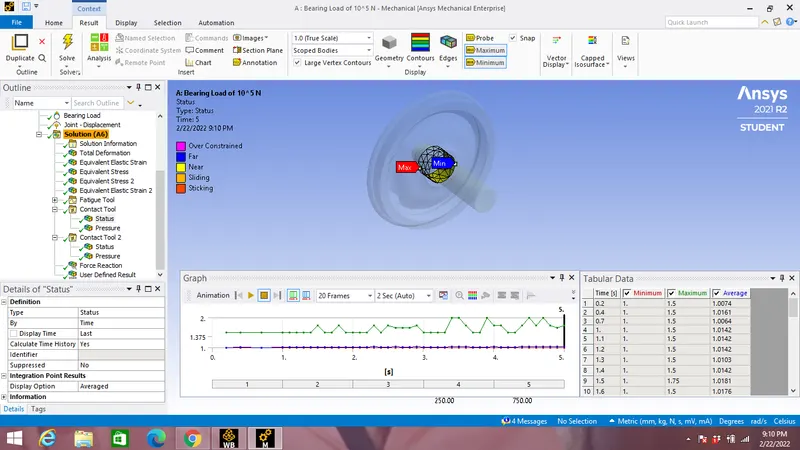
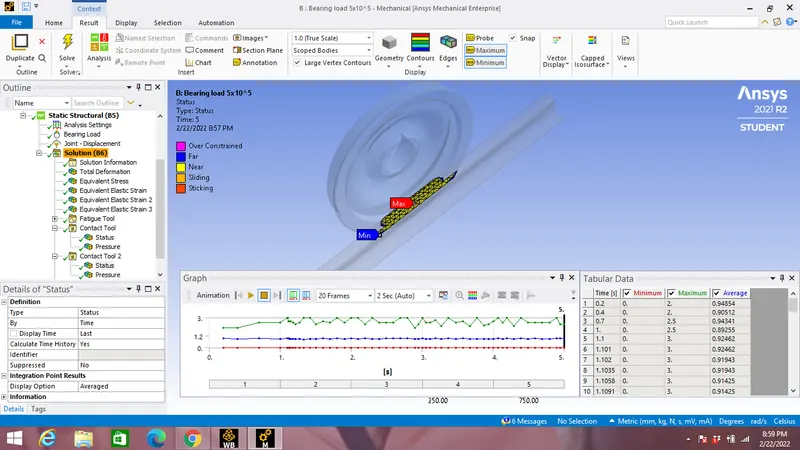
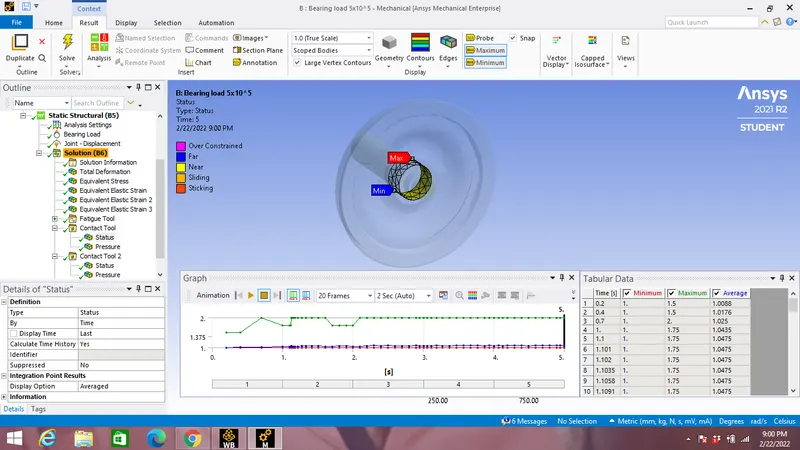
Contact Status:
a) For 100000N load:
For Wheel & Track:
For Shaft & Wheel Hub:
b) For 500000N load:
For Wheel Track:
For Shaft & Wheel Hub:
Contact Pressure:
a) For 100000N load:
For Wheel & Track:
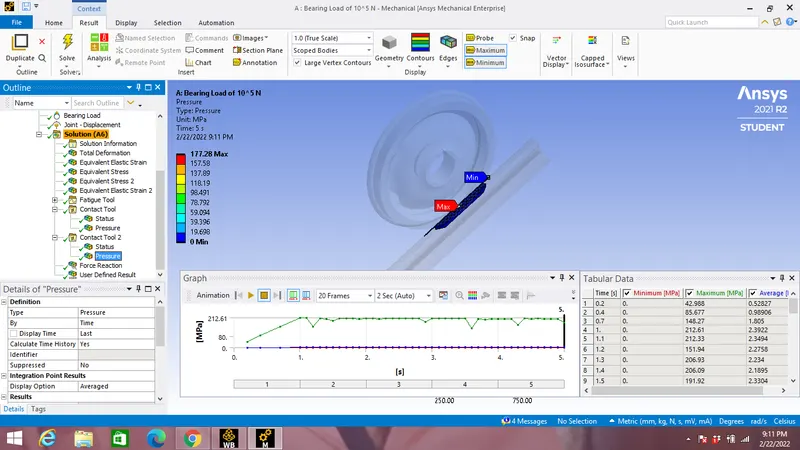
Maximum Contact pressure at wheel & track: 212.61MPa
For Shaft & Wheel Hub:
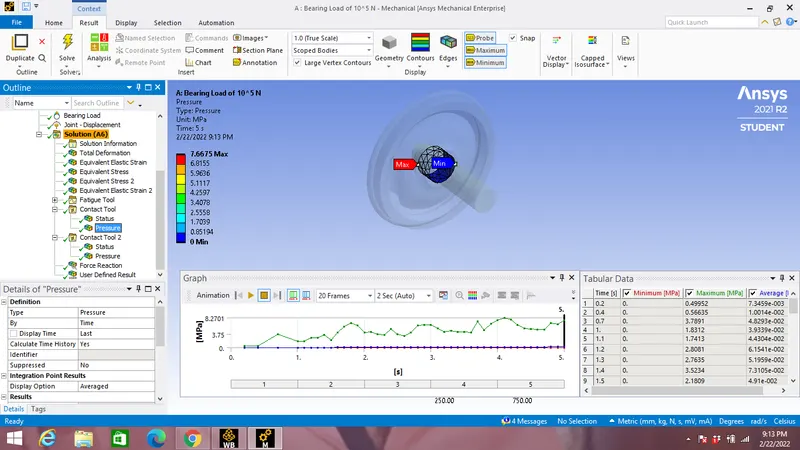
Maximum Contact pressure at shaft & wheel hub: 8.2701 MPa.
b) For 500000N load:
For Wheel & Track:
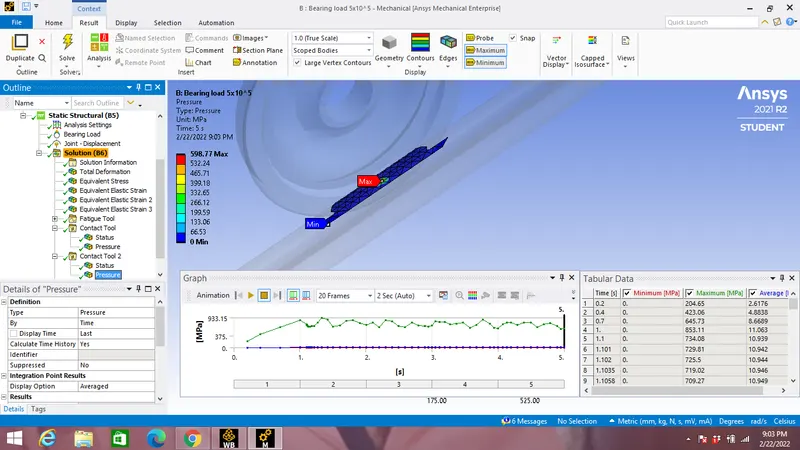
Max contact pressure at Wheel & Track:933.15MPa
For Shaft & Wheel Hub:
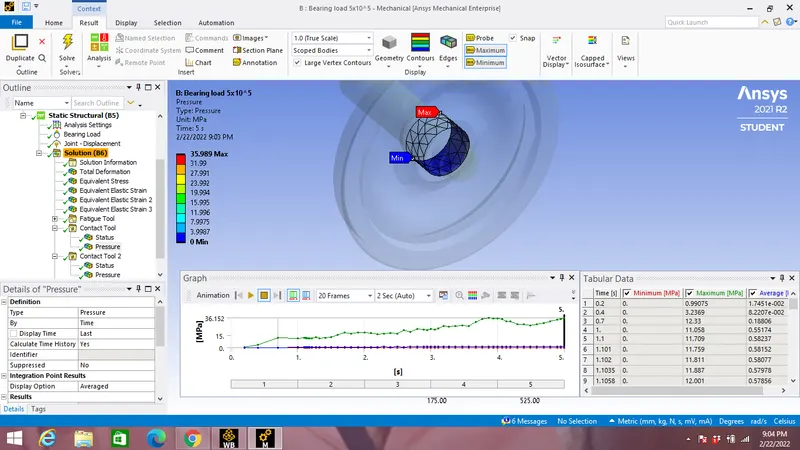
Max contact pressure at shaft & wheel hub assembly:36.152MPa
Case 2: Total Deformation calculation from User Defined Result:
User Defined Result is obtained for total deformation(U) along 3 Principal axis in cartesian coordinate system of x,y & z axis.
U=Sqrt(Ux^2+Uy^2+Uz^2), were Ux,Uy & Uz are the directional deformation along x,y & z axis respectively.
Total Deformation:
a) For 100000N load:
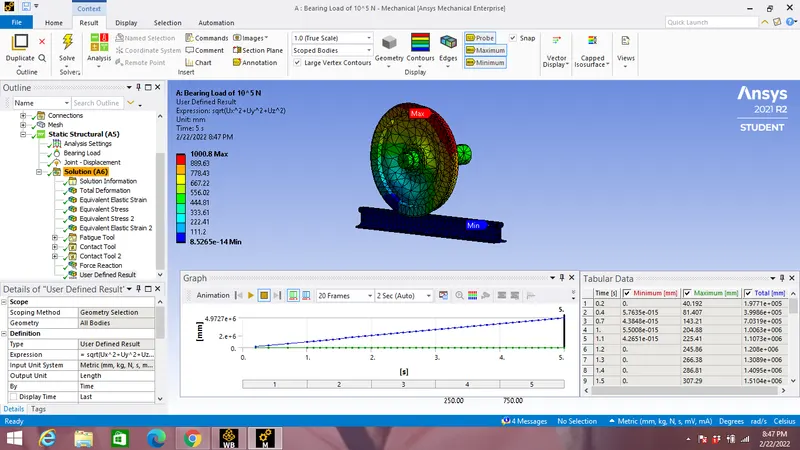
Maximum Total Deformation for 100000N=1000.8mm
b) For 500000N load:
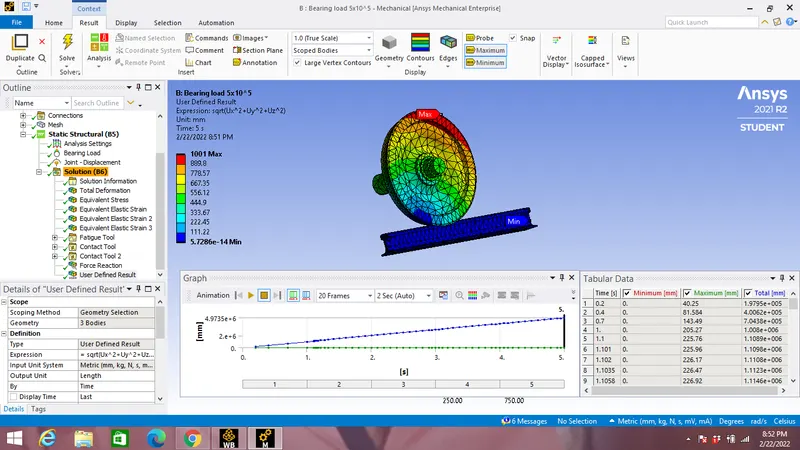
Maximum Total Deformation for 500000N=1001mm,
Therefore Total Deformation does not have any change in User Defined Results when compared with Ansys Inbuilt Results in both cases of same 100000 N & 500000N Bearing Loads.
Conclusion:
From the above results there are two conclusions can be derived:
- As the bearing load increases the Total Deformation,Equivalent Elastic Stress & Elastic Strain increases & contact status changes to sticking contact with high contact pressure at both wheel & track and shaft & wheel hub assemblies.This wheel sticking nature due to increase bearing loads may lead to loss in Power Transmissions.
- Total Deformation when compared between Ansys Inbulit result and User Defined Result with Deformation expression of U=sqrt(Ux^2+Uy^2+Uz^2) gives same values.
- As Ultimate tensile strength of Structural Steel is 460 MPa, so loading of 500000N at bearings can cause Catastrophic failure of Rail wheels. So we avoid such huge loadings with Structural Steel Material of wheels & tracks.