Week 3 - Pitot tube
A pitot tube is a flow measurement device used to measure fluid flow velocity. It is widely used to determine the airspeed of an aircraft, water speed of a boat, and to measure liquid, air and gas flow velocities in certain industrial applications.
The basic pitot tube consists of a tube pointing directly into the fluid flow. As this tube contains fluid, a pressure can be measured; the moving fluid is brought to rest (stagnates) as there is no outlet to allow flow to continue. This pressure is the stagnation pressure of the fluid, also known as the total pressure or (particularly in aviation) the pitot pressure.
The measured stagnation pressure cannot itself be used to determine the fluid flow velocity (airspeed in aviation). However, Bernoulli's equation states:
Stagnation pressure = static pressure + dynamic pressure


u is flow velocity
Pt is stagnation or total pressure
 is Fluid density
After extracting fluid volume, because by removing unwanted parts we could reduce computational time, for this simulation we have removed the casing by considering only the volume where the fluid flows
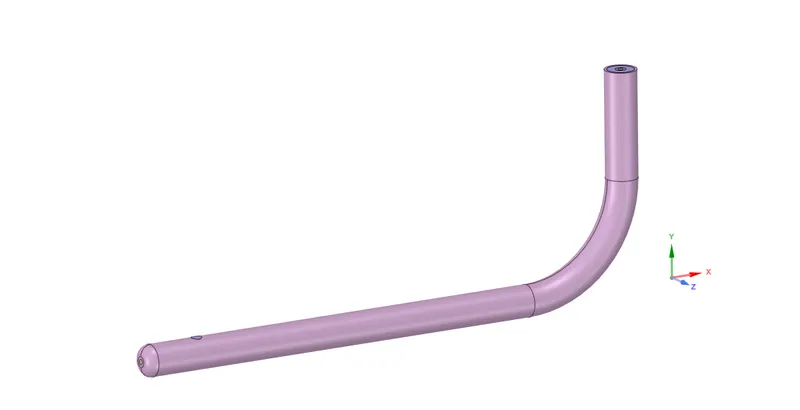
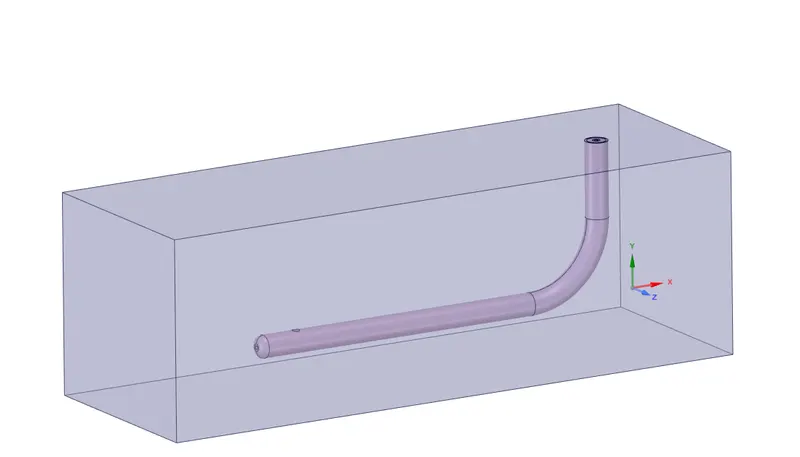
Solver - Pressure based
Velocity Formulation - Absolute
Time - Steady
Viscous - Laminar flow
Boundary conditions
Inlet - Velocity inlet
Outlet - Pressure outlet
Enclosure wall - Symmetry
Static pitot tube- Wall (No slip condition)
No. of Iteration - 1000
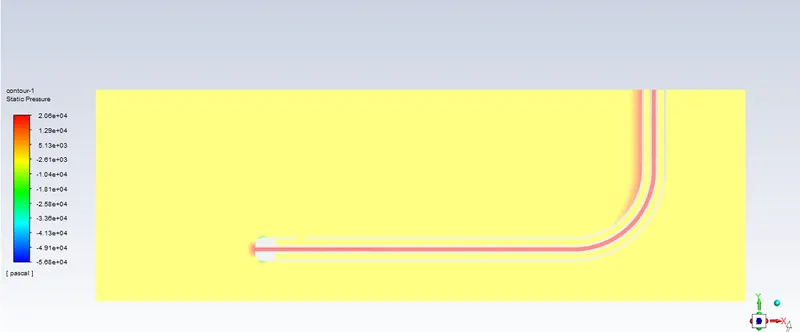
Case 1: For 240 m/s & press -2817pa
Total press after 1000 iter= 20320.543 pa
Static press after 1000 iter=-3536.1238 pa
we get 244 m/s
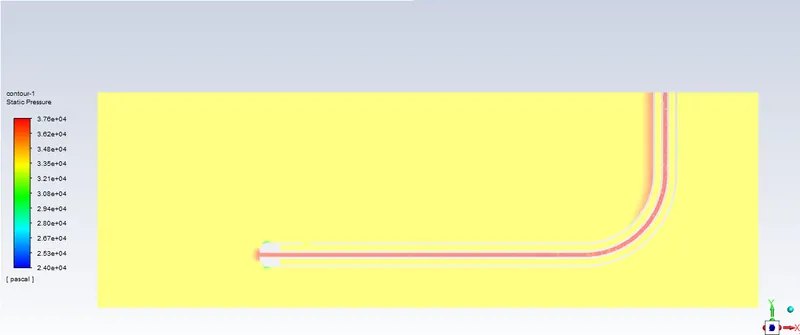
CAse 2 : For 100 m/s & press 33287pa
Total press after 1000 iter= 37319.846 pa
Static press after 1000 iter=33174.343 pa
we get 101 m/s
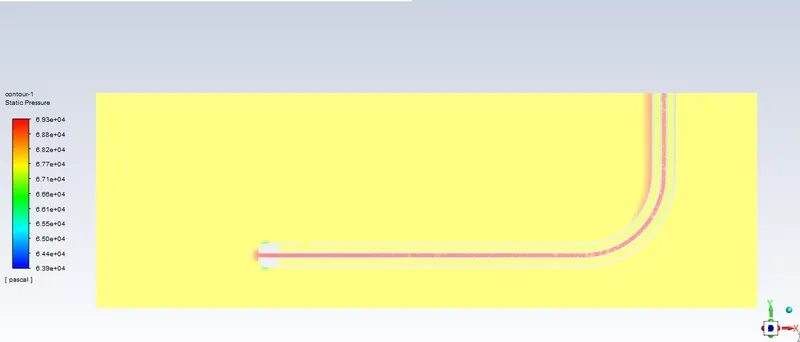
Case 3 : For 62 m/s & press 67580pa
Total press after 1000 iter= 69132.175 pa
Static press after 1000 iter=67541.476 pa
we get 63 m/s
 \
\
| Velocity(given) | Velocity(simulation) | error % | |
| case 1 | 240 | 244 | -1.66 |
| case 2 | 100 | 101 | -1 |
| case 3 | 62 | 63 | -1 |