Week 3 - External flow simulation over an Ahmed body.
Introduction to GUI based CFD using Ansys Fluent
Week - 3 : External Flow Simulation over an Ahmed body
Objective : To simulate the flow over a body as to capture the near surface effects and visualize the vortices formed at the rear.
The Ahmed body, is a car model to analyze and capture essential features of the flow and it has already experimental data available. The aim is to create an external flow field around the body and validate the results for appropriate approximations.
Case 1: Baseline setup
To begin with, an already created body is loaded in the Spaceclaim module, and is enclosed in a boxed region, so as to create a flow domain. Thereafter, the car body is suppressed (not taken into account) with a reason that the flow takes place externally. The mesh is created with a default value with the element size of 0.4136 m, to run a baseline simulation.
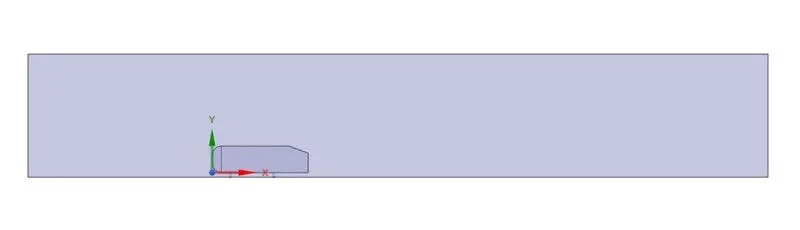
The boundary conditions are setup as;
Inlet : velocity inlet of 25m/s
Outlet : Pressure outlet of 1 atm
Car surface : No slip condition
Walls : Symmetry
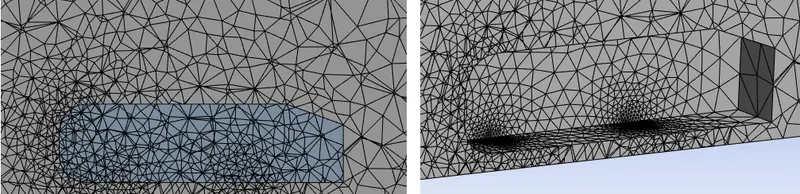
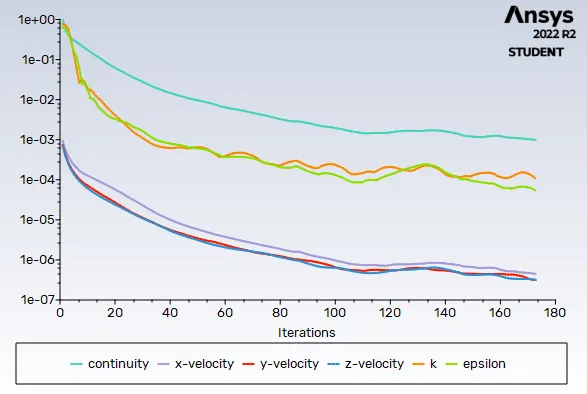
The total cell count is 84268. Regarding the Fluent setup, the Pressure based solver is used as the flow has very less velocity and the density does not vary significantly. The solver solves the corrected values of pressure and velocity for convergence, Continuity equation, x-momentum, y-momentum and z-momentum equation.
The fluid is set to air with sea level conditions of density and dynamic viscosity. The projected area for the Ahmed body is calculated as 0.065 `m^2`.
Secondly, with Hybrid initialization, the initial velocity values are printed out and with cut plane normal to Z axis, a velocity contour is displayed. Here as the flow is viscous, the k-epsilon model is used for 300 iterations.
Plots and contours:
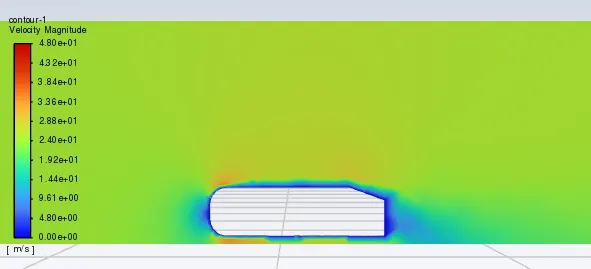
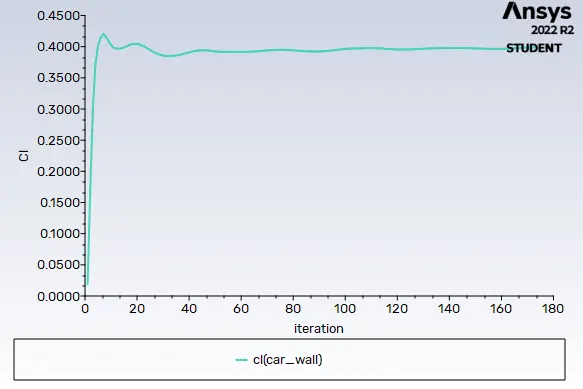
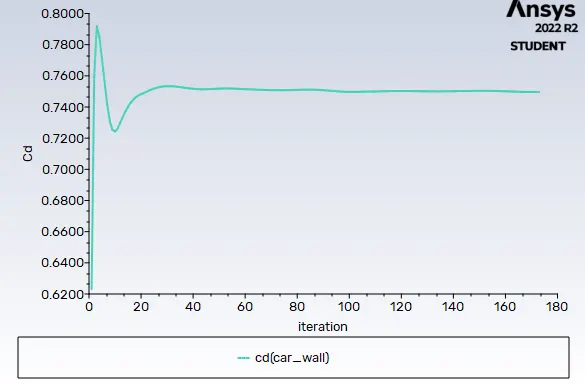
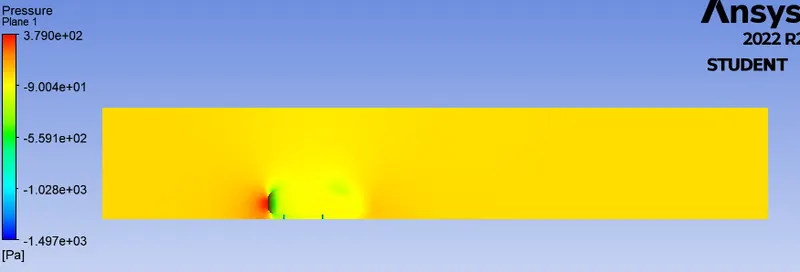
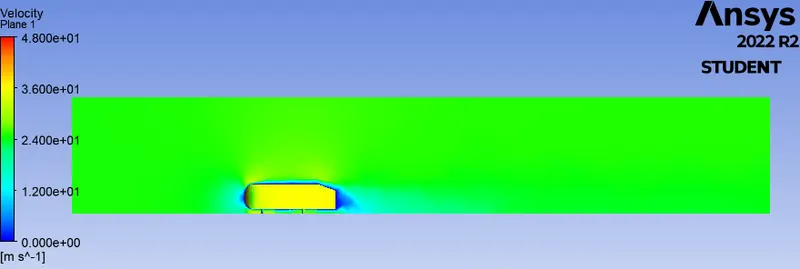
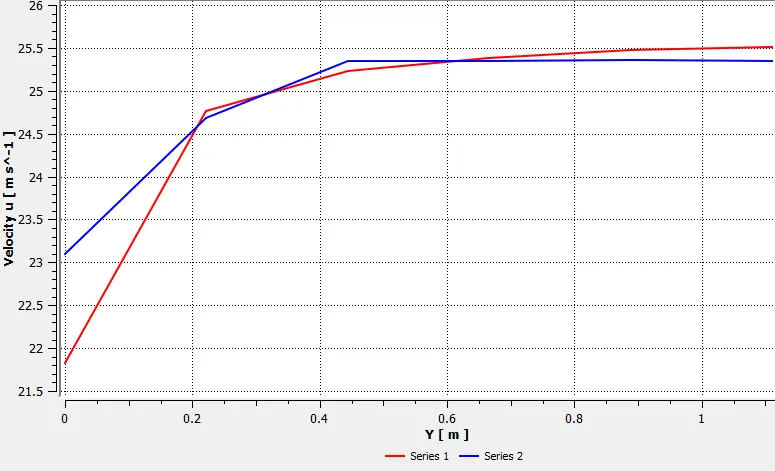
For reviewing the velocity values, lines are created at certain distance from rear end and a graph is plotted of u component of velocity vs. Y, which is a dimensionless wall distance.
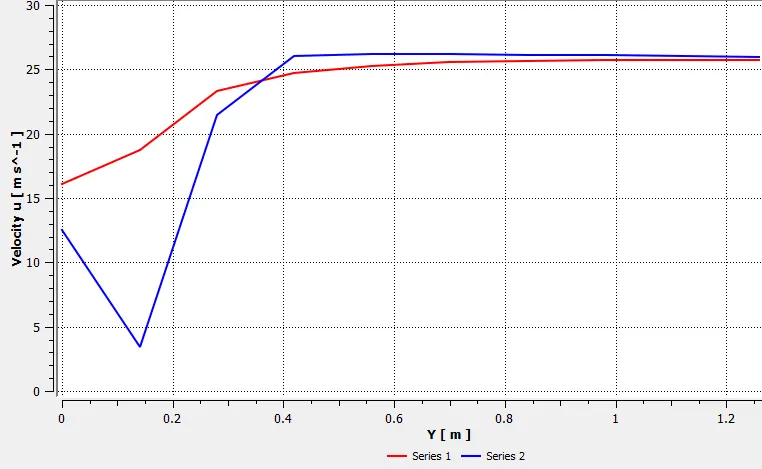
Here the velocity distribution is coarse at the aft part, which needs to be refined.
Case 2 : Refined setup
In order to make the mesh more refined, a second enclosure is made inside the first one.
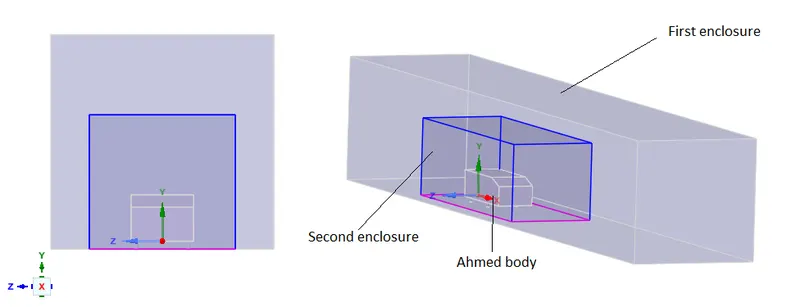
The mesh is created again within the first region, for better output.
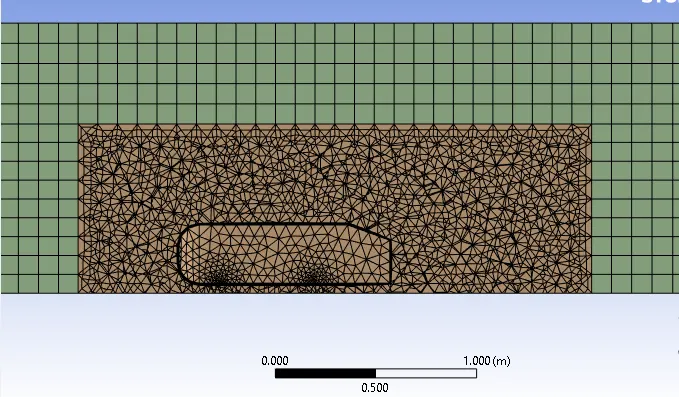
The outer body is discretized with hexahedral meshes. The inner with sizing of 0.06 m cell and additionally inflation layers are created on the car wall surface, with total thickness of 12.5 mm and growth rate of 1.2.
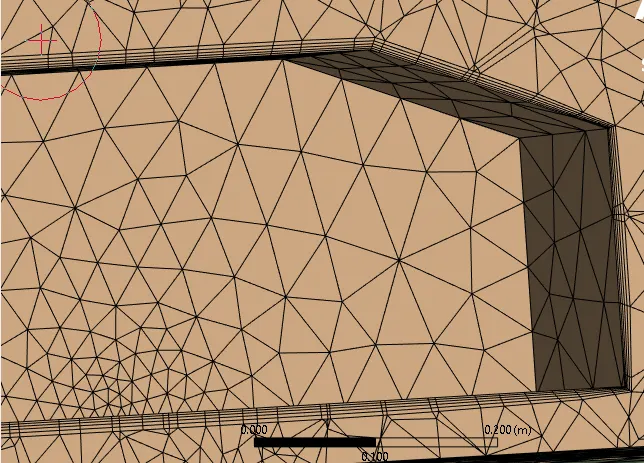
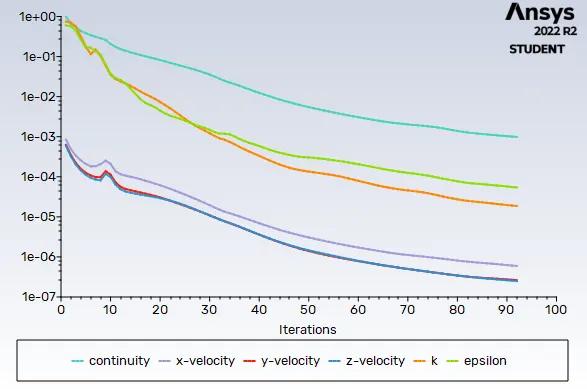
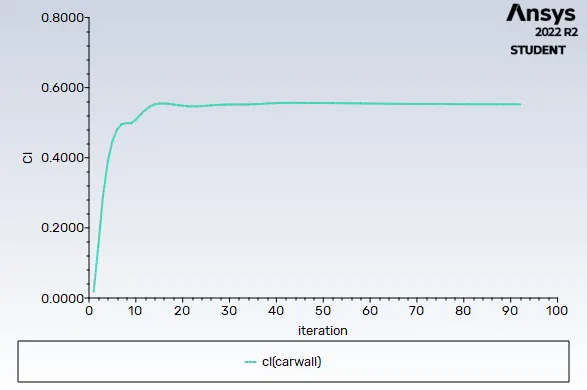
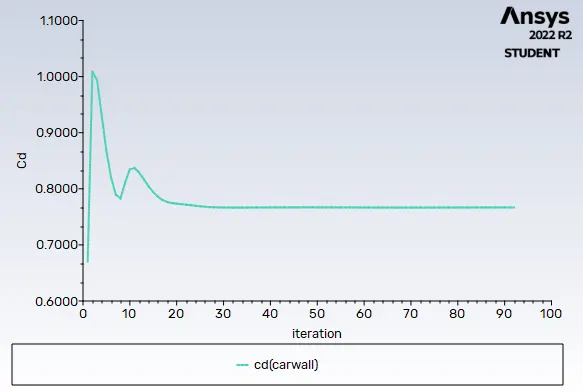
The total cell count in the refined case is 110390. Here, the k-eplison and k-omega models are selected for the simulations with 300 iterations.
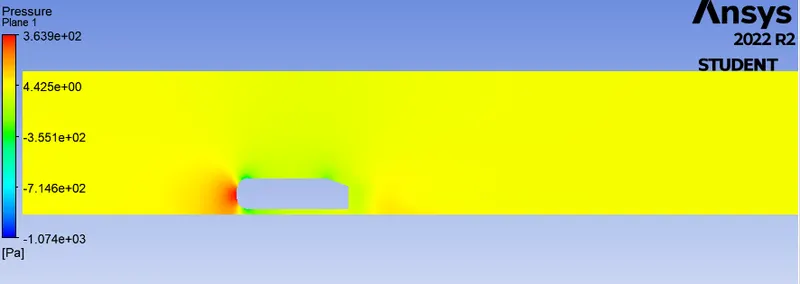
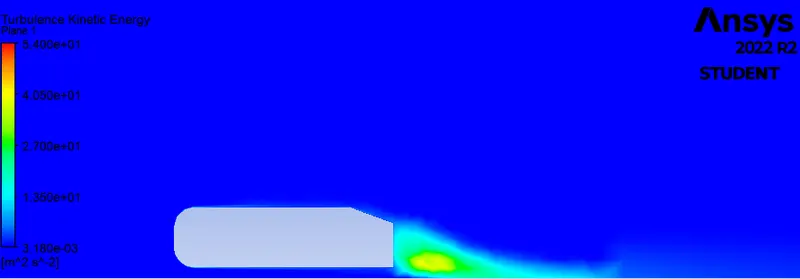
Plots and contours with k-epsilon model:
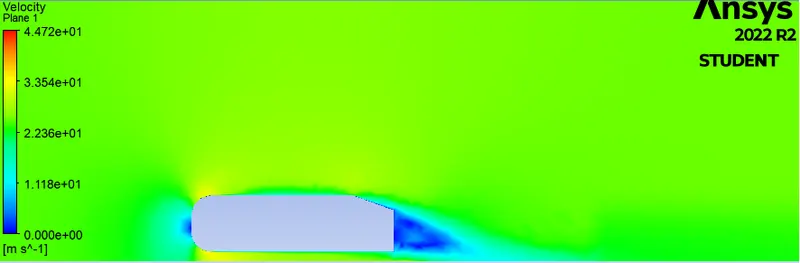
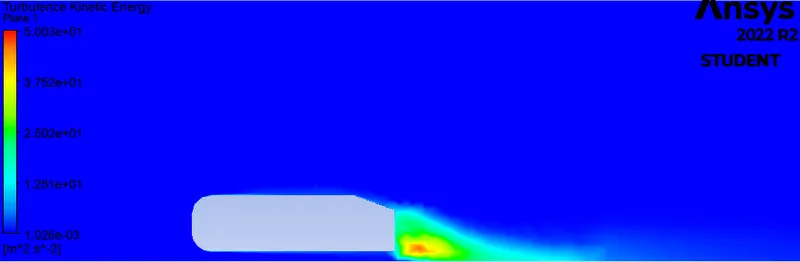
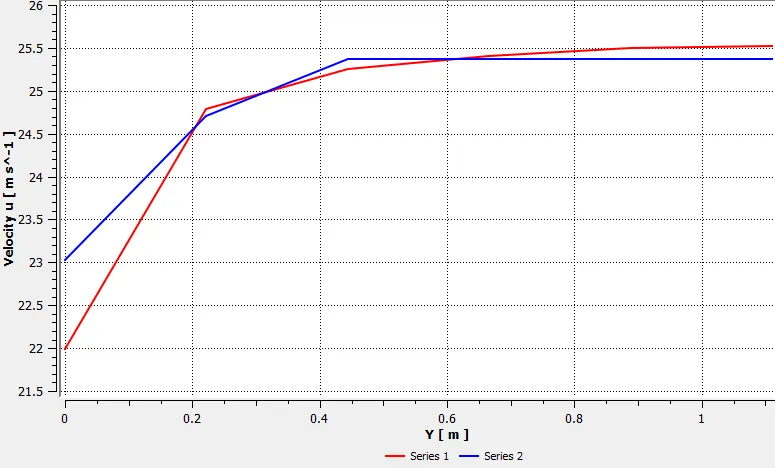
Plots and contours with k-omega SST model:
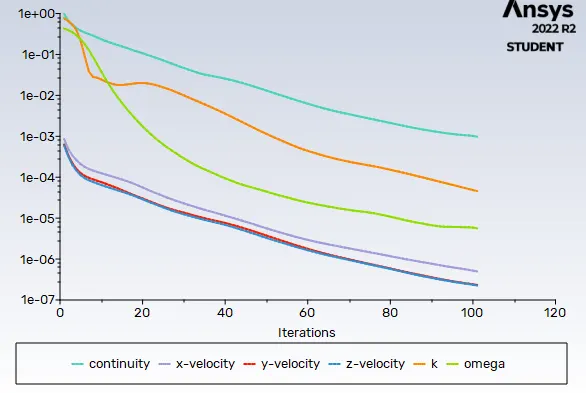
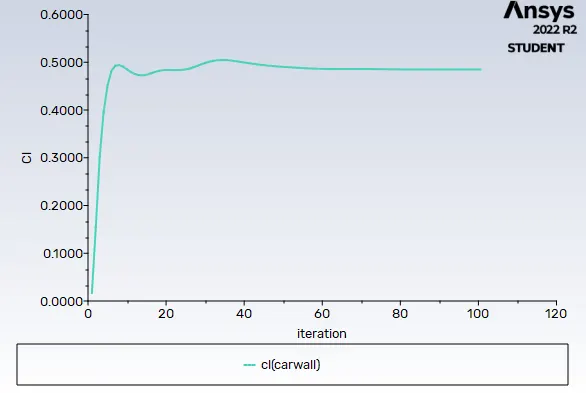
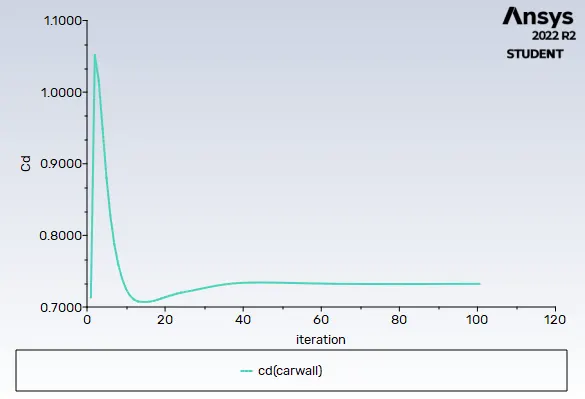
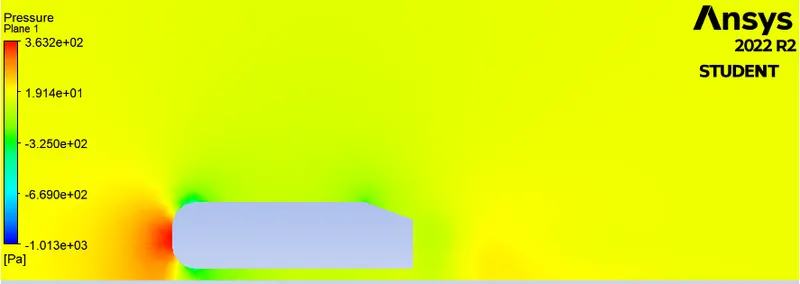
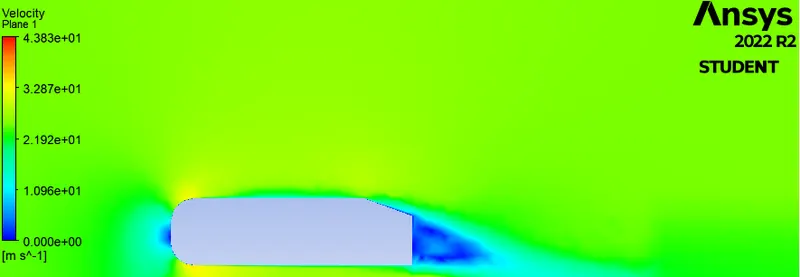
Results:
| Setup | Cells | Cl | Cd |
|
Case 1: Unrefined (k-epsilon) |
84268 | 0.4 | 0.74 |
|
Case 2: Refined (k-epsilon) |
110390 | 0.45 | 0.76 |
|
Case 2: Refined (k-omega) |
110390 | 0.48 | 0.730 |
Reason for the negative pressure in the wake region
Flow, in order to remain attached to the object, requires energy, this is the kinetic energy. When the flow separates, it creates a region with the circulating eddies due to pressure drag. The pressure in the wake region is low and creates drag.
Significance of the point of separation
When the boundary layer starts to get detached, thepressure gradient is positive and the flow starts to slip which creates vortices and augments drag.
In short,
While in the boundary layer flow, `(delv)/(delx)>0 and (delp)/(delx)<0`
At the separation point, `(delp)/(delx)=0` and flow starts to slip, and
when the flow is separated, `(delv)/(delx)<0 and (delp)/(delx)>0`.
Conclusion
More refined mesh is desirable for better prediction of flow situation, however, this also depends on the quality of mesh as it will take more time to compute the solution. At the rear end, the flow separates and has eddies that is responsible for drag.