Week 3 - External flow simulation over an Ahmed body.
Aim: To simulate the flow over Ahmed body and to plot for velocity and pressure contours, the vector and drag coefficient plot for a refined case.
Ahmed Body:
The Ahmed body represent a simplified vehicle model. This was first developed by SR Ahmed and hence named it as Ahmed body. The airflow around Ahmed body captures the flow features around the automobile. This simplified body is able to capture almost the same airflow which will occur to an exact automibile.
Pre-processing:
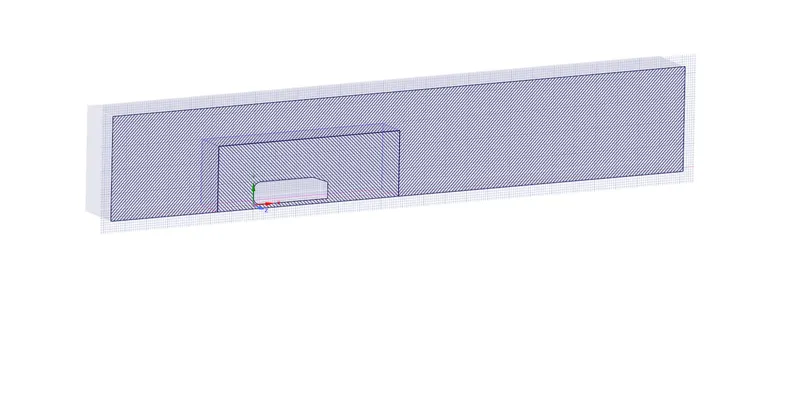
The STEP file of the geometry was imported into space claim. Enclosure option was selected to create an enclosure around the geometry. Inorder to refine the regions around the body another enlcoure was setup near to the body. and now the body was suppressed for physics.The split body option was used to split the body about the symmetry plane. Now we check the body for interferance using the option and finally we share the region of two enclosure inorder to share the flow through both of them.
Split body of the geometry showing two enclosures and the booleaned geometry:
Meshing:
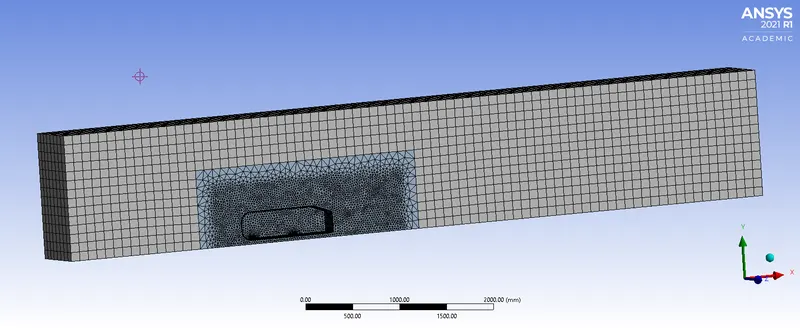
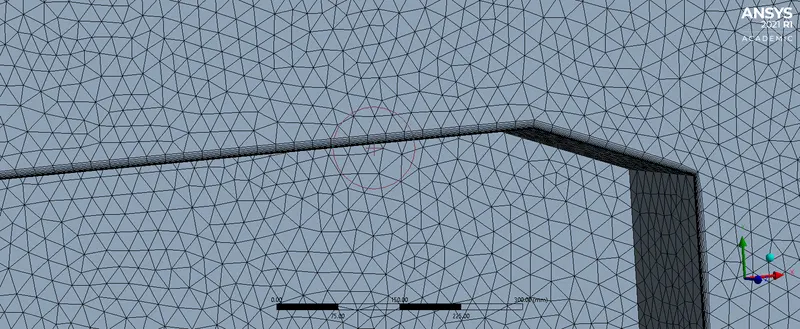
The body was subjected to multi zone meshing with hexadominant mesh on the outer enclosure and tetrahedral mesh in the inner enclosure. Body sizing was applied on to the inner enclosure to refine the mesh in the inner region. A layer of inflation was carried out around the Ahmed body by calculating the value of hieght of the first layer by chosing the y+value as 30 for k-epsilon model and inflation was applied for around 10 layers. Face sizing was given to the legs of the model to get a circular shape.
No. of elements (For refined case): 494475
Meshed view of the geometry showing multizone method:
Meshed view showing inflation layer:
Post-Postprocessing:
Result:
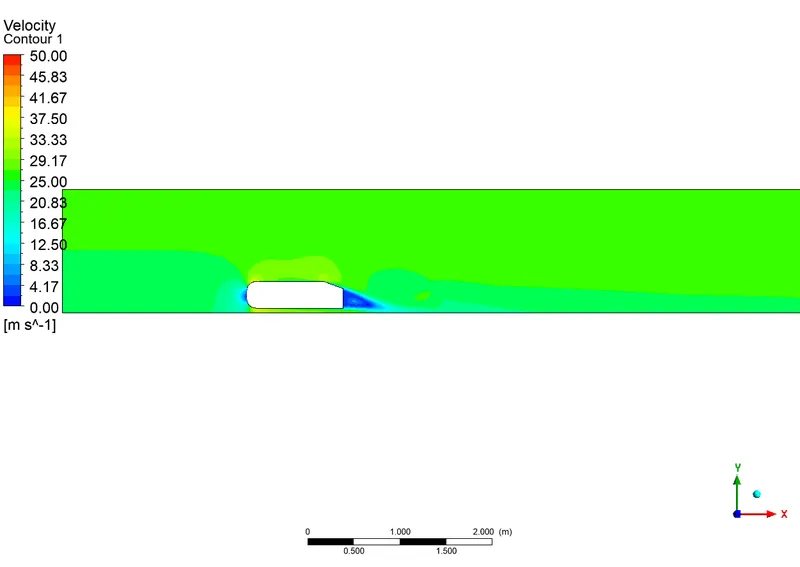
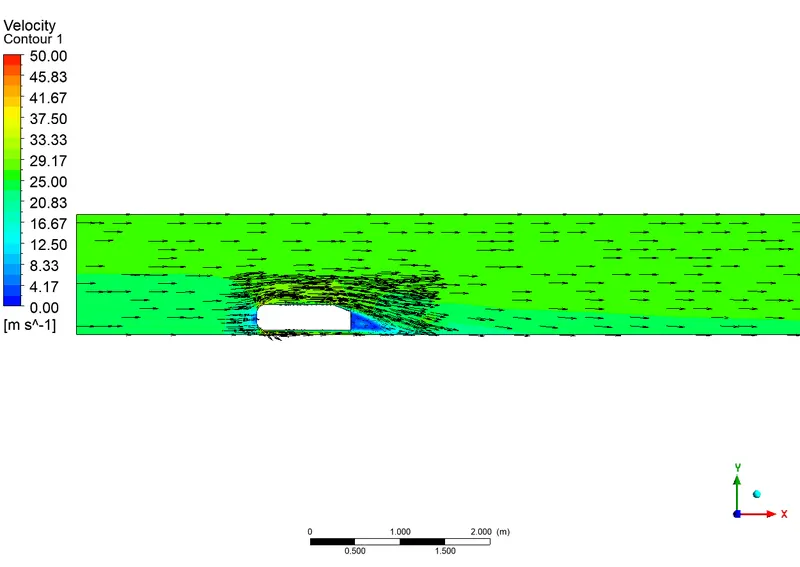
Velocity Contour:
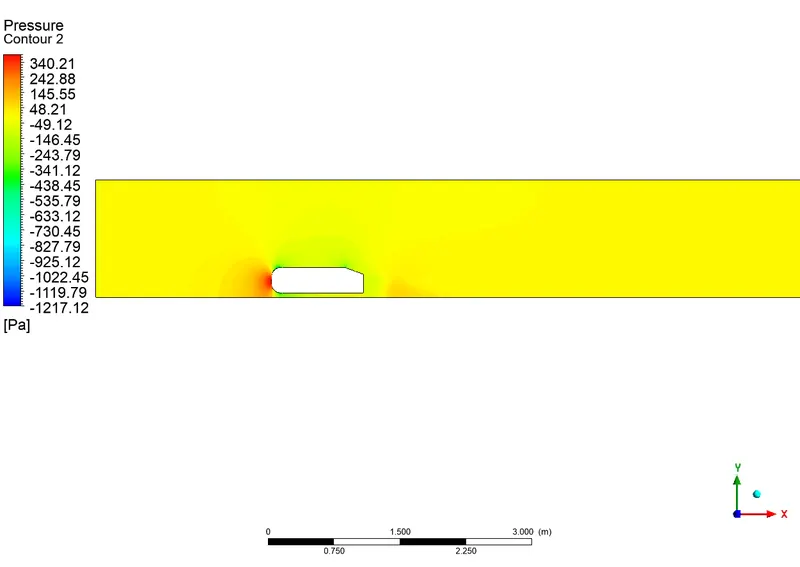
Pressure Contour:
Vector plot:
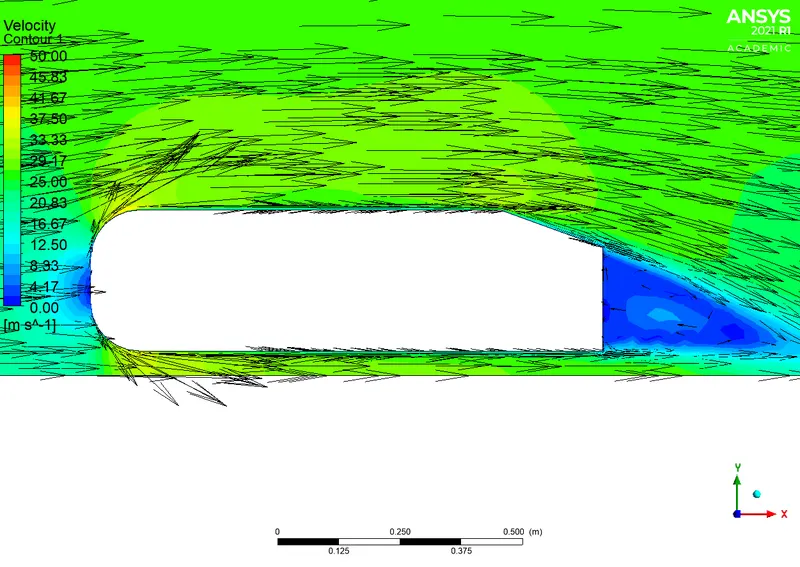
Zoomed view of wake region:
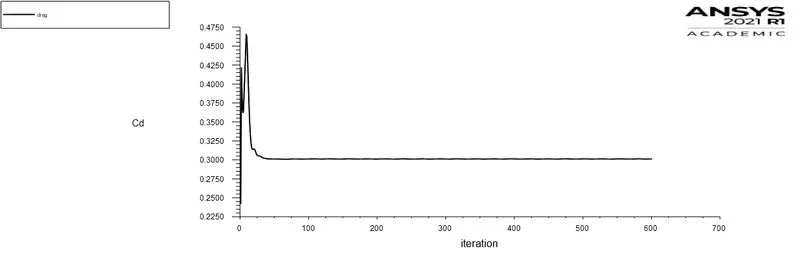
Plot of coefficient of Drag:
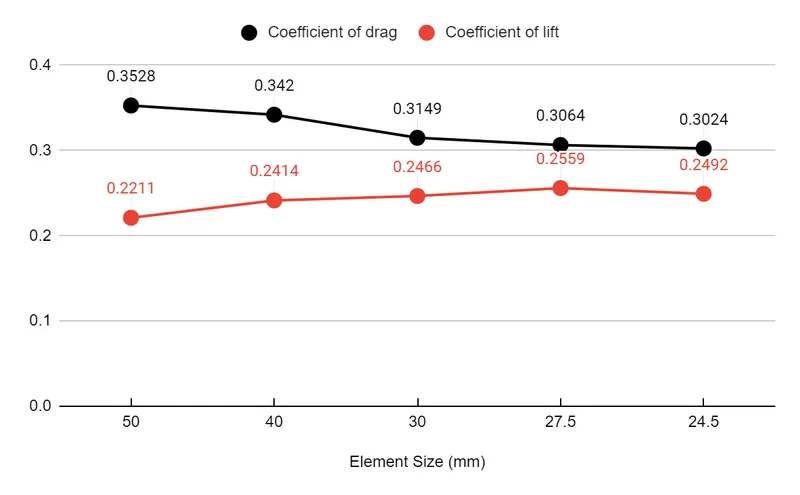
Grid independance Study:
| Element Size (mm) | No. of elements | Coefficient of drag | Coefficient of lift |
| 50 | 105173 | 0.3528 | 0.2211 |
| 40 | 156545 | 0.342 | 0.2414 |
| 30 | 294987 | 0.3149 | 0.2466 |
| 27.5 | 365662 | 0.3064 | 0.2559 |
| 24.5 | 494475 | 0.3024 | 0.2493 |
Conclusion:
Refining the mesh defenitly increases the quality of results, being an acadamic version of ansys the no. of elements was limited on to .5million cells which restricts the quality of results. The least element size showed a coefficicnet of drag 0.3024 for 25m/s velocity.
Negative pressure in the wake region:
The negative pressure in the wake region can be releated to the recirculation region caused after the bluff body. As the air hits the frontal area of the Ahmed body it is subjected to a high pressure region which is termed as stagnation point .Since vehicles can be treated as a bluff body, the flow will experience seperation at the rear leading to wake region behind the body . This is the main reson for aerodynamics resistrance.
Point of Seperation:
Separation of flow is said to occur when the direction of the flow velocity near the surface is opposed to the direction of the free stream velocity, which means `(du)/dy ≤ 0`. Here the skin friction coefficeient reaches to a vlue of zero. At this point the wall shear stress vanishes and is called the point of seperation. Reverse flow take place beyond this point. due to reverse flow large eddies are formed and a lot of energy is dissipated. this region is inturn called as wake.