Week 3 - External flow simulation over an Ahmed body.
Aim:
As the body is perfectly symmetric, we can run the simulation by considering the only half body. This is the best practice where you can save on the number of cells and get the results faster as well.
The geometry which is provided with the challenge needs a modification which you should be able to do at this stage of a course. You need to use the 'split body' command in SpaceClaim to perform the operation and then you can use the symmetry boundary condition in fluent to perform the simulation.
Run the simulation for the velocity of 25 m/sec with the default air properties in fluent.
Objective:
- Describe Ahmed's body and its importance.
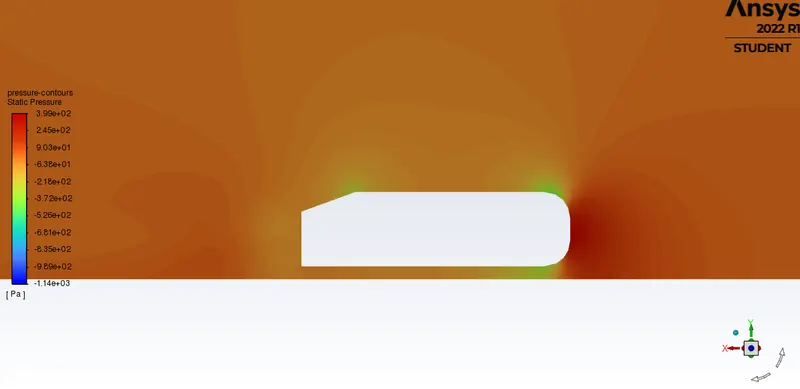
- Explain the reason for the negative pressure in the wake region.
- Explain the significance of the point of separation.
Ahmed Body:
Introduction:
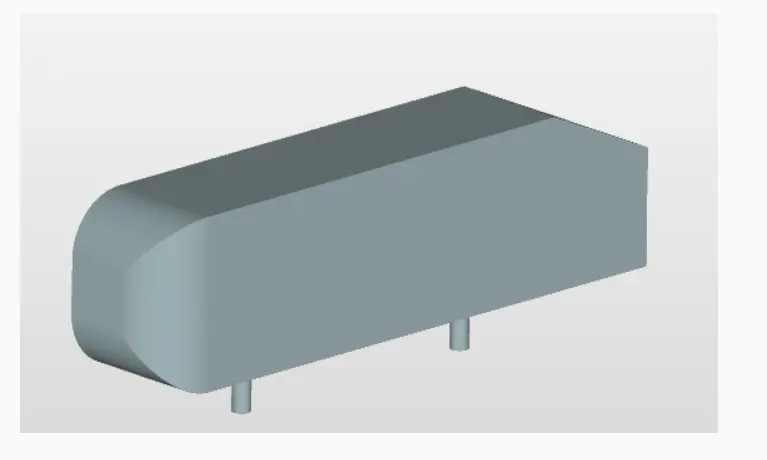
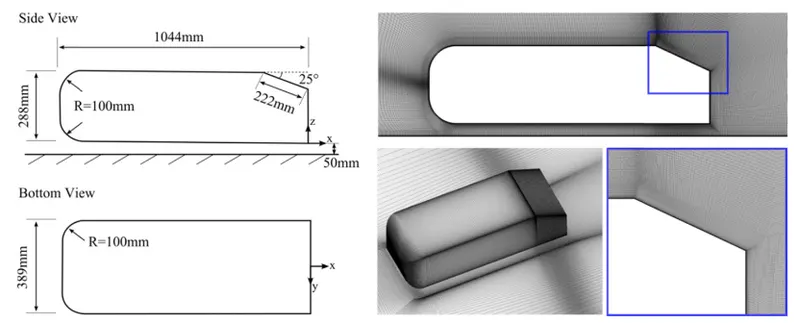
The Ahmed Body was first created by S.R. Ahmed in his research “Some Salient Features of the Time-Averaged Ground Vehicle Wake” in 1984. Ahmed's body is the benchmark model for aerodynamics simulation tools. The simple geometrical shape has a length of 1.044 meters, a height of 0.288 meters, and a width of 0.389 meters.
The Ahmed body was initially advance by Ahmed et al. (1984). may be a general automotive model that is employed by the
automotive industries (Morel (1978), smart and Garry (2004), Guilmineau and Chometon (2009), Heft et al. (2012)
and Huminic and Huminic (2012)), to look at the wake forces and dynamics that is experienced during a verity of
configurations. The Ahmed body is meant to possess a smooth-edged side with a flat roof and a flat bottom
section ANd an angulate back slant that primarily acts because the car window of a automotive and ending with a vertical base.
Theory:
The back-slant angle that is often selected as ϕ is extremely essential to the flow patterns that area unit intentional at the
near wake region and afterward has an effect on the mechanical forces that act on the body. automotive corporations
make varied makes an attempt to develop changed styles to effectively cut back the mechanics drag force that happens
at the seat while not golf stroke any constraints within the stability, comfort, and safety of the passengers. The mechanic's
drag of road cars is firmly connected to the vehicle’s wake downstream flow. The separation zone size and
the drag force FD directly rest principally on the position of flow separation over the Ahmed body. afterward,
comprehensive facts relating to the wake flow characteristics and its reference to the pure mathematics of the body is crucial
for a sure-fire style of future cars. the appliance of process Fluid Dynamics (CFD) in
determining fluid flow patterns has been determined to be quite common among researchers within gift days. CFD
modeling in the decisive flow line of fluid around the Ahmed body has been utilized since the first twenty-first century. In
many open kinds of literature, the CFD application in the decisive airflow pattern and also the changes in flow motion with
altering pure mathematics of the Ahmed body are found. bound modifications within the Ahmed body aid researchers and
designers to see the result of modification on the resultant drag and carry force which might be calculated as mistreatment.
CFD modeling. The chief purpose of automotive mechanics is that the reduction of drag, change noise emission,
increase fuel economy and eliminate redundant elevated forces and alternative origins of mechanics unsteadiness that
arises at high speeds. customary} Ahmed reference model has been thought of because the standard model during this
research work for polishing off numerical simulations for analysising on the mechanics parameters. The Ahmed
body has alike featured sort of a general automotive and is generally used for authentication of recent codes within the automobile
industry. this easy geometric model features a length of one.044-meter, height of zero.288 meter and a dimension of zero.389 meter.
It consists of cylindrical legs of zero.5-meter radius connected to the bottom a part of the body. The hindmost surface
has Associate in Nursing inclination of twenty five degrees. Ahmed body characterizes the simplified pure mathematics of a ground vehicle as a bluff
body type. Its pure mathematics is adequate enough for precise flow simulation and retains few important sensible options relevant
to cars. This model aids engineers and designers to get flow field close the straightforward automotive model by
the use of k-epsilon model. In spite of neglecting quite few numbers of options of a true automotive like rough bottom,
rotating wheels, surface projections etc. The Ahmed body generates the crucial options of flow pattern around a automotive
for instance flow impinge-mentation and therefore the displacement round the nose, relative uniform flow of air round the
middle portion and flow separation beside the wake generation at the rear. Since the Ahmed body is straightforward to model,
it may be effortlessly used for researching varied properties like turbulence, coefficient of drag, wake region, lift
forces, rate magnitude at varied regions of the automotive, magnitude of pressure round the automotive that helps in
determining what is going to be resistance, fuel potency etc. of the automotive thereby providing designers a transparent plan on that
region must be optimized for higher effectiveness. the most objective of this study being stimulation of turbulent
flow among the structure and round the Ahmed body to capture the flow pattern at the rear and wake region.
Solving & Modelling approach:
Creating the Geometry:
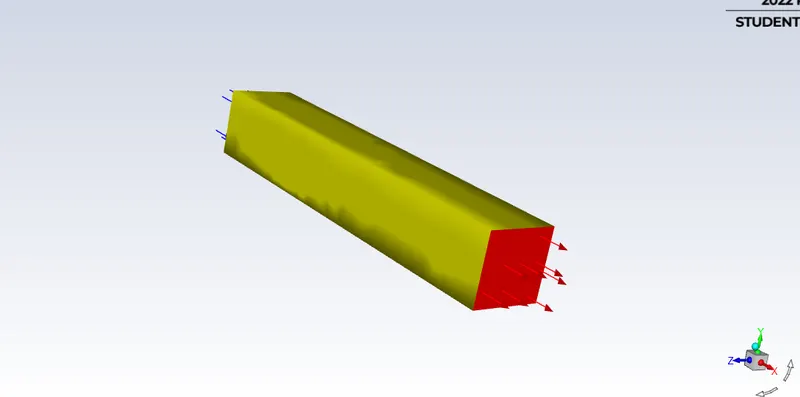
- Import the Ahmed body file to the Ansys workbench.
- Creating the rectangular box around the body and giving it's dimensions.
- Creating the plane through the origin and selecting the plane which makes the half of Ahmed section of the Ahmed bodyAhmed
- The saving the ahmed body and closing the geometric window and creating the mesh.
Meshing:
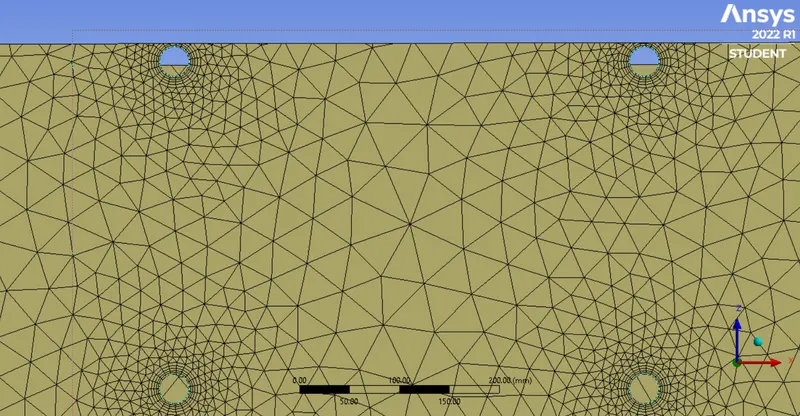
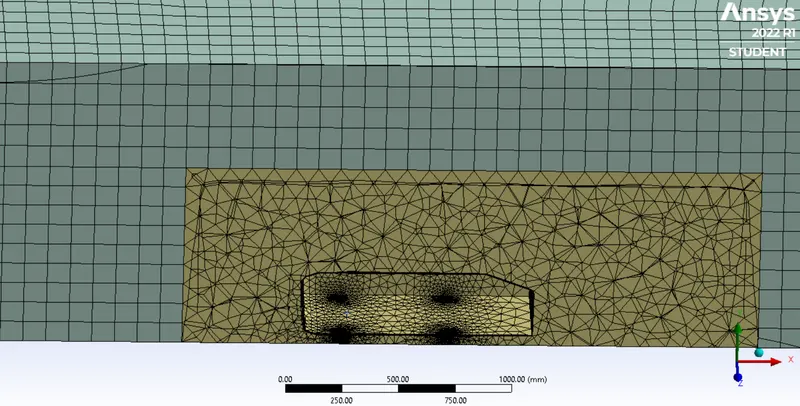
- Importing the geometry in the meshing module. And generating the mesh to see how the mesh will come out.
- Now giving the faces name for the fluid flow inlet, outlet, symmetric walls, car walls etc.
- After giving names now we'll use the mesh method option to insert a method for the meshing ceritria.
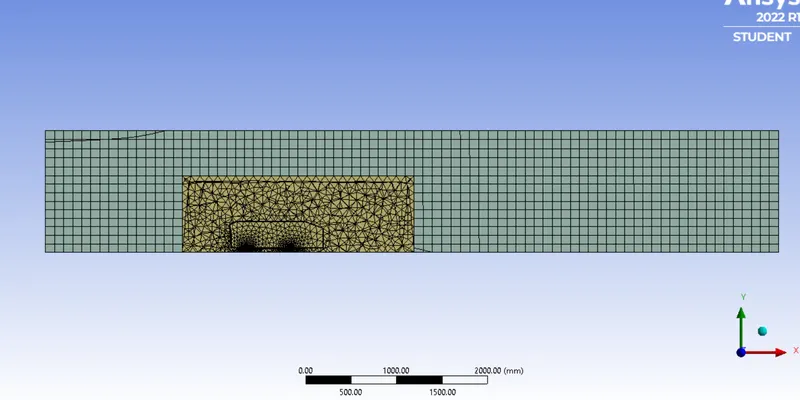
- Choosing the outer body and choosing the method as a multizone method.
- Now giving the mesh default size as 100mm, and size of 100mm. Click on generating mesh.
- Now we can see a fine mesh of the multizone method.
- Now give a mesh size option and give the mesh size of the inner box of 50mm.
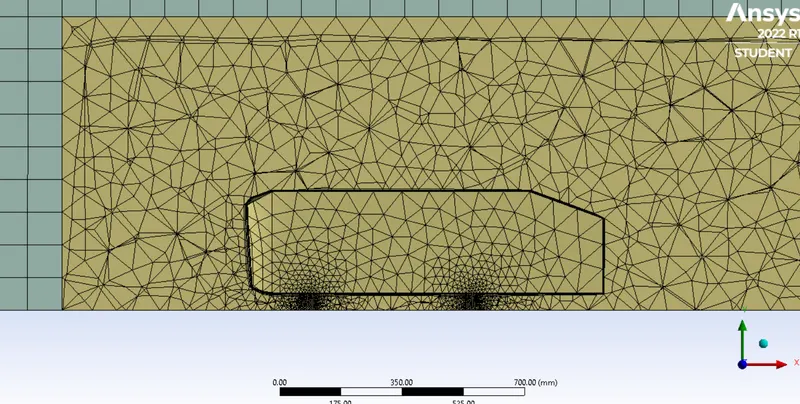
- And in the end giving a mesh sizing option of car-walls of 5mm.
- As we have given the sizing we need to give an inflation layer to the outer car-walls.
- Now we need to select the faces of out car-walls and name it inflation-walls.
- Going to inflation and selecting the all faces method, now selecting the inflation wall and giving the maximum thickness 12.5mm and no of inflation is 5.
- Now again generating the mesh we can see the layer of mesh at the outer wall of the Ahmed body.
Pre-processing and solver setting:
- After the generation of mesh we need to close the module and import the meshing in the setup module in Ansys fluent.
- After creating a new fluent setup of double-precision we can see the mesh and the faces we declearing as inlet and outlet.
- Now giving the parameters and checking the box of energy.
- Giving the viscosity as K epsilon method.
- Now click on boundaries and select inlet and give the velocity as 25m/s.
- Check the outlet is a pressure outlet and has symmetric walls.
- Now initialization of the result we can verify the initialization in the console box.
- Now creating the plane onto the normal and giving all the coordinates for the plane as 0 and normals z-axis as 1.
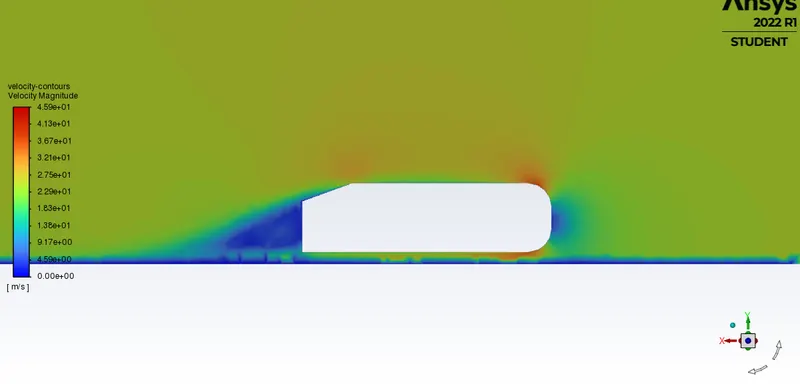
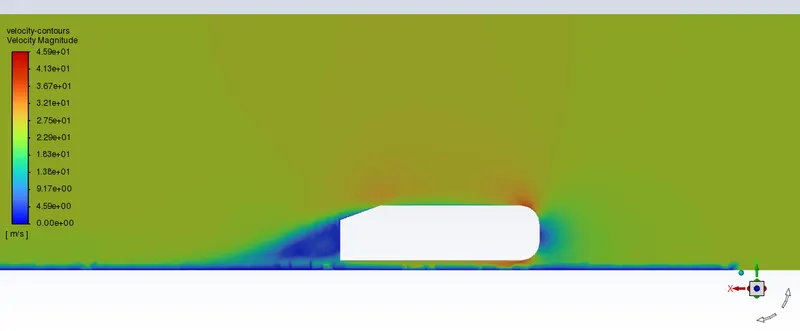
- Creating the contours of velocity-contour and pressure contours select the cut-plane and click display/save.
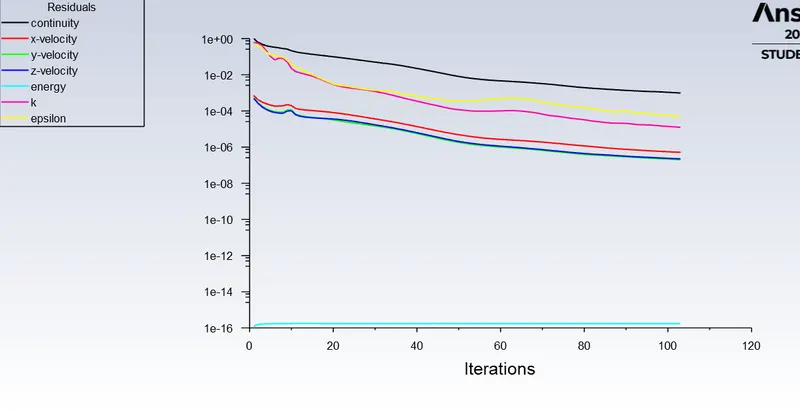
- Now creating a solution animation as appropriate to the viewer and giving the no of iteration as 100- 150.
- Now we'll hit the RUN.
- We have obtained the flow over Ahmed body as follow wind velocity and coefficient fo drag at 25m/s.
Geometry:
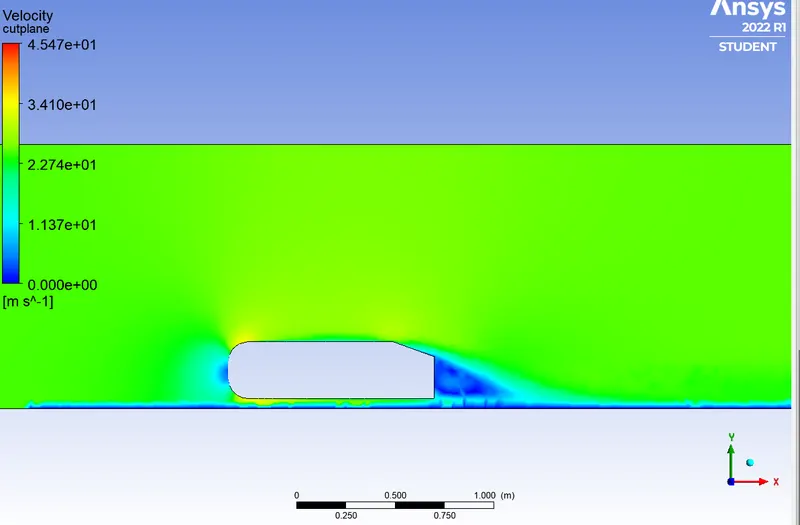
Velocity contours:
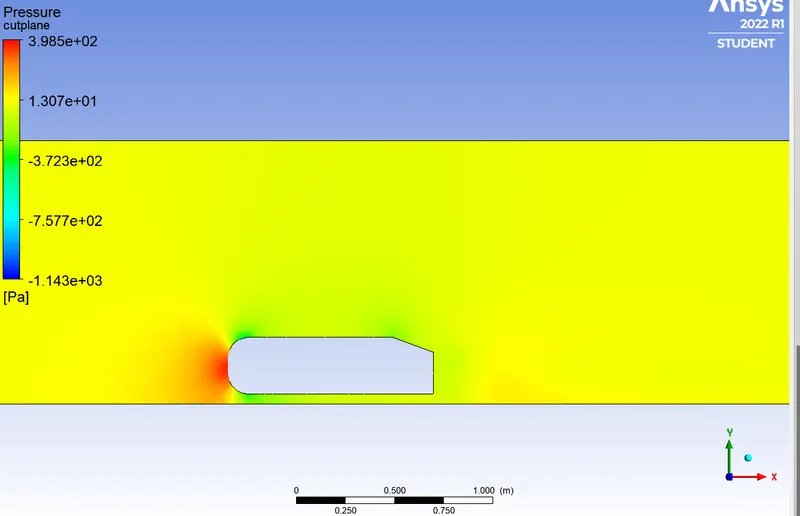
Pressure contours:
Residuals:
Result:
- As we have finished with fluent setup and running the flow over Ahmed body.
- We can now go for generating the velocity flow over the body.
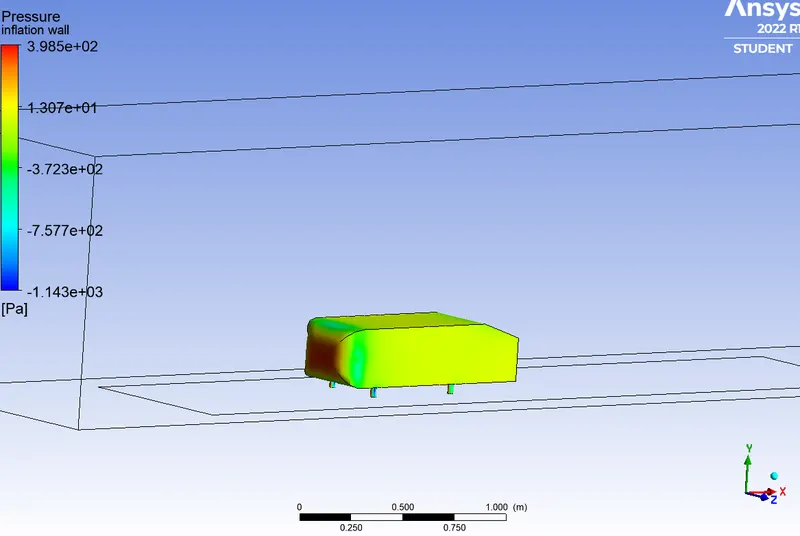
- Click on the body of car wall and go to colors creating a pressure result on Ahmed body.
- Now insert a plane on XY axis and disable the car walls.
- Generate the velocity and pressure plots.
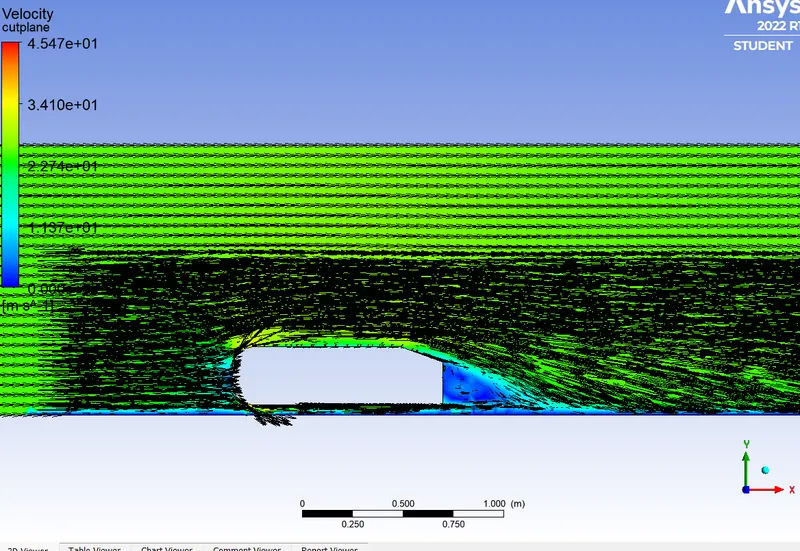
- Now insert vector on the Ahmed body color it as black.
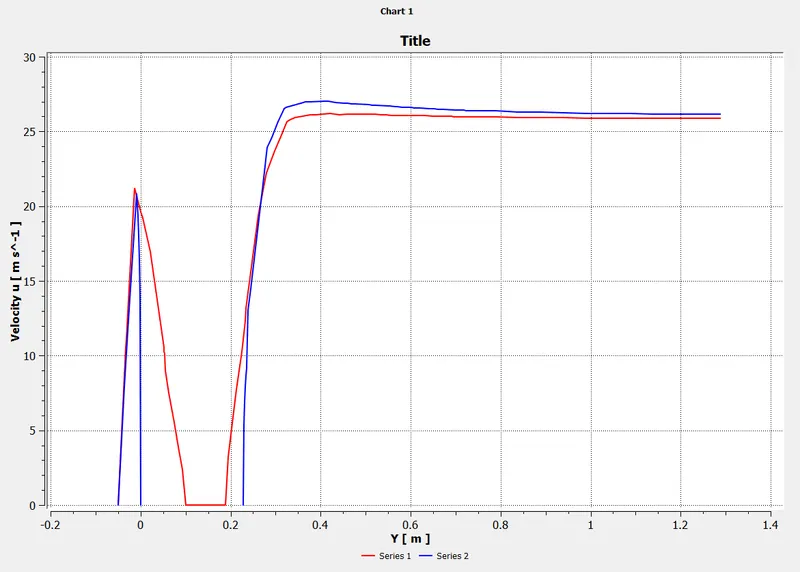
- Now insert 2 line before the Ahmed body and after. Select the chart and choose the line1 choose the velocity U on Y-axis.
- Now we can see the graph of the velocity at the line.
- Similarly for the line 2 we can see the graph of the velocity of the air producing drag force on Ahmed body.
- As follows.
Car body pressure plot:
Velocity Plots:
Pressure Plots:
Vector:
velocity flow after Ahmed body:
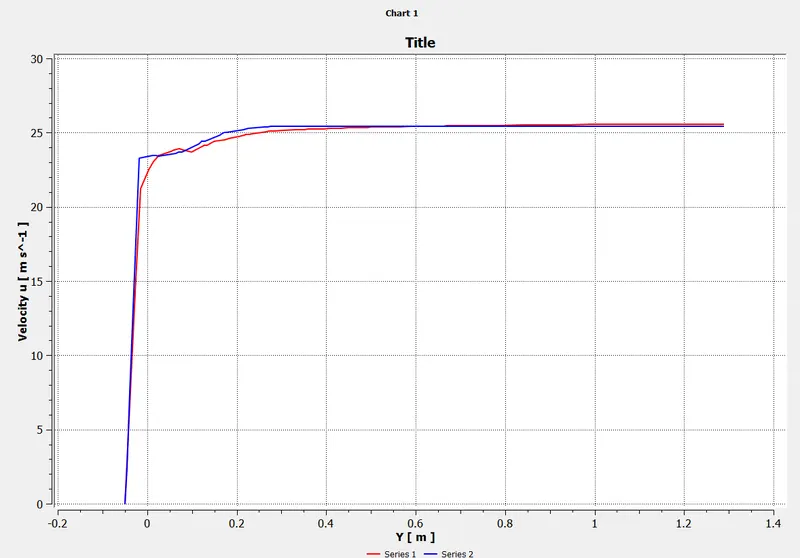
Velocity flow before and after Ahmed body:
Conclusion:
Hence we run the simulation by considering only half body. This is the best practice where you can save on the number of cells and get the results faster as well.
The geometry which is provided with the challenge needs a modification which you should be able to do at this stage of a course. You need to use the 'split body' command in SpaceClaim to perform the operation and then you can use the symmetry boundary condition in fluent to perform the simulation.
Run the simulation for the velocity of 25 m/sec with the default air properties in fluent.
Some problems occured on the fluent the mesh is not updating properly. And the iteration timing has to recalibrate and then set the no of iteration.
The fluent takes time to iterate over the Ahmed body.
But in the end, I have finally obtained the flow over the Ahmed body.