Week - 3 Drop test Challenge
AIM:
The objective of this assignment is not to get a correct simulation but to get a feel of creating an input deck from scratch and to prepare the drop test of the phone from scratch using just the finite element model of the mobile phone.
PROCEDURE:
The unit system follows mm,ms,Kg,KN .
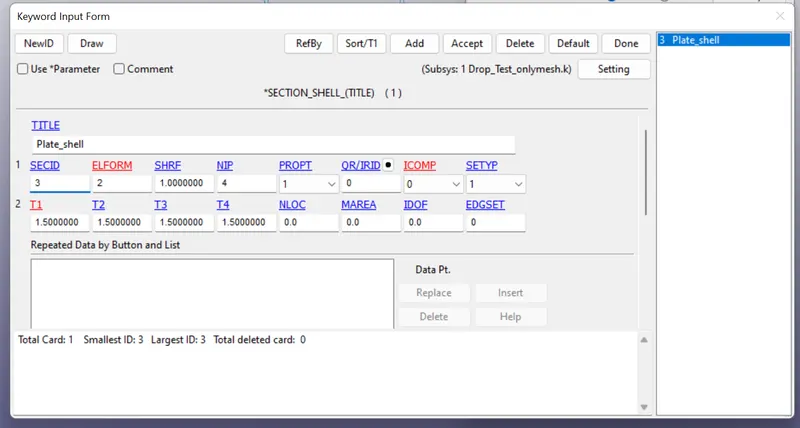
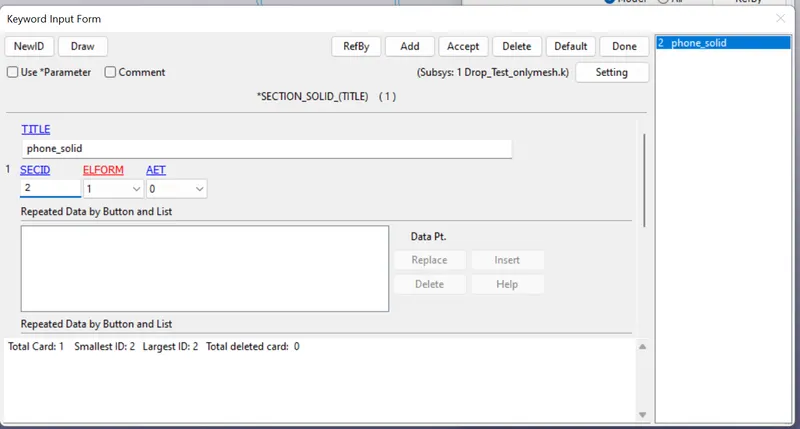
1. Section- SECTION_SHELL and SECTION_SOLID
Shell and solid sections are created using the above-mentioned key words and selectively reduced shell and solid elements are used as they are economical from a computation perspective.
2. Material- MAT_ELASTIC
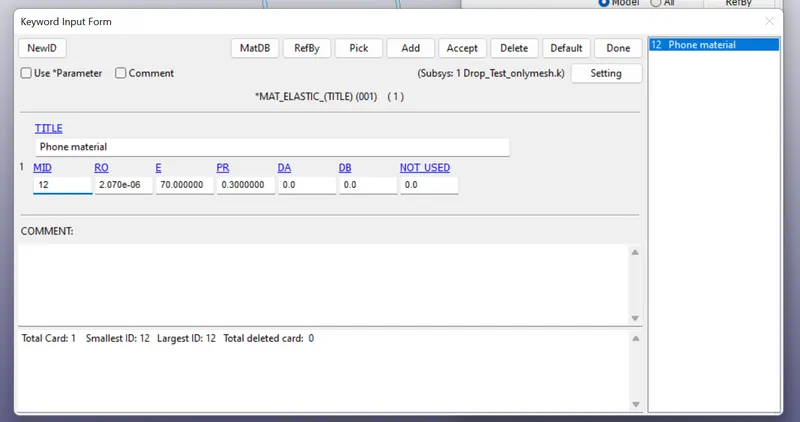
The elastic material is used for the mobile phone.
Material - MAT_RIGID
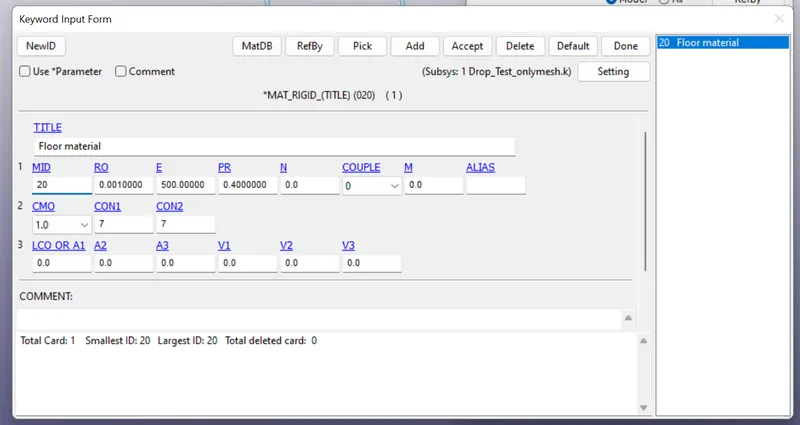
The rigid material is used for the floor material.
3. Part definition - PART_PART
The created section ID and Material ID are then entered in PART card.
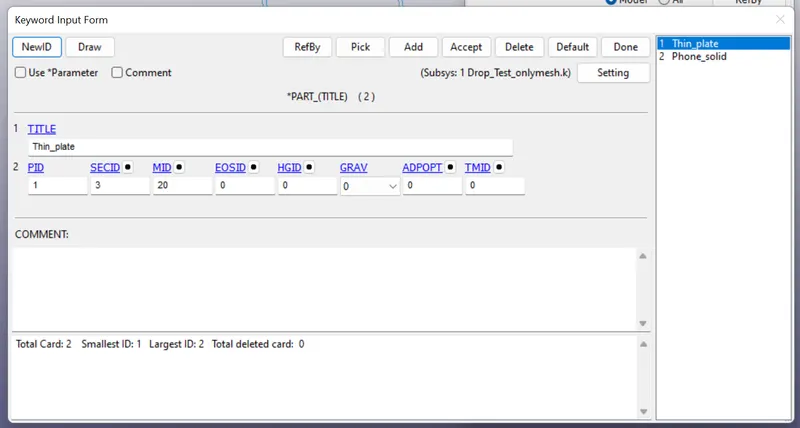
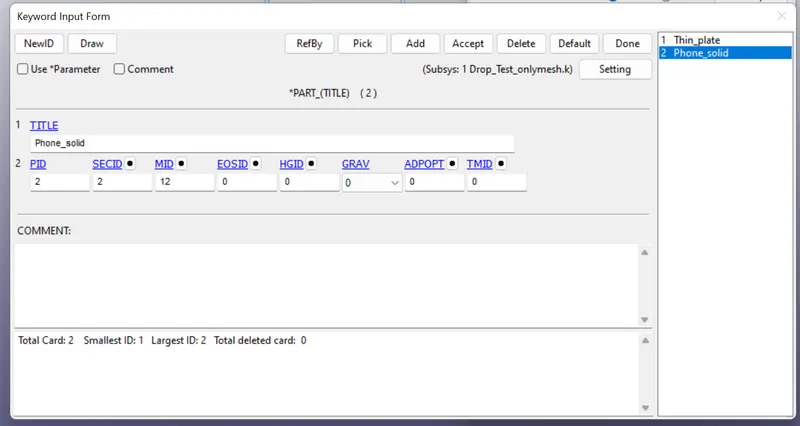
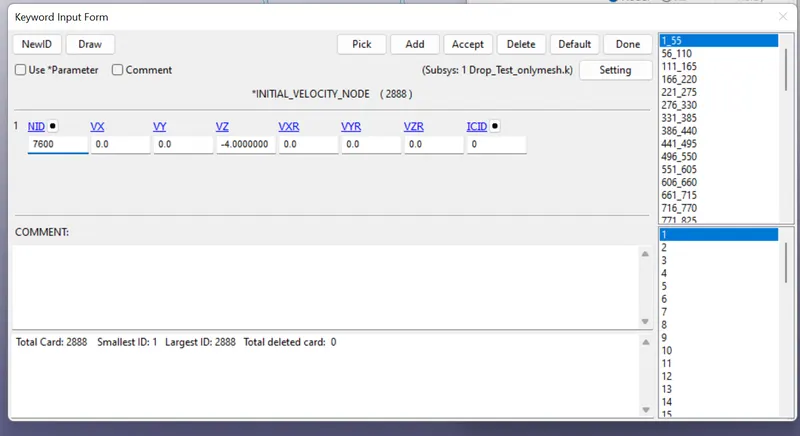
4. INITAL - INITIAL_VELOCITY_NODE
Select the node of velocity and velocity axis also give the value of velocity flows. The loads applied here are Initial velocity.
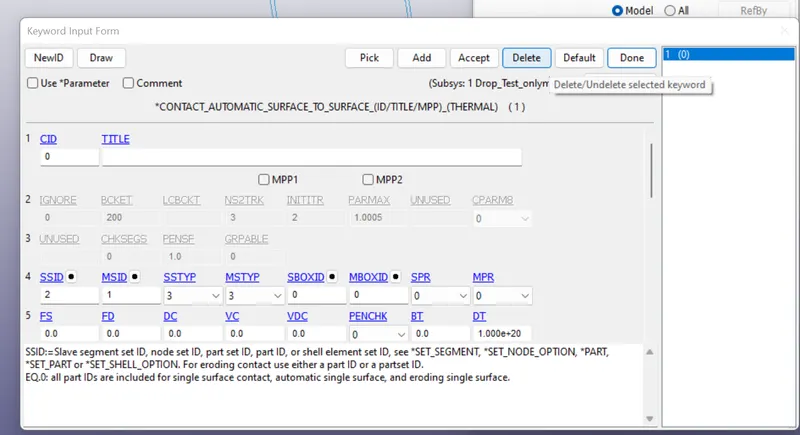
5. Contact - CONTACT_AUTOMATIC_SURFACE_TO_SURFACE
The contact keyword is created to define a contact to make sure that the phone does not pass through the ground while doing the simulation.
Usually, the hard surface or body with coarse mesh is chosen as the master surface and the body with fine mesh is chosen as slave.
Hence, in this model, the ground is chosen as master surface and the phone is chosen as slave surface.
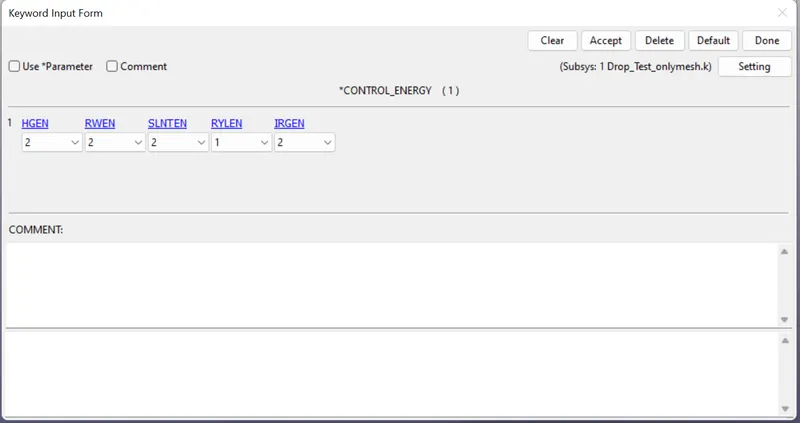
6. Control - CONTROL_ENERGY, CONTROL_HOURGLASS, and CONTROL_TERMINATION
The CONTROL_ENERGY is used to make sure that the hourglass energy and sliding energies are calculated for the energy balance check.
The CONTROL_HOURGLASS card is used to make sure that the hourglass effect is minimal or nonexistent.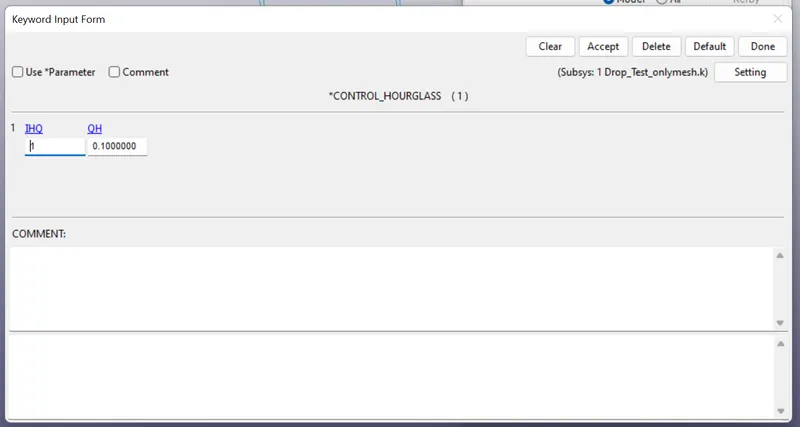
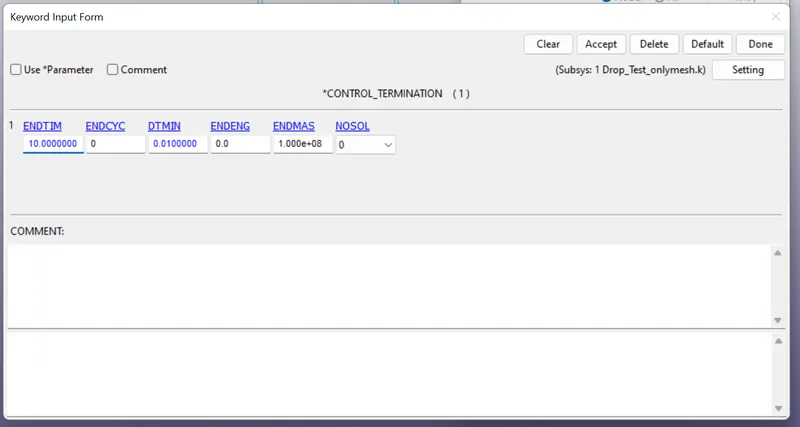
The CONTROL_TERMINATION card is used to input the simulation run time as 10ms and minimum time step as 0.01ms.
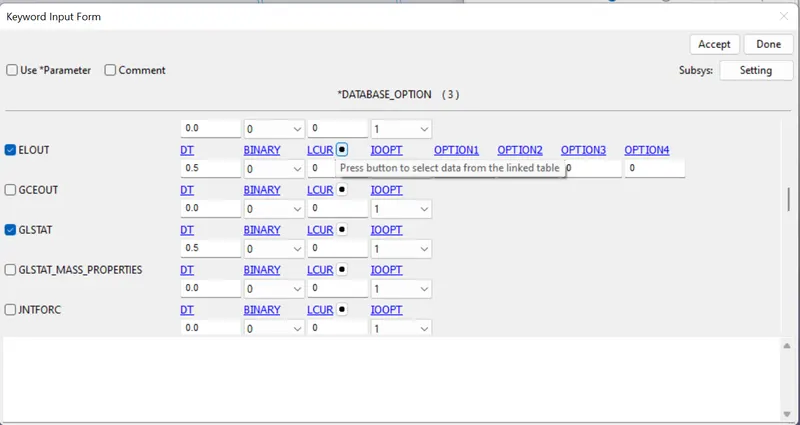
7. Database - DATABASE_ASCII_option and DATABASE_BINARY_D3PLOT
The DATABASE_BINARY_D3PLOT keyword is used to mention the time interval between outputs.
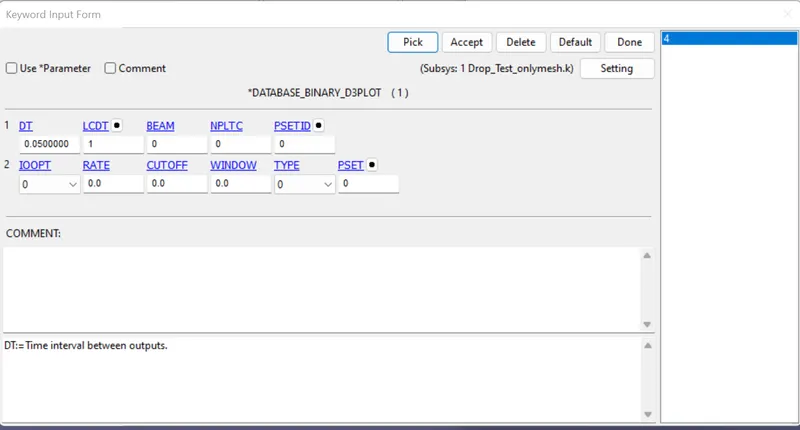
The DATABASE_ASCII_option is used to request the ELOUT (element output), NODOUT (Nodal outputs), GLSTAT, etc at interval of 0.05ms.
Plots & Contours:
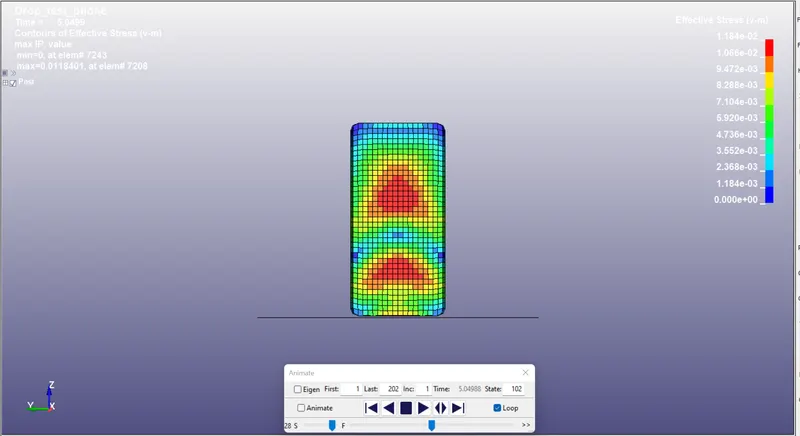
Von-Mises Stress contour at the time of Impact:
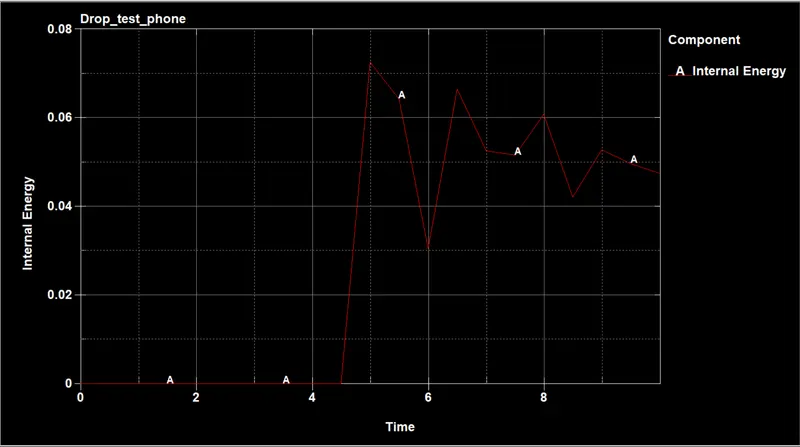
Internal Energy:
1. Since the phone is dropped from a hight, initially, the internal energy is zero.
2. After the phone hits the ground, the reaction force imparts energy to the phone and thus internal energy increases to achieve the maximum value.
3. After the phone bounces off the ground, the fluctuations in internal energy can be noted due to the impact loading.
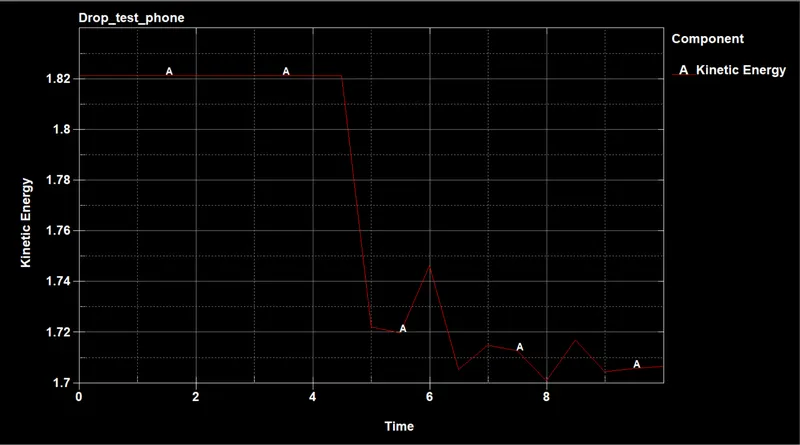
Kinetic Energy:
1. Since an initial velocity is given to the phone, the kinetic energy is maximum at the begining.
2. Kinetic energy becomes zero the moment the phone touches the ground and then increases from zero as the phone bounces off the floor.
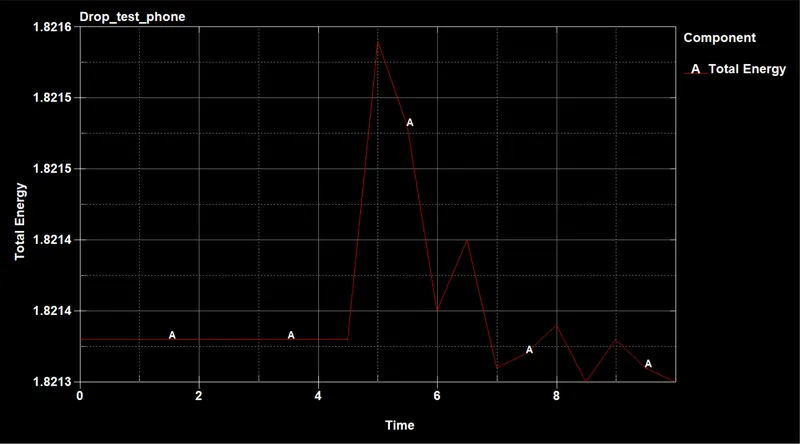
Total Energy:
1. Total energy is the sum of all the energies like Internal energy, hourglass energy, kinetic energy, external work etc.
RESULT:
The given meshed model was successfully used to build a LS-Dyna keyword deck and the drop test was successfully simulated with normal termination.