Week - 3 Drop test Challenge
The Simulation is done in a live zoom session.
AIM:
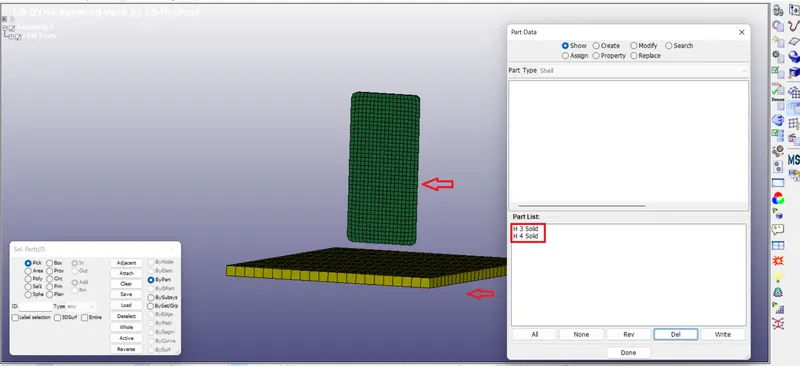
To create a complete simulation file to perform a drop test from a given basic .k file consisting of only nodes and elements. Essential keywords should be added to create a basic solver deck to simulate a drop test.
PROCEDURE:
Open the LS-PrePost and open the given keyword file.
The given input file consists of three different parts the bottom plate of shell elements, the mobile phone of solid elements, and the bottom plate of solid elements. We can either model the test with a bottom plate as a shell or solid elements.
For this analysis, I have considered the mobile phone and bottom plate with solid elements formulation and deleted the extra part ‘bottom plate’ which was modeled with shell elements.
Analysis
Here we will see the Drop Test of a simplified model of Cellphone on the concrete ground.
There will be free fall of a Cellphone on the ground, which is generally made of concrete.
So we will take the material for Cellphone as Steel and for the Rigid body will be concrete.
Here the reason for taking the concrete as a rigid body is to see the effects like phone drops on the floor at home.
Material Specifications:
Define material properties like mass density, Young’s modulus, Poisson’s ration, and other required quantities for both the material cards.
Cellphone:
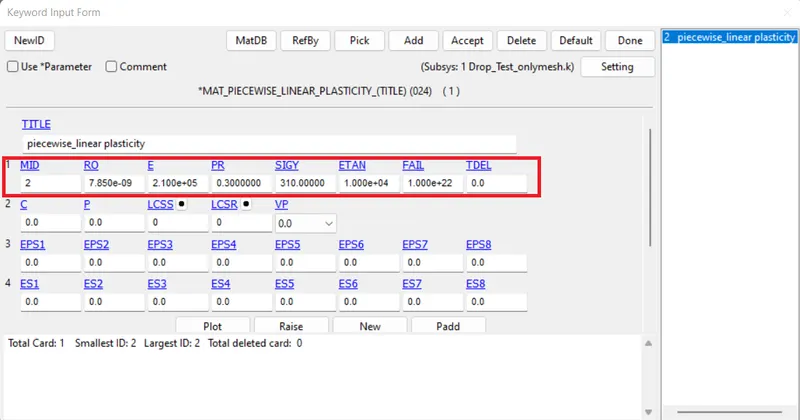
Material Model: PIECEWISE_LINEAR_PLASTICITY (024)
Density: 0.0078500 gm / mm
Elastic Modulus: 200000 Mpa
Poisson’s Ratio: 0.25
Tensile Yield Strength: 350 Mpa
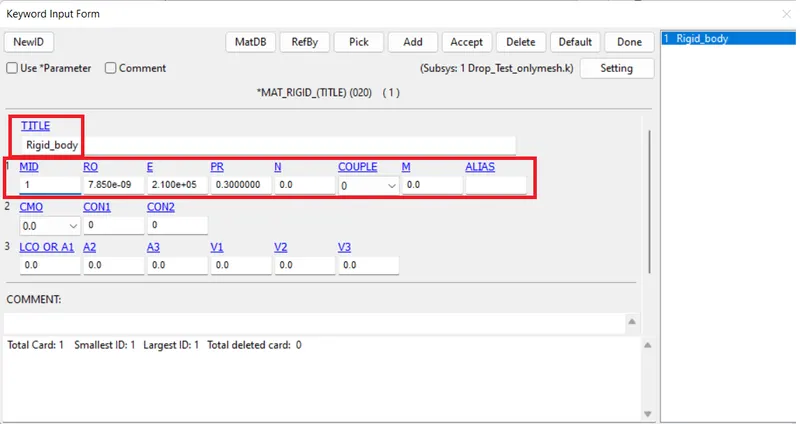
Rigid Wall:
Material Model: RIGID (020)
Density: 0.0024000gm / mm
Elastic Modulus: 41000 Mpa
Poisson’s Ratio: 0.21
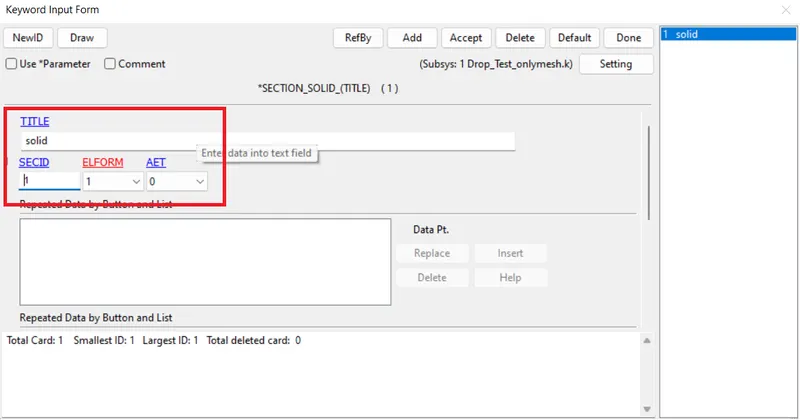
Section:
Similarly, define section card for assigning element type as solid. Select *SECTION_SOLID card and define the required properties.
Now, assign proper boundary conditions to the parts. This can be done by going through creating an entity and selecting the required boundary conditions.
Constraining the bottom plate:
The bottom plate is fixed by constraining the boundary elements of the plate in all degrees of freedom. The selection of nodes is done by area. Boundary>Spc(Single point constraint) option is utilized for defining this boundary condition.
Velocity:
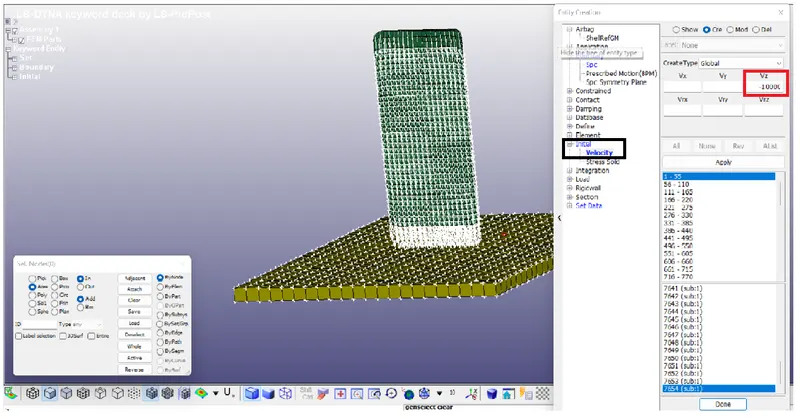
Similarly, the velocity of 10000mm/s is given through the
*INITIAL_VELOCITY card available in create entity toolbar. The mobile phone is selected by picking the part option.
Contact:
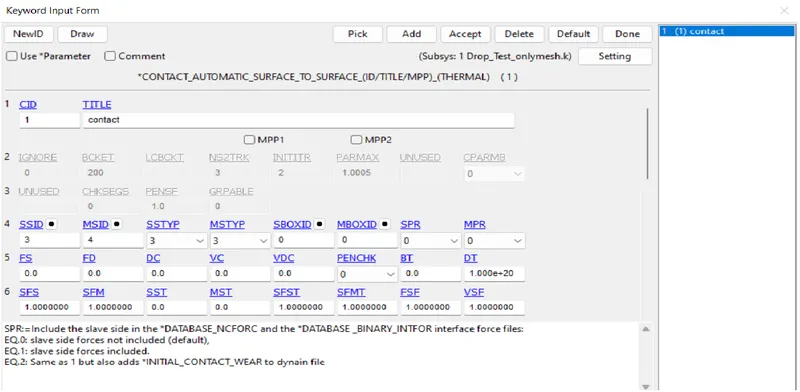
The contact between the two parts is an important parameter. This is defined by
*CONTACT_AUTOMATIC_SURFACE_TO_SURFACE card. The slave segment(SSTYP) and master segment(MSTYP) set type is defined as part ID. The slave segment is defined as a mobile phone and the master segment is defined as the bottom plate.
Termination:
The termination time for the problem is defined by the *CONTROL_TERMINATION card. The distance between the mobile phone and the bottom plate is calculated and the approximate time taken to hit the bottom plate and some additional time after the impact is calculated. This cumulative time (0.003 s) is defined as termination time in the card.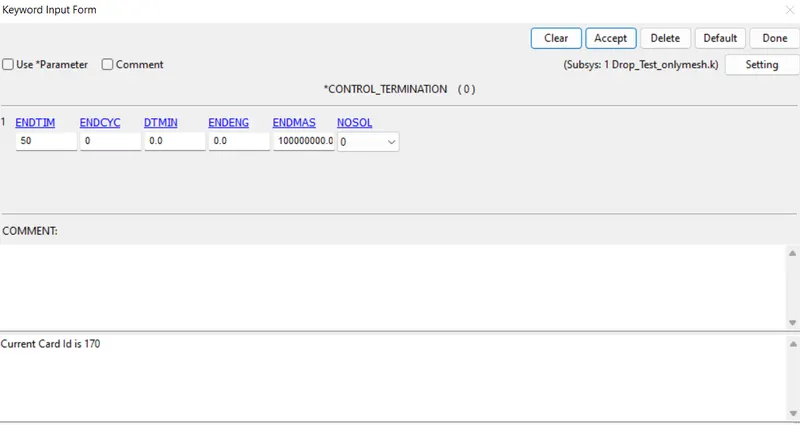
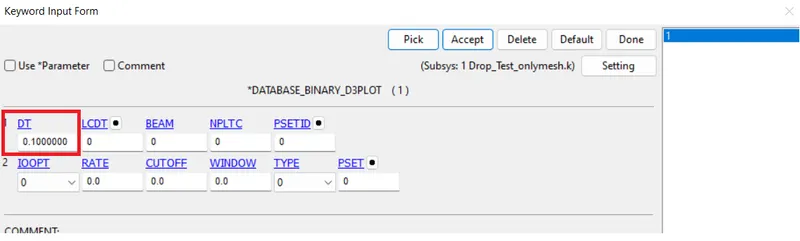
DATABASE_BINARY_D3PLOT is defined. This card gives animation and other post-processing data after the simulation. RCFORC the card is enabled with 0.0001 as the output time interval which gives interface forces between two parts mobile phone and bottom plate.
RESULTS:
After defining all the input cards, save the keyword file in .k format. This file can be read by any text editor and can be edited directly if wanted. The path of this generated .k file is given in the LS-DYNA manager and solved. The solver reads the file step by step and solves the problem.
The .d3plot is opened in LS-PrePost for further post-processing options. The following images depict a few post-processing images.
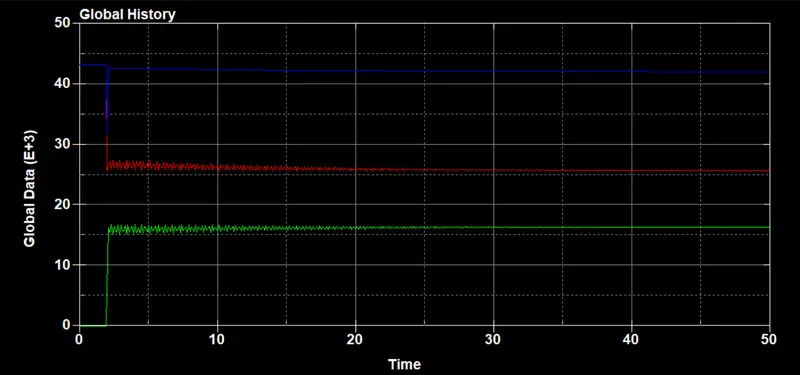
Fig: Internal energy, kinetic energy, and hourglass energy of the mobile phone
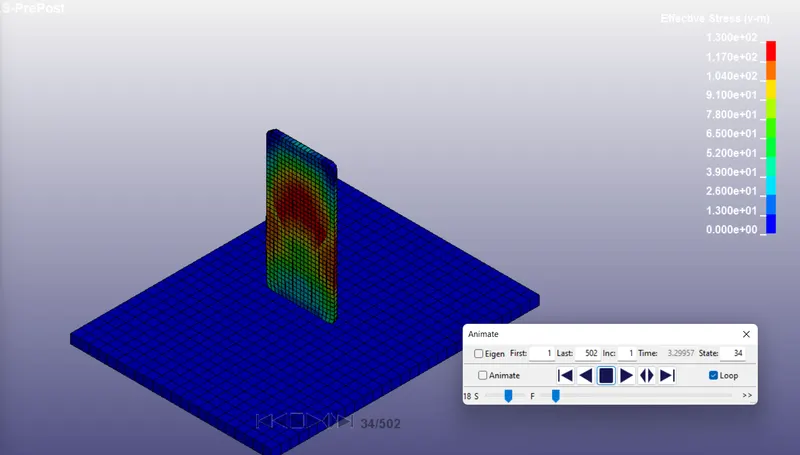
Fig 3: Von-Mises stress contours over a few time steps after the impact
CONCLUSION:
The complete simulation file (keyword file) has been generated from the given primary file. A solver deck has been created to perform the mobile phone drop test with post-processing data.