Week-3 Challenge: ADVISOR Tool
ADVISOR (ADVANCED VEHICLE SIMULATOR) TOOL :
- It is a set of model, data, and script text files for use with MATLAB and simulink environment.
- It is designed for rapid analysis of the performance and fuel economy of conventional, electric and hybrid vehicle.
- This tool is very useful in case of user-defined powertrain /vehicle dynamics and wants to see the following results before the implementation of the model.
1. For EV_defaults_in file, if cargo mass is 500 kg with all other default conditions, can the vehicle travel for 45 km with FTP drive cycle? Conclude your observations.
Here, we have to check whether the vehicle can travel for 45 km with FTP drive cycle, having a cargo mass of 500 kg. At first, load the ADVISOR tool from the MATLAB commad window and select the metric system. Instead of the US system, select EV_default_in file from the drop down menu in load file section. where the cargo mass is changed to 500 kg, so the total calculated mass becomes 1508 kg and the remaining parameter values remain unchanged, as in fig 1.1. Then click on the continue button to load the next GUI(Graphical User Interfce) window.
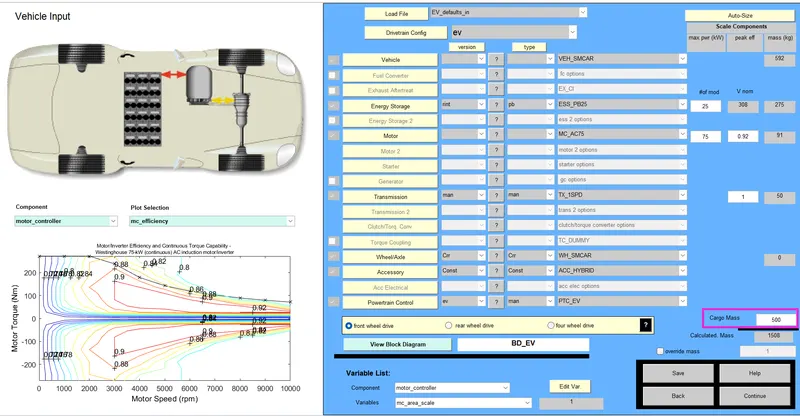 fig 1.1
Here, we are using a FTP based drive cycle from the drive cycle option and the number of cycles is set at 1, as in fig 1.2. Then, the run is clicked to go to the next stage.
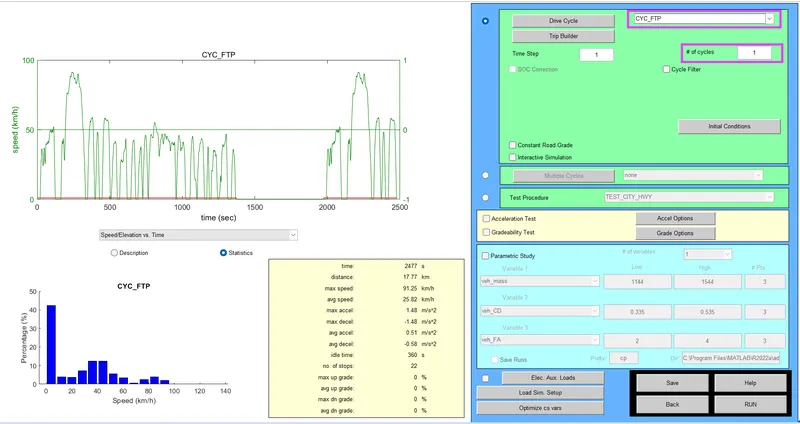 fig 1.2
As, we run the previous GUI of the EV_default_in file with a single FTP cycle, it is seen that the distance(in km) covered is 17.8 km, which is very much less than the distance to be travelled(ie 45 km), as in fig 1.3
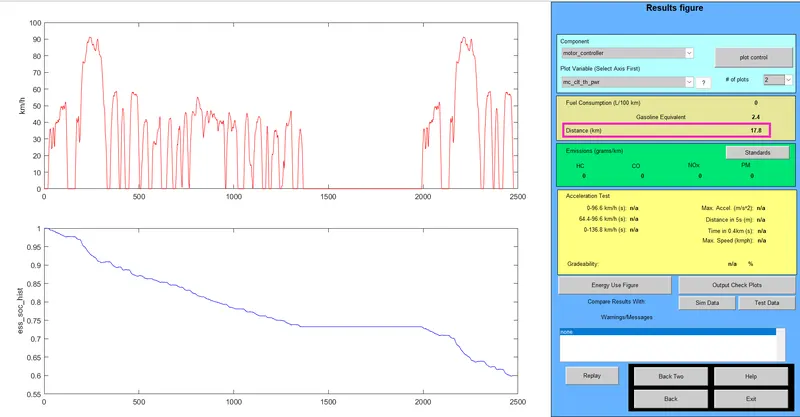 fig 1.3
Here, in the case more than 1 drive cycle is required, so 3 drive cycle are taken into acccount and it is again run. But a warning is popped up indicating that the required distance exceeds the EV range, ie the distance that the vehicle can cover within the 3 cycles of FTP drive cycle is 41.1 km. which is less than the required distance of 45 km, by a difference of 3.2 km at full battery capacity value of 25 KW (ess_SOC_=100%), as in fig 1.4.
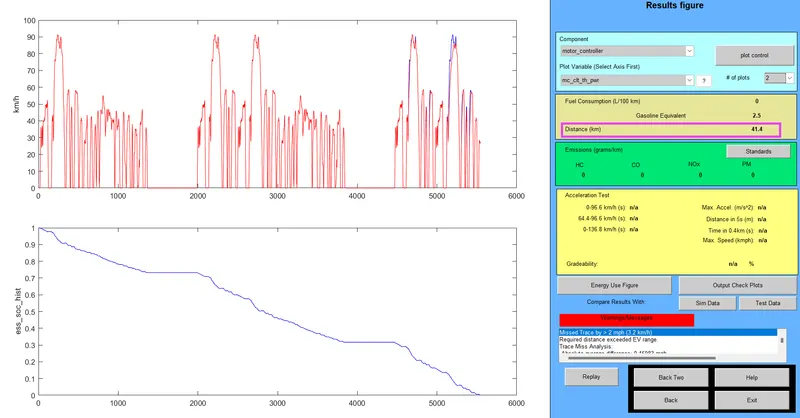 fig 1.4
CONCLUTION :
Here, for 3 number of FTP drive-cycle, the total distance travelled is 41.1 km at the given conditions with 100% SOC value (ie SOC drops to 0%), less than the required distance. So the vehicle model cannot travel the required distance of 45 km with the current battery capacity and in the given conditions.
2. In the above case, try changing the battery capacity and repeat the simulation.
For the above EV_default_in file for the same cargo mass of 500 kg, The battery capacity is changed from 25 KW to 50 KW, The battery voltage changes from 308V to 617V, The weight f the battery changes from 275 kg to 550kg. which in turn increases the calculated mass to 1783 kg, Then click continue button ,as in fig 2.1
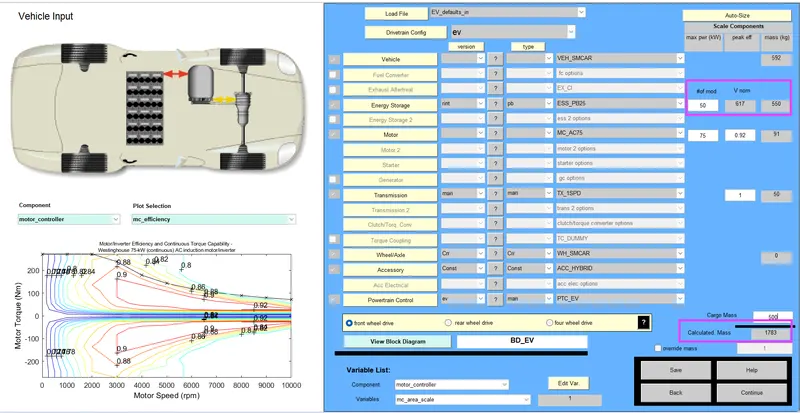 fig 2.1
In this case more than 1 drive cycle is required, so 3 drive cycles are taken into account to meet the required distance of 45 km and then it is again run. it is seen that no warnings are given as the distance that the vehicle can cover within the 3 cycles of FTP drive cycle is 53.3 km. which is much greater than the required distance and it will not use the full battery capacity of 50 KW, as in fig 2.2
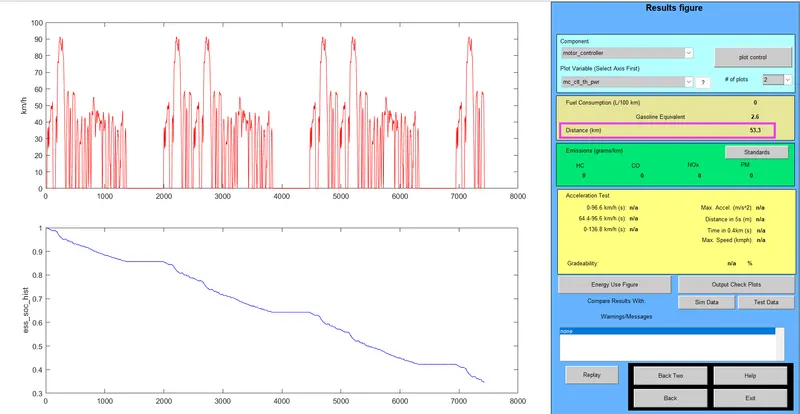 fig 2.2
CONCLUTION :
We can see that when battery capacity is increased from 25 KW to 50 KW, then the vehicle model covers the required distance of 45 km without using full battery capacity(SOC drops upto 35%). similarly when we decrese the battery capacity, the vehicle model travel lesser distance.
3.Perform gradeability test with PRIUS_Jpn_defaults_in file
Compare your results in table and conclude.
Here, we select the PRIUS_Jpn_defaults_in file as the vehicle file from the load file option and the prius model file is loaded. All the default parameters are remained unchganged(fig 3.1) and the continue button is selected.
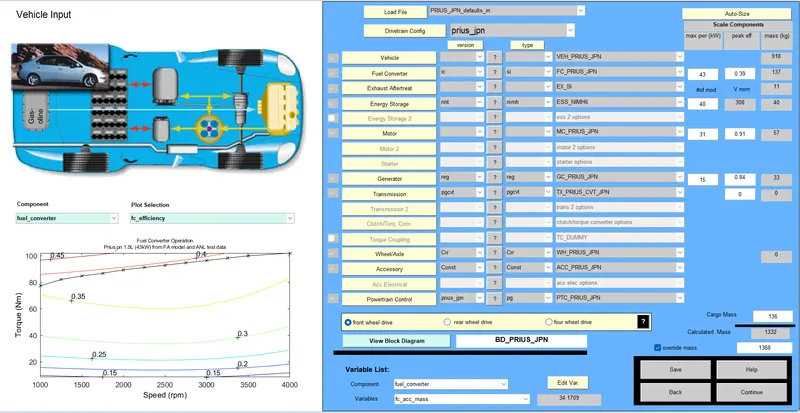 fig 3.1
Inorder to check the gradeability of the PRIUS_Jpn_defaults_in file, a UUDS cycle is selected as the drive cycle and the number of drive of drive cycle is selected as 1. As gradeability test is to be performed , so this option is selected and grade options are selected, where we need to change the option which will include both fuel and storage systems. hence we selected all system enabled and the speed option is changed on the range of our observations. here iam selecting the speeds 10,20,30,40,50 mph for a duration of 10 sec. Then it is run total of 12 km.
(1) For a speed 10 mph = 16.1 kmph :
Here, the speed in the grade options of a gradeability test is selected as 10 mph as in fig 3.2. so gradeability at 16.1 km/hr is 30.3% (fig 3.3)
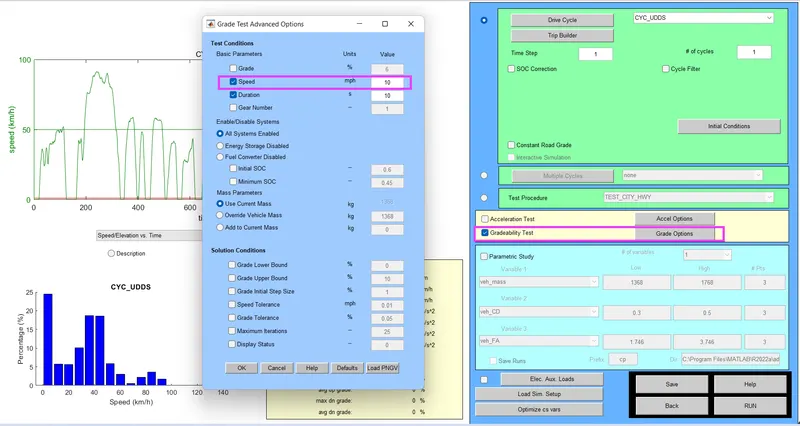 fig 3.2
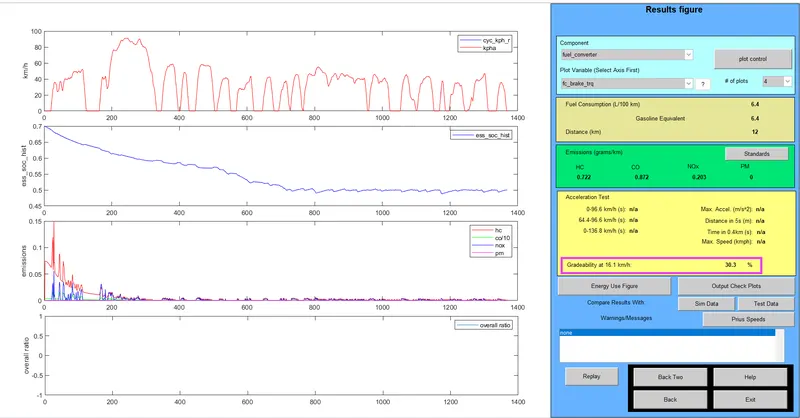 fig 3.3
(2) For a speed 20 mph = 32.2 kmph :
Here, the speed in the grade options of a gradeability test is selected as 20 mph as in fig 3.4 , so gradeability at 32.2 km/hr is 19.8% (fig 3.5)
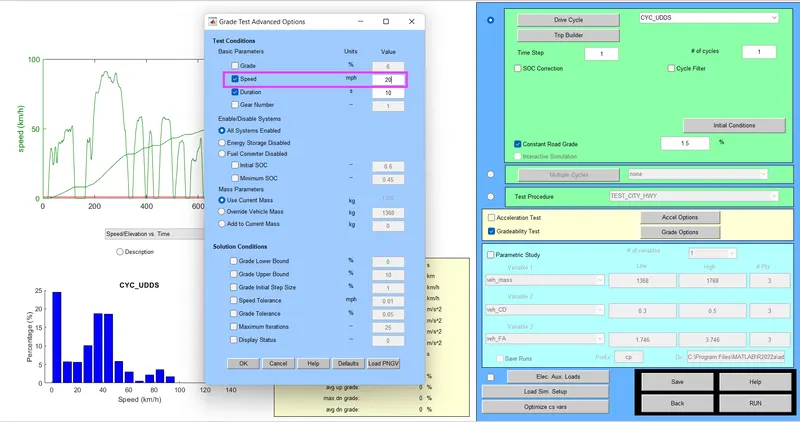 fig 3.4
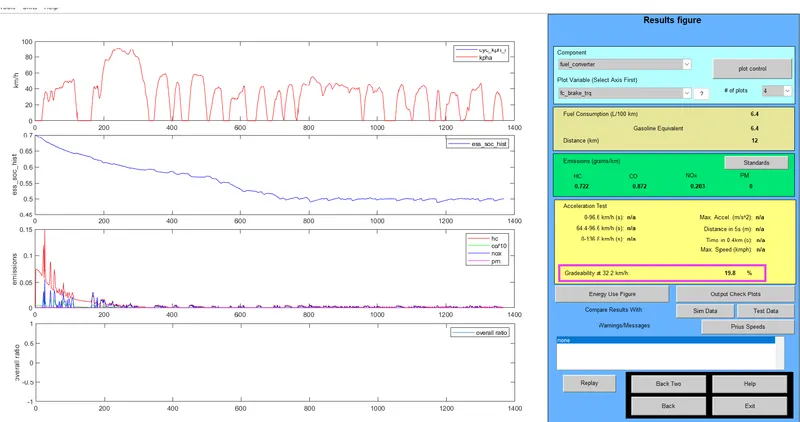 fig 3.5
(3) For a speed 30 mph = 48.3 kmph :
Here, the speed in the grade options of a gradeability test is selected as 30 mph as in fig 3.6 , so gradeability at 48.3 km/hr is 14.7% (fig 3.7)
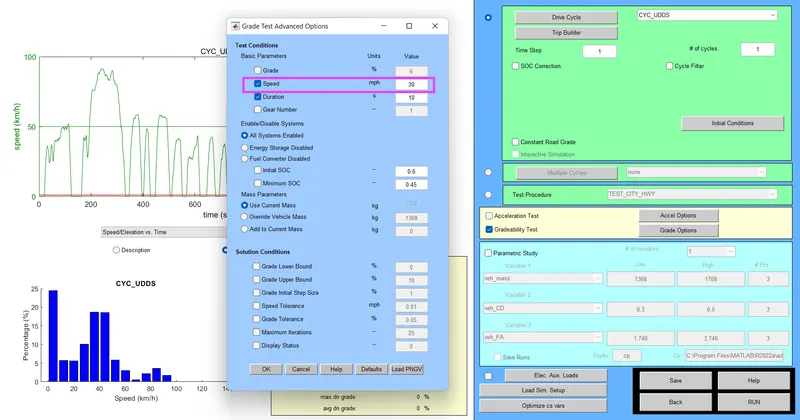 fig 3.6
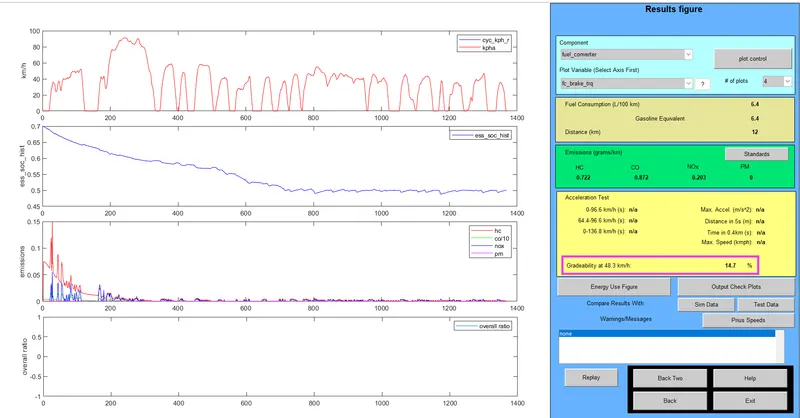 fig 3.7
(4) For a speed 40 mph = 64.4 kmph :
Here, the speed in the grade options of a gradeability test is selected as 40 mph as in fig 3.8 , so gradeability at 64.4 km/hr is 11.7% (fig 3.9)
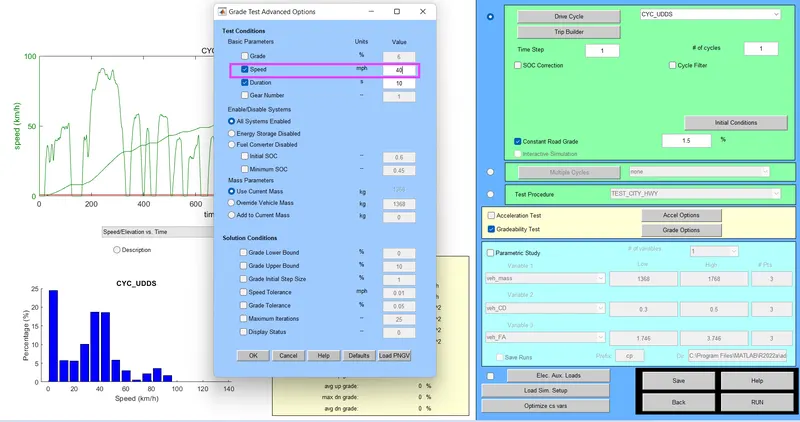 fig 3.8
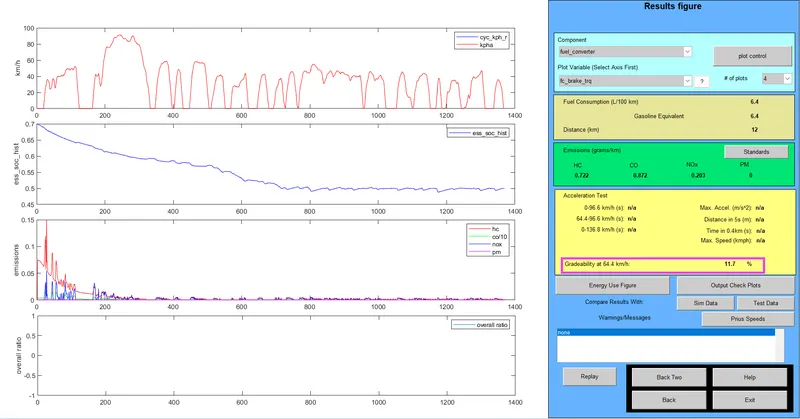 fig 3.9
(5) For a speed 50 mph = 80.5 kmph :
Here, the speed in the grade options of a gradeability test is selected as 50 mph as in fig 3.10 , so gradeability at 80.5 km/hr is 9.7% (fig 3.11)
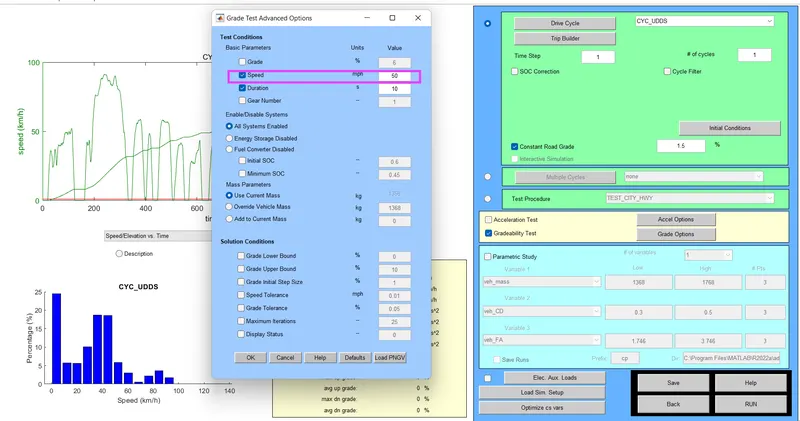 fig 3.10
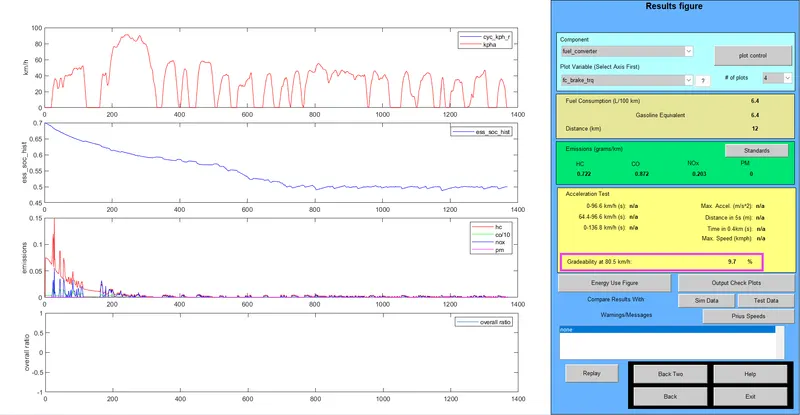 fig 3.11
| SL.NO | SPEED (in mph) | SPEED (in kmph) | GRADEABILITY (in %) |
| 1 | 10 | 16.1 | 30.3 |
| 2 | 20 | 32.2 | 19.8 |
| 3 | 30 | 48.3 | 14.7 |
| 4 | 40 | 64.4 | 11.7 |
| 5 | 50 | 80.5 | 9.7 |
CONCLUTION :
From the above table, it is seen that gradeability decreases with the increase in speed. So in our observation, the gradeability will be highest at 10 mph and lowest at 50 mph.