Week-3 Challenge: ADVISOR Tool
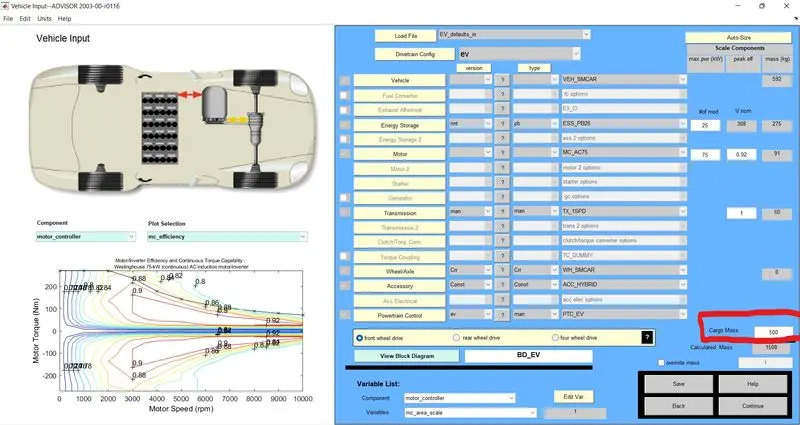
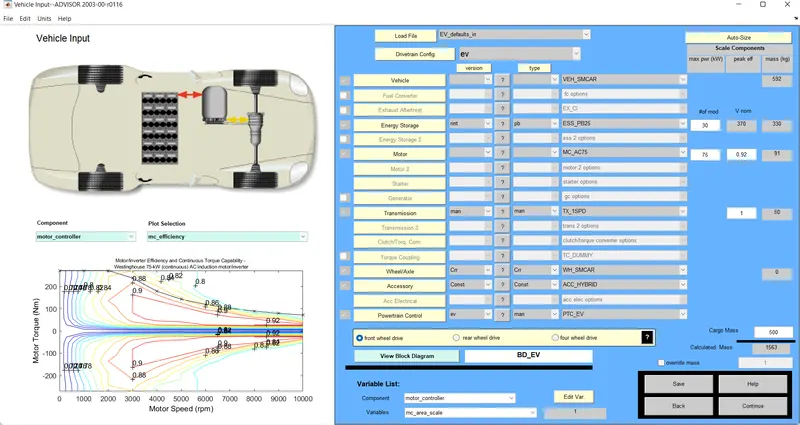
EV_default_in is a fully Electric vehicle. where, in the vehicle module battery and the motor is available as a source of energy and drivetrain respectively.
Specifications of the EV_default_in:
Vehicle Type: VEH_SMCAR
Weight: 552 kg
Energy storage :
Version : rint (internal resistance type)
Type: pb (lead acid battery) ESS_PB25
Modules of Battery: 25
Voltage of Battery: 308V
Weight: 275
Motor(MC_AC75):
Max. power: 75kw
Efficiency: 92%
Weight: 91kg
Transmission(TX_1SPD): Manual
Cargo mass : 500kg
Total mass of the vehicle : 1508 kg
The vehicle has front wheel drive The Internal view/block diagram of a Vehicle:
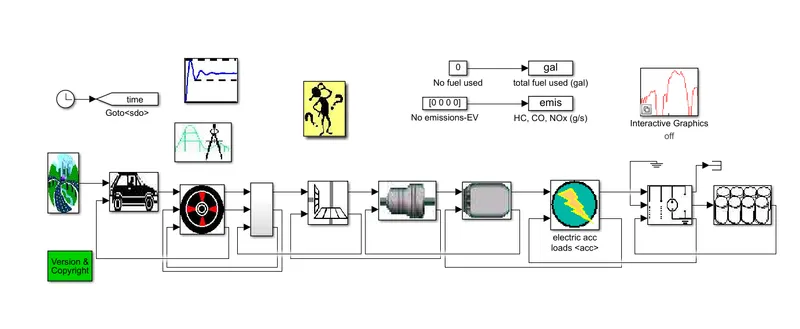
This block diagram is based upon the real time data feeder in terms of lookup table. It consists of a drive cycle, vehicle, wheel and axle, gear box, motor, electric acceleration loads, power bus and batteries modules. There are no inbuilt models of MATLAB.
FTP (Federal Test Procedure) drive test:
A driving cycle is a set of data points which represents the speed of a vehicle versus time. These are produced by different countries to assess the performance of vehicles in various ways, as for instance fuel consumption, electric vehicle autonomy and polluting emissions. FTP drive cycle is used for emission certification and fuel economy testing of light-duty vehicles in the United States. FTP is a varient of EPA Urban Dynamometer Driving Schedule (UDDS). This drive cycle consists following segments
- Cold start transient phase (ambient temperature 20-30°C), 0-505 s,
- Stabilized phase, 506-1372 s,
- Hot soak (min 540 s, max 660 s),
- Hot start transient phase, 0-505 s
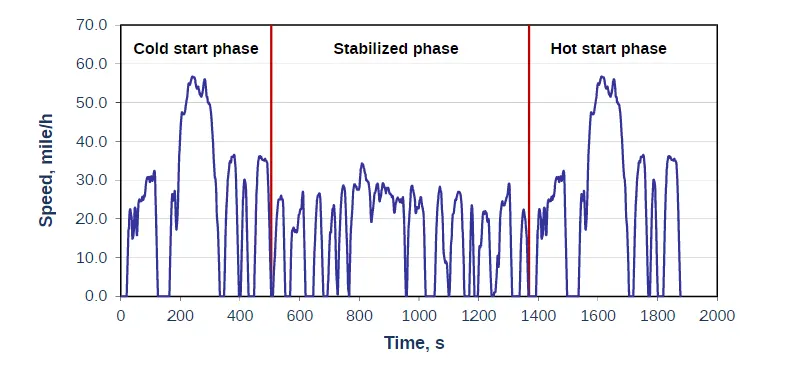
One FTP drive cycle consists of following parameters:
- Duration: 1877 s
- Distance traveled: 17.77 km
- Average speed: 34.12 km/h
- Maximum speed: 91.25 km/h
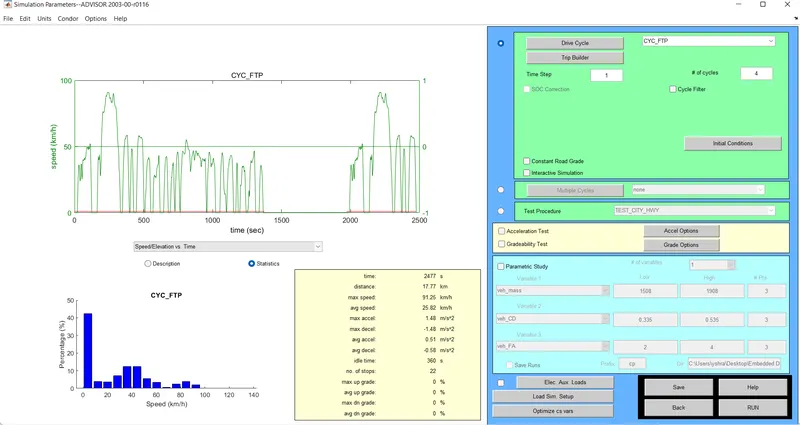
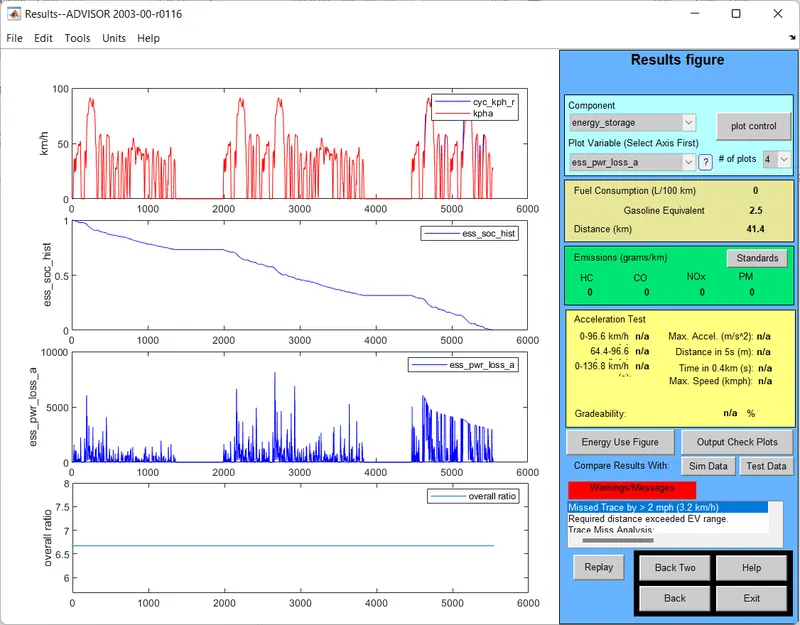
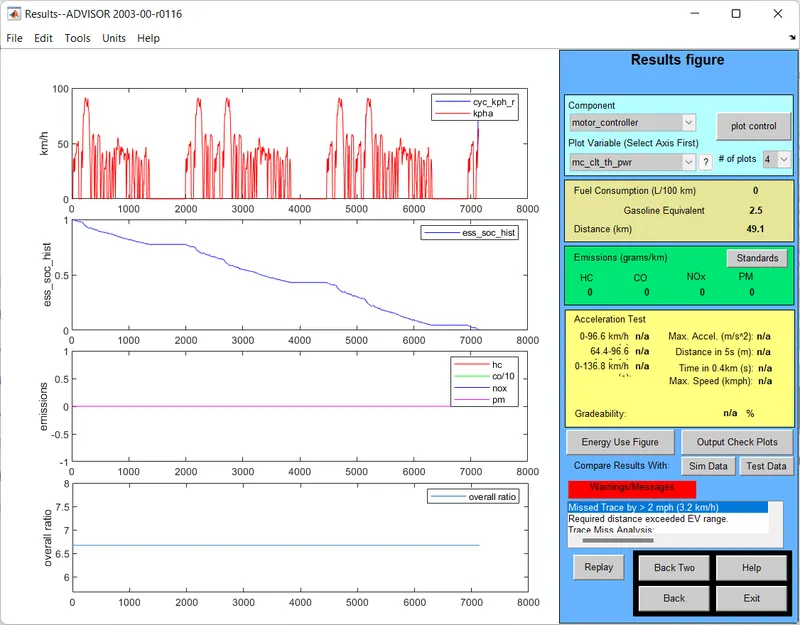
FTP one drive cycle is 17.77km long so max 4 FTP drive cycles are required to drain SOC (state of charge) to completely zero.Here drive cycle statistics plot shows that for 40% of the drive cycle vehicle has speed in between 0 to 10 kmph. Only for 0.1% the vehicle speed was at max. speed.
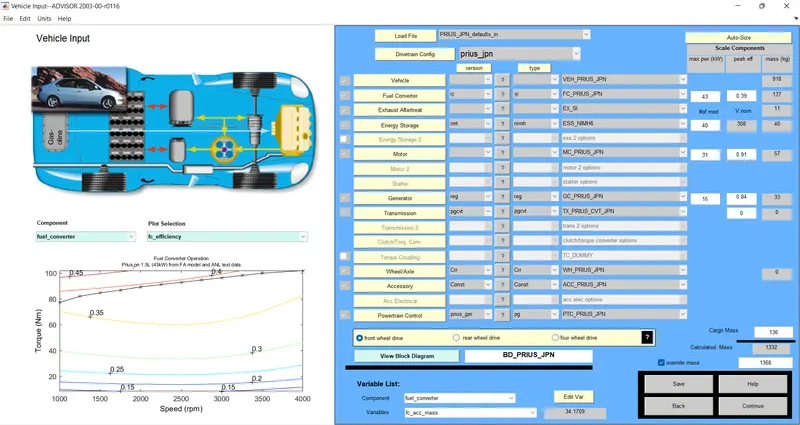
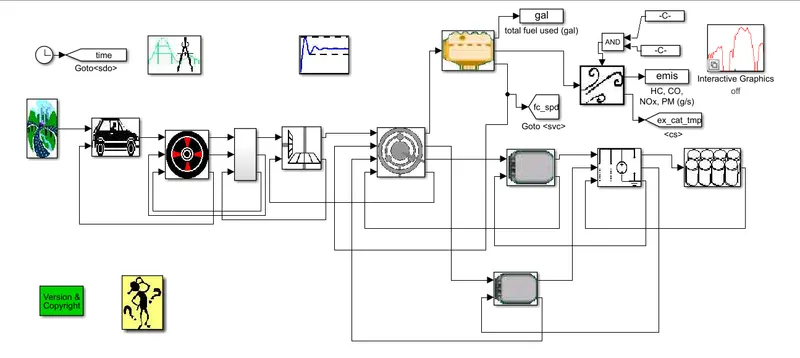
Vehicle Type: VEH_PRIUS_JPN
Weight: 918 kg
Fuel Converter(FC_PRIUS_JPN):
Version: Internal Combustion
Type: Spark Ignition
Max. Power: 43kw
Efficiency: 39%
Weight: 137kg
Exhaust Aftertreat (EX_SI):
Weight: 11kg
Energy storage :
Version : rint (internal resistance type)
Type (ESS_NIMH6) : Nickel metal hybrid battery
Modules of Battery: 40
Voltage of Battery: 308V
Weight: 40 kg
Motor(MC_PRIUS_JPN):
Max. power: 31kw
Efficiency: 91%
Weight: 57kg
Generator(GC_PRIUS_JPN): Regular
Max. power: 15kw
Efficiency: 84%
Weight: 33kg
Transmission(TX_PRIUS_CVT_JPN): CVT
Cargo mass : 136kg
Total mass of the vehicle : 1332kg
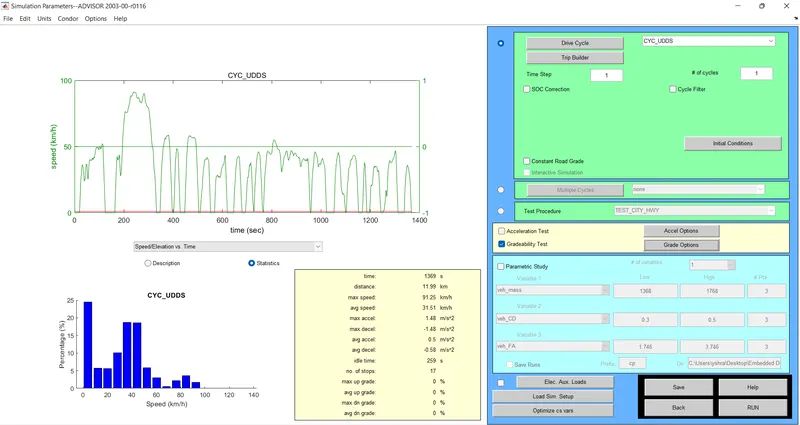
In this simulation by default the one drive cycle UDDS is used. To check the gradiability response enable the gradeability test option. Here keep gradeability constant as 6%. Vary the speed and run the gradeability test for 10 sec to see the result.
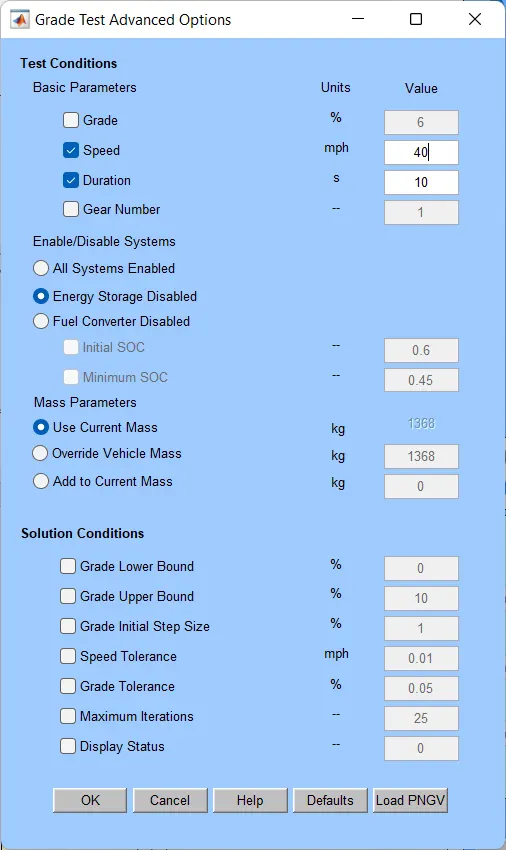
In the above figure speed is 40 mph i.e. 64.4 km/h this speed will have the 2.5% greadability.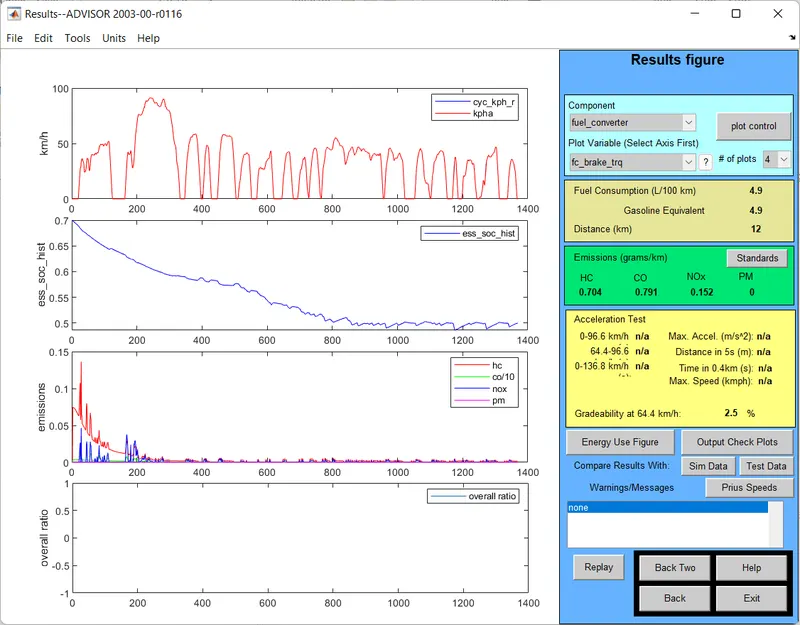
Similarly gradeability test is taken for following speeds.
| Speed(mph) | Speed(km/h) | Gradeability(%) |
| 40 | 64.4 | 2.5 |
| 45 | 72.4 | 2.2 |
| 50 | 80.5 | 2 |
| 55 | 88.5 | 1.7 |
| 60 | 96.6 | 1.5 |
As the speed of vehicle increses the Gradeability decreases.