Introduction to HEV using MATLAB and SIMULINK: ADVISOR Tool (#03)
AIM:
The aim of this challenge is to explore the basic funtionalities of the 2002 ADVISOR tool kit available in MATLAB.
OBJECTIVES:
1. To find whether an electric vehicle, with a cargo mass of 500kg, can travel for 45 km in the FTP (Federal Test Procedure) test drive cycle using standard ADVISOR tool settings.
2. To re-run the above simulation with altered battery capacities.
3. To peform a gradeability test on a Toyota Prius.
ADVISOR Simulation Tool for Vehicle Evaluation and Testing:
The U.S. Department of Energy (DOE) and the National Renewable Energy Laboratory (NREL) have worked with industry partners to develop a sophisticated systems analysis tool that can answer crucial questions about specific component and vehicle designs. ADVISOR (Advanced Vehicle Simulator) is a model written in the widely used MATLAB/Simulink software environment. It can be used to simulate and analyze conventional, advanced, light and heavy vehicles, including hybrid electric and fuel cell vehicles.
ADVISOR tests the effect of changes in vehicle components (such as motors, batteries, catalytic converters, climate control systems, and alternative fuels) or other modifications that might affect fuel economy, performance, or emissions.
Benefits of ADVISOR Tool:
• Reduces testing time to evaluate various vehicle powertrain alternatives
• Provides a shared simulation tool for government and industry
• Assists the automotive industry to develop fuel-efficient vehicles and
components
For more information visit: https://www1.eere.energy.gov/vehiclesandfuels/pdfs/success/advisor_simulation_tool.pdf
STUDY 1:
To find whether an electric vehicle, with a cargo mass of 500kg, can travel for 45 km in the FTP (Federal Test Procedure) test drive cycle using standard ADVISOR tool settings.
Step 1: We load up the AVDVISOR tool for an electric drivetrain with default configurations with the cargo mass set as 500kg
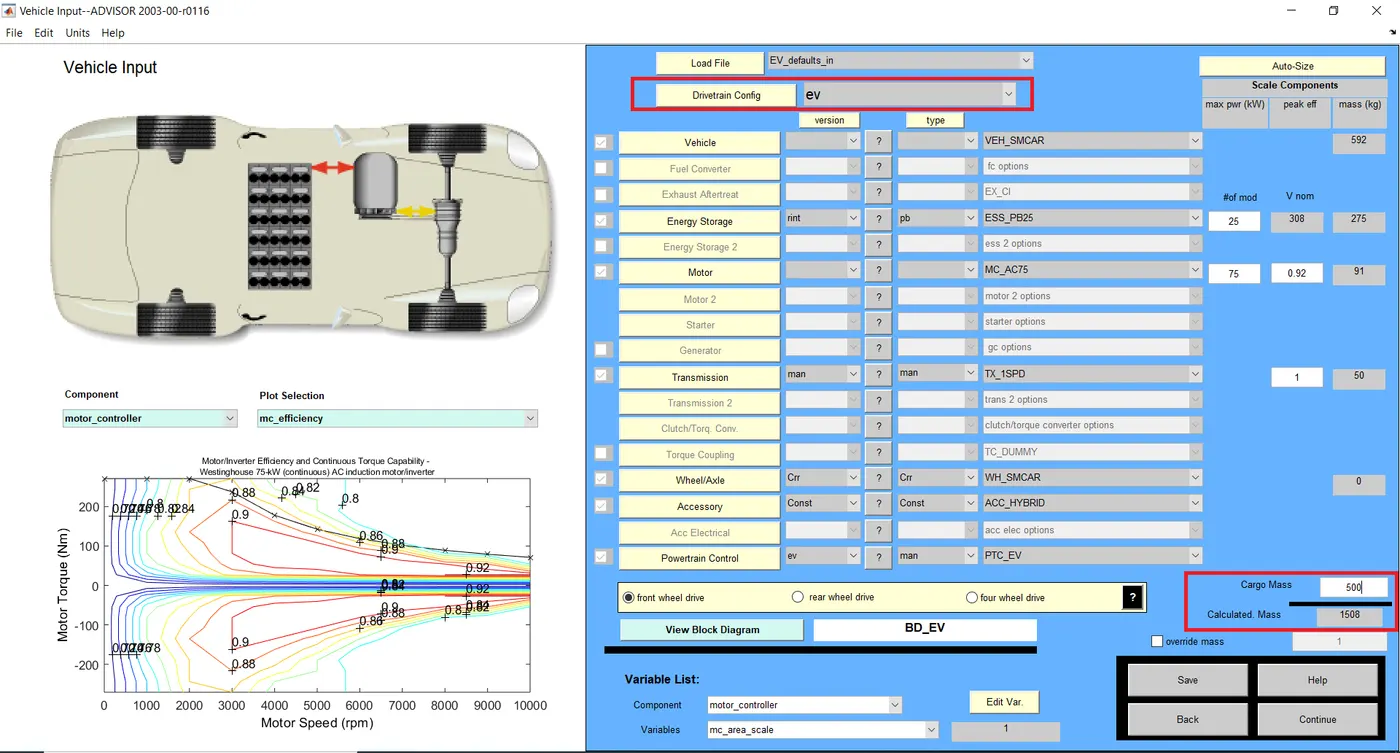
Thus we would be simulating a vehicle with the following specifications:
1) Drivetrain: Electric Vehicle
2) Energy Storage: Lead-Acid Battery (25 modules with nominal volatge of 308V; weight= 275kg)
3) Motor: 75kW with peak efficiency of 92%
4) Transmission: Front wheel drive with manual transmission
Step 2: We set the drive cycle to CYC_FTP (Federal Test Procedure). Since the FTP covers a distance of 17.77km we would need to simulate the car for a minimum of 3 drive cycles to find weather the vehicle meets the criterion. 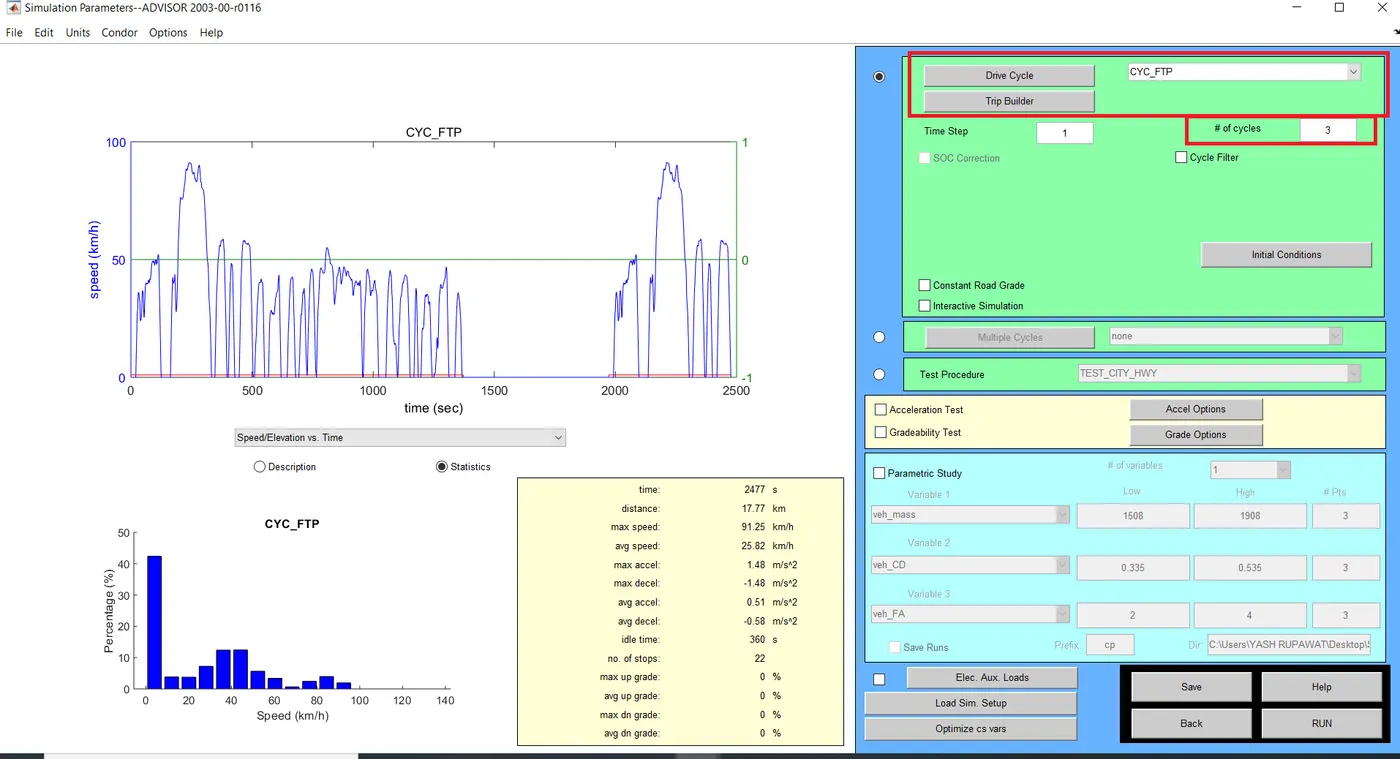
Step 3: We analyze the results: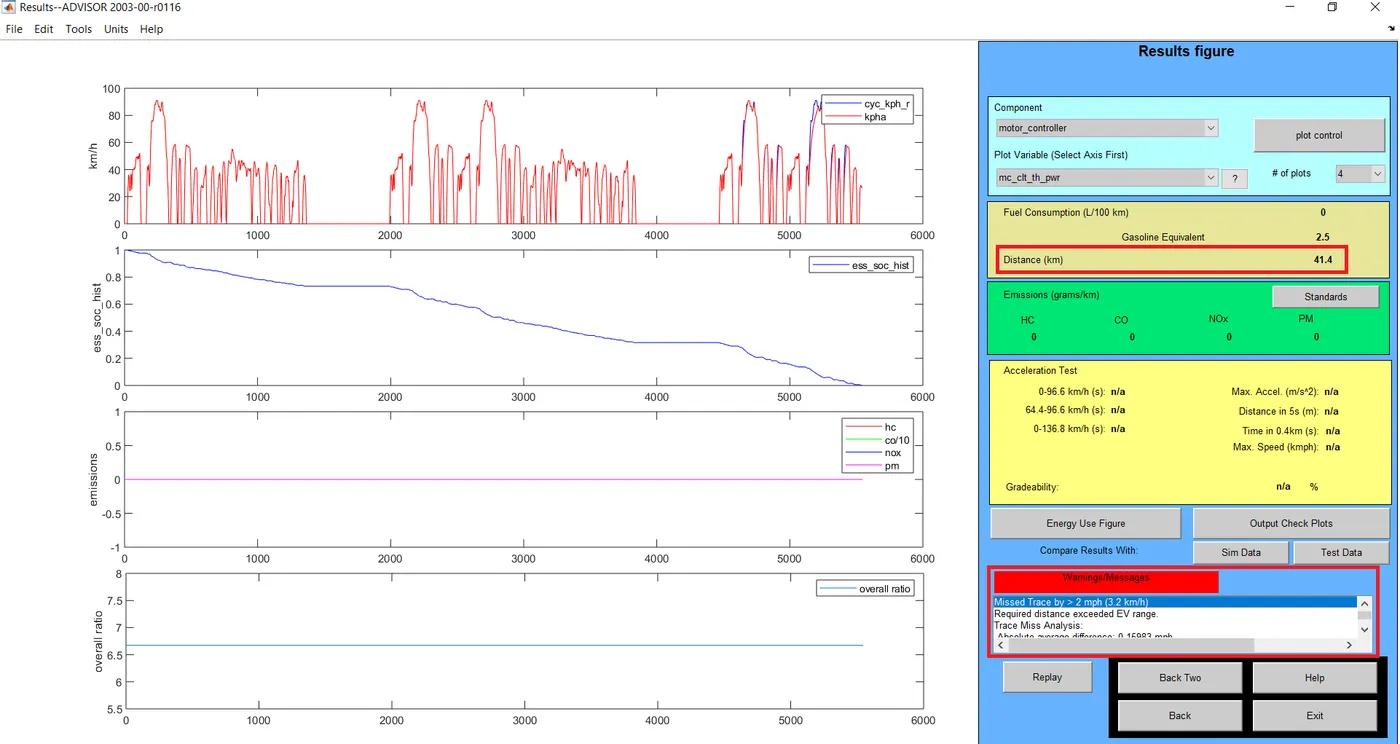
Results:
We find that the maximum range of the electric vehicle is 41.4km (~2.532 CYC_FTP)
STUDY 2:
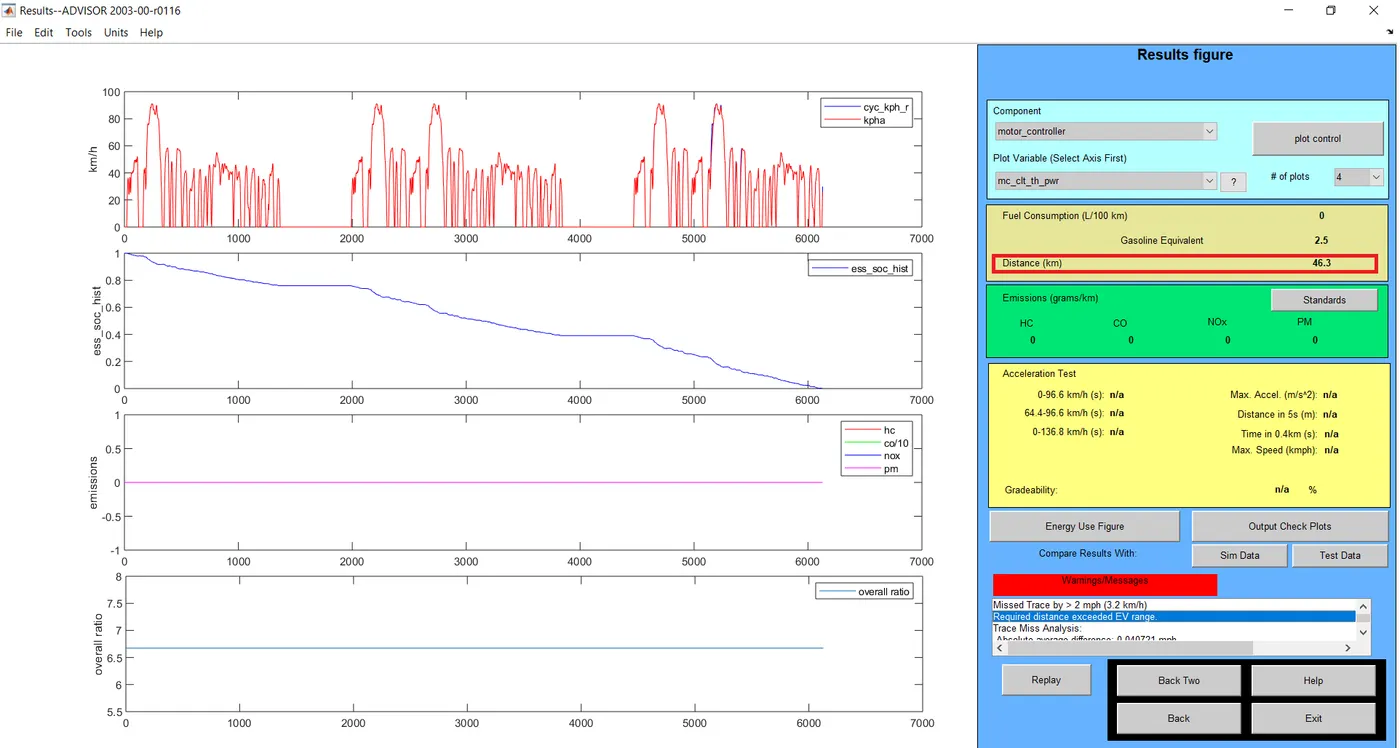
In this study we re-run the above simulation with altered battery capacities to meet the requirements:
Steps: We run the test iteratively for every unit increase in number of battery capacities.
Result: We find that we reach the requiremnets if we have 28 modules with a nominal voltage of 345V.
STUDY 3:
In this study we peform a gradeability test on a Toyota Prius using the ADVISOR tool. The grade test routine in ADVISOR will determine the maximum grade on which the vehicle can sustain the specified constant speed.
If when calling the grade test, the user specifies both the speed and grade, the grade test routine will only evaluate that point. If the vehicle is able to maintain the specified speed and grade it will return the grade otherwise it will return and empty set. If only the speed is specified by the user when calling the grade test it will find the maximum sustainable grade at this speed for the vehicle and return that grade.
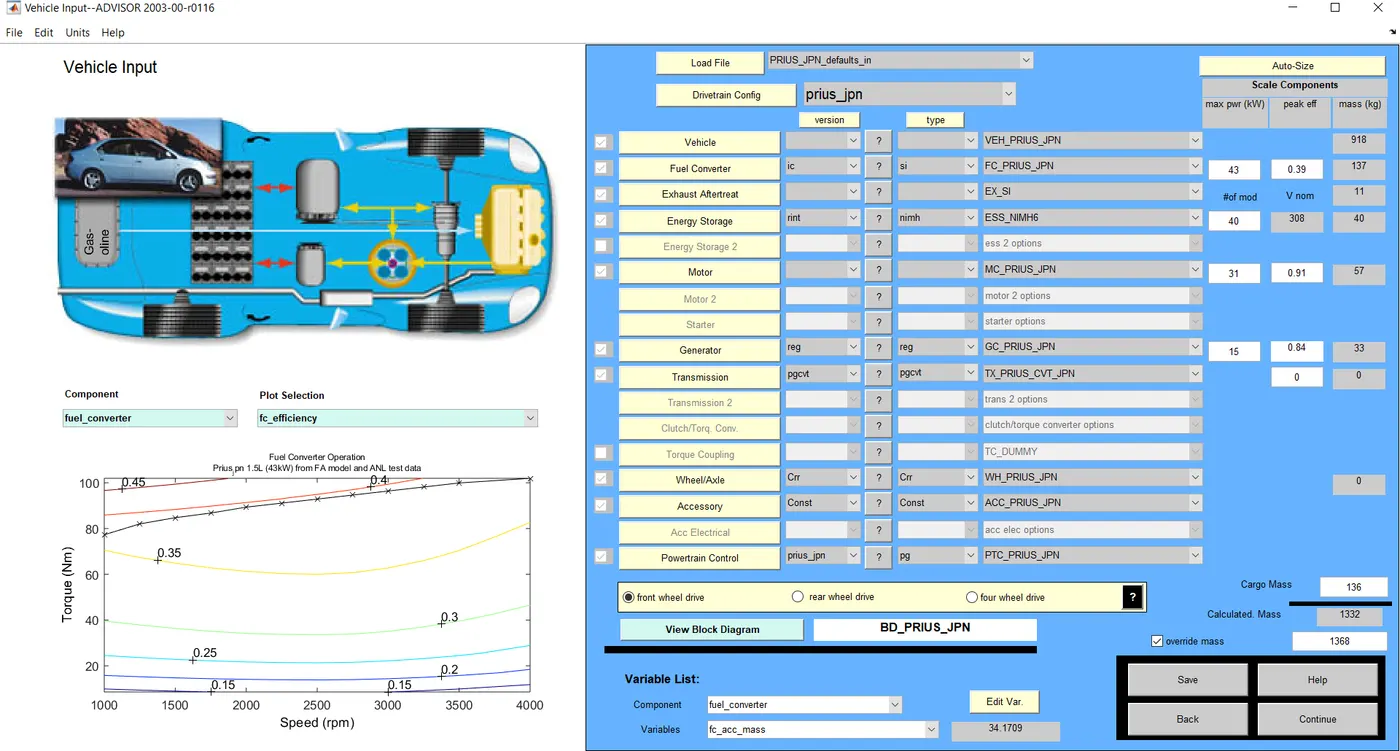
Step 1: We load the prius_jpn drivetrain configration provided by NREL with the tool.
Thus we would be simulating a vehicle with the following specifications:
1) Drivetrain: Parallel Hybrid Electric Vehicle
2) Energy Storage: Nickel Metal Hydride (40 modules with nominal volatge of 308V; weight= 40kg)
3) Motor: 31kW with peak efficiency of 57%
4) Engine: 43kW with peak efficiency of 39%
5) Transmission: Front wheel drive with planetary gear continuously variable transmission (pgcvt)
6) Generator: 15kW with peak efficiency of 33%
The PRIUS leverages a power split device that connects the engine, generator and electric motor together. It allows the car to operate like a parallel hybrid -- the electric motor can power the car by itself, the gas engine can power the car by itself or they can power the car together. The power split device also allows the car to operate like a series hybrid -- the gasoline engine can operate independently of the vehicle speed, charging the batteries or providing power to the wheels as needed. It also acts as a continuously variable transmission, eliminating the need for a manual or automatic transmission. Finally, because the power split device allows the generator to start the engine, the car does not need a starter.
Step 2:
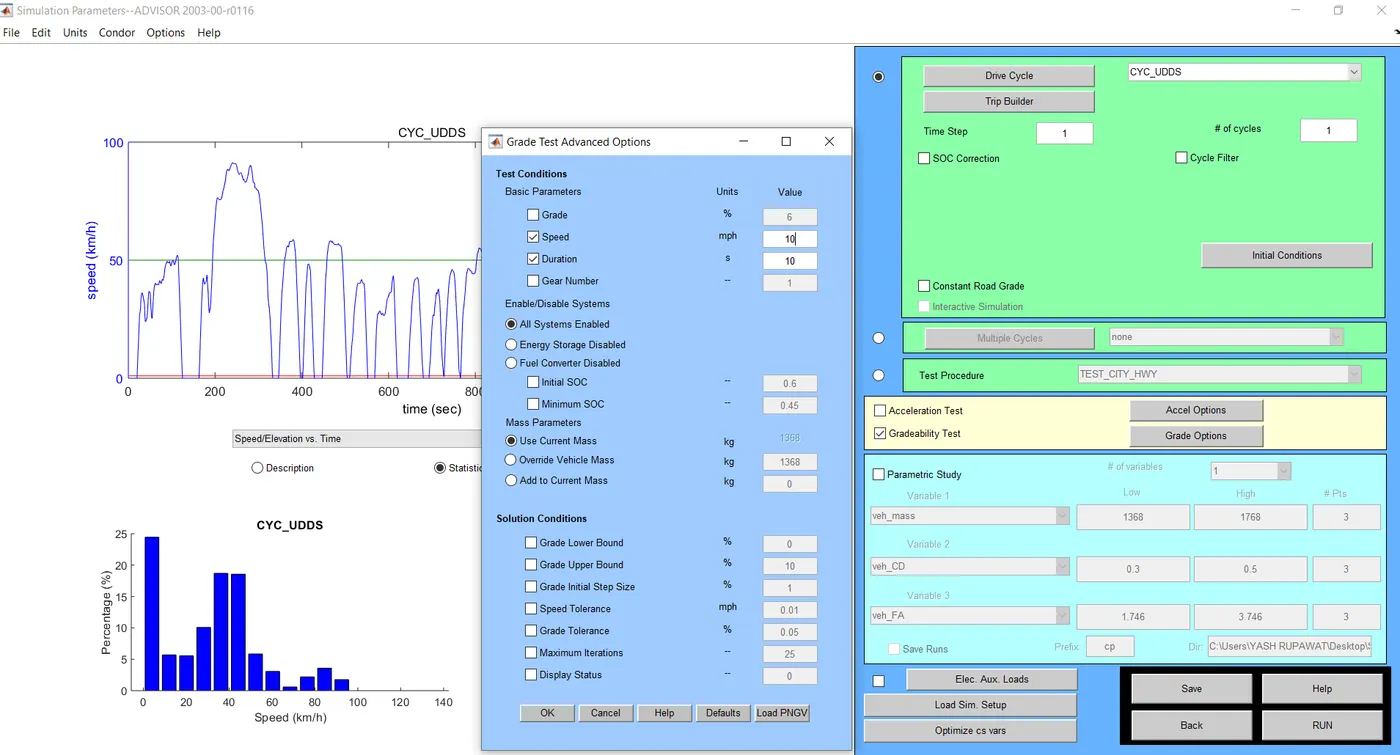
We select the gradeability test and open the grade options tab. We select all systems enables which will maxiize throttle at that speed giving us the absolute maximum gradeability for the vehicle in the real world. We iteratively run the simulation at different speeds to find the maximum gradeability for a vehicle at that speed for 10s.
Results:
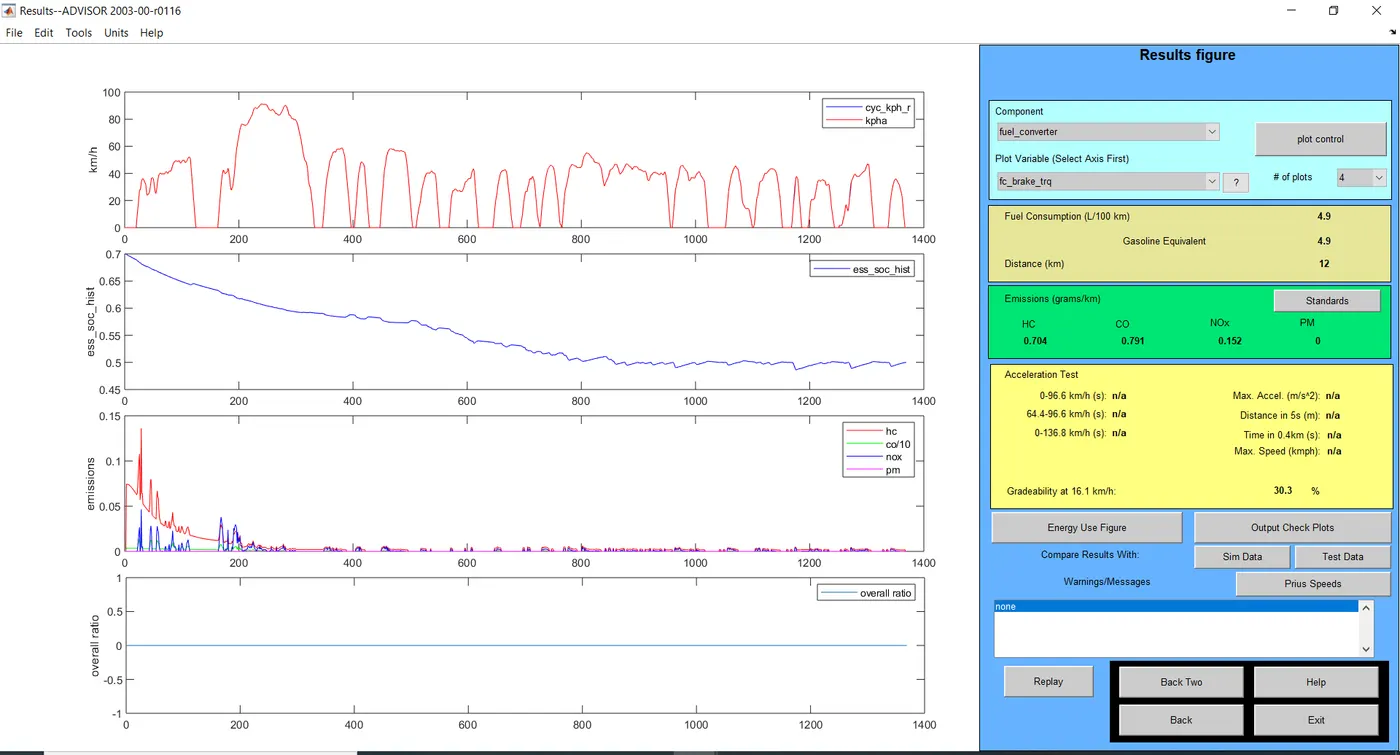
The results for different speeds are tabulated below:
| Speed (mph) | Gradeability (%) |
| 10 | 30.3 |
| 20 | 19.8 |
| 30 | 14.7 |
| 40 | 11.7 |
| 50 | 9.7 |
| 60 | 8.1 |
| 70 | 6.3 |
| 80 | 4.5 |
| 90 | 2.8 |
| 100 | 1.3 |
| 101 | 1.1 |
| 102 | 0.3 |
| 103 | null |
We can see that at 103mph (165.8kmph) the car can only travel on 0 gradeability roads. An important observation is that the maximum gradeability decreases with increasing speed which indicates lower torques at higher speeds.