Week 3 Challenge
- Determine the total number of possible different column configurations for separating each of the individual components in the below-mentioned composition. Explain at least 4 possible configuration
Ethane- 0.3 mol%
n-Pentane-0.2 mol%
n-Hexane – 0.2 mol%
n-Heptane-0.3 mol %
Before determining the column configurations, it is important to identify/group light-key and heavy-key components in the component list.
In order to determine the light key and heavy key component, first, determine the boiling point for each of the components and then arrange the components in the ascending order of their boiling point.
Add four streams in the simulation to determine their boiling points. The next step is arranging in ascending order. Since these are hydrocarbon components and are already in the ascending order based on their carbon count.
Select stream 1, rename it as ethane, and specify the composition as 1 and click normalise. Then go to conditions and enter the atmospheric pressure value as 101.325 kPa, mass flow rate as 1000kg/h. now enter vapour/phase fraction as 1 then the stream converges and calculates the boiling temperature as -88.73°C.
Similarly, find out the boiling points of all the four components and keep it in ascending order. The boiling points of ethane, n-pentane, n-hexane, and n-heptane are -88.73°C, 36.24°C, 69.01°C, 98.48°C.
Therefore, the ascending order for the above components boiling points is Ethane >n-pentane > n-hexane > n-heptane.
It is important to use proper fluid packages for the selected components. Peng-Robinson is used in this problem because the components are hydrocarbons.
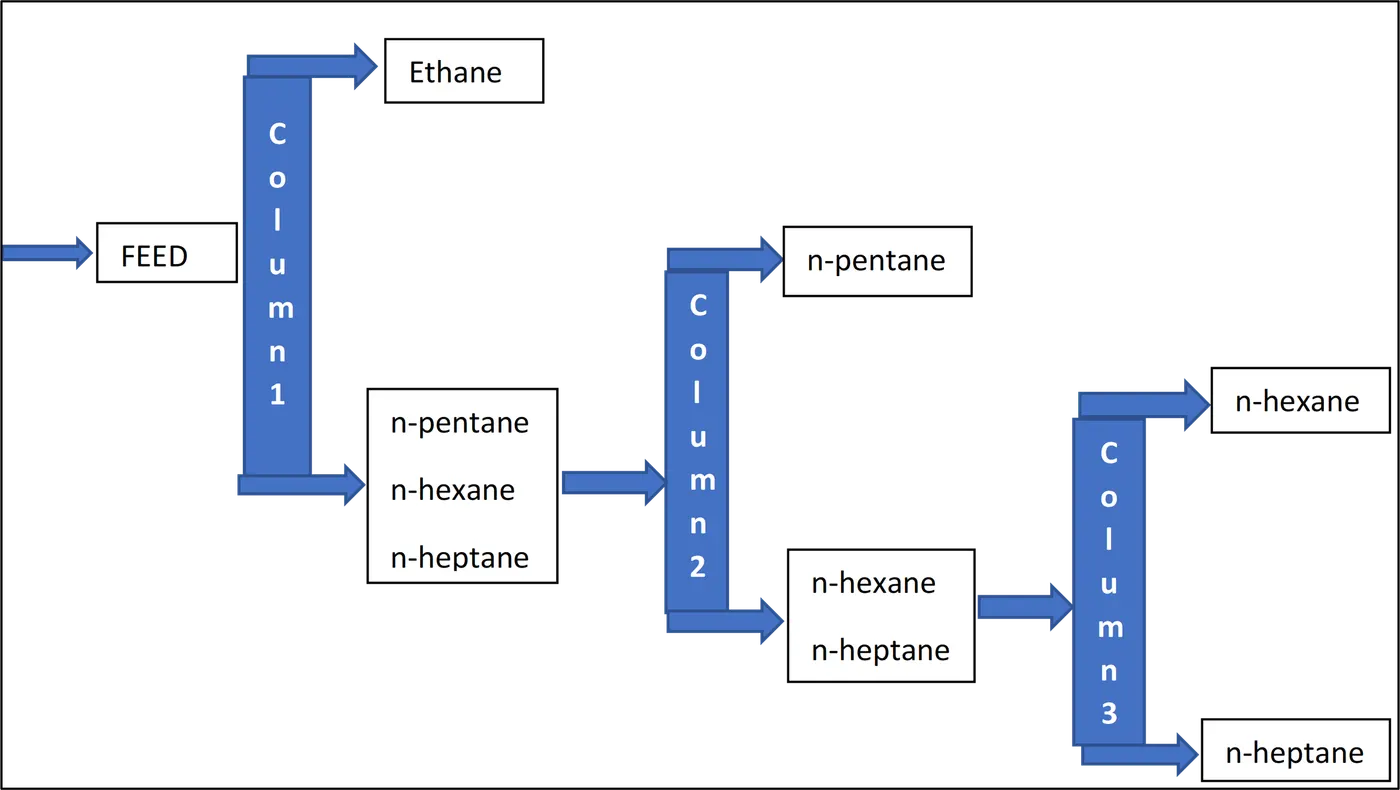
Column configuration 1:
Consider ethane as a light-key component and n-pentane as a heavy key component. In the first column, ethane will be in the distillate and all the other components in the bottom product. Based on the reflux ratio or desired purity, a small percentage of ethane will be in the bottoms and a small portion of n-pentane will be in the distillate.
In the second column, n-pentane is taken as a light-key component and the remaining components can be taken as heavy-key components. N-pentane will be in the distillate and n-hexane and n-heptane will be in the bottoms.
In the third column, n-hexane and n-heptane can be separated out as distillate and bottoms respectively.
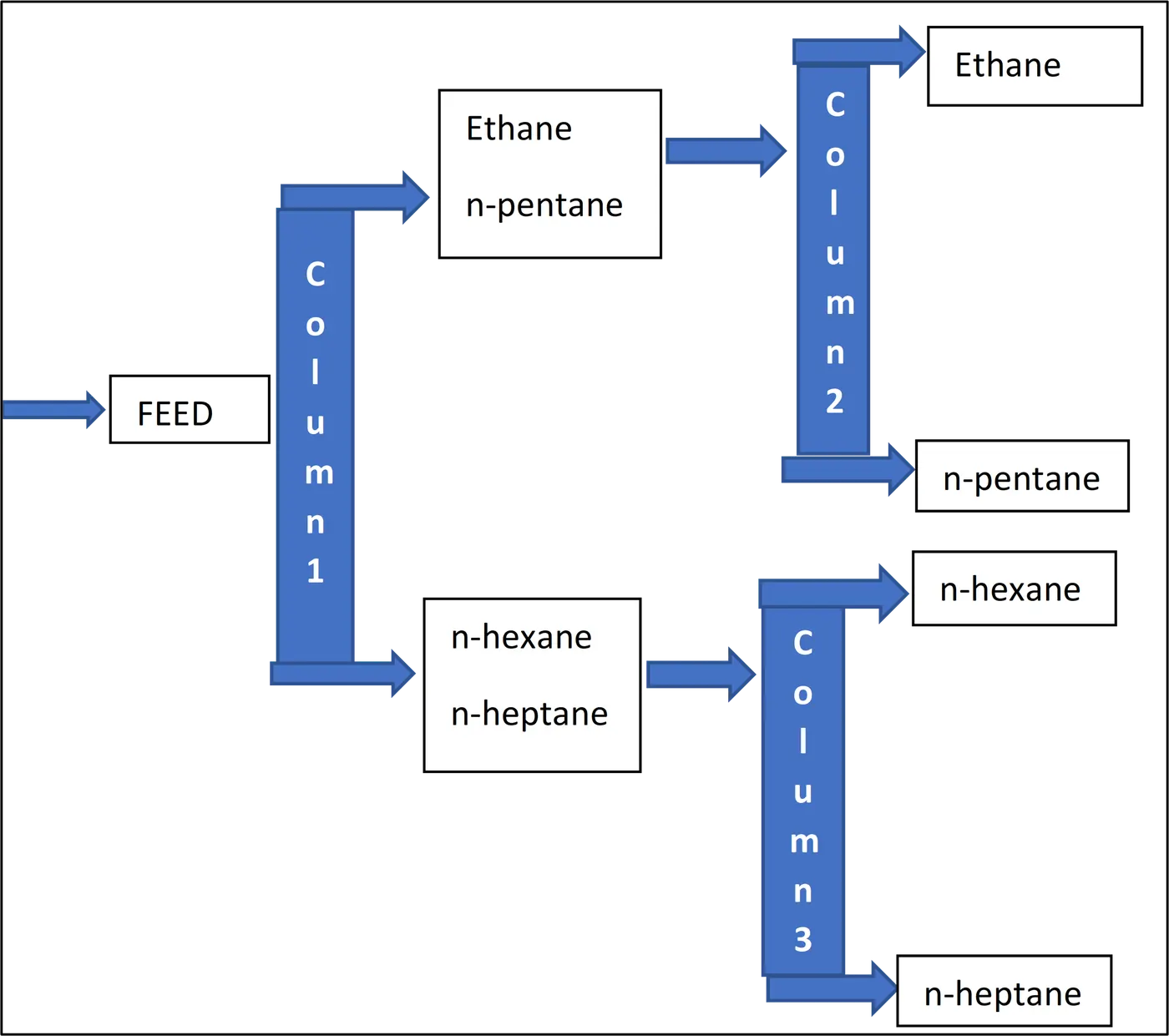
Configuration 2:
Ethane and n-pentane are considered light-key components and n-hexane and n-heptane is considered as heavy-key components.
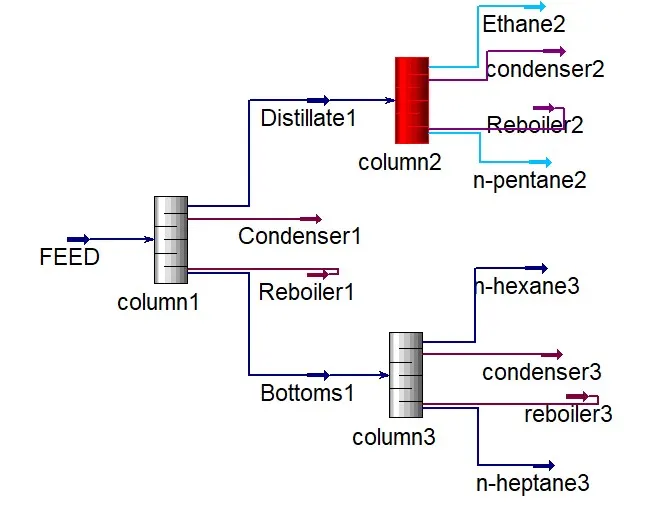
In the first column, ethane and n-pentane are separated out as a distillate and the remaining components are separated out in the bottoms. In column-2, ethane is distilled out while the n-pentane remains in the bottom product. Similarly, in column-3, n-hexane is separated out as distillate, and n-heptane is collected in the bottoms.
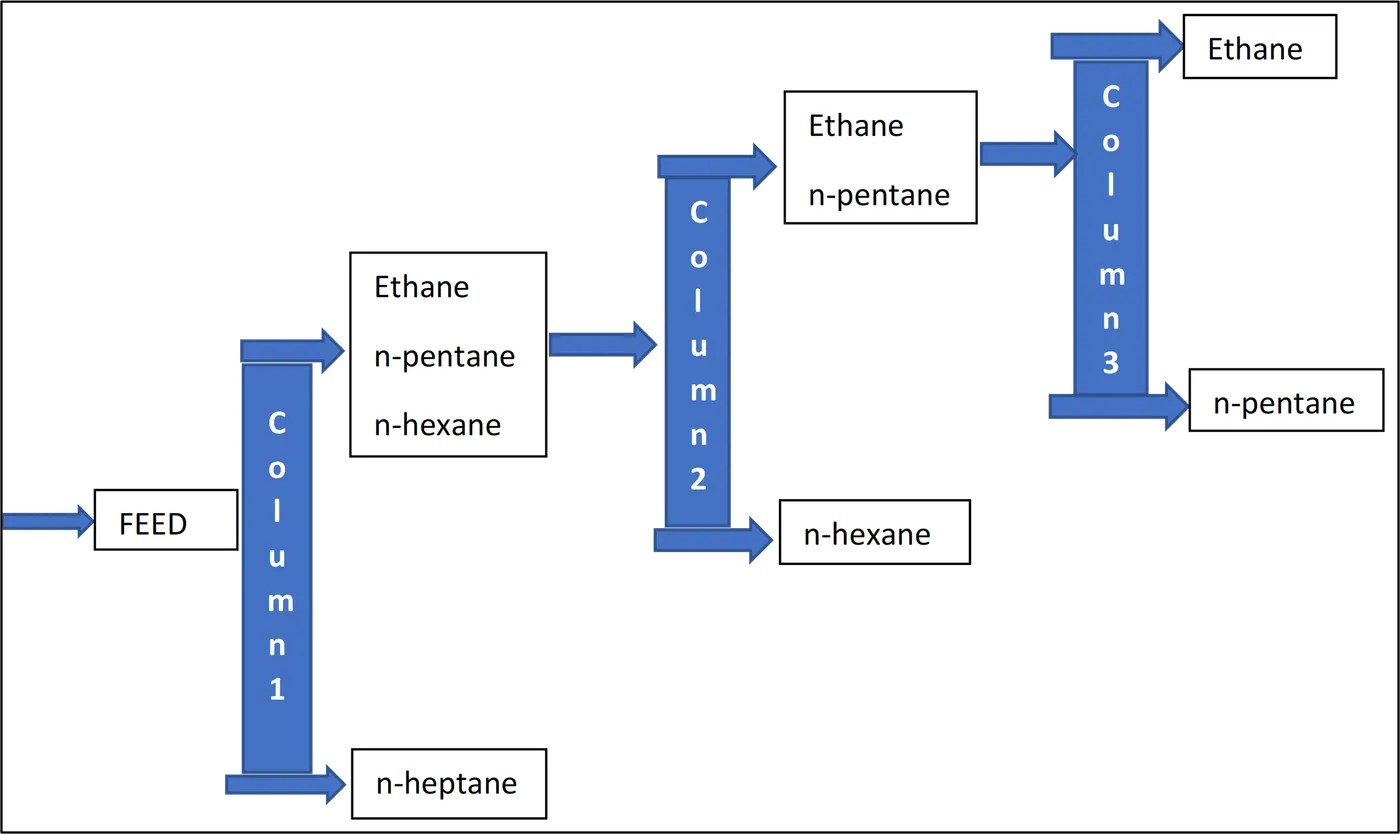
Column configuration: 3
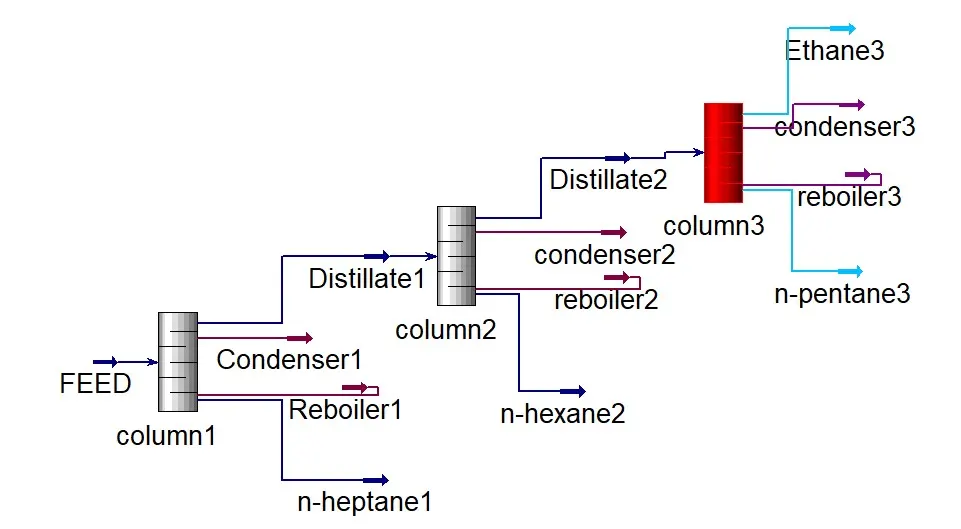
Ethane, n-pentane, and n-hexane are considered as light-key components and n-heptane is taken as a heavy-key component. Light-key components distilled out as distillate while n-heptane is taken out as the bottom product in the first column. In the second column, ethane and n-pentane are distilled in the top, and n-hexane is taken out as a bottom product. In the third column, ethane is separated out as distillate and the n-pentane is taken out as bottoms.
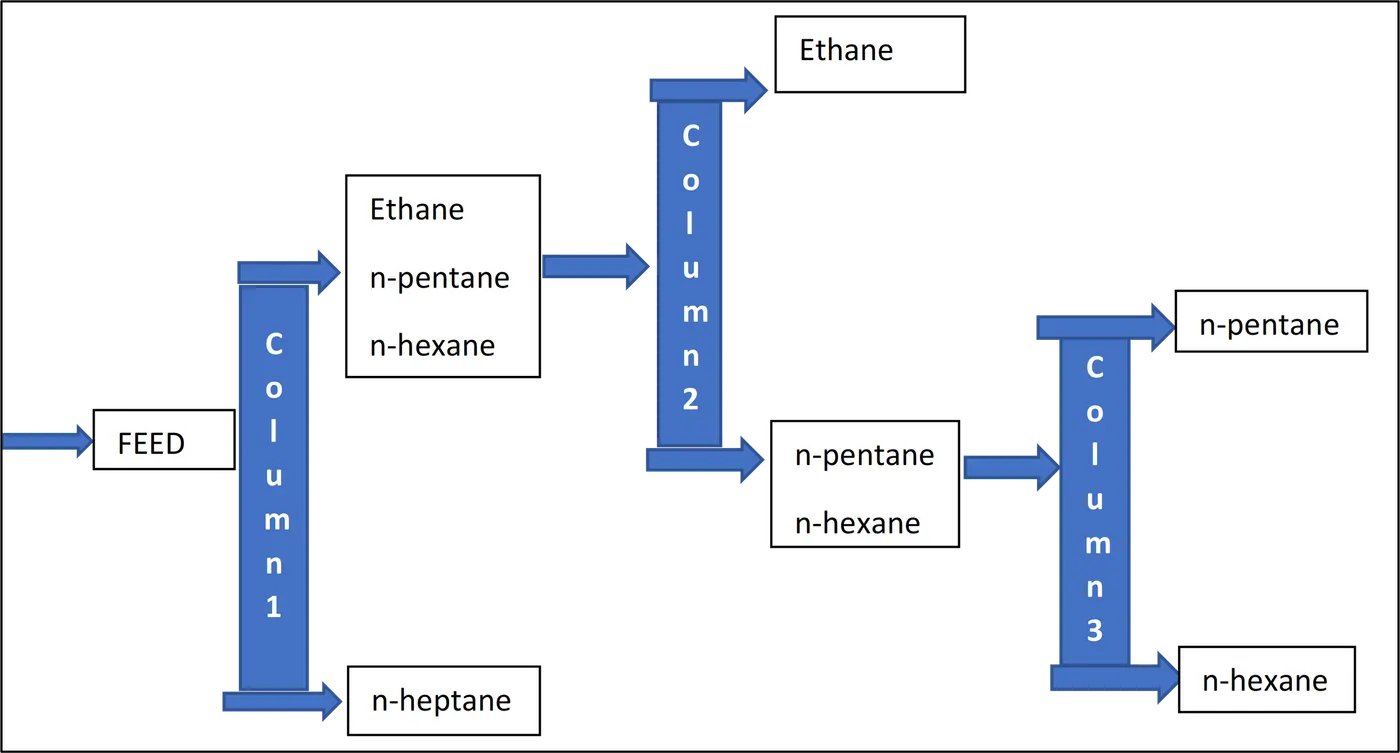
Column configuration: 4
Ethane, n-pentane, and n-hexane are considered as light-key components and n-heptane is taken as a heavy-key component. Light-key components distilled out as distillate while n-heptane is taken out as the bottom product in the first column. In the second column, ethane is taken out as distillate, and n-pentane and n-hexane are taken out as bottoms. In the third column, n-pentane is taken out as distillate while n-hexane is taken out as bottoms.
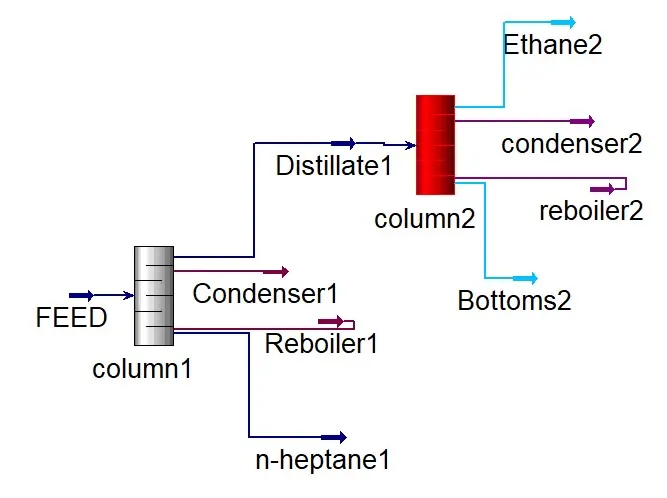
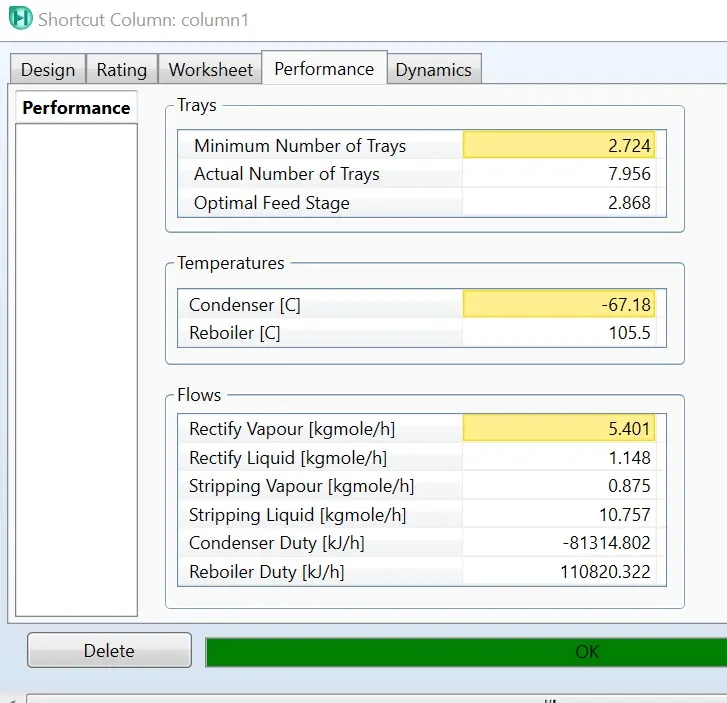
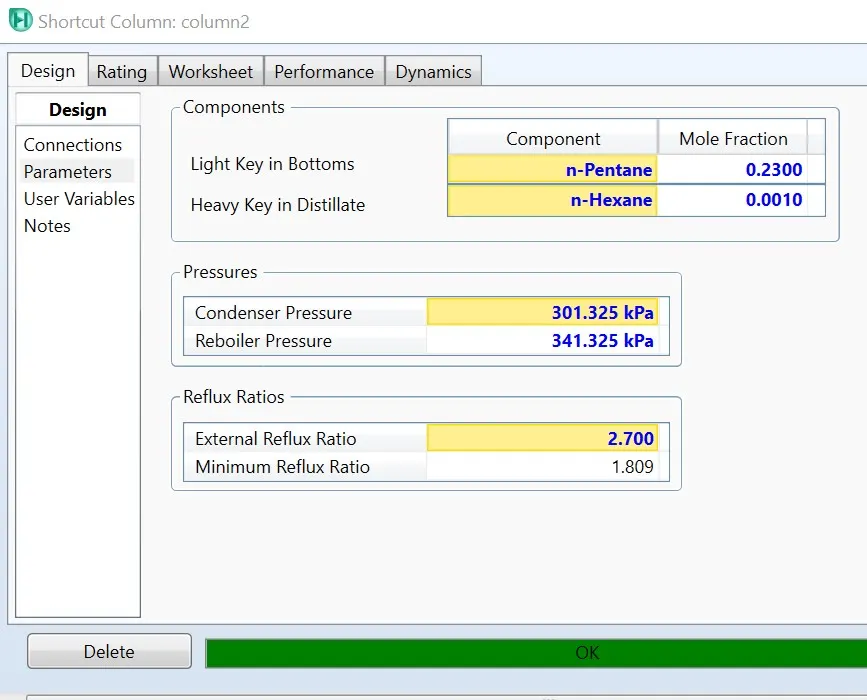
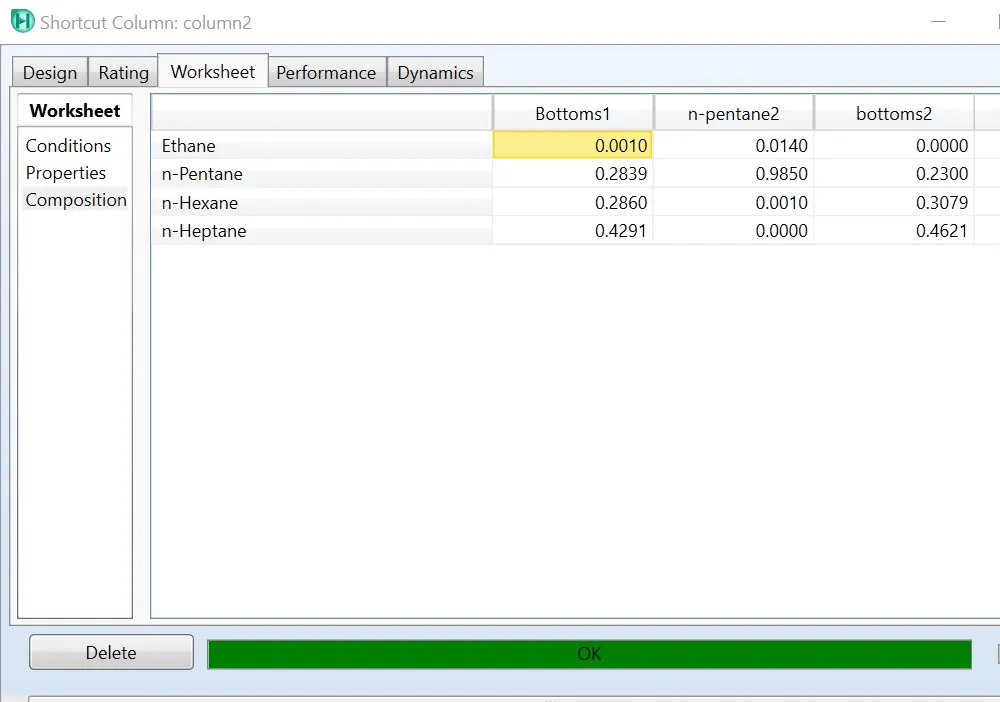
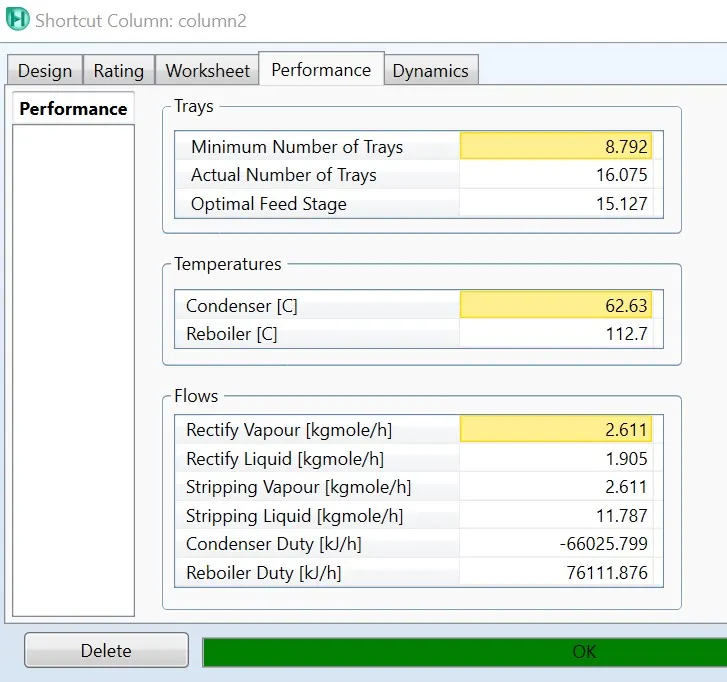
Using a short-cut column model to configuration 1 for finding out if this will be feasible to separate out the components.
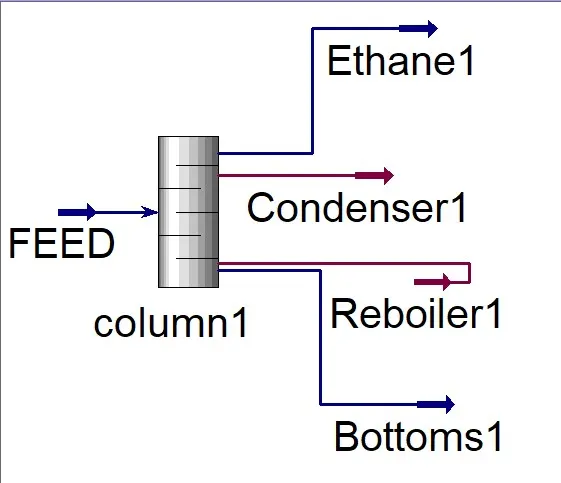
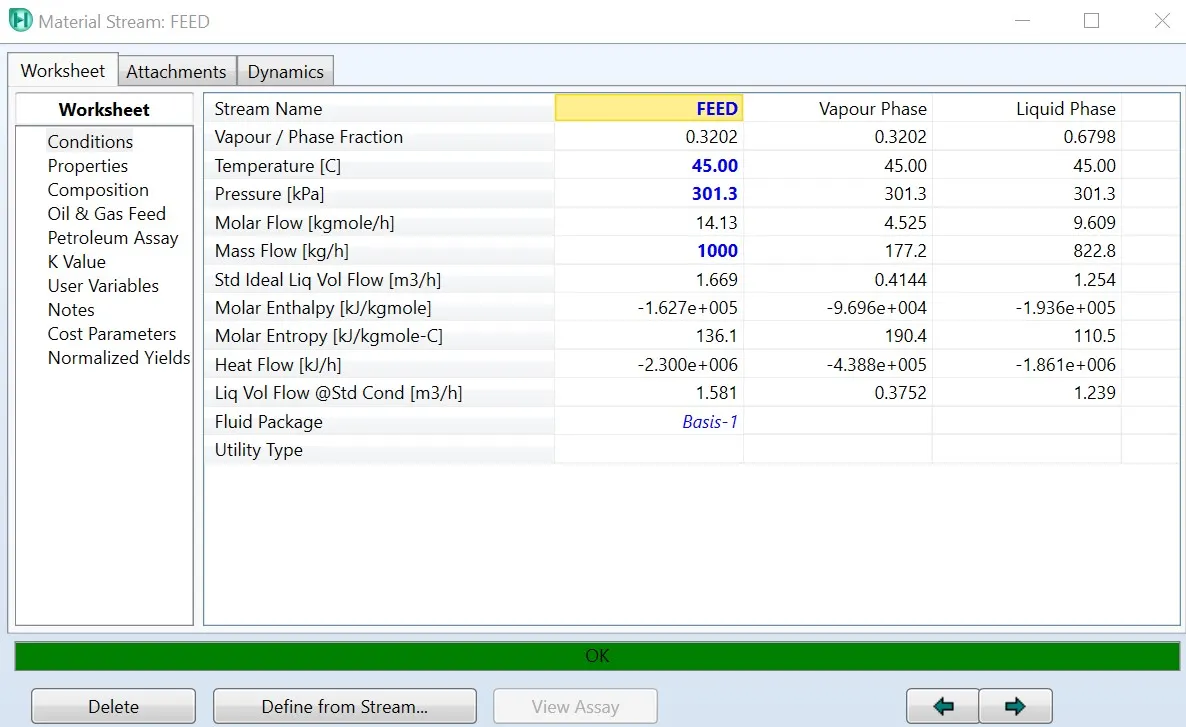
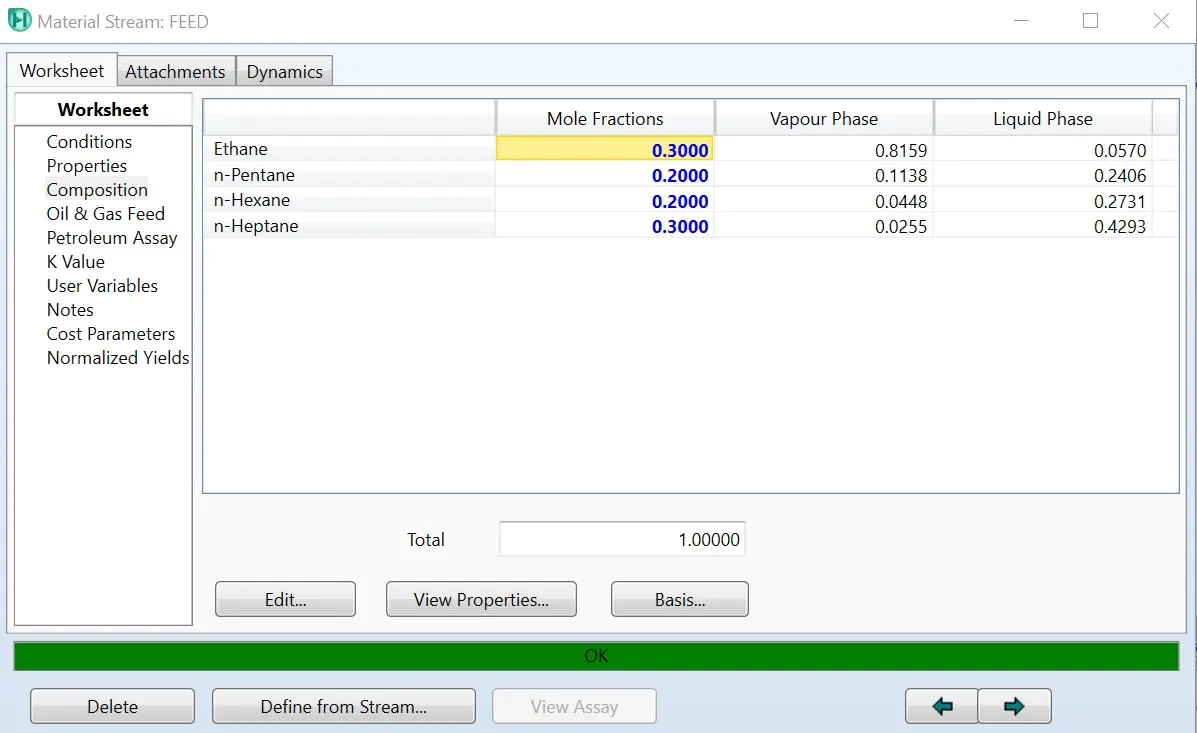
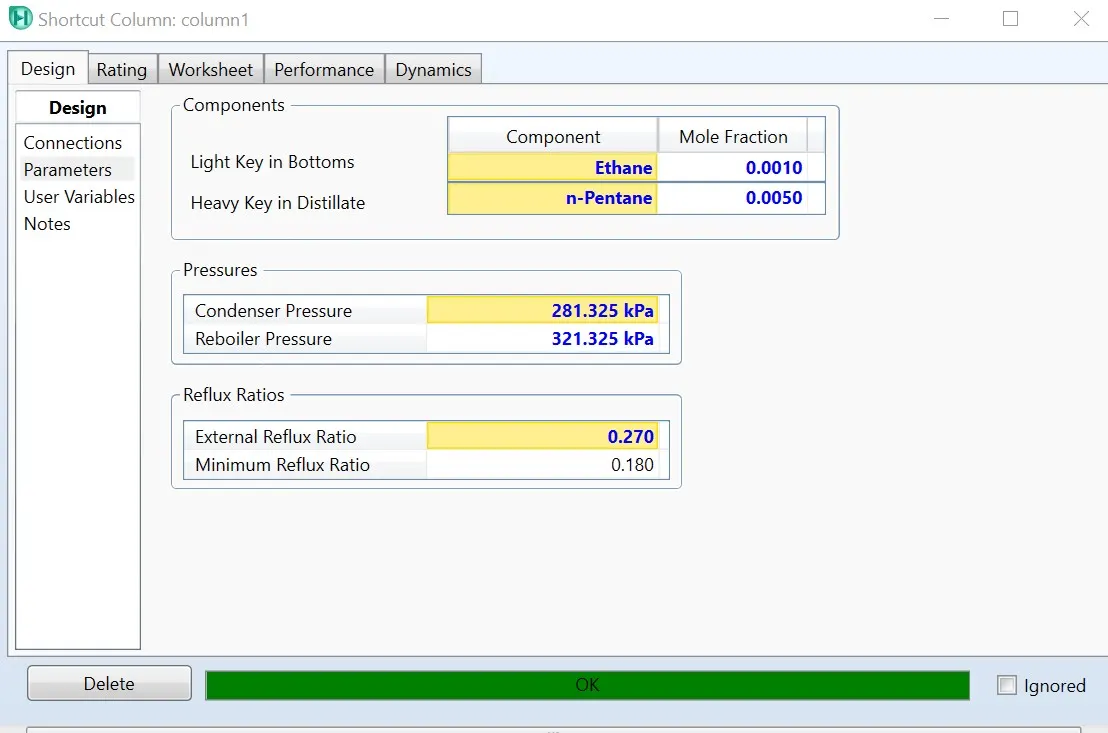
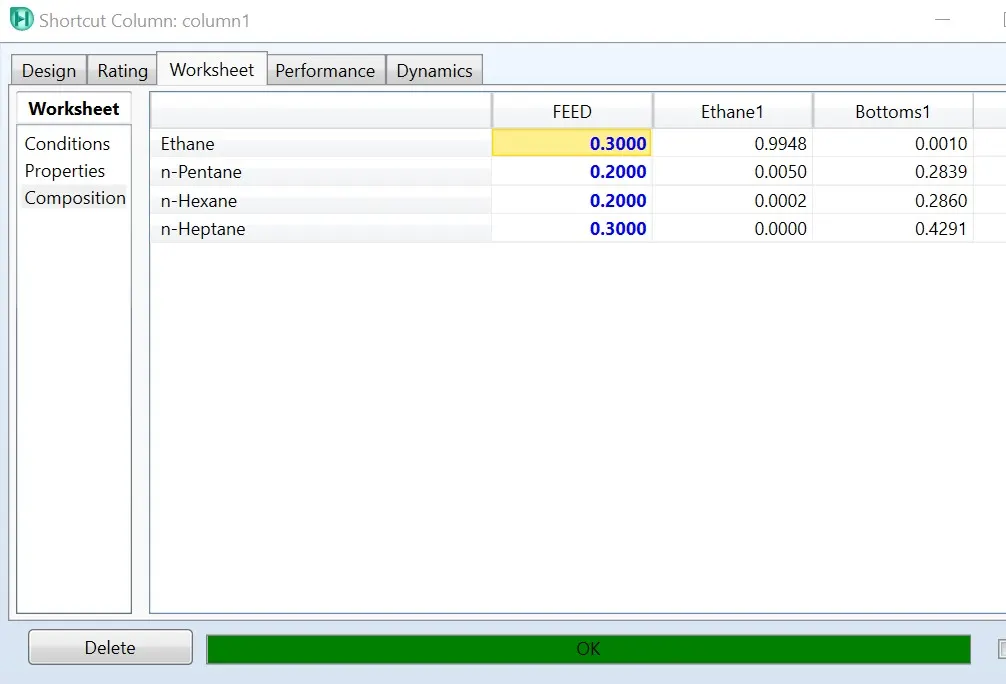
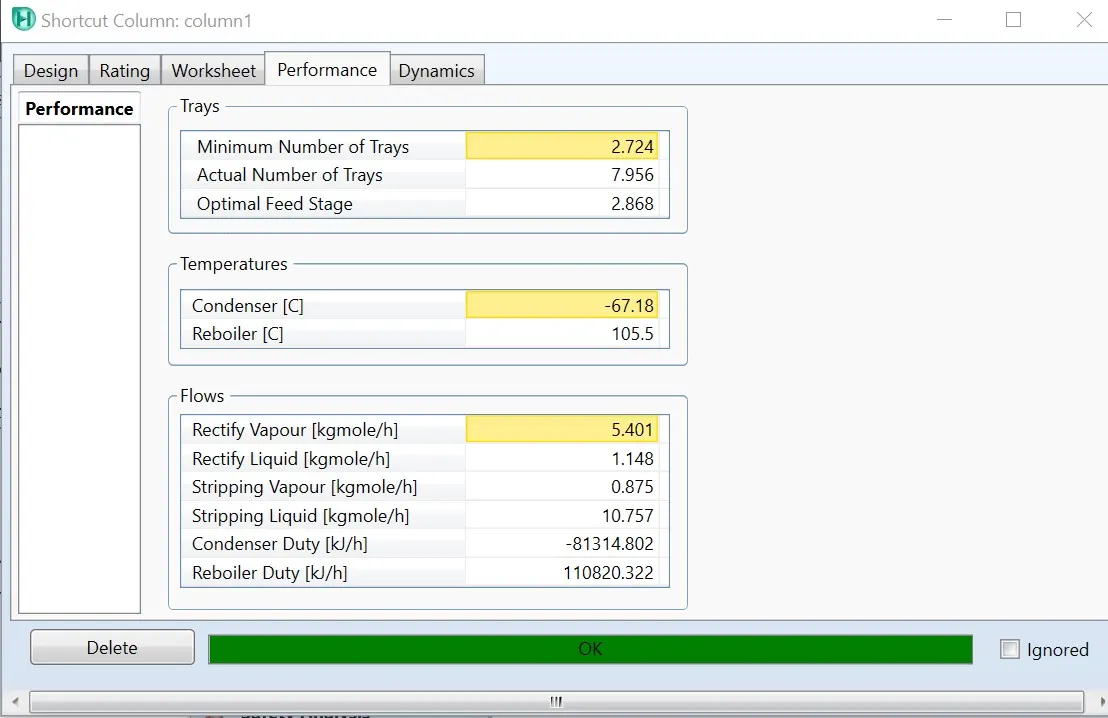
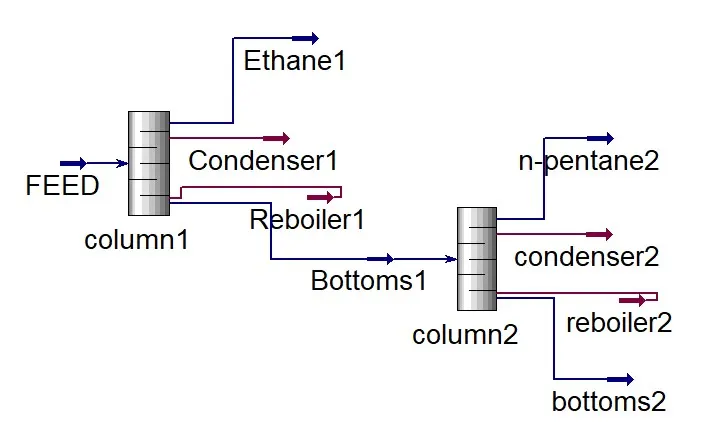
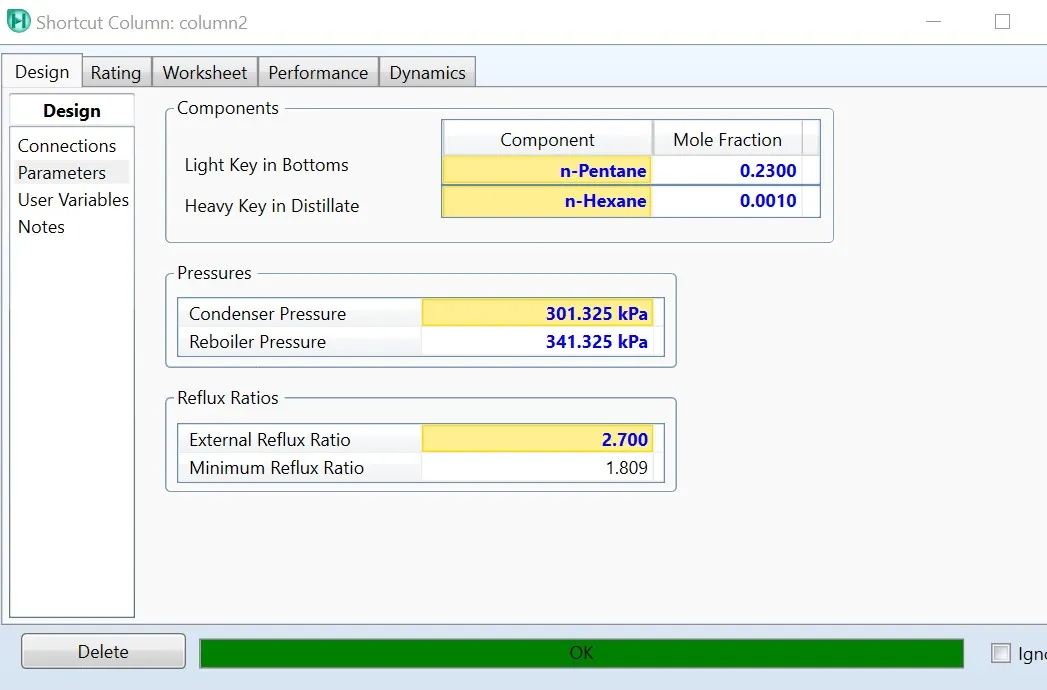
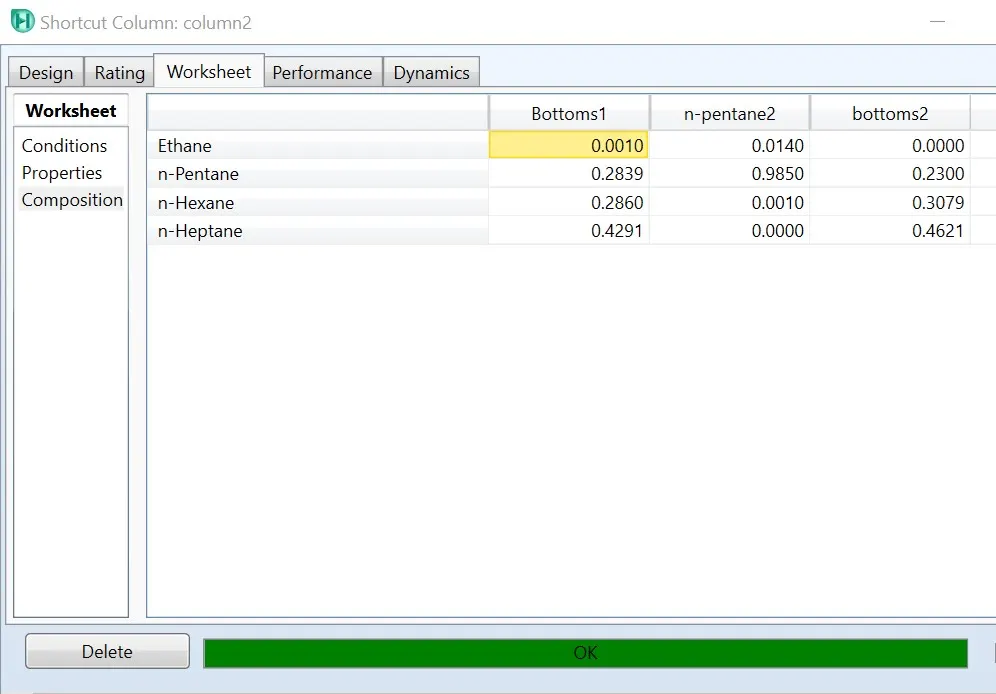
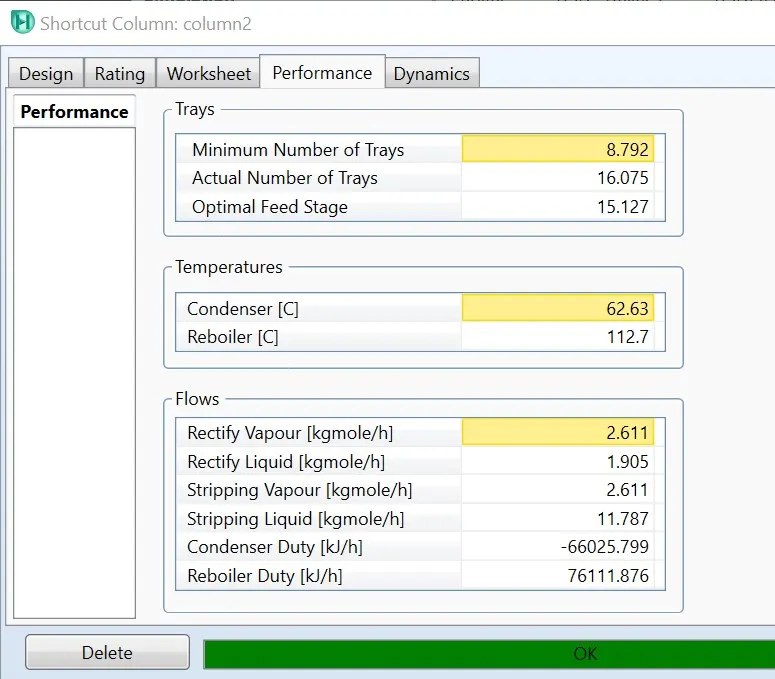
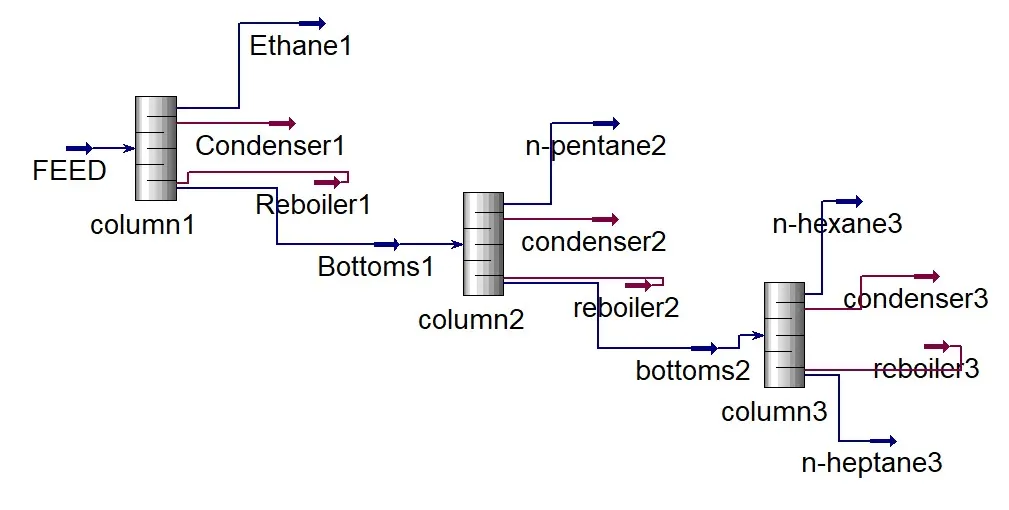
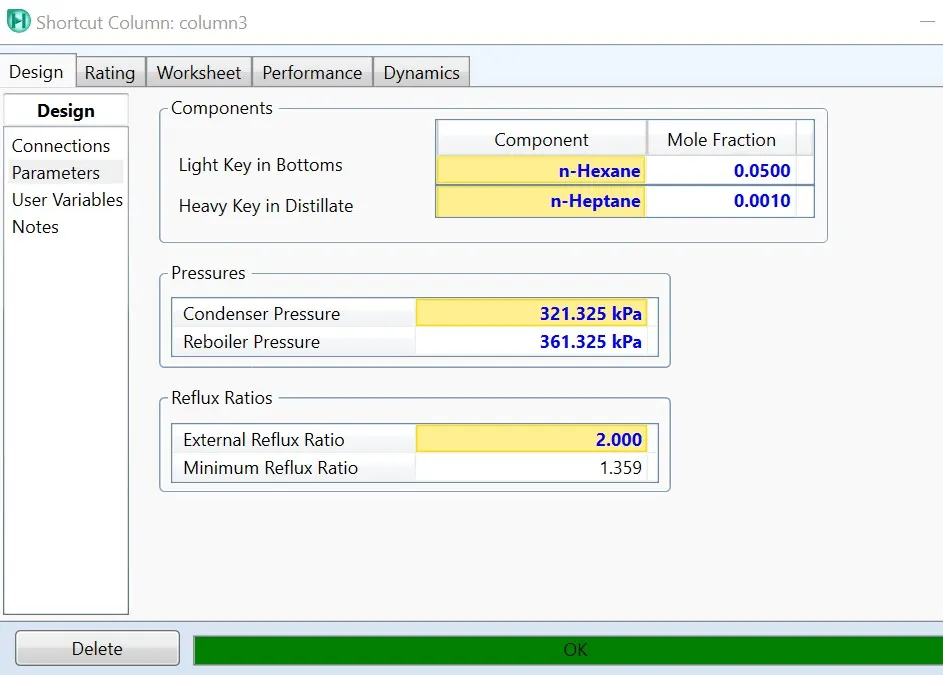
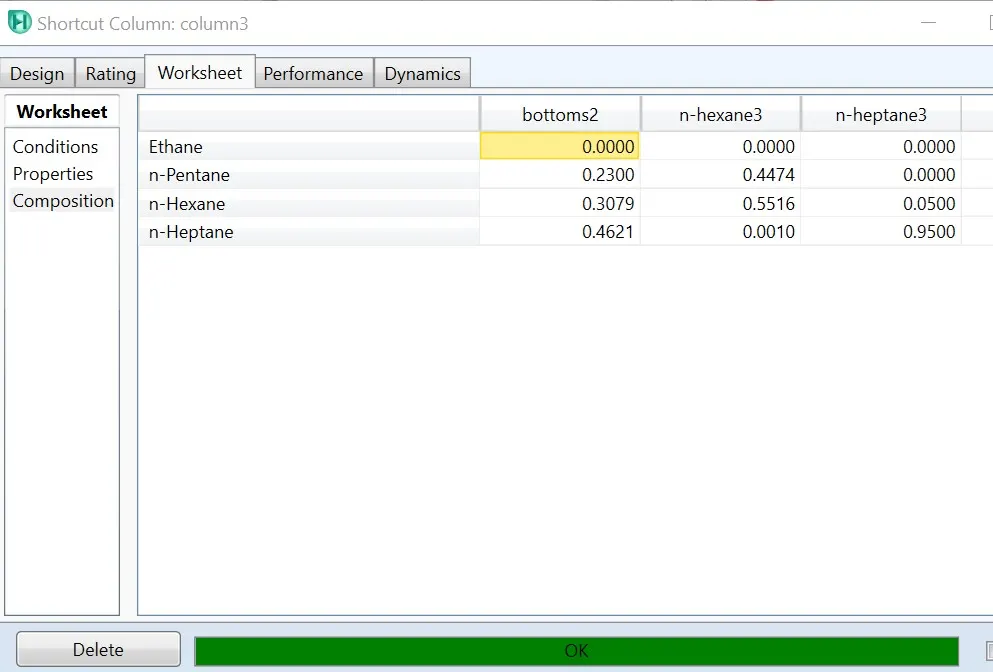
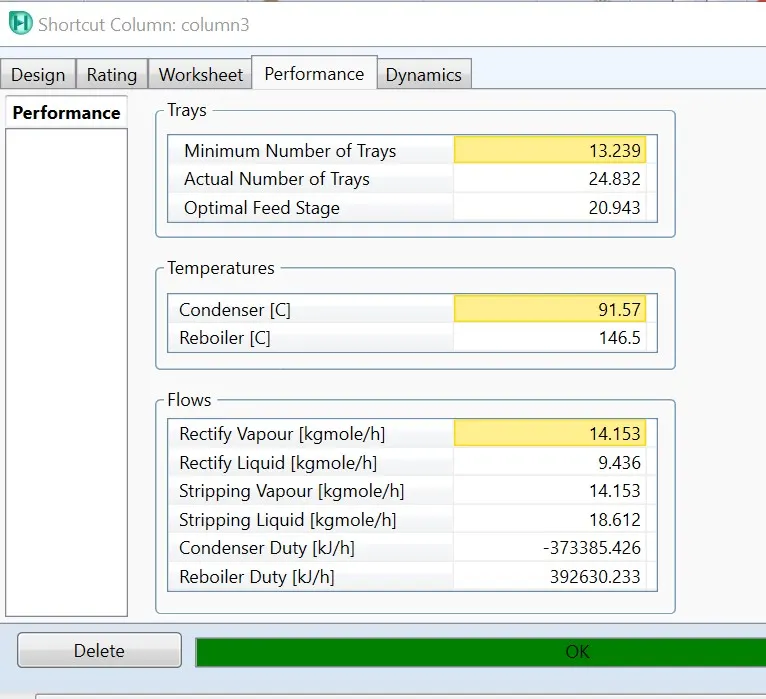
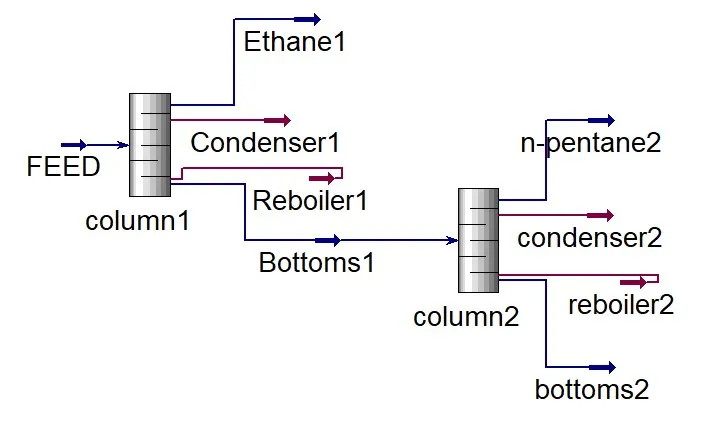
When the same procedure is followed to use the shortcut column model to the other three configurations (2, 3, and 4), the column could not converge and show error messages. This may be due to the stringent molefraction values. It has been identified that these three configurations can not be used to separate each of the components. The shortcut column flowsheets are shown below for the other configurations.
Shortcut column model is used for the Configuration 2
Shortcut column model is used for the Configuration 3
Shortcut column model is used for the Configuration 4
Summary:
Only column configuration 1 can successfully separate each of the components with the desired purity. Therefore, column configuration 1 can be used to determine the other parameters in problem 2 using the actual distillation column.
- Based on the composition provided in s.no-1 and feed condition of 45°C and 2 barg pressure, determine
- number of stages,
- Optimum feed stage location
- condenser duty,
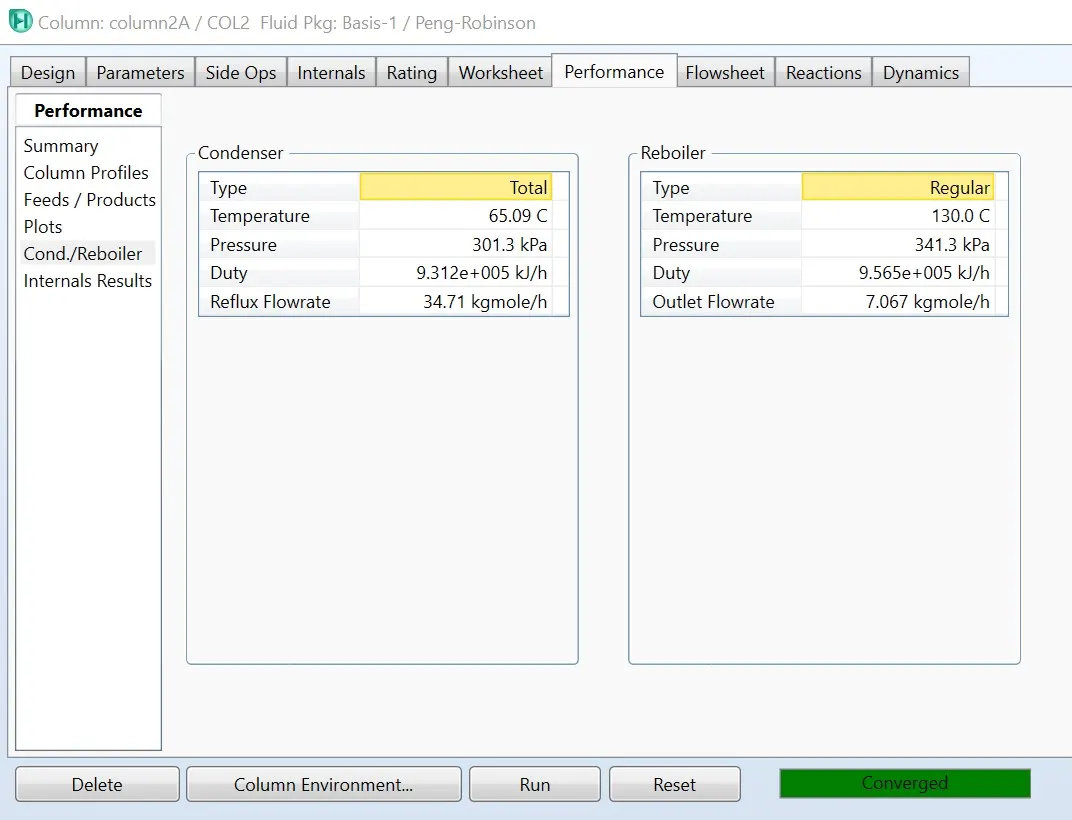
- reboiler duty,
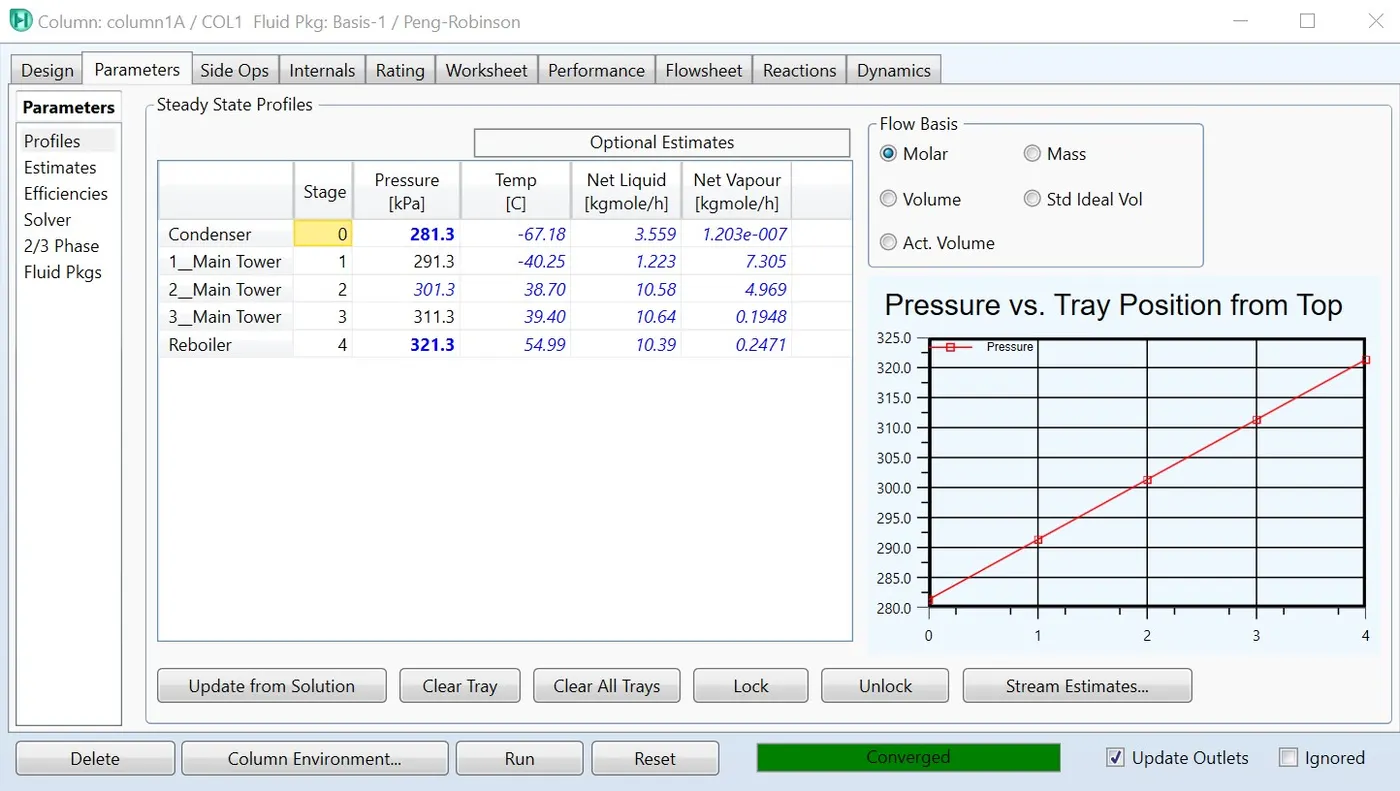
- vapor loading at each stage,
- liquid loading at each stage
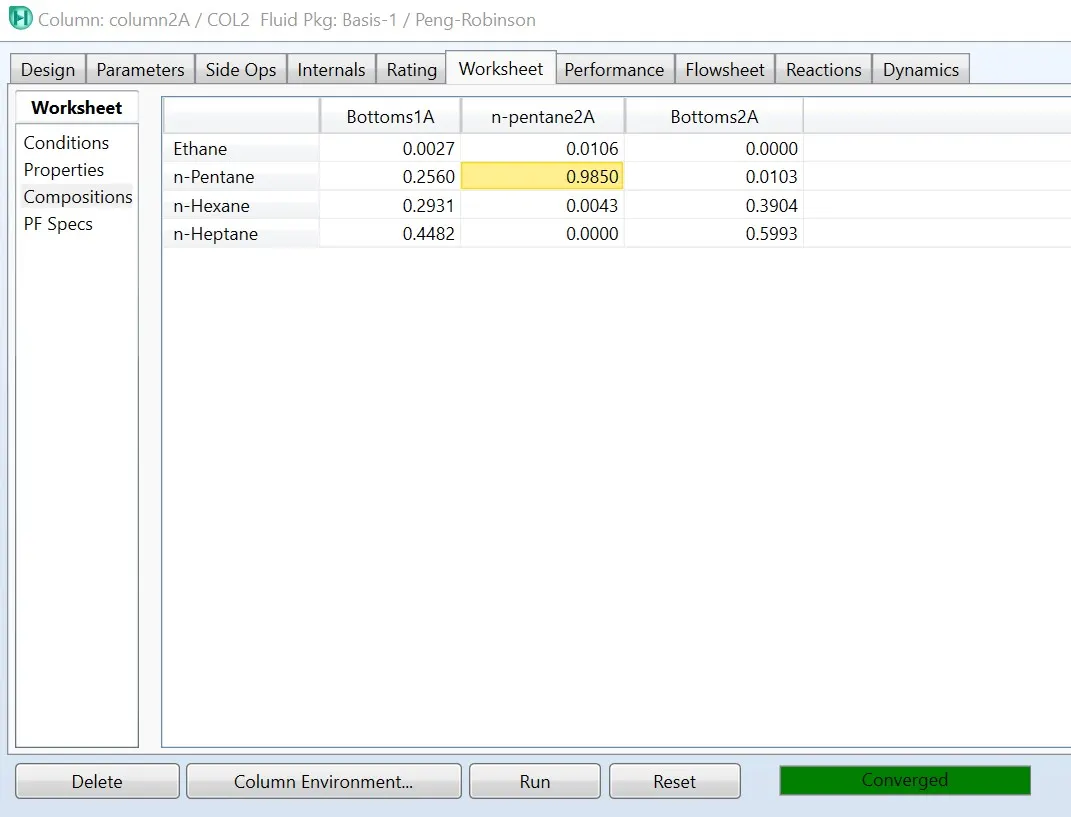
to separate out 99.5 mol% of ethane and 98.5 mol % of n-pentane using distillation column with column operating pressure of 2 barg.
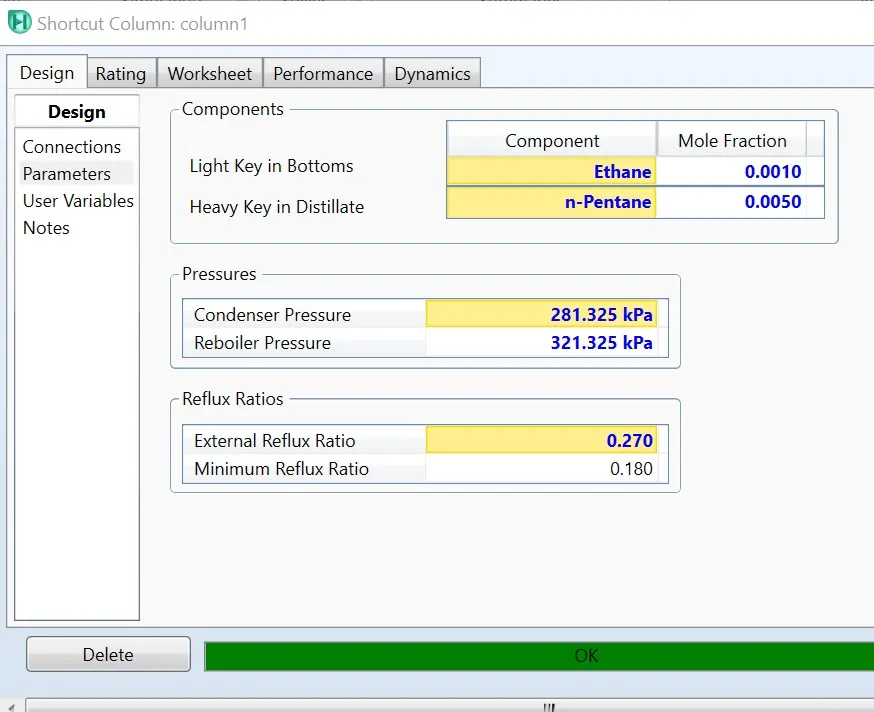
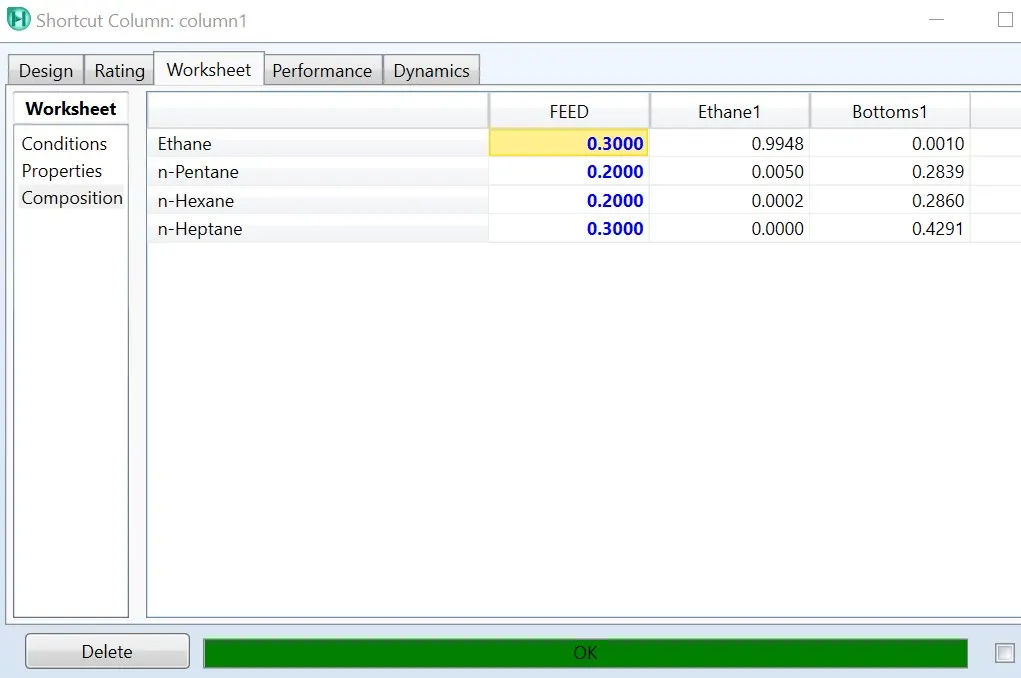
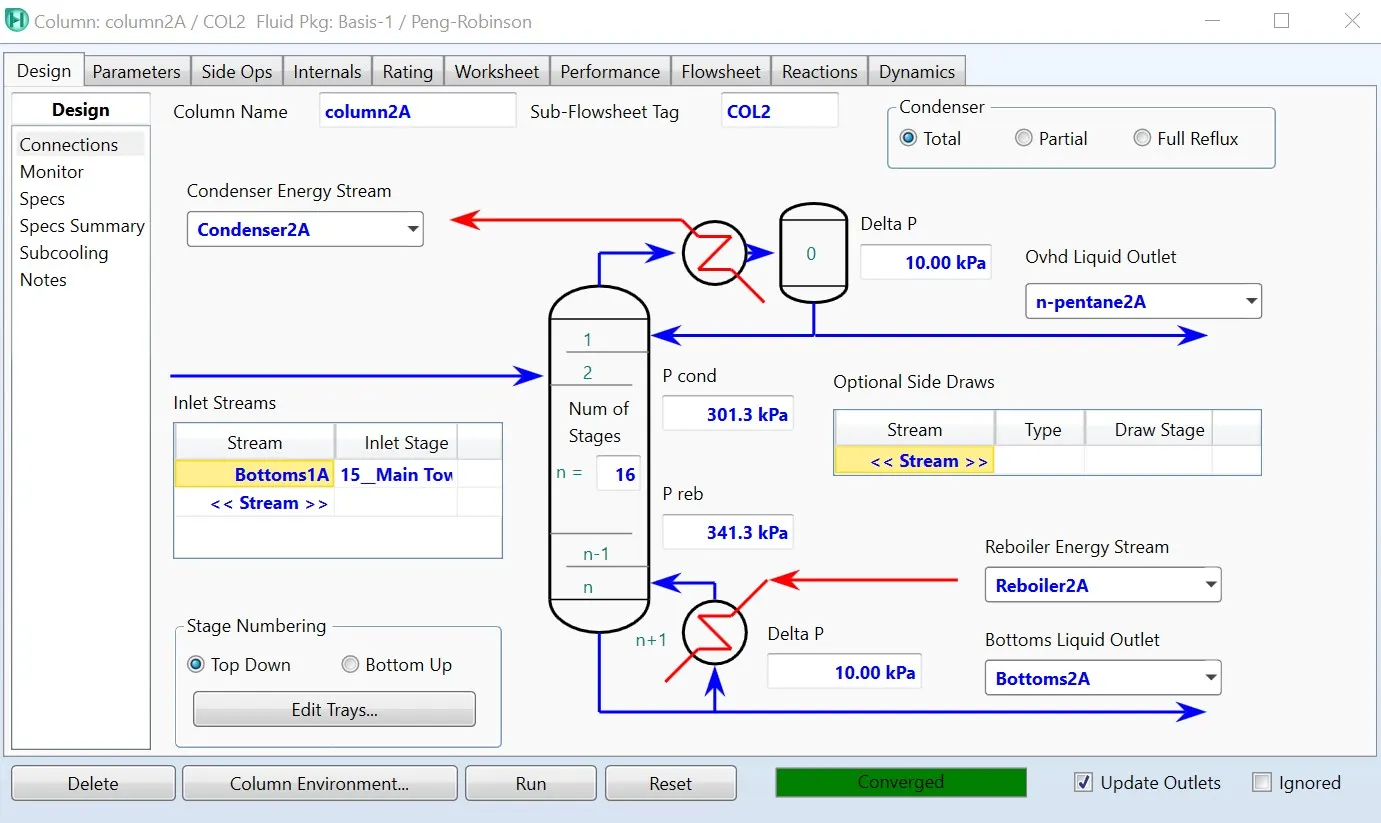
In order to obtain the results, using the shortcut column results such as reflux ratio, number of stages and feed entry as an initial guess to feed in the input in actual distillation column. After converging the column with this input, it may not give the required purity when compared it with the shortcut column results.
Therefore, fine tuning or optimising the distillation column is required to obtain the purity needed. Fine tuning is done based on the design requirements and a good trade-off between capital cost and operating cost.
When the number of stages in the column increases, it increases the capital cost requirement. When the reflux ratio increases for the desired purity of product, reboiler and condenser duties are also increases thereby increasing the operational costs.
The results obtained are tabulated below to compare both the columns before and after optimisation for the required purity.
|
Column |
Column 1A |
Column1A |
Column2A |
Column2A |
|
Fine-tune / optimising |
Before |
After |
Before |
After |
|
Reflux ratio |
0.27 |
0.95 |
2.7 |
14.57 |
|
Number of stages |
8 |
3 |
16 |
16 |
|
Optimum feed entry |
3 |
2 |
15 |
15 |
|
Product purity (%) |
89.96 |
99.5 |
92.74 |
98.5 |
|
Reboiler temperature (°C) |
105.5 |
55 |
112.7 |
130 |
|
Reboiler duty (kJ/h) |
134500 |
35900 |
409070 |
956500 |
|
Condenser duty (kJ/h) |
116700 |
110600 |
38290 |
931200 |
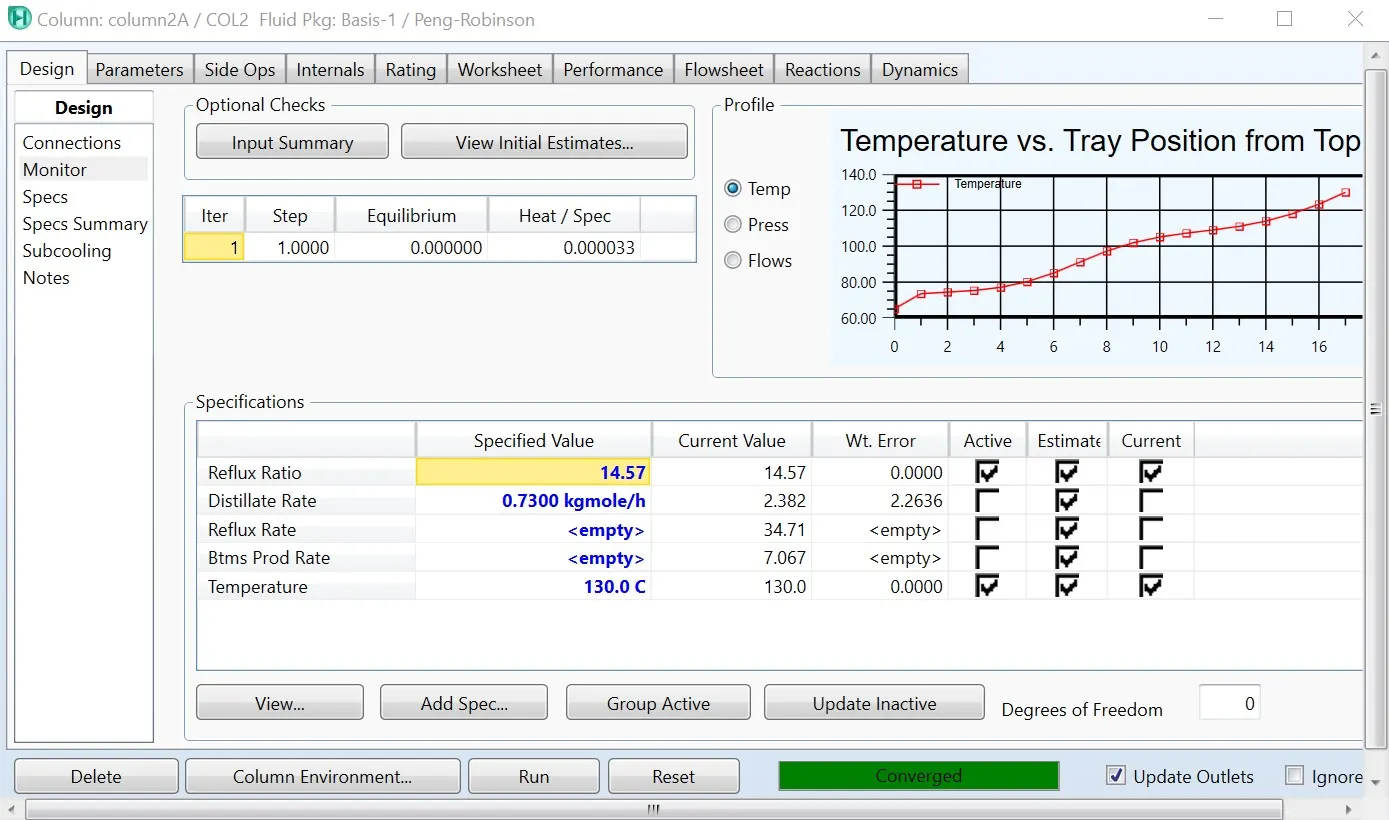
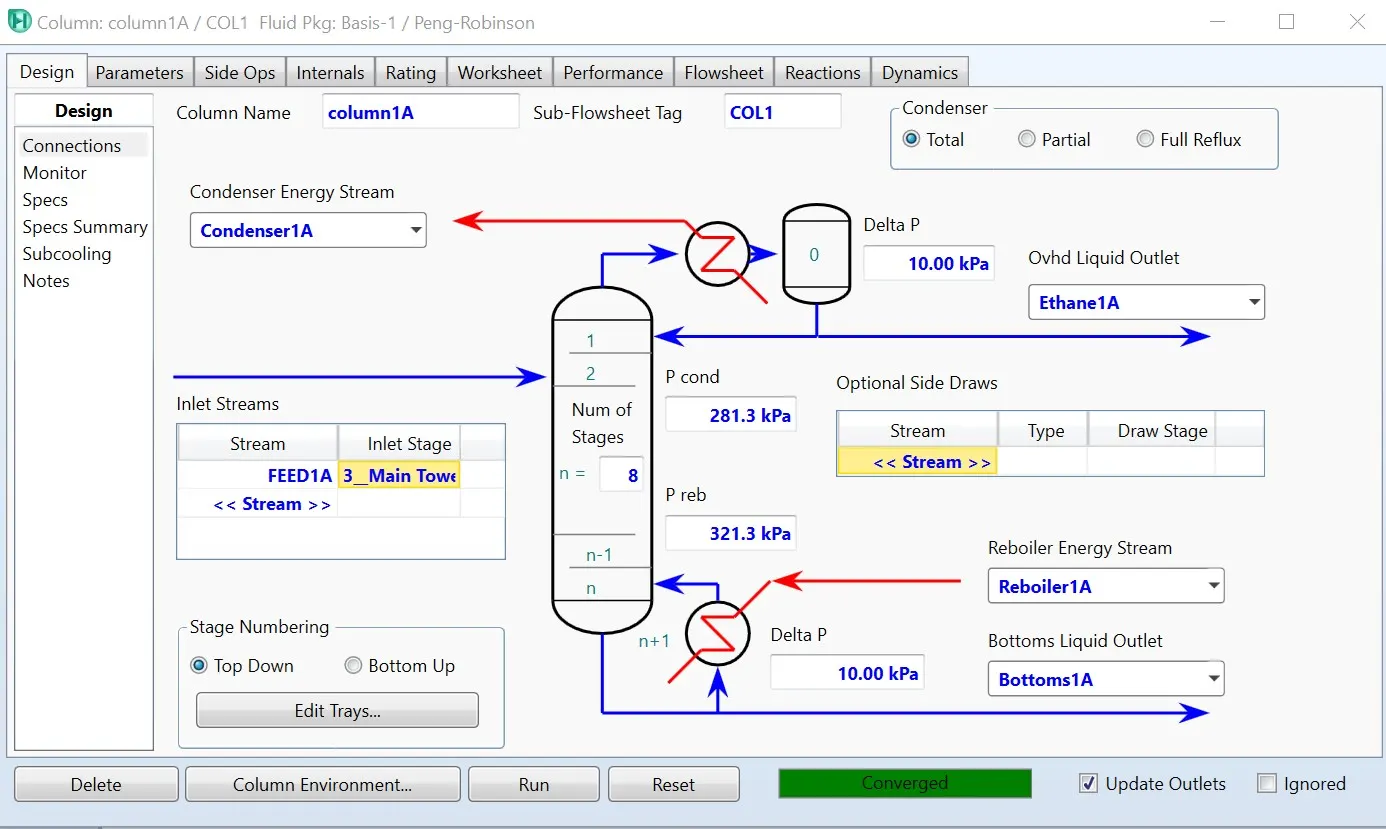
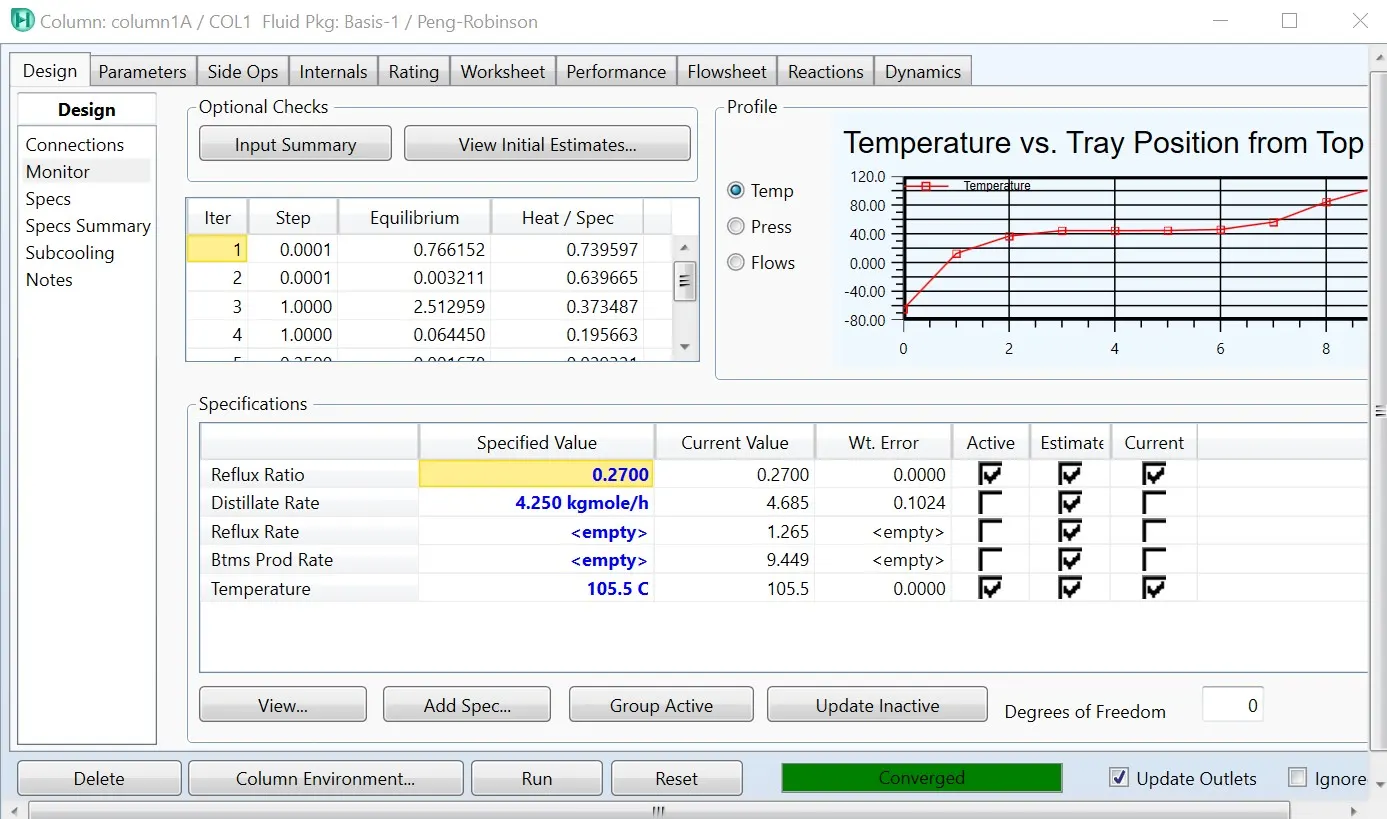
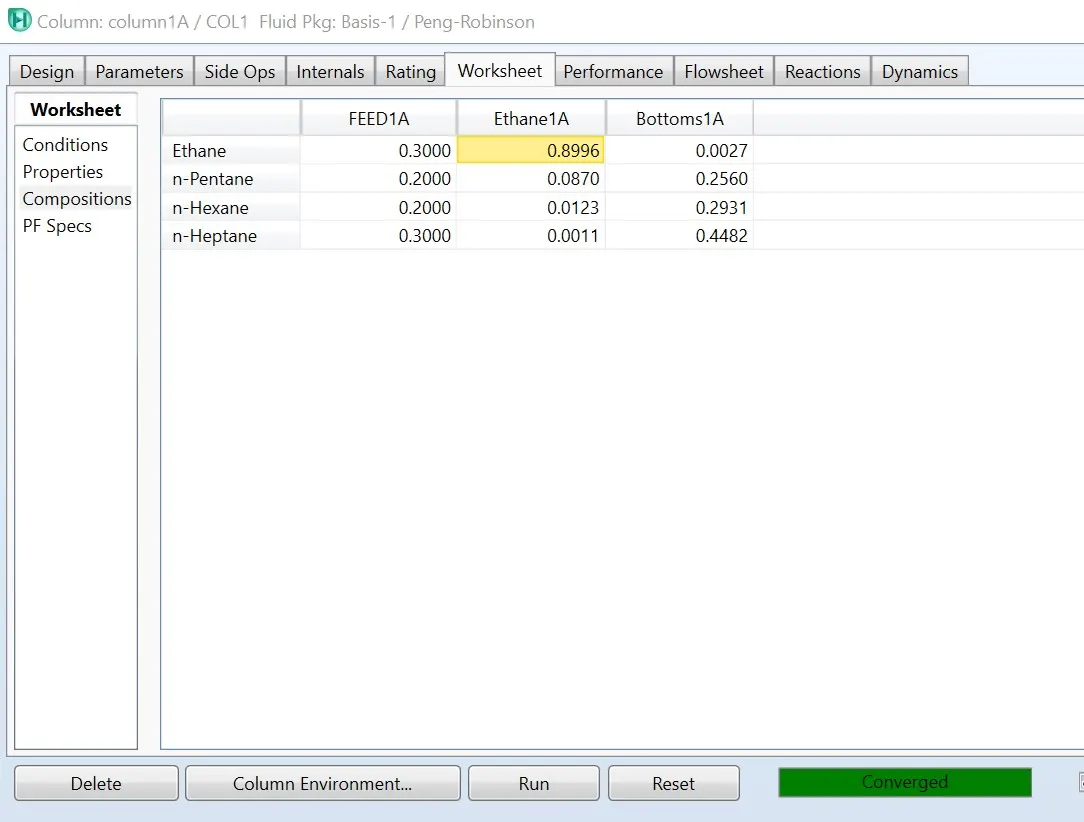
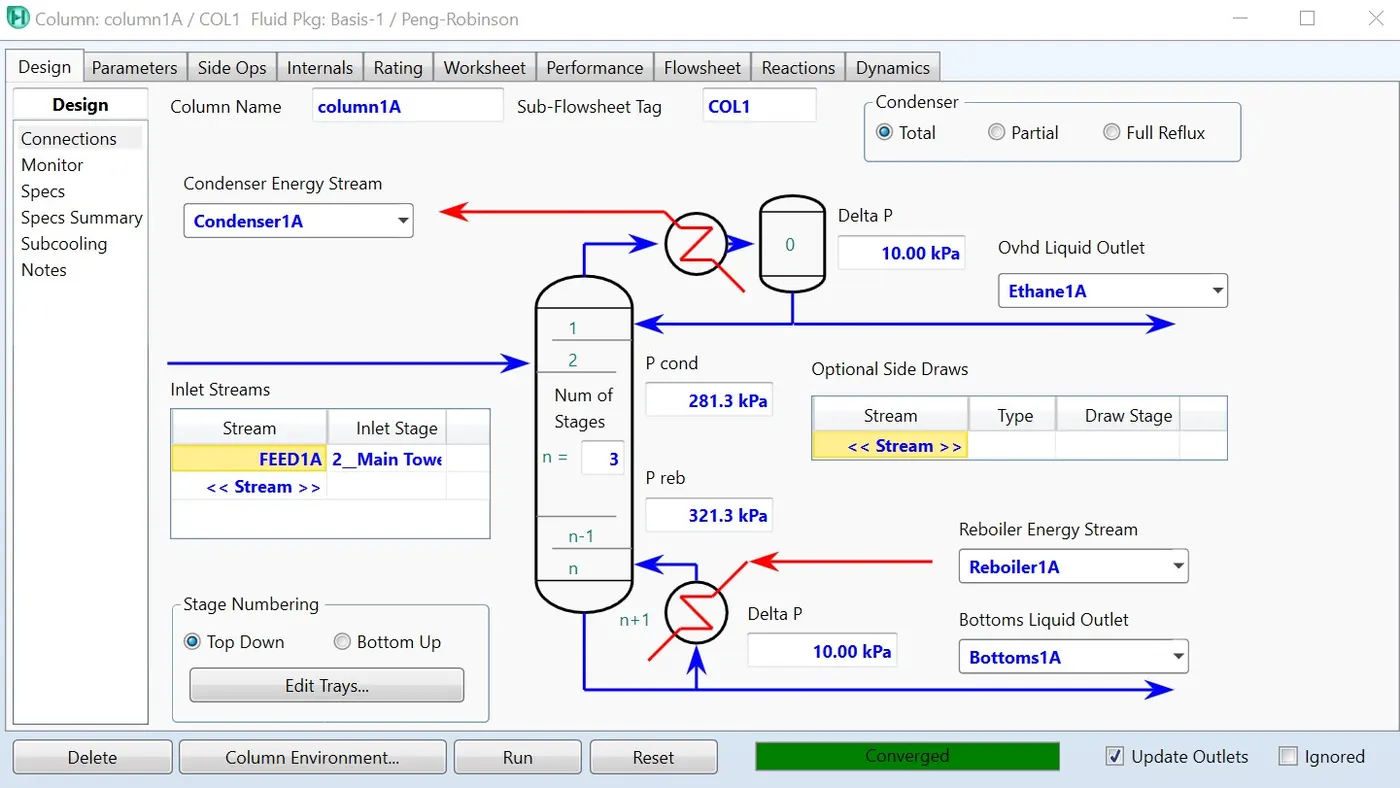
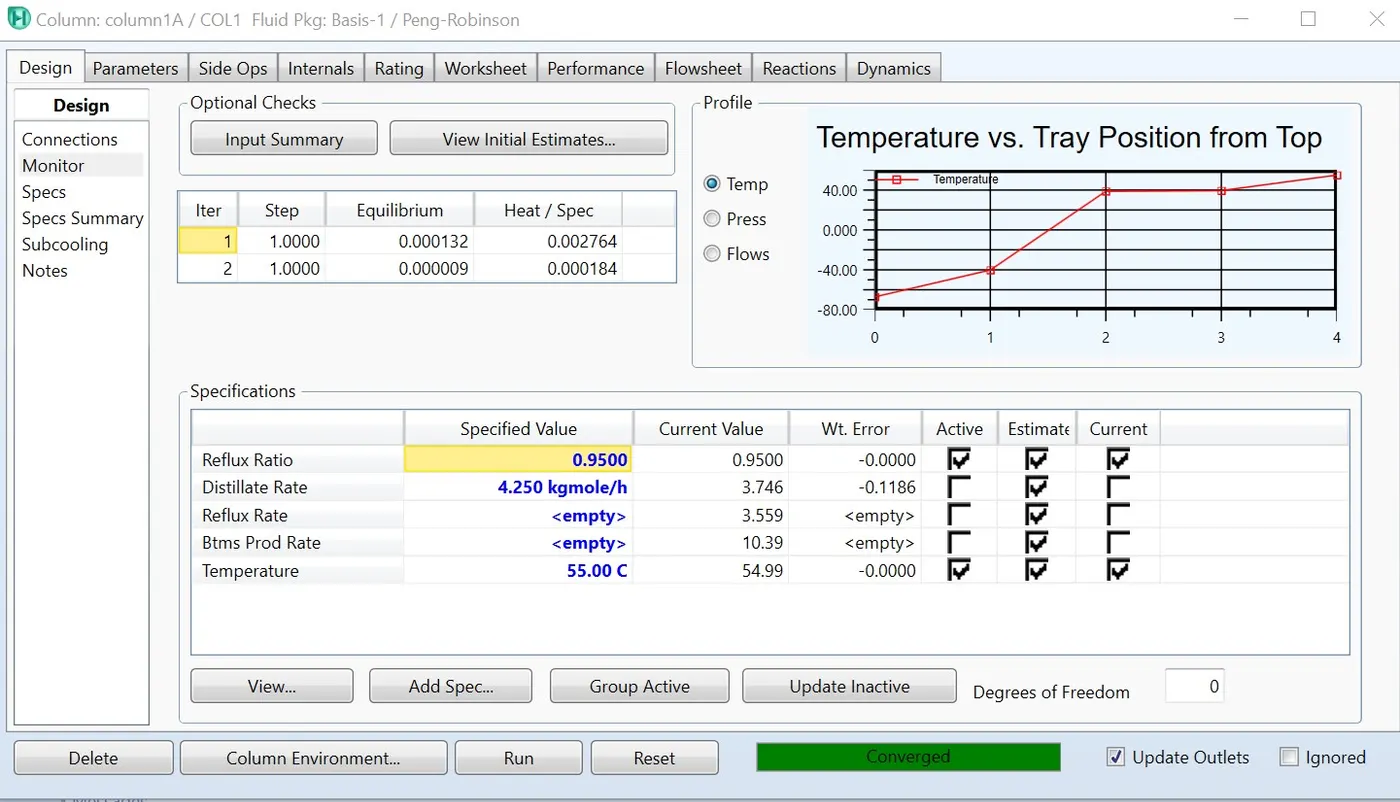
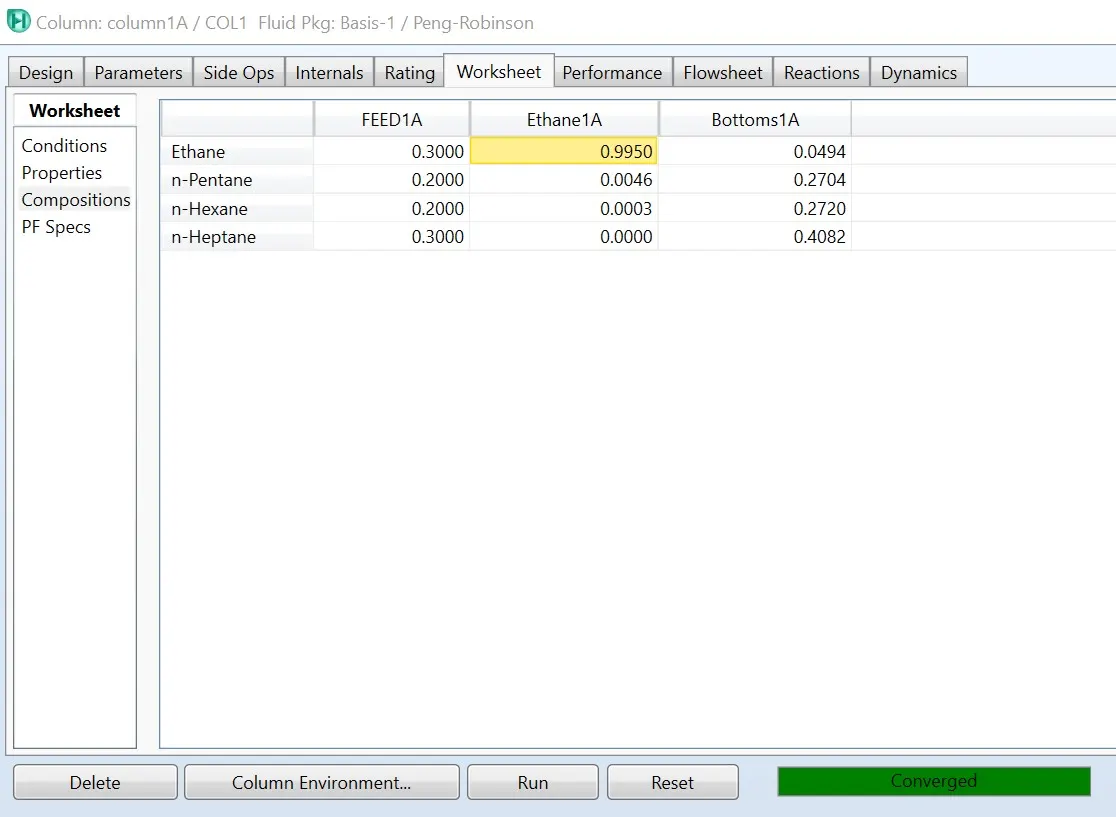
Results summary: In both the columns, the reflux ratio has to be increased to obtain the required purity of ethane and n-pentane. In column1A, number of stages were able to reduce from 8 to 3 there by saving the capital cost at early stages. whereas, column2A stages were kept same in order to obtain the purity of n-pentane. In column1A, reboiler temperature has reduced from 105.5°C to 55°C there by saving operating costs whereas, column2A temperature has to be increased from 112.7°C to 130°C to obtain the purity and the purity changes everytime when the reboiler temperature and reflux ratio changes in column2A.
Using shortcut model to obtain the initial guess values:
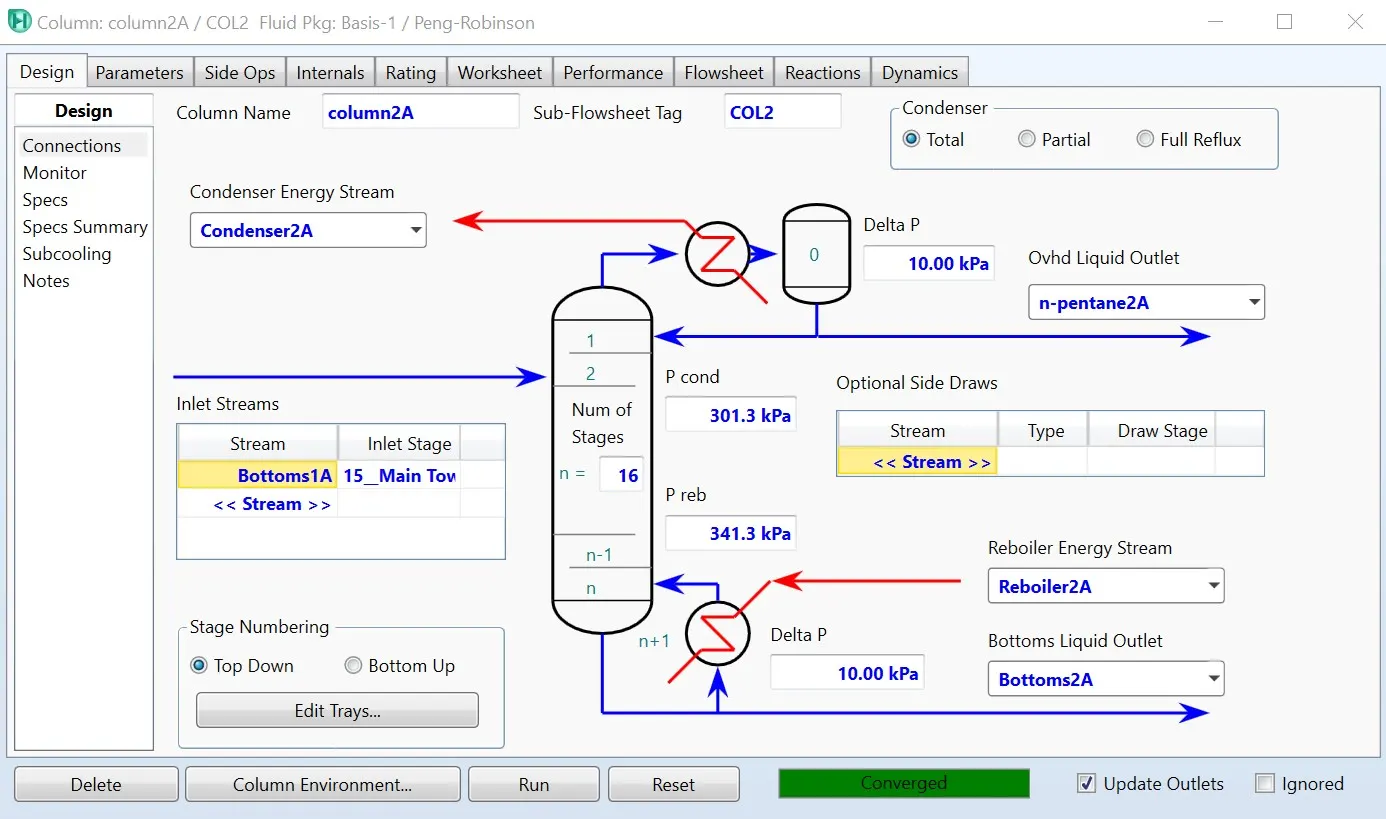
Actual Distillation column design for the problem2
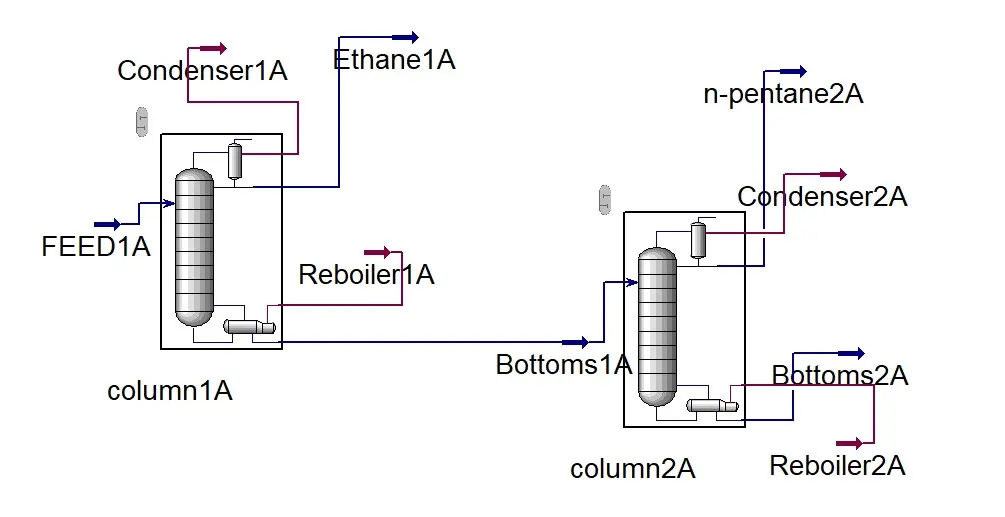
Before fine tuning column1A - shortcut column results were used below
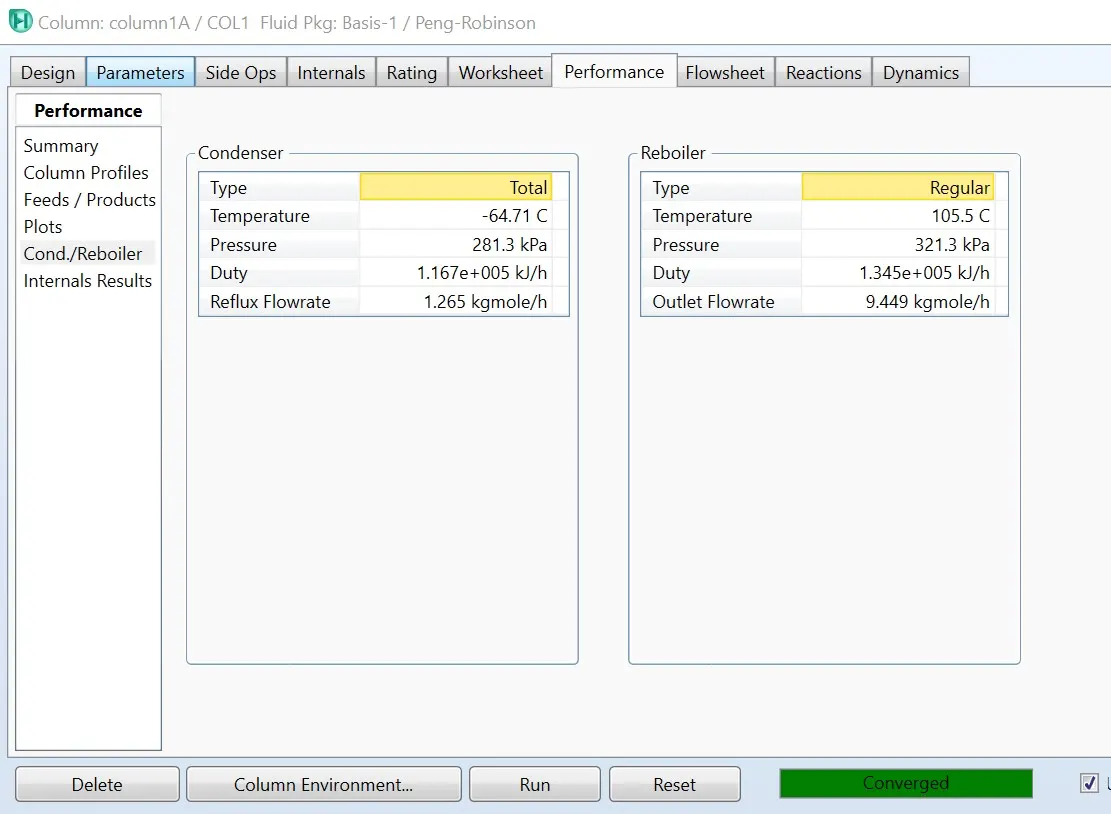
After fine tuning the distillation column1A, the results are shown below
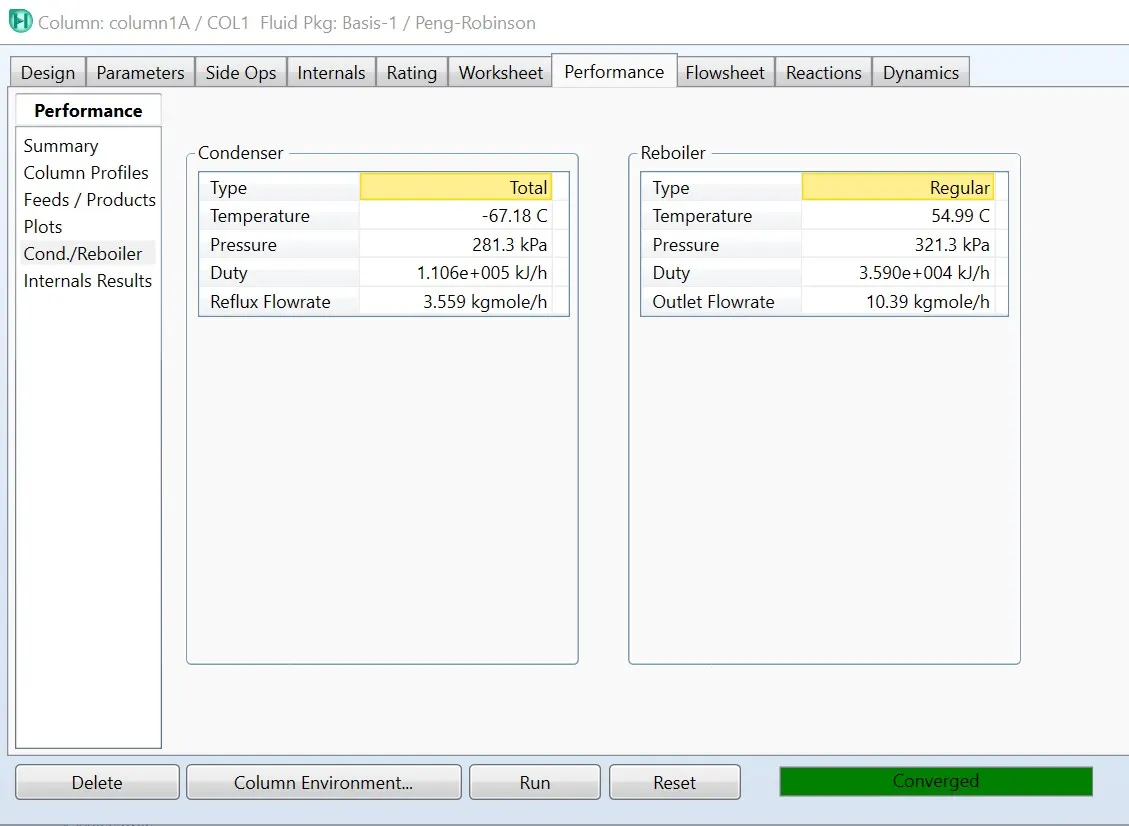
Vapour and liquid load at each stage in column1A
Before fine tuning Column2A - shortcut column results were used below
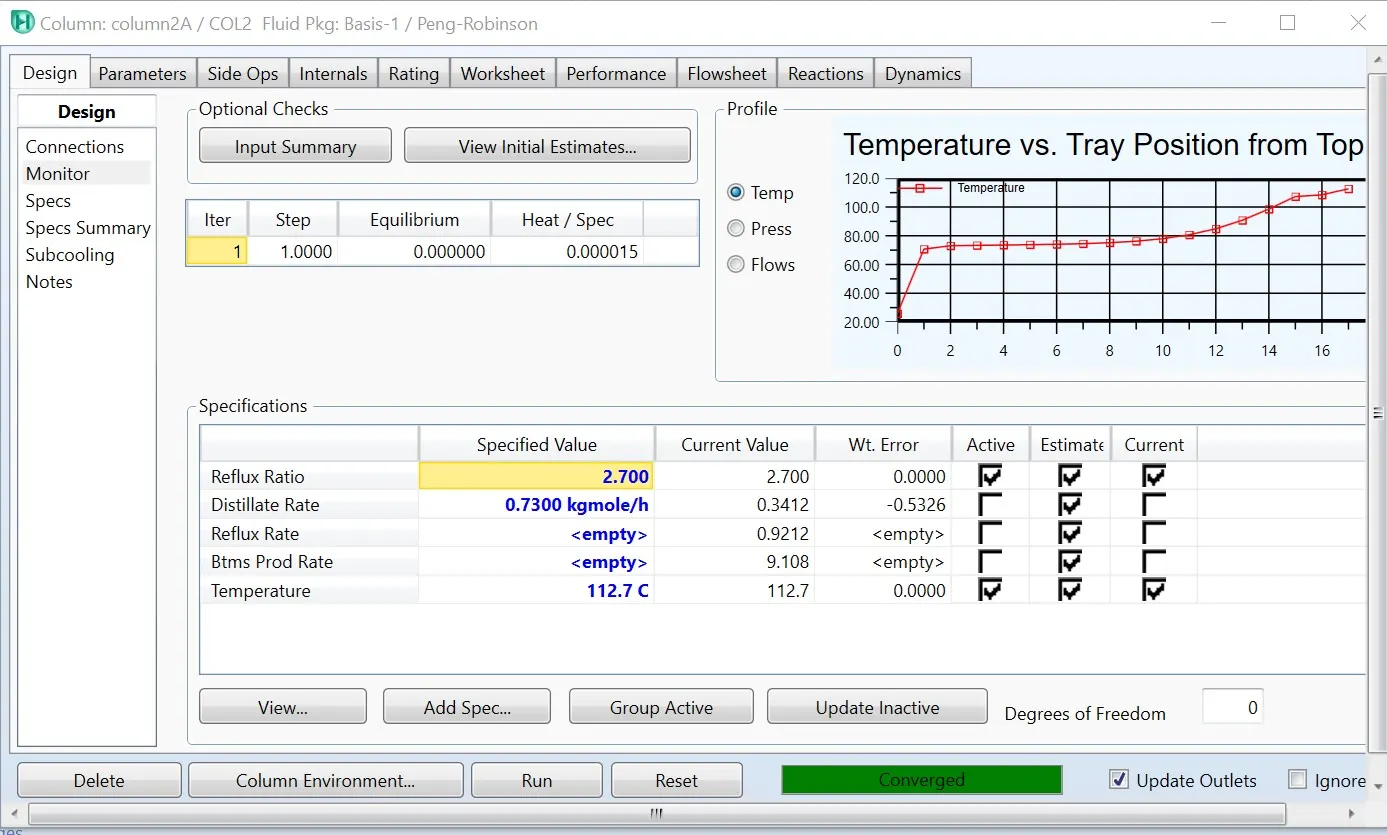
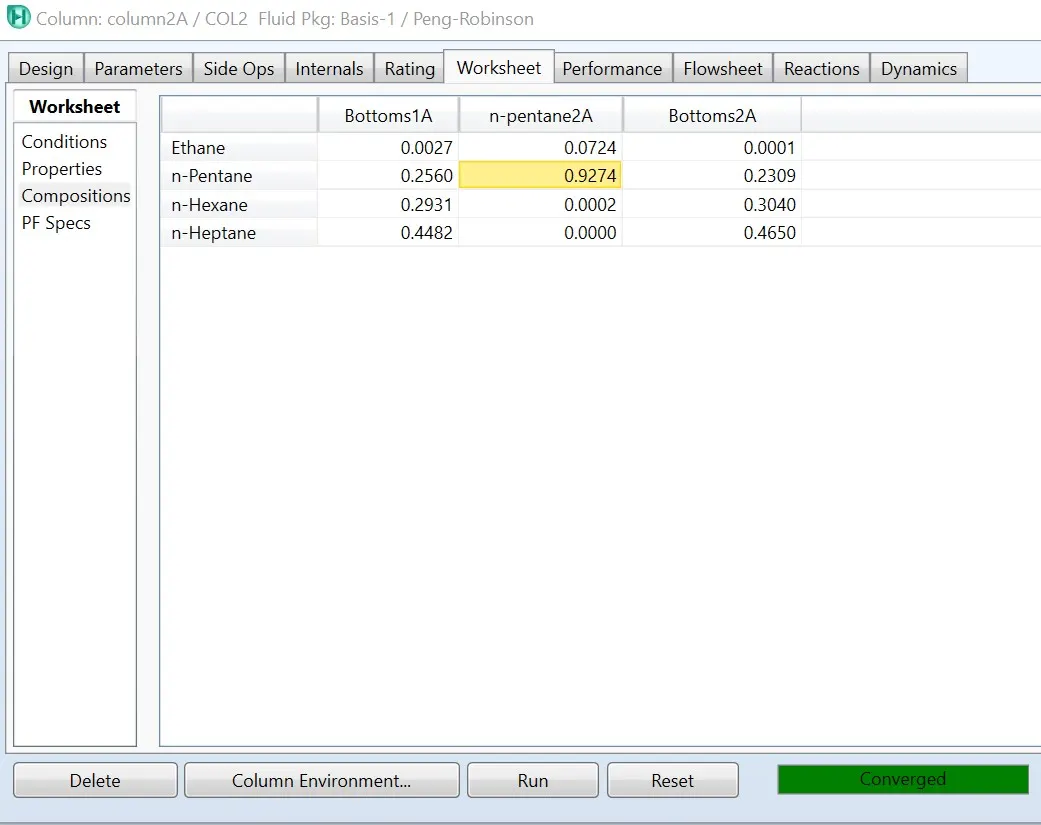
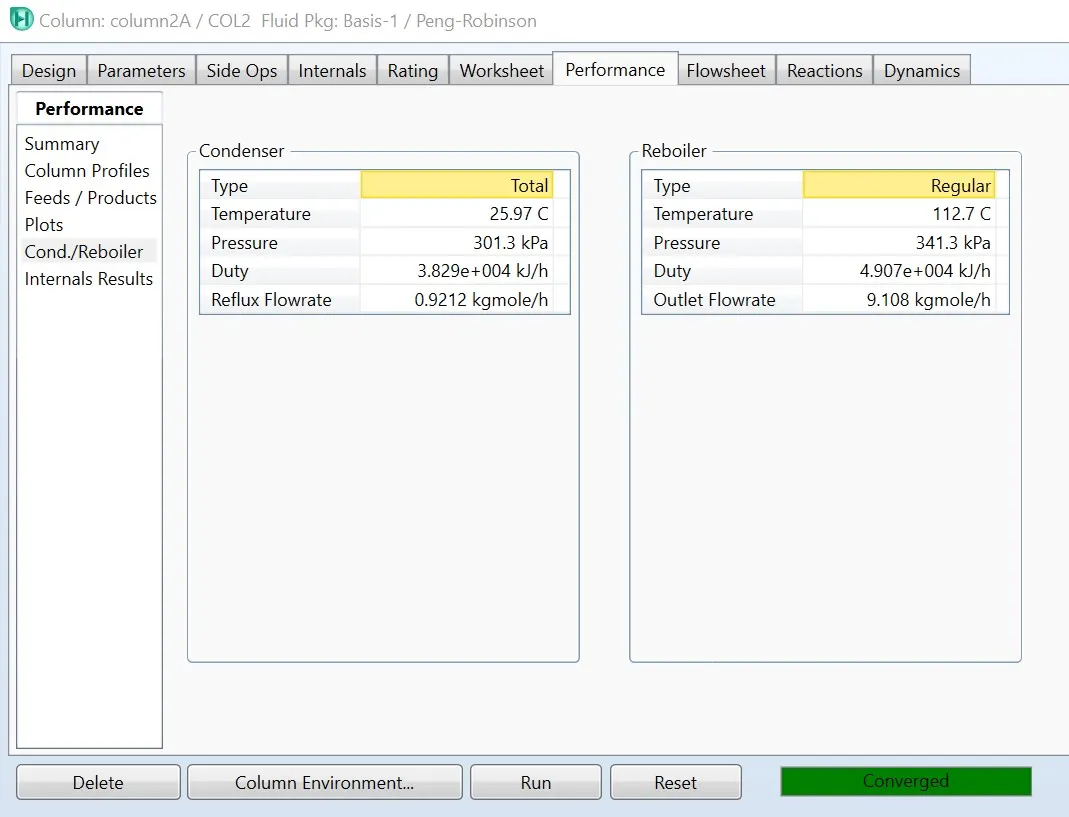
After fine-tuning the column2A the results are shown below