Week 3 Challenge
Hydrology and Geo technical studies gives data to design a safe bridge structure.
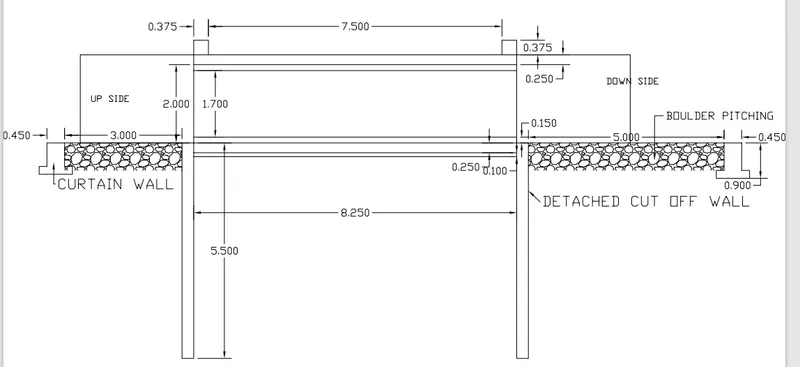
The aim is to figure out no of span and length of span by evaluating linear waterway from discharge, velocity, different sections of river, catchment area and soil property. To decide foundation depth of abutment, pier and its protection by evaluating scour depth, uplift pressure. Thus hydrology and Geo technical studies are necessary.
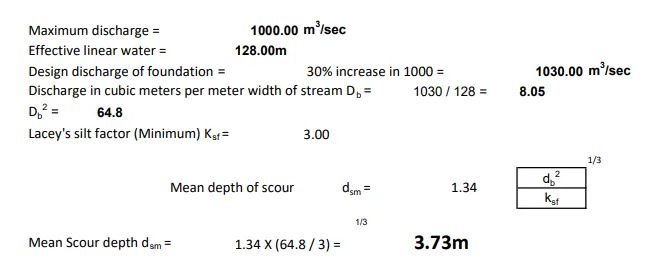
Hydrology The linear waterway is being calculated by analyzing discharge and velocity. For safety margin design discharge has been increased in accordance with the catchment area as per IRC 5. Catchment area is being evaluated from Topo sheet of that area or Google earth. Highest flood level has been fixed on study of 50years history of river flow. Some time local inquiry and site inspection gives near to correct data. River survey in large area gives the position of minimum distance of banks, which helps in choosing economical linear waterway. Scour level and afflux has been figure out with empirical formulas. Site inspection gives correct idea. No of bridge spans are modelled considering site situation, economy and construction constraint. Once the span is finalized, No of pier and abutment with distance comes out.
Geotechnical studies For density of soil, plasticity of soil, grain size, and angle of repose, cohesion, water table, silt factor of river and N value from SPT co relating reduced level of site geo technical studies are conducted. By bore holes and SPT disturbed and undisturbed samples are being collected. Samples are tested in laboratory, which gives the result for different physical property of soil and its type.
For fixing span knowledge of linear water way of river and silt factor are necessary. For linear water way we require discharge which is being figure out by hydrology. For silt factor we require size of soil particle, which is being exercised in geo technical studies.
Geo technical studies give ideas of type of soil, layer wise. Level of different soil layer, especially soft soil helps in deciding open foundation or deep foundations. Sometime liquifiable soil layer directs to increase depth or remove the soil.
When the structure rests on liquid (Water) a thrust of liquid acts on the base tends to raise the structure. These happening are uplift. Larger the base area more the up lift force will generate. The density of liquid or water and acceleration due to gravity has major role in this observable fact.
It withdraws slightly the load considered on structure and reduces weight of structure. Drag force and lifting force creates moment results in loosening of structure’s contact from ground.
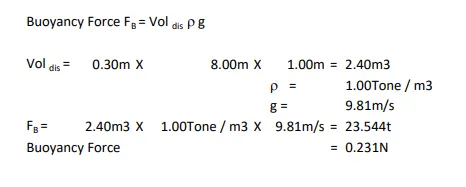
To avoid uplift force trial of fixing foundation level above water table is commissioned. Increase the volume by increasing height of structure or density of material to counter the uplift force. Provision of anchorage in the rock also helps in defying uplift force.