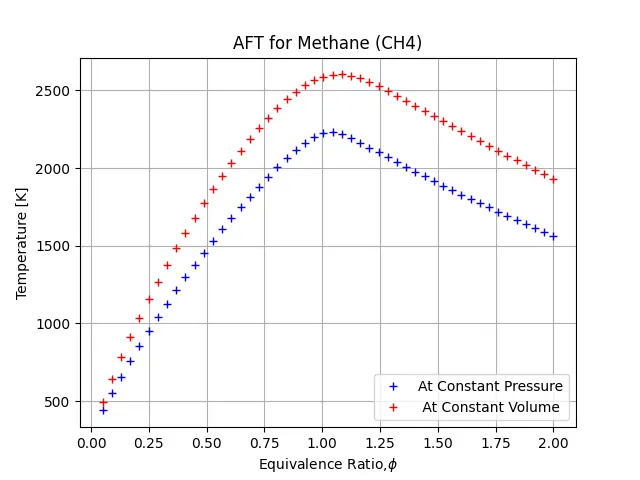
Week 3 - Adiabatic Flame Temperature calculation
Theory:
1. ATF Vs equivalence ratio in Constant Volume condition.
The Stoichiometric general equation for the combustion of methane is given as follows
CxHy + a(O2 +3.76N2) = b(xCO2) + c((y/2)H2O) + 3.76a N2 + d(O2) + e(CO)
For phi<1, the coefficient for CO(product), i.e, e=0, This is known a lean combustion
For phi<1, the coefficient for O2 (product), i.e, d=0, This is known a rich combustion
For phi=1, the coefficient for CO & O2(product), i.e, e=0, This is known as schoichiometric combustion
The process of combustion generates heat, and if this heat is not lost to the environment or assumed to be contained within the system, the temperature of the products is known as Adiabatic Flame Temperature.
Now,
For a constant pressure system, enthalpies of product and enthalpies of reactants should equate to zero to get the AFT using Newton-Rhapson method.
Delta H=H_products_aft - H_reactants_stp =0
But,
For a constant volume system, the internal energies of the products and reactants are equated to be zero to get the AFT using Newton-Rhapson method.
However, H=U+PV
PV=NRT ( Assumed to be ideal gas system)
(H_products - H_reactants - R*(N_p*Taft -(N_r*Tstp)))
Utilising the coefficients from the thermo.dat file - UCBerkeley for products and reactant species respectively, the enthalpies are calculated:
The NASA polynomials have the form:
Cp/R = a1 + a2 T + a3 T^2 + a4 T^3 + a5 T^4
H/RT = a1 + a2 T /2 + a3 T^2 /3 + a4 T^3 /4 + a5 T^4 /5 + a6/T
S/R = a1 lnT + a2 T + a3 T^2 /2 + a4 T^3 /3 + a5 T^4 /4 + a7
where R is universal gas constant =8.314 J/mol-K
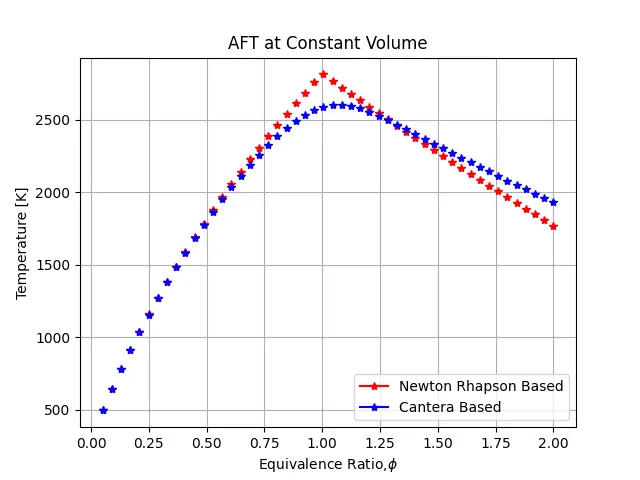
After this the Newton-Rhapson is applied to obtain the AFT at given equivalence ratio, iteratively and plotted.
This process is shortened by the cantera libraries.
The equilibrate() is set for constant volume 'UV' | constant pressure 'HP'
Refer the code here:
https://drive.google.com/file/d/1qJlwhJqpik5AFpjPO8THoeLfJSNw70im/view?usp=sharing
Results:
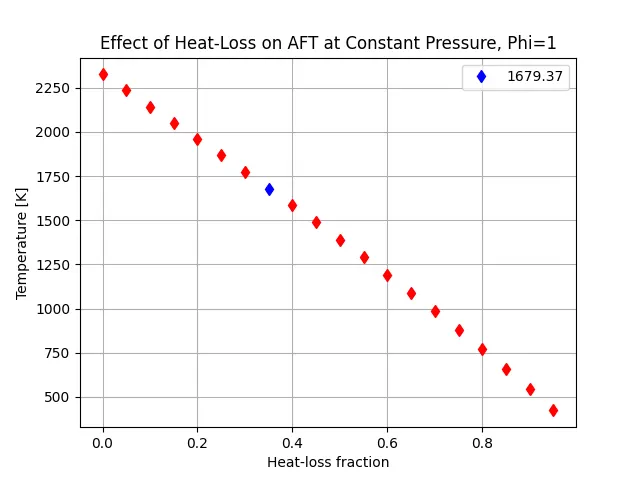
2. Adiabatic Flame temperature with heat loss effect in Constant pressure condition
LHV assumes all the H2O formed is in gas phase, this is realistic for engines where the H2O leaves in the exhaust. Note in a real engine the H2O in the exhaust would be hot, but the LHV calculation usually assumes room temperature steam. HHV assumes all the H2O formed is in the liquid phase.This is realistic for bomb calorimetry experiments, where the final temperature is usually pretty low. So UHV is easier to measure. But it can be a big overestimate of the true heat delivered by the fuel in an engine.
Source:(Combustion & Fuels Chemistry & Kinetics, William H. Green
MIT Dept. of Chemical Engineering, 2017 Princeton-CEFRC Summer School On Combustion)
https://drive.google.com/file/d/1ceIkVyfgLF-jfltM0QEdQgNISCR6OXEx/view?usp=sharing
3. AFT variation with Hydrocarbon group (variation in number of Hydrogen atoms)
https://drive.google.com/file/d/1Q82Jj9DvL2yhTSLVBT0wBuGJRCvC9GwW/view?usp=sharing
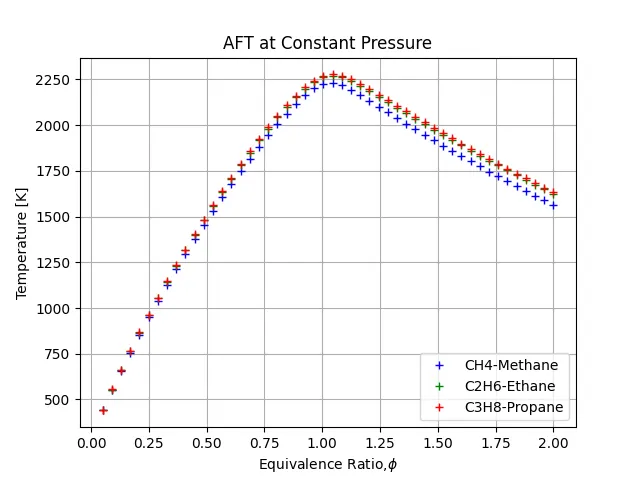
Using cantera, variation with respect to a number of hydrogen atoms was mapped.A significant benefit was observed as phi moved closer to 1 and beyond.
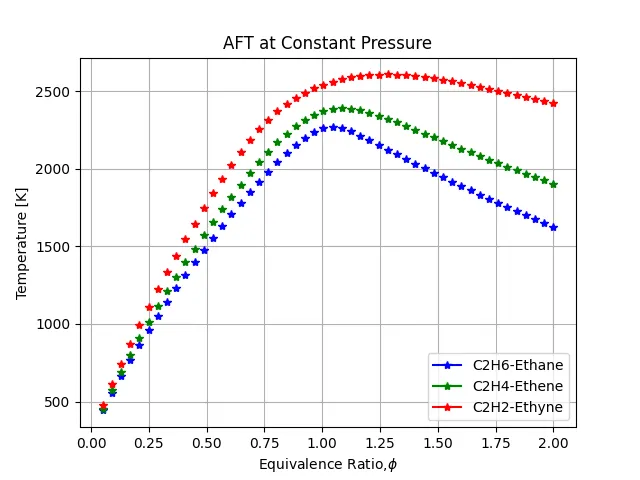
4. Adiabatic flame temperature variation with respect to a number of Carbon atom chains :
Variation with respect to a number of Carbon atoms was also mapped in a similar fashion. Clearly, changes in number of carbon atoms doesn't provide significant benefit. The AFT is close to around 2250 K more or less.
(Code contained in the same file)
Lastly, the effect of Constant pressure and Constant volume on AFT calculation was visualized.
Only Methane was picked this time. It can be observed that, the AFT is considerably high for the constant volume system. This is because some of the energy released during combustion goes into changing the volume of the control system as opposed to constant volume AFT where no heat is utilised in doing work of any kind.
(Code contained in the same file)