Week 2 - Flow over a Cylinder.
Objective
To simulate flow over Cylinder with different Reynolds number and calculate the coefficient of Drag and Lift for each case for a steady solver. And Simulate the flow with steady and unsteady case and calculate the Strouhal number for Re=100.
Induction:
Vortex shedding
When a fluid, such air or water, is moving through a non-streamlined object, like a bluff body, at a specified speed determined by its size and shape, vortex shedding happens. A Von Karman vortex street is the consequence of vortices that originate at the back of the item and periodically separate from both sides of the flow. On the downstream side of the object, low-pressure vortices alternately form as a result of the fluid's interaction with it. As a result, the object tends to travel in the direction of the area of low pressure.
Resonance can happen when a bluff structure doesn't have robust mounting and the frequency of vortex shedding coincides with the resonance frequency of the structure. As a result, the structure begins to vibrate with harmonic oscillations that are driven by the fluid's motion. This vibration can be felt in a number of situations, such as when windy overhead power line cables vibrate or while moving at a certain speed, whip radio antennas flutter.
Reynolds Number
The Reynolds number is defined as the ratio of inertial forces to viscous forces within the fluid. Mathematically, it can be expressed as:
`Re = (rho * U * L) / mu`
Where:
ρ is the density of the fluid,
U is the velocity of the fluid relative to the object,
L is the characteristic length,
μ is the dynamic viscosity of the fluid.
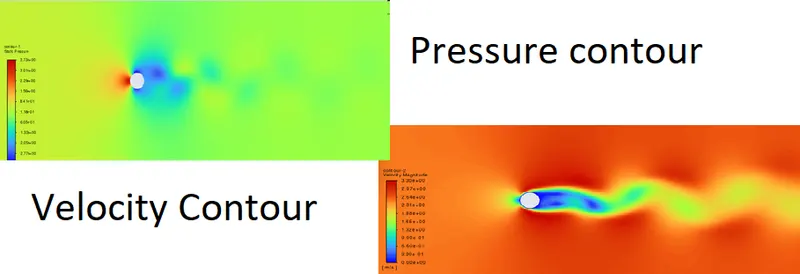
The size, shape, and kinematic viscosity of the fluid, as well as the body from which eddies are being shed, will all affect the range of Reynolds numbers. Rows of vortices are left in their wake as a result of the constant shedding of eddies from each side of the circular border over a large area. The core of one vortex in a row is placed opposite the halfway between two vortex cores in the adjacent row as a result of this alternate shedding, as seen in the image.
The regular pattern progressively disappears as the vortices go downstream because viscosity gradually lets go of their energy. The original alternating pattern eventually vanishes as the vortices eventually lose their energy and coherence.
Strouhal number (St):
Strouhal number is a dimensionless number describing oscillating flow mechanisms. The Strouhal number is often given as
`St = (f*d)/u`
Where,
f is the frequency of vortex shading,
L is the characteristic length and
U is the flow velocity.
Procedure
- Open a new fluent tree in Ansys WorkBench.
-
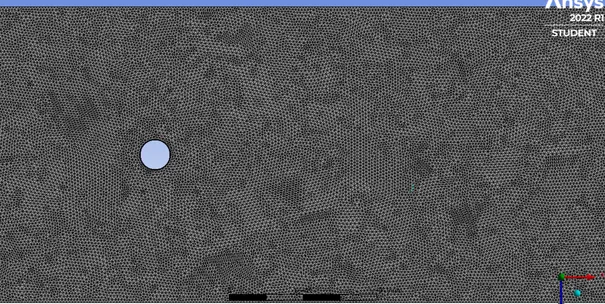
Draw a rectangular (60m*20m) with hole of dia 2m. A 20m away form left side and create a surface
Import the geometry into Mesh and give a approximate name to the edge.
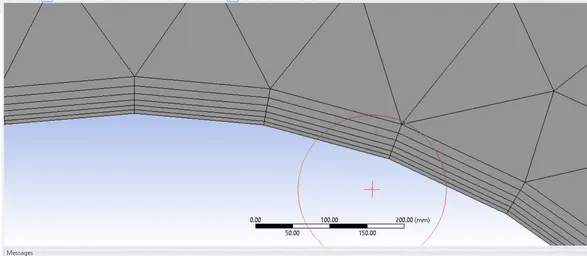
- And final and the infnlation at circle edge.

Solving :
1. select laminar flow inside the viscous model.
2.Materials :- density = 1 Kg/m3, Viscosity(Kg/m-s) = 0.05 calculated from Renolds number formulae.
Boundary Condition:
Outlet : gauge pressure = 0 Pa.
wall : no slip condition.
| Reynolds number | velocity |
| 10 | 0.25 |
| 100 | 2.5 |
| 1000 | 25 |
| 10000 | 250 |
| 100000 | 2500 |
Results
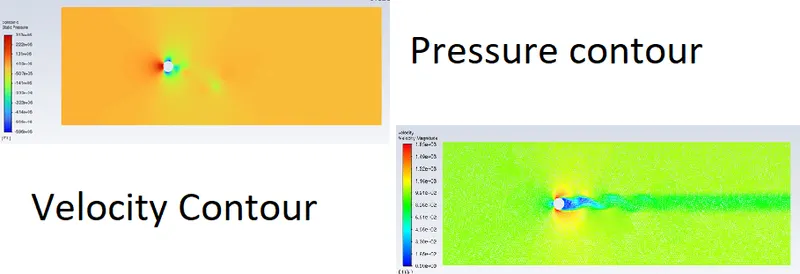
Steady State
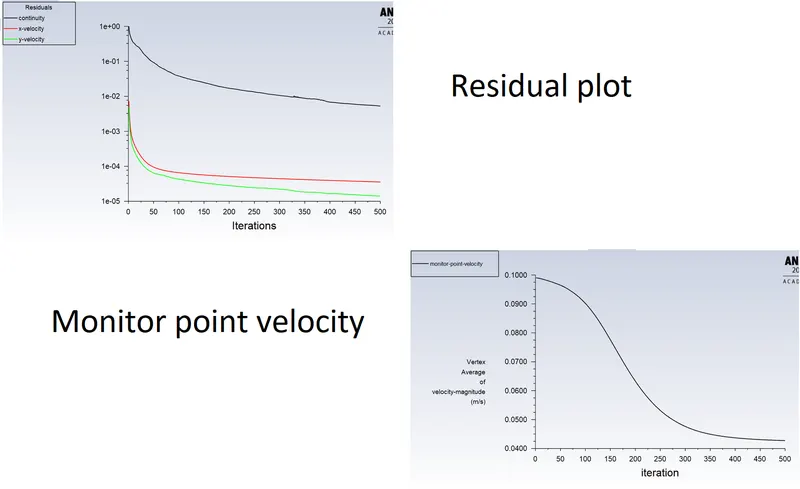
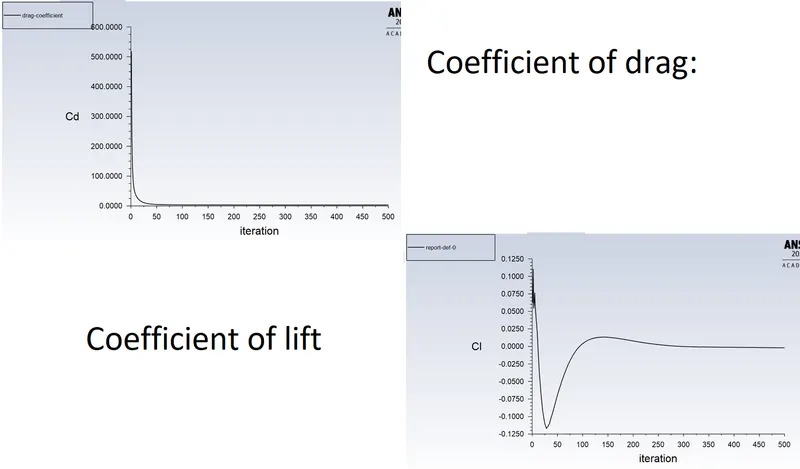
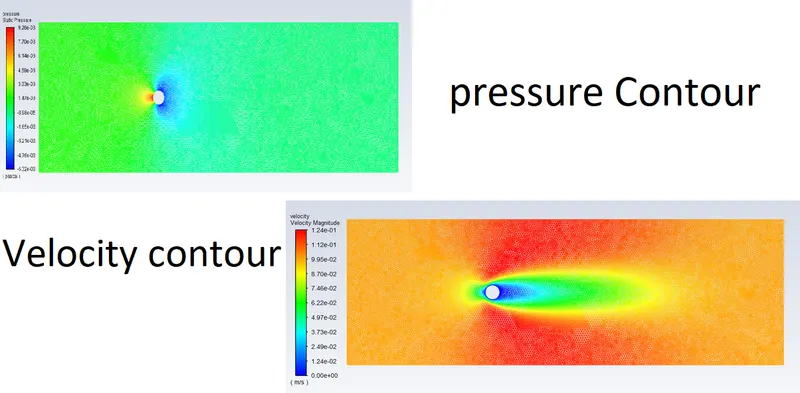
For Re=10
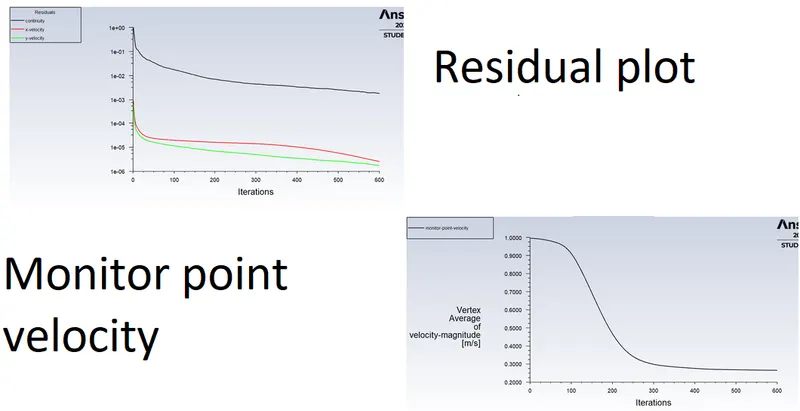
For Re=100
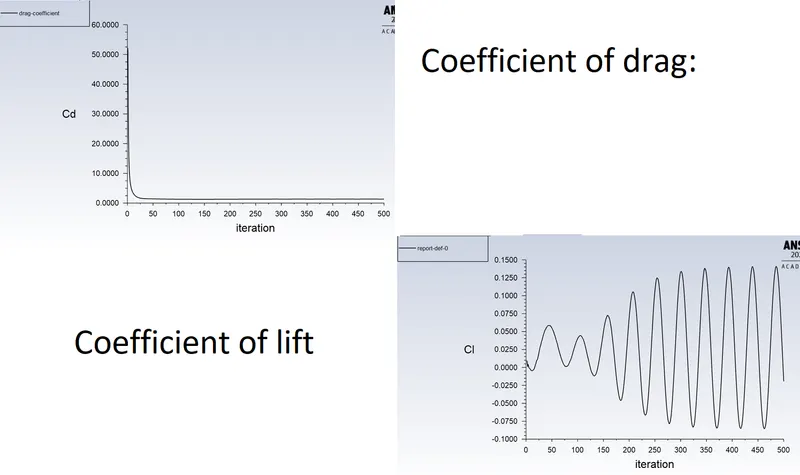
For Re=1000
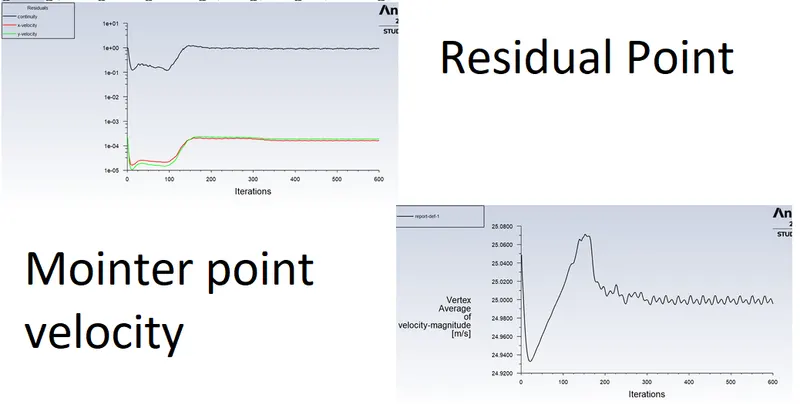
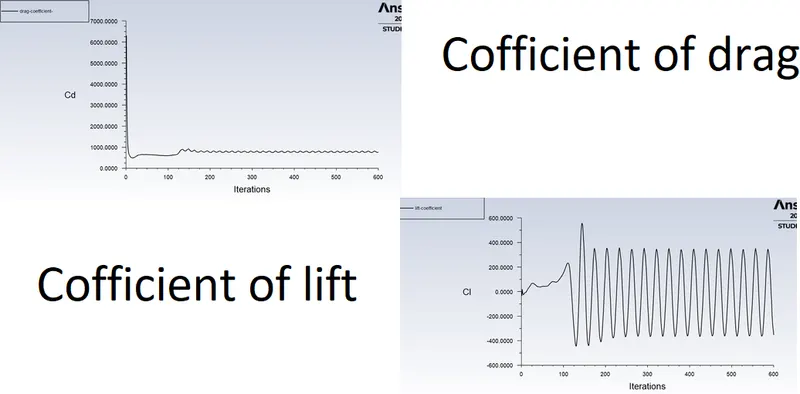
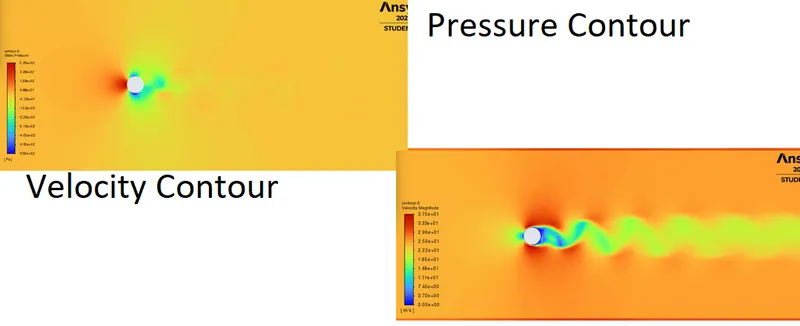
For Re=10000
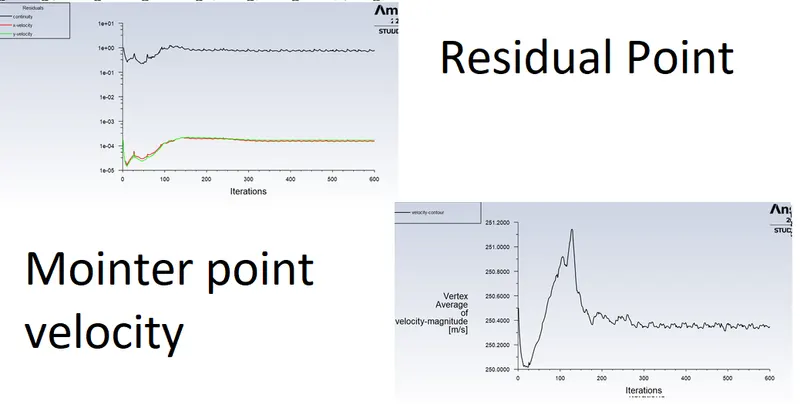
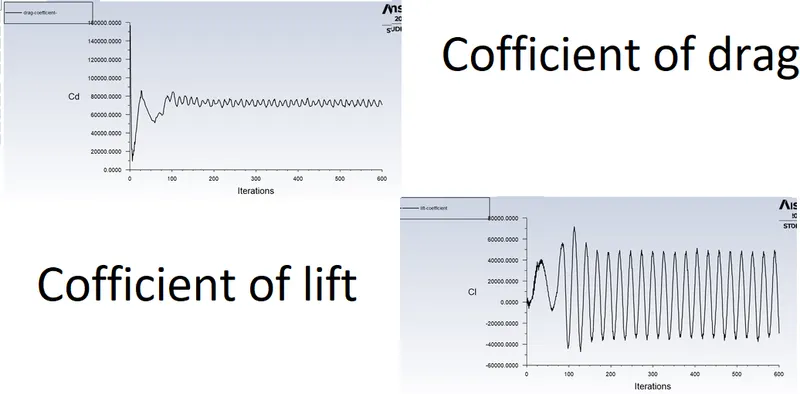
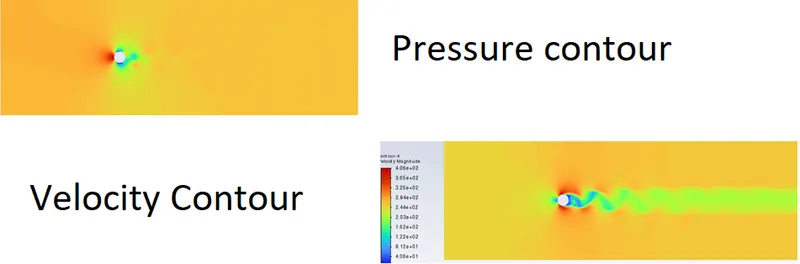
For Re=100000
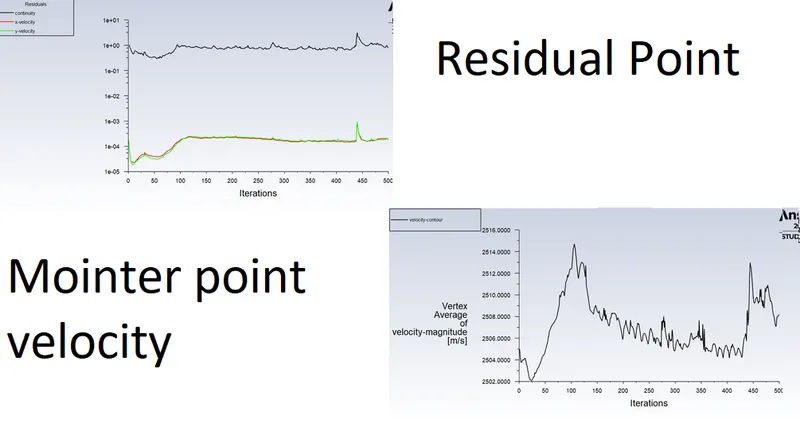
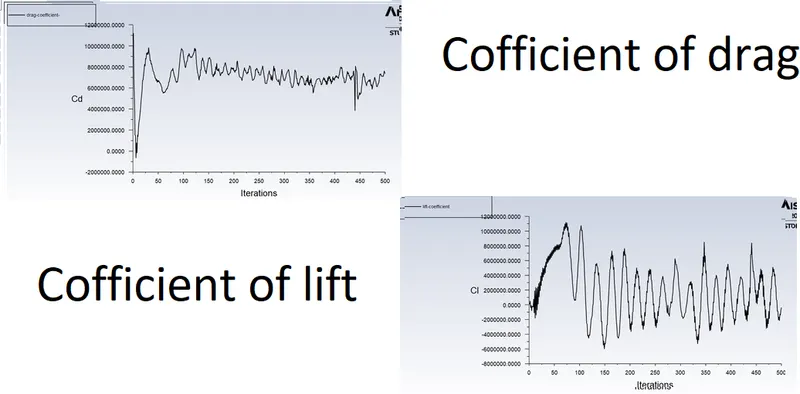
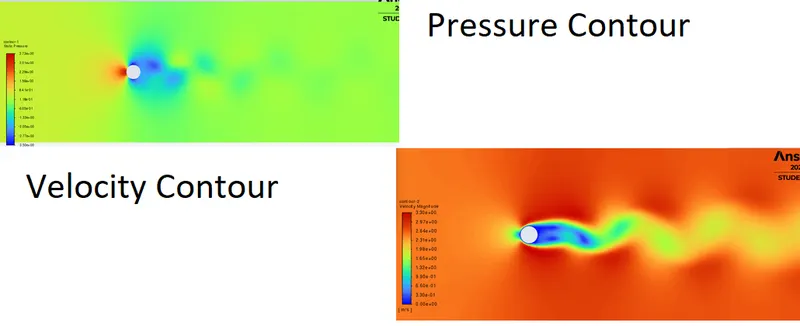
Unsteady flow
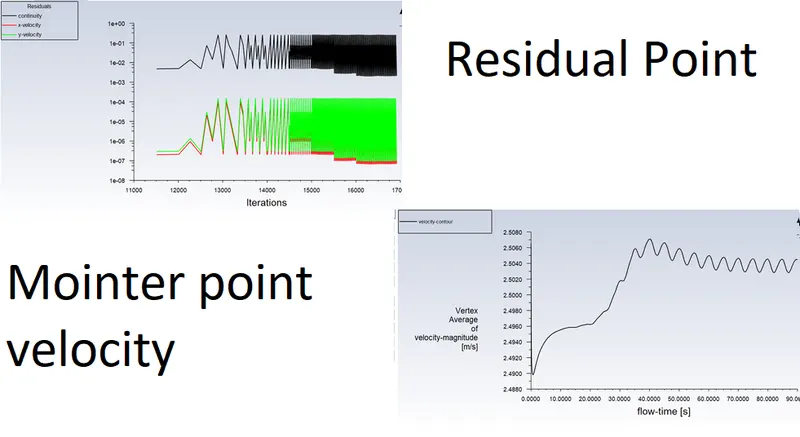
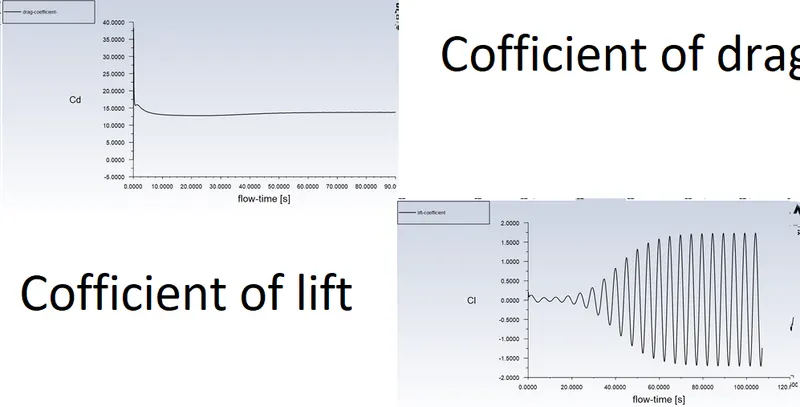
For Re=100
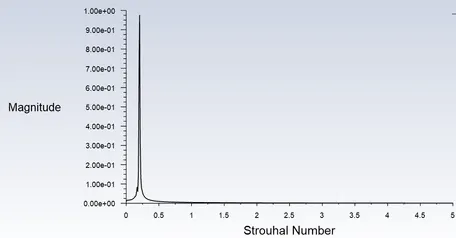
strauhal number
Calculation for strouhal number
To get the magnitude of strauhal number,
go to results > fft analyser > click on write fft to file > click on write fft.
open the file in excel and 1st coloumn denotes the frequncy and 2nd coloumn denotes strauhal number.use the command max and select 2nd row and find the magnitude of strauhal number.
Strauhal number of the transient oscillation is equivalent to 2.05E-01 when Reynolds number is 100 and velocity is 2.5 m/sec.
Effect of Reynolds Number on the drag coefficient
| Reynolds Number | Lift Cofficient | Drag cofficient |
| 10 | 0.0012 | 3.4 |
| 100 | 0.048 | 1.32 |
| 1000 | 0.049 | 1.18 |
| 10000 | 0.570 | 1.05 |
| 100000 | 0.680 | 0.85 |
CONCLUSION :
From the above plot, we can state that for a flow over a cylinder as Reynolds number increases, the drag co-efficient decreases.The cylinder's surface and the flowing air are rubbing against each other, causing the phenomena. It causes the boundary layer to collapse prior to flow separation; as a result, we experience flow separation, which reduces the amount of drag and increases the lift.