Week 2 - Flow over a Cylinder.
FLOW OVER A CYLINDER
Aim
To Simulate the flow over a cylinder and explain the phenomenon of Karman vortex street by using ANSYS Fluent.
Objective
- To Calculate the coefficient of drag and lift over a cylinder by setting the Reynolds number to 10,100,1000,10000 and 100000. (Run with steady solver)
- Discuss the effect of Reynolds number on the coefficient of drag
- Simulate the flow with the steady and unsteady case and calculate the Strouhal Number for Re as 100.
Introduction
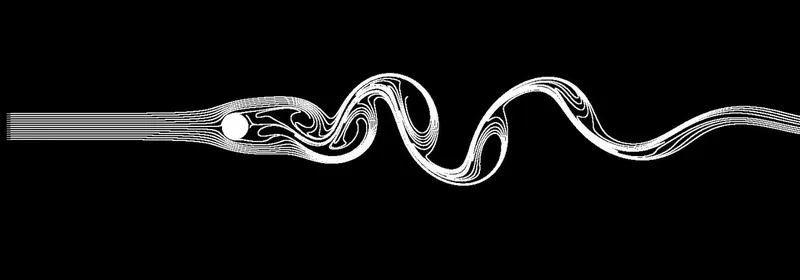
- Vortex shedding is an oscillating flow that occurs when a fluid, such as air or water, flows at different velocities through a bluff (as opposed to streamlined) body, depending on the size and form of the body. In this flow, vortices develop towards the rear of the body and separate from either side of the body on a regular basis, generating a Von Karman vortex street. On the downstream side of the item, the fluid flow forms alternating low-pressure vortices. The item will gravitate towards the low-pressure area.
- If the bluff structure is not firmly attached and the frequency of vortex shedding matches the structure's resonance frequency, the structure can begin to resonate, vibrating with harmonic oscillations produced by the flow's energy.
Reynolds Number (Re):
Reynolds number for a flow is a measure of the ratio of inertial to viscous forces in the flow of a fluid around a body.
`Re=\frac{\rho uD}{\mu }`
Where,
`\rho` is density of the flowing fluid over a cylinder
u is the velocity of the flowing fluid over a cylinder
D is the diameter of the cylinder
`\mu` is the dynamic viscosity of the flowing fluid over a cylinder
Strouhal number (Sr)
Strouhal number is a dimensionless number describing oscillating flow mechanisms.
The Strouhal number is often given as
`Sr=\frac{f.D}{u }`
Where,
f is the frequency of vortex shading,
D is the diameter of the cylinder
u is the flow velocity.
Coefficient of drag:
In fluid dynamics, the drag coefficient (`C_d`) is a dimensionless quantity that is used to quantify the drag or resistance of an object in a fluid environment, such as air or water. It is used in the drag equation in which a lower drag coefficient indicates the object will have a less aerodynamic or hydrodynamic drag. The drag coefficient is always associated with a particular surface area.
The drag coefficient (`C_d`) is defined as
`C_d=\frac{2.F_d}{\rho u^2A }`
where:
- `F_d` is the drag force, (force component in the direction of the flow velocity)
Coefficient of lift:
The lift coefficient (`C_l`) is a dimensionless coefficient that relates the lift generated by a lifting body to the fluid density around the body, the fluid velocity, and an associated reference area. A lifting body is a foil or a complete foil-bearing body such as a fixed-wing aircraft.
`C_d=\frac{2.F_l}{\rho u^2A }`
where:
- `F_l` is the lift force, (force component in the direction of normal to the flow velocity)
Steps for the Simulation:
- Create the geomentry or load the geomentry
- Discretize the geomentry with adaptable mesh element size
- Apply the material and boundary conditions
- Solve the problem
- Interrupt the results
Problem Setup
Geometry
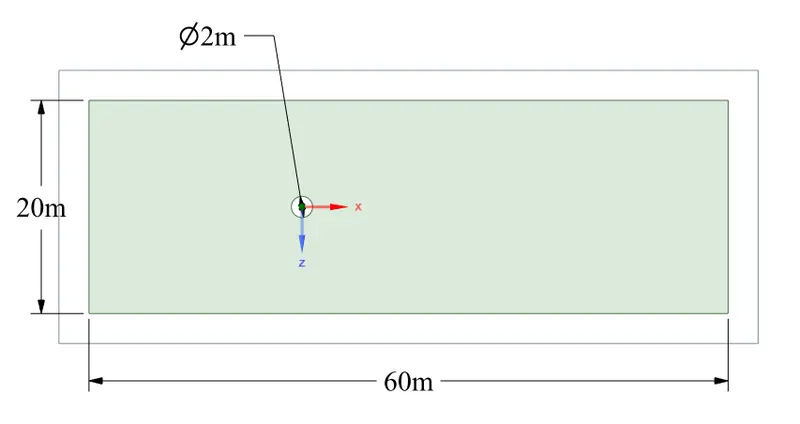
- After the geometry was created, load the geomentry in to mesh to discretize the geomentry with the mesh element size of 100mm (Note: Mesh element size is depends upon the refinement of the mesh based on the required criteria)
Mesh
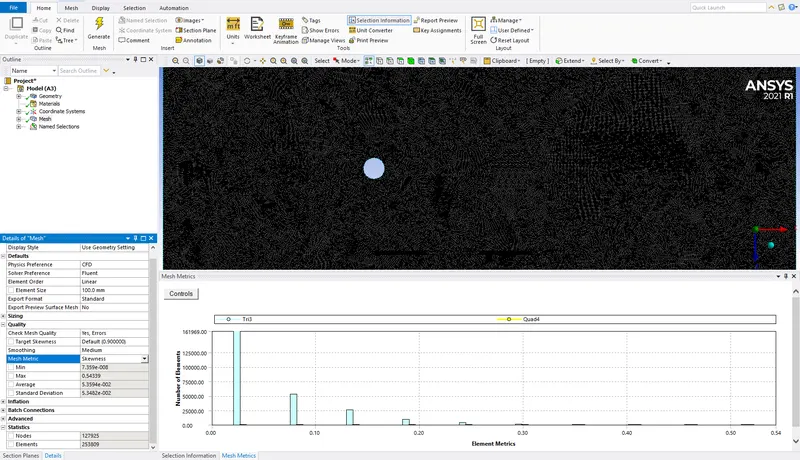
- After the geometry was discretize with the mesh element of 100 mm, load the mesh into Fluient solver to solve the problem.
Solution Setup
Fluent Solver
- Viscous - laminar model
- Fluid- user defined (`\rho =1 {kg}/m^3,\mu=0.05Pa.s`)
- Method of solve- SIMPLE
- monitoring point - 8 m in x-direction from center of the cylinder
- Create reports/plots for drag, lift, velocity with respect to monitoring point.
- Create reports/plots for drag coefficient and lift coefficient with respect to cylinder wall.
- Initialization - Hybrid
Results
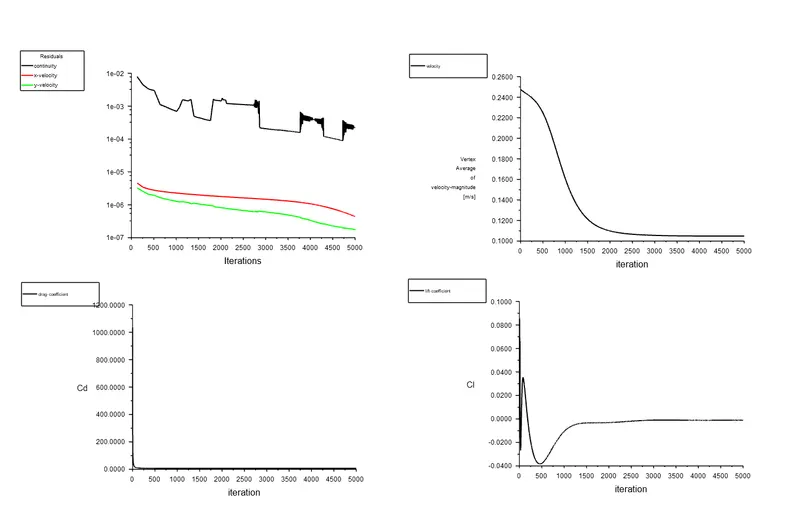
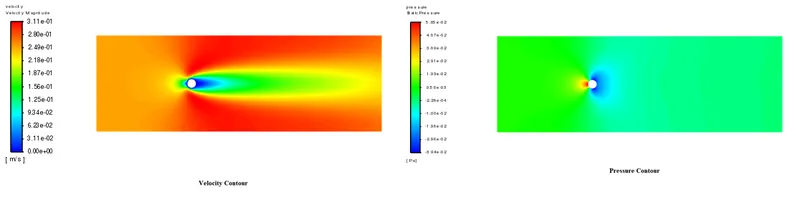
(i) Re=10
Plots
Contours
(ii) Re=100
Plots
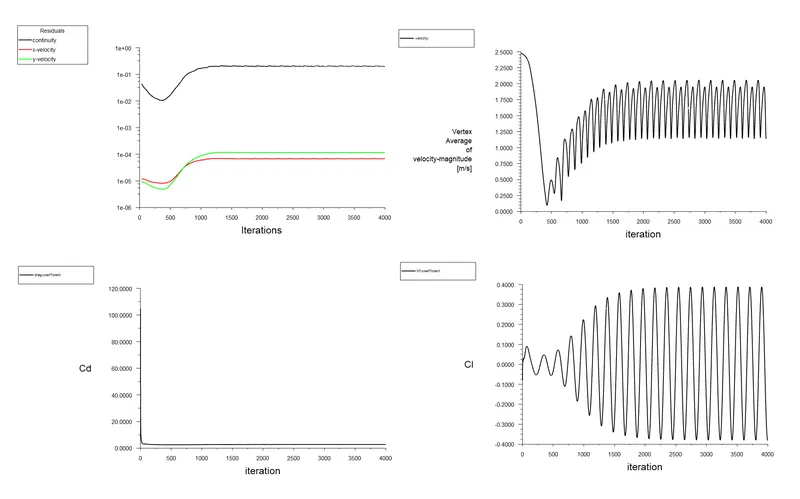
Contours
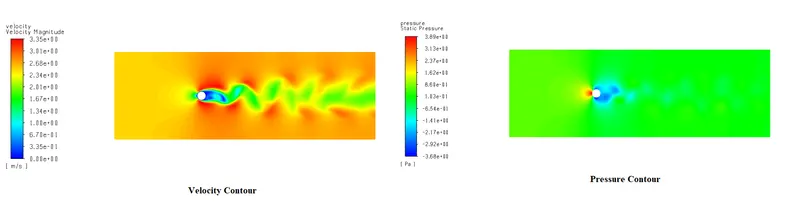
Vertex flow simulation
Animation Video link: https://drive.google.com/file/d/1pjDsIPxkjmJ4vDeOqOrkzqrhMl6h5dq5/view?usp=sharing
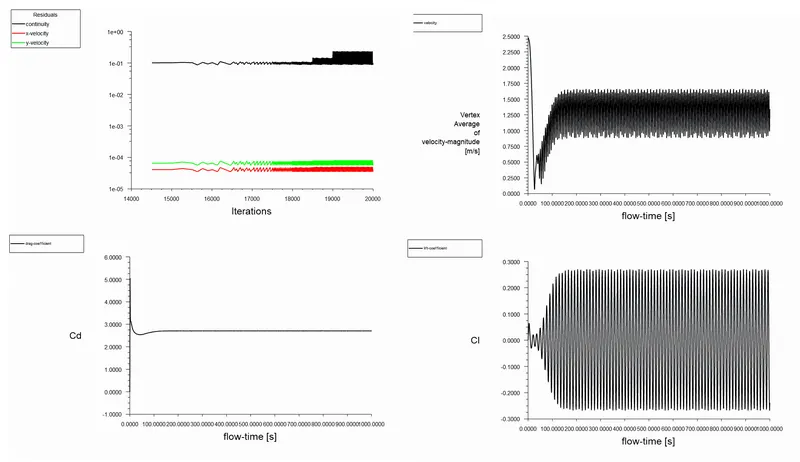
(iii) Re=100 (Transient)
Plots
Contours
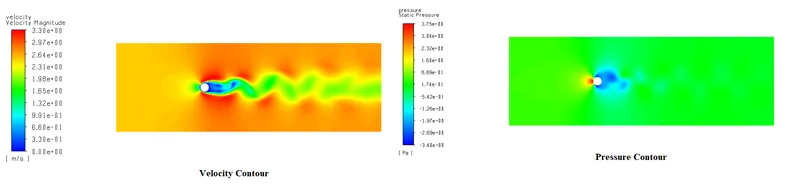
Vertex flow simulation
Animation Video link: https://drive.google.com/file/d/1cxT65LM4EHfXbBOqtDEuY-SdvbeWuUKn/view?usp=sharing
(iv) Re=1000
Plots
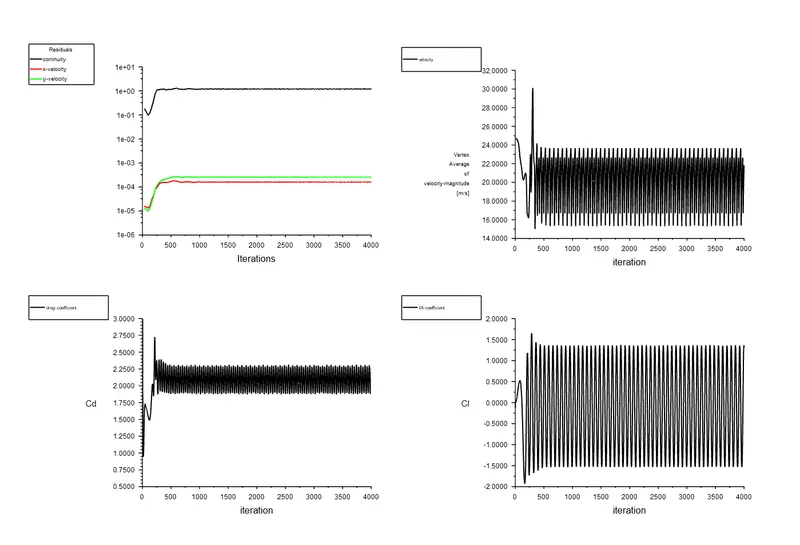
Contours
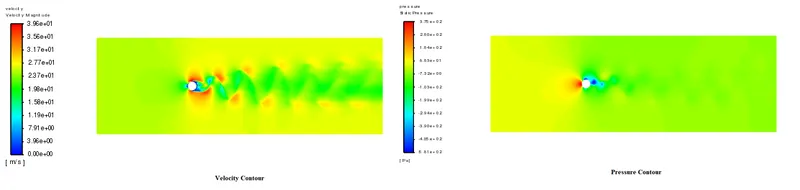
Vertex flow simulation
Animation Video link: https://drive.google.com/file/d/1jGGS_Sj7TTqffVl2OW4wrkE7NW75TPo9/view?usp=sharing
(v) Re=10000
Plots
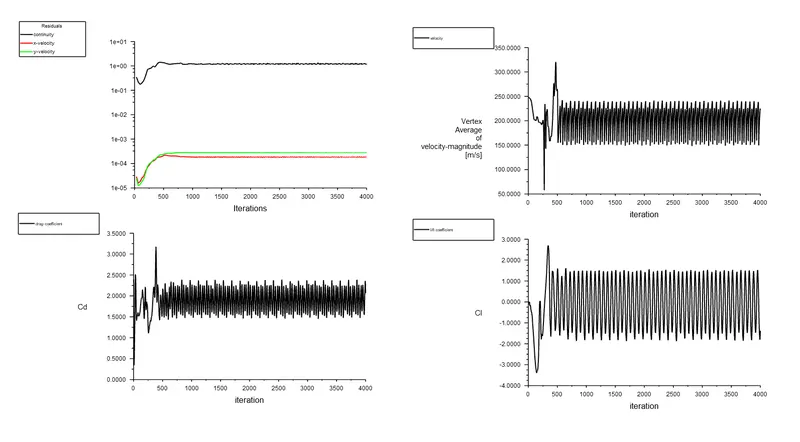
Contours
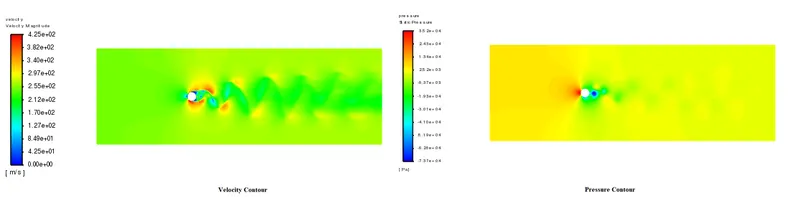
Vertex flow simulation
Animation Video link: https://drive.google.com/file/d/1JbJxEDs-XwoB7BtIy2r4bUDBeywf2_he/view?usp=sharing
(vi) Re=100000
Plots
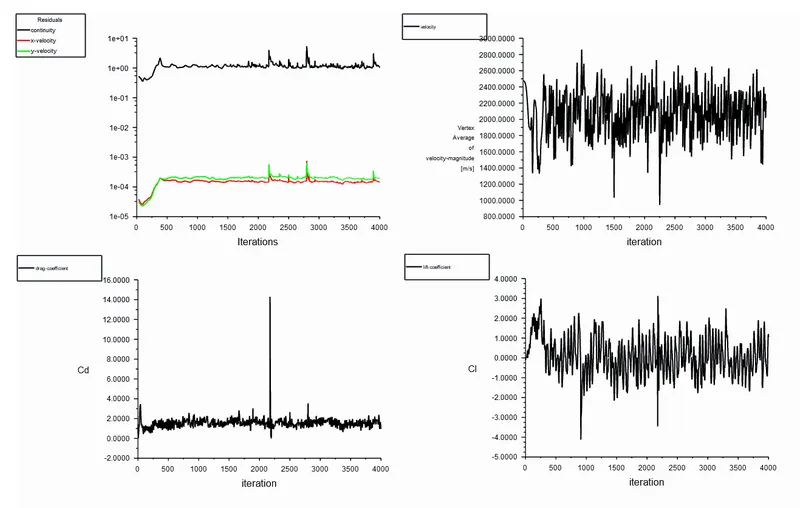
Contours
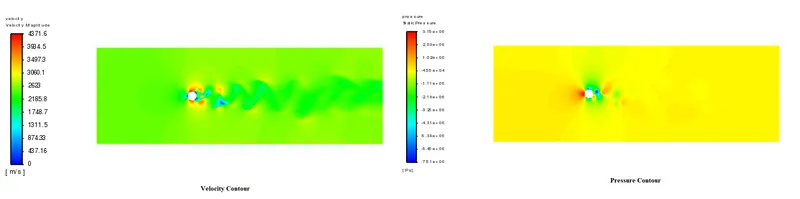
Vertex flow simulation
Animation Video link: https://drive.google.com/file/d/1qkncyszgJPgbOlcf74JSCRdjbU6n39CF/view?usp=sharing
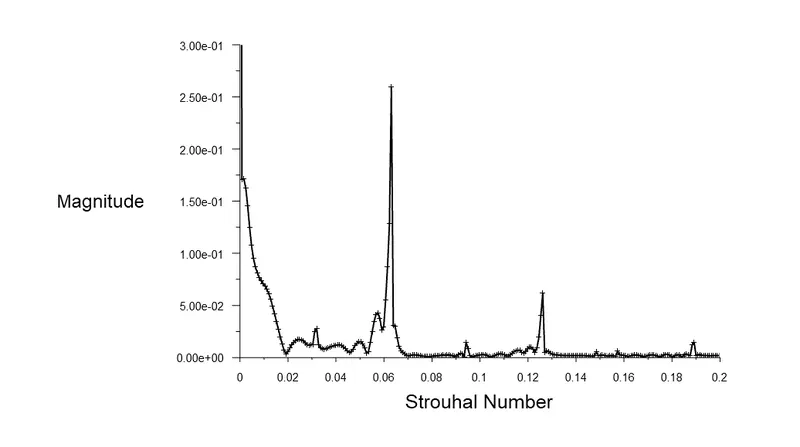
Strouhal number (Sr)
|
Reynolds Number |
Velocity at monitoring point (m/s) |
Coefficient of Drag (Cd) |
Coefficient of Lift (Cf) |
|
10 |
0.10484 | 6.6766 | -0.001048 |
|
100 |
1.1463614 |
2.7773 |
-0.37834 |
|
100 (Transient) |
1.5922 |
2.7064 |
0.05713 |
|
1000 |
21.828 | 2.2792 | 1.3025 |
|
10000 |
222.374 | 2.0667 | -1.3784 |
|
100000 |
2227.986 | 1.0489 | 1.0427 |
Conclusion:
- When fluid flows over a cylinder, a wake region forms next to the cylinder due to a decrease in pressure, and flow recirculation occurs, resulting in flow separation.
- Six separate simulations are run (Re = 10,100,1000,10000,100000,1000000) to study the behaviour of the drag and lift coefficients when the Reynolds number is changed.
- The creation of vortex shedding is not detected for Re=10, although it is clearly evident in the other situations.
- The results are confirmed from the literature based on the fundamental circumstances and parameters.
- The flow across a cylinder is simulated for both steady and unstable scenarios with Re=100, and the results show the Von Karman Vortex Street phenomenon.
- Strouhal number was estimated for unsteady state with Reynolds number of 100 for flow over a cylinder is 0.139.