Week 2 - Flow over a Cylinder.
OBJECTIVE: Simulate the flow over a cylinder
PART-I
- Simulate the flow with the steady and unsteady case and calculate the Strouhal Number for Re= 100.
PART-II
- Calculate the coefficient of drag and lift over a cylinder by setting the Reynolds number to 10,100,1000,10000 & 100000. (with steady solver)
- Discuss the effect of Reynolds number on the coefficient of drag.
THEORY:
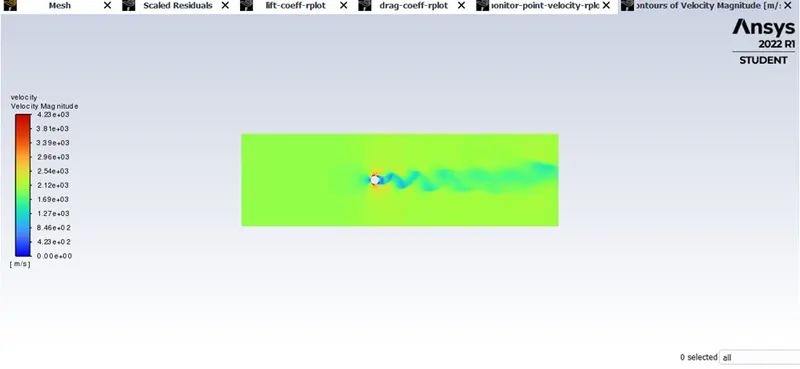
A von Karman vortex street is a repeating pattern of swirling vortices arising in the wake of flows around blunt objects. This phenomenon is often exemplified on 2-dimensional flow around a cylinder. Vortex shedding is of practical interest as it exerts a (typically undesirable) cyclic load on the body (i.e., the cylinder). The phenomenon arises under certain flow conditions, expressed commonly by the dimensionless Reynolds number.
Co-efficient of drag, in fluid dynamics is a dimensionless quantity that is used to quantify the drag of an object in the fluid environment. It is used in the drag equation in which a lower drag indicates that the object will have less aerodynamic resistance, though drag coefficient is always associated with particular area.
Co-efficient of lift, is a dimensionless quantity that relates the lift generated by a lifting body to fluid density around the body, fluid velocity and an associate reference area. Lift coefficient is a function of the angle of the body to the flow, its Reynolds number and the Mach number. The section lift coefficient refers to dynamic lift characteristics of two-dimensional foil.
Strouhal number, is a dimensionless number describing oscillating flow mechanism. For larger Strouhal number viscosity dominates the fluid flow resulting in collective oscillating movement of fluid, for ow Strouhal number quasi steady state portion of thee movement dominates the oscillation.
PROCEDURE: We start by creating our 2D sketch in space-claim and then use the pull tool to convert the sketch into the required surface.
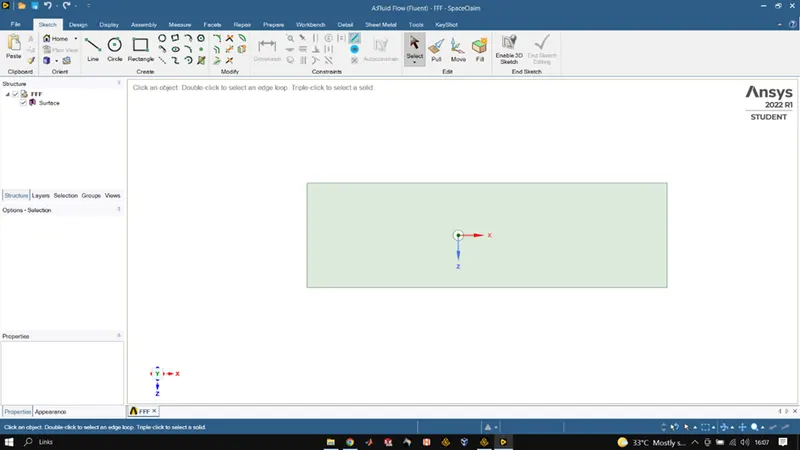
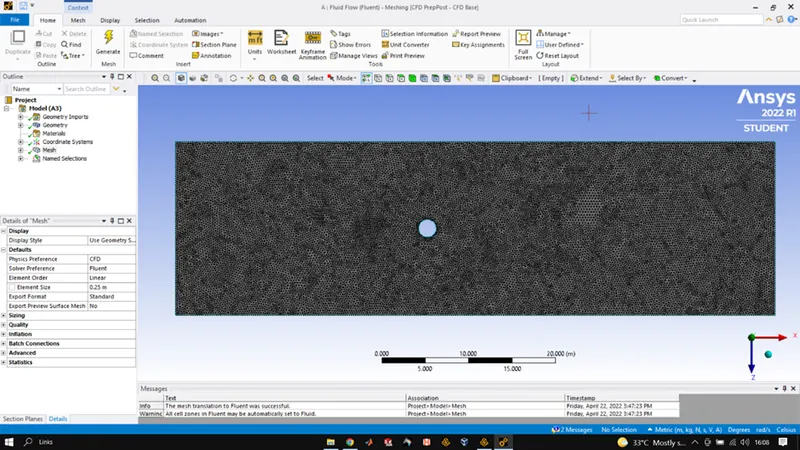
Once we make the sketch, we head to mesh GUI where we set the element size of the mesh as 0.25 and after that we insert a method into the mesh where we select the body we are willing to mesh and make the mesh triangle dominant from quadrilateral dominant. After that we insert the sizing option and select the edge of the cylinder and divide into 36 divisions to make our edge of the cylinder smoother. After that we insert inflation layer it is like body fitting in modelling. We select the body and then we select the boundary and then we decide to make 6 layers increasing with rate of 1.2 and the height of the layer was set to 5e-3. We update our mesh and gave name to all the boundaries in a appropriate manner.
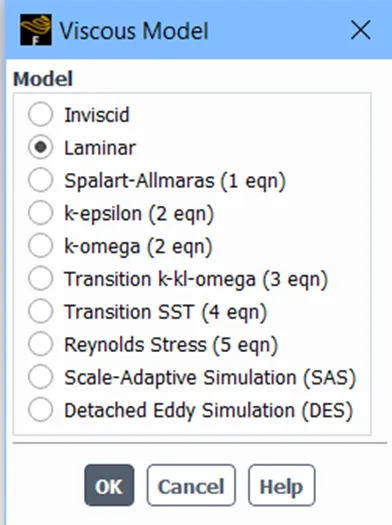
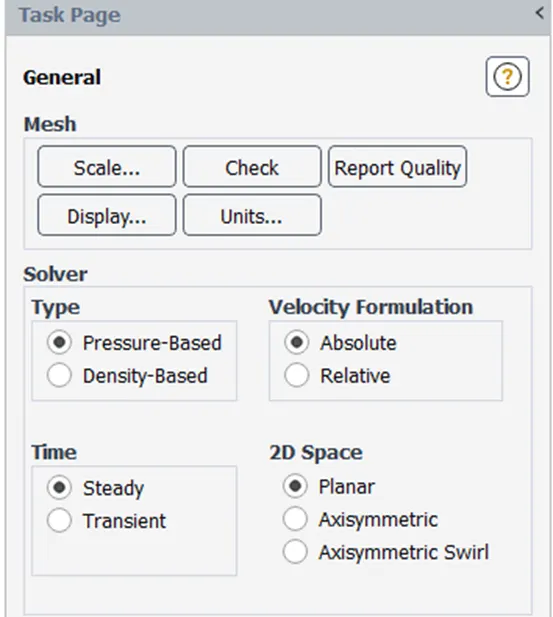
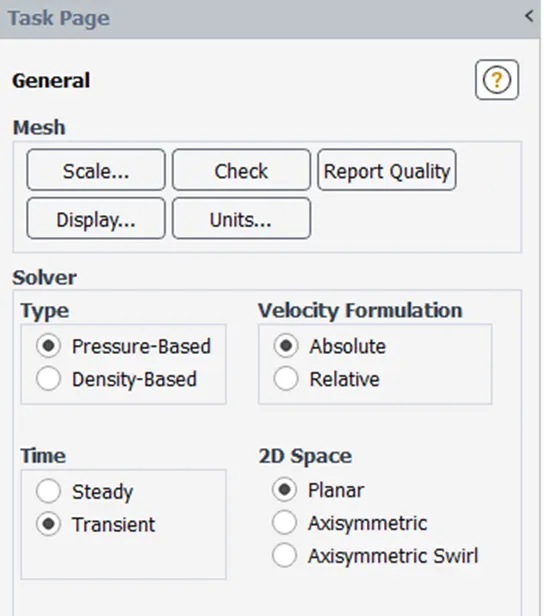
After that we head to setup which launches Ansys fluent, there we first perform mesh check if its ok we step ahead. We head to physics where we decide our model type and define our cell materials and boundary initial conditions, we also create a new material to have control over the Reynolds number for different test cases. Here we performed steady state simulation with laminar model type.
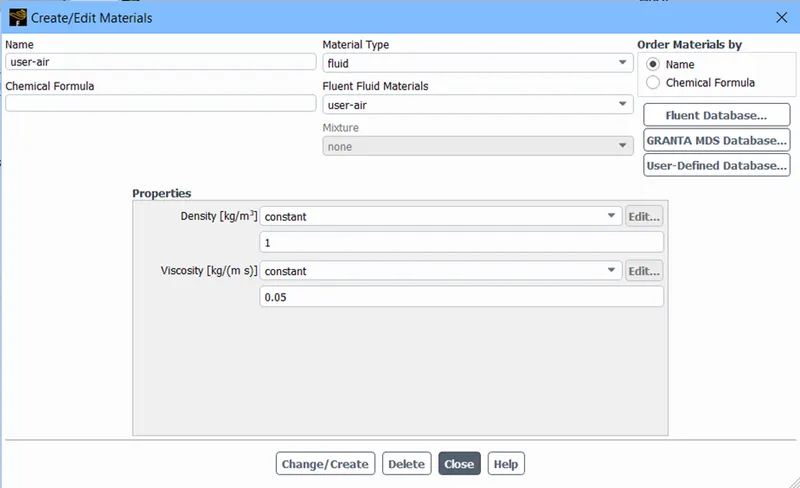
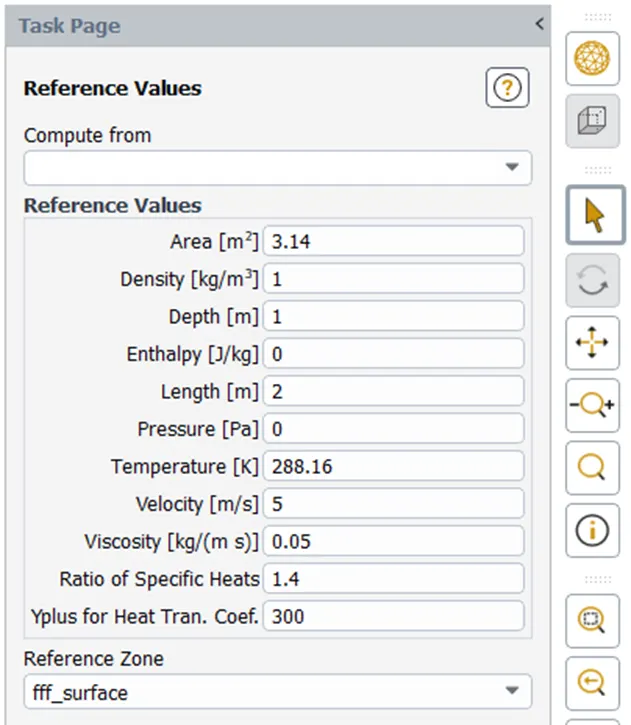
Reference values were provided so that calculation of drag coefficient and lift coefficient are calculated accurately.
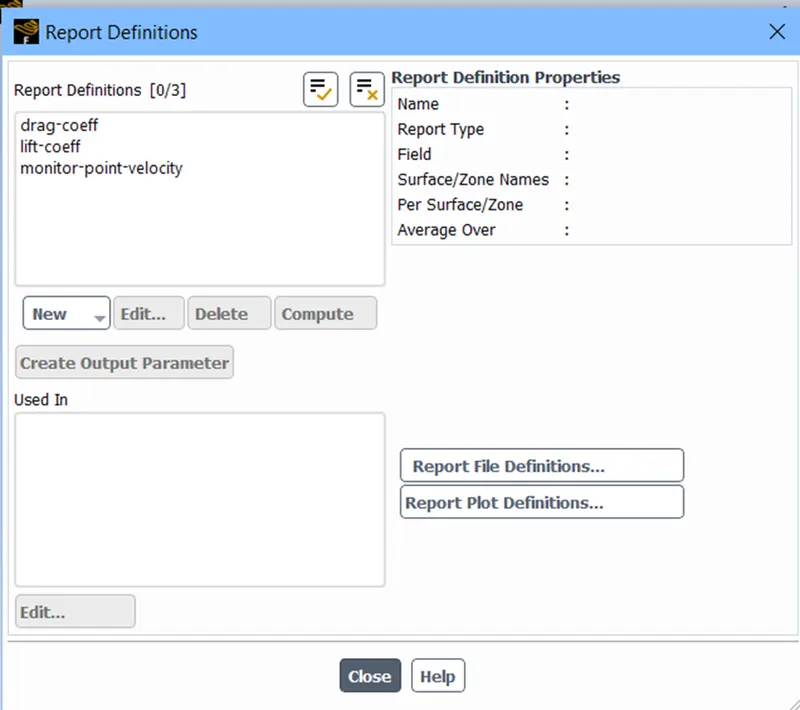
After that we went to definition and added the plots we wanted from surface plot and force plot.
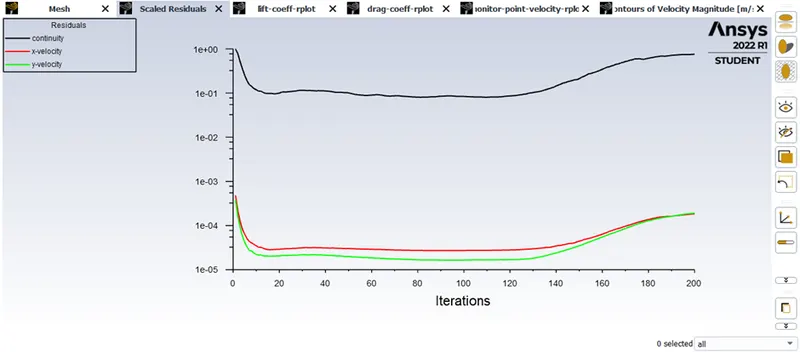
And in residuals we unchecked convergence in order to run the simulation complelty for the number of iterations we want.
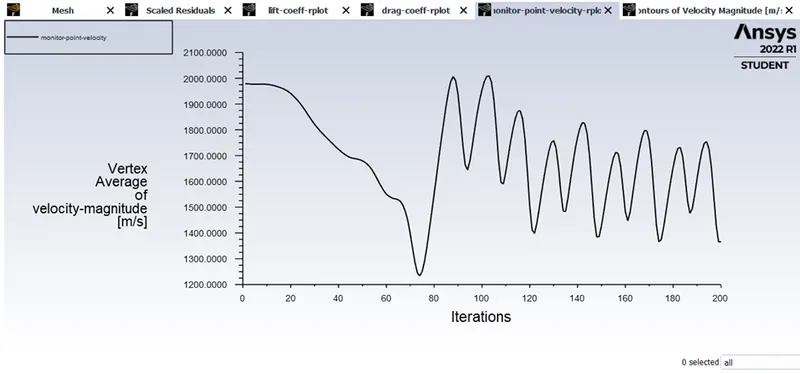
After this we initialised the solution in hybrid mode and once it was done we we created velocity contours and animation files. And to plot the vertex avaerage we created a monitor point 8m right of the cylinder ( this was done before initialising)
RESULTS:
STEADY STATE for Re = 100, density =1, viscosity = 0.05, inlet velocity = 5m/s
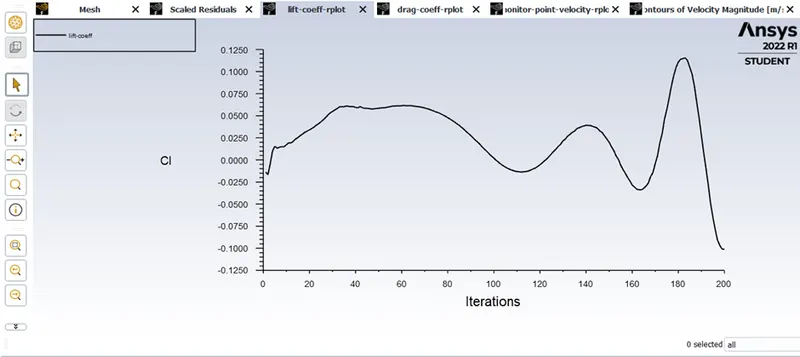
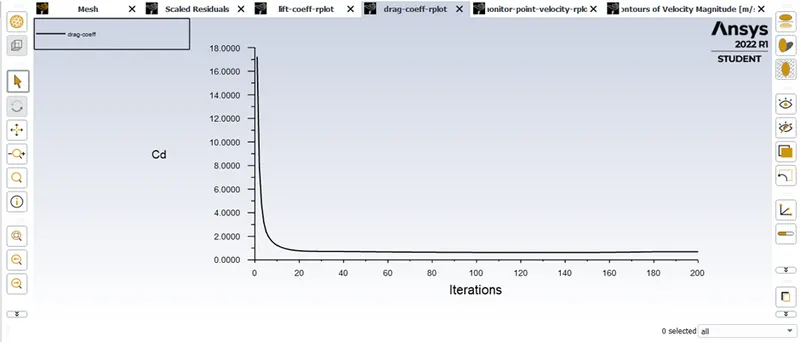
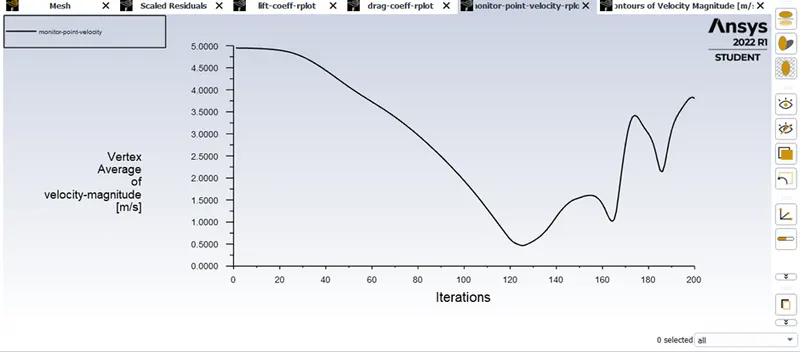
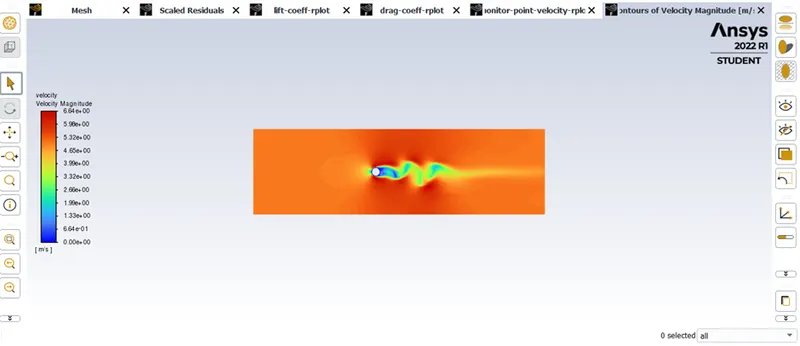
After that we changed time to transient and ran the simulation with same setup for Re=100.
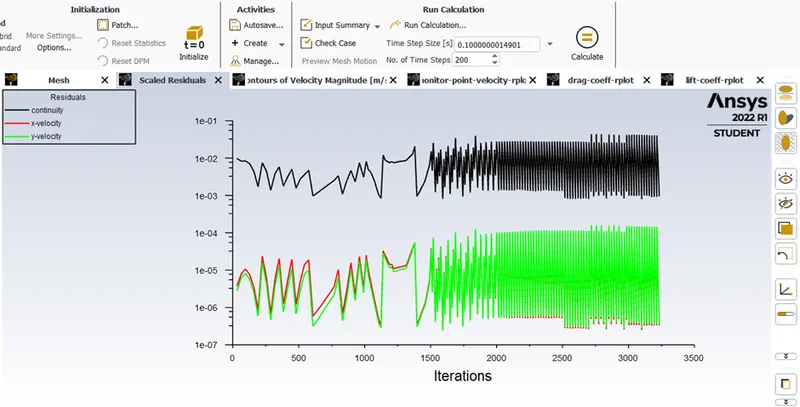
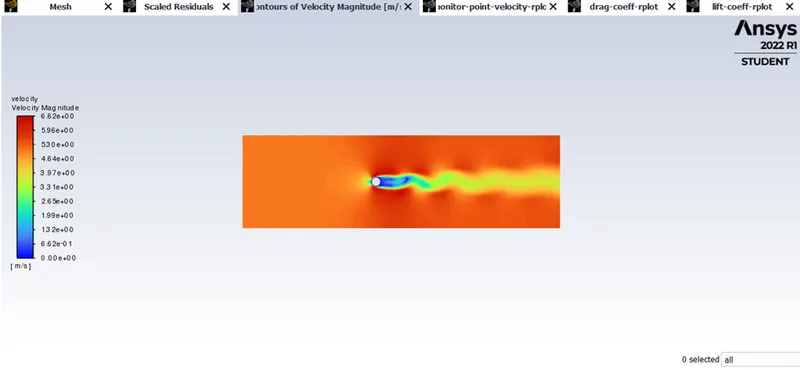
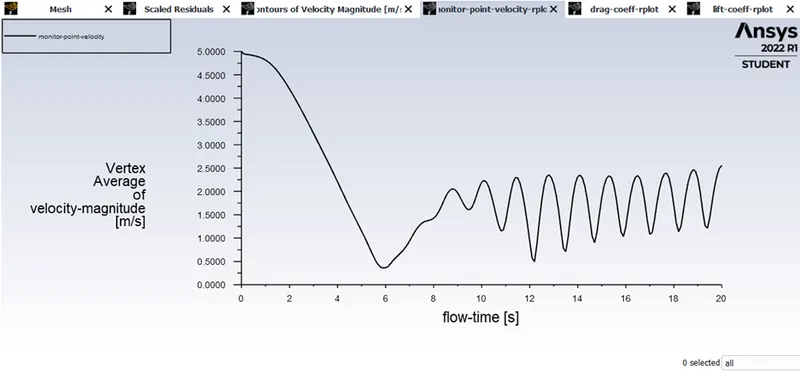
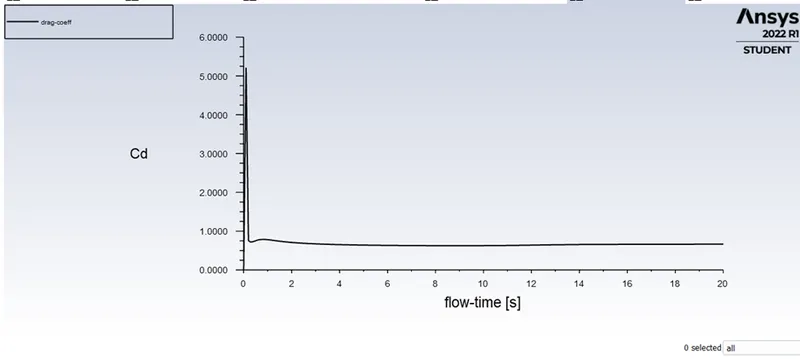
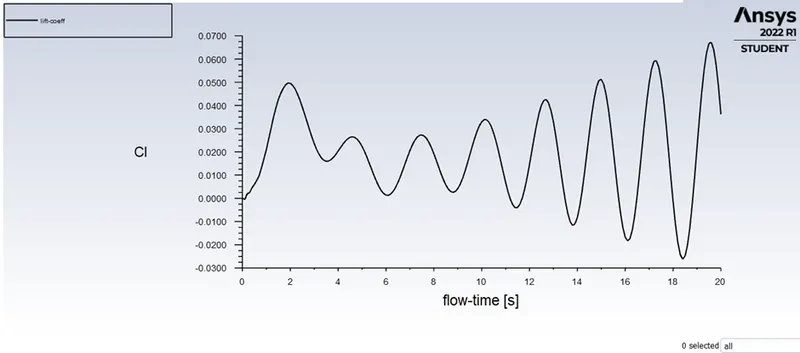
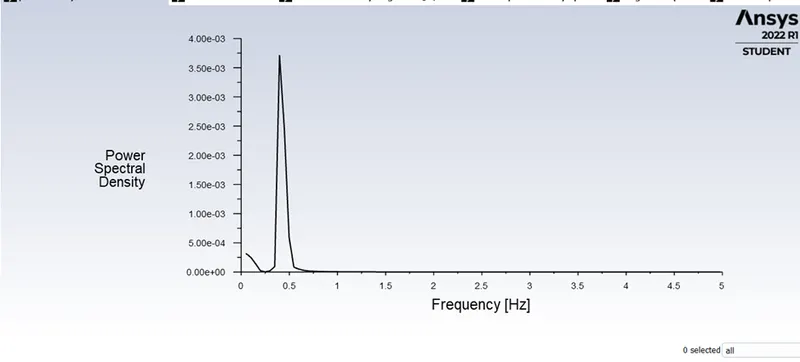
We plotted Strouhal number using the FFT analyser tool. we wrote the Strouhal number in an excel file by loading the load lift file and writing it down in an excel file.
Based on the excel file the STROUHAL NUMBER IS 3.71e-03
STEADY STATE for Re = 10, density =1, viscosity = 0.05, inlet velocity = 0.5m/s
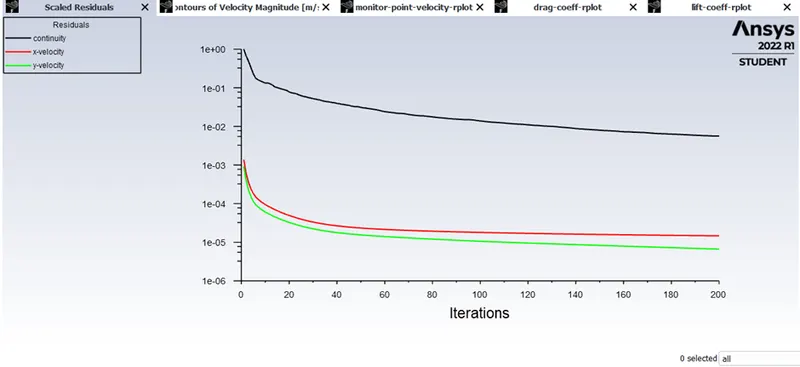
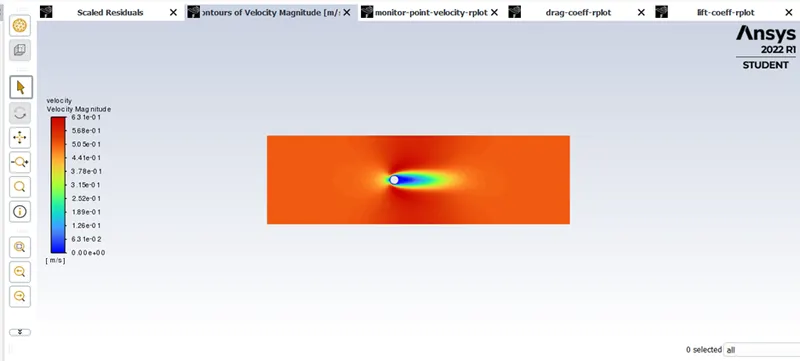
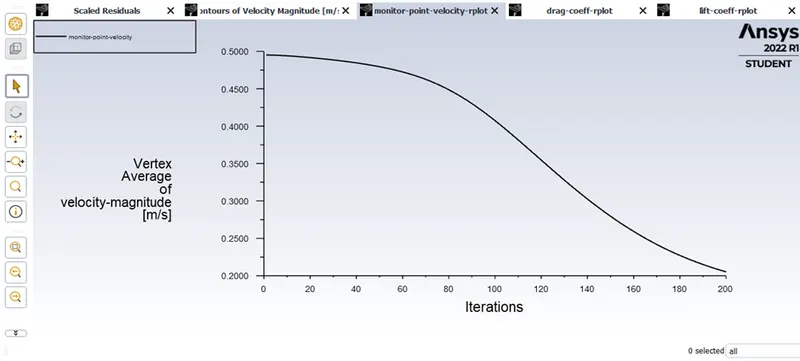
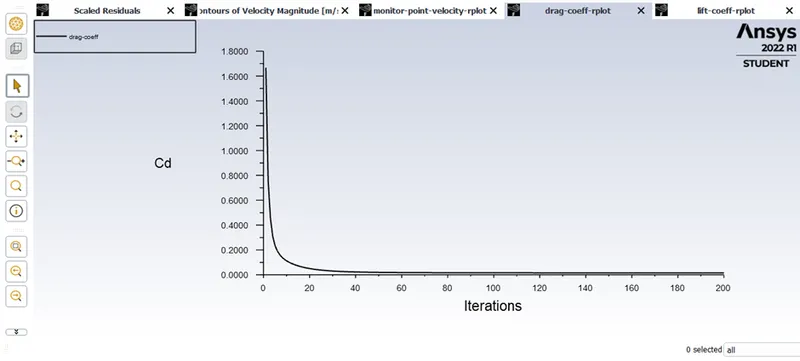
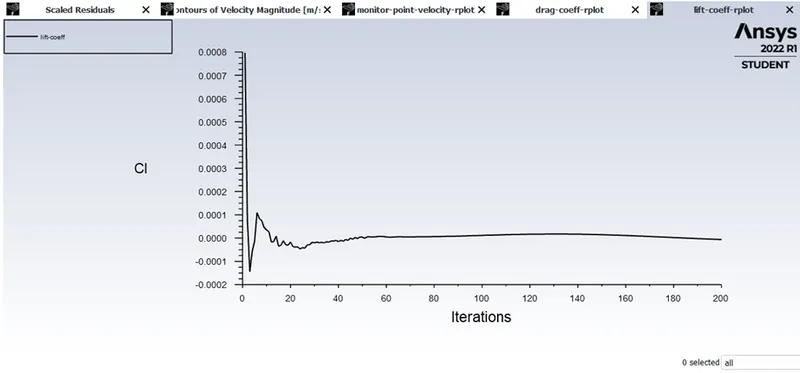
STEADY STATE for Re = 1000, density =1, viscosity = 0.05, inlet velocity = 50m/s
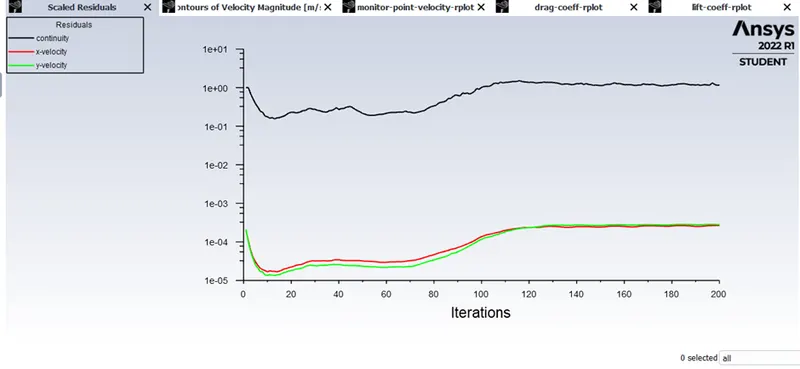
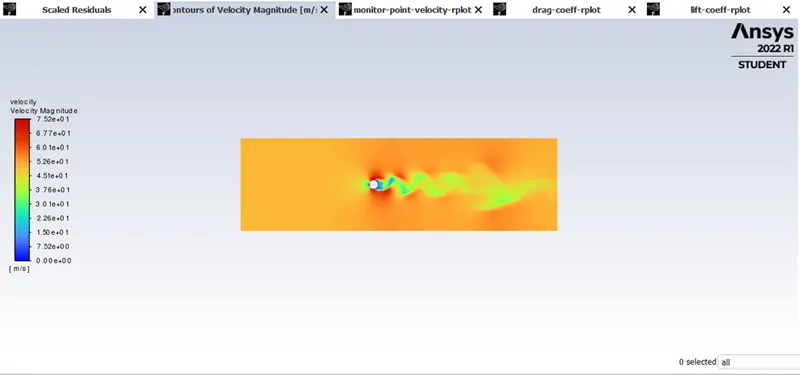
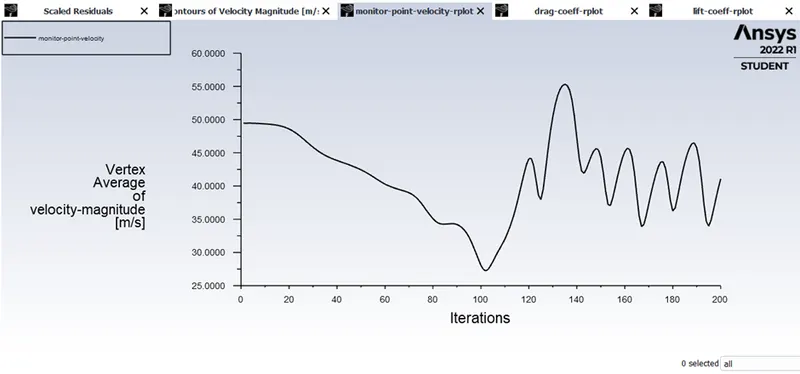
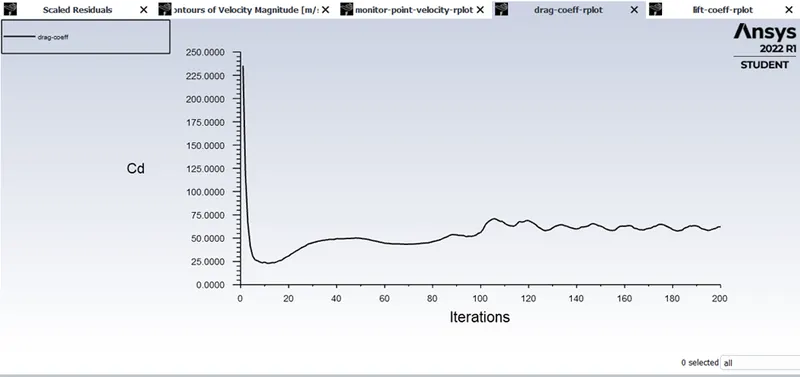
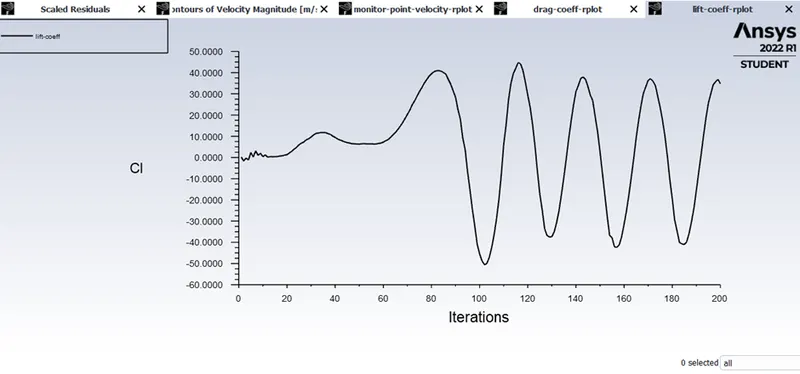
STEADY STATE for Re = 10000, density =1, viscosity = 0.02, inlet velocity = 200m/s
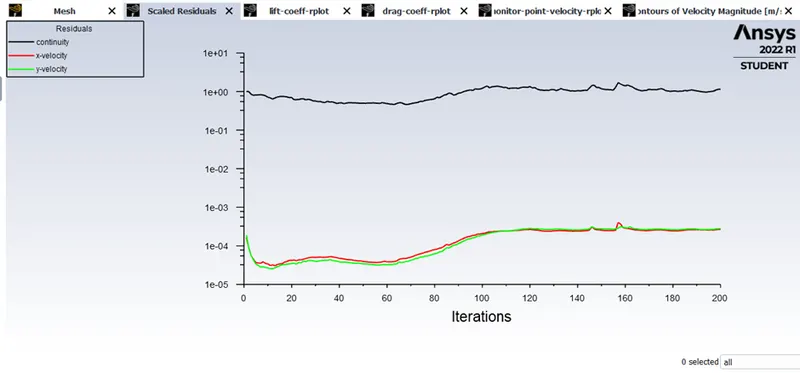
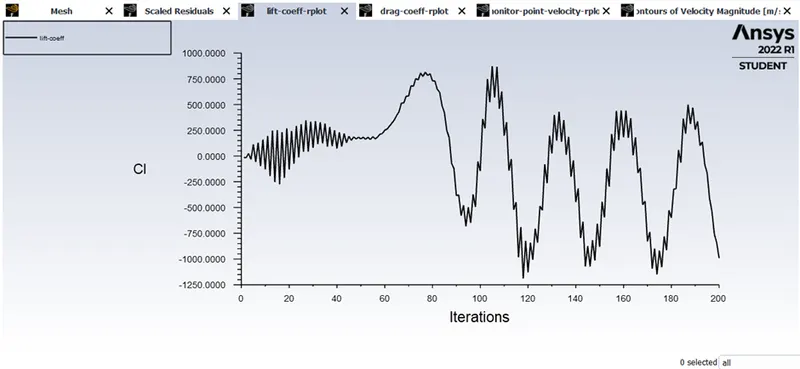
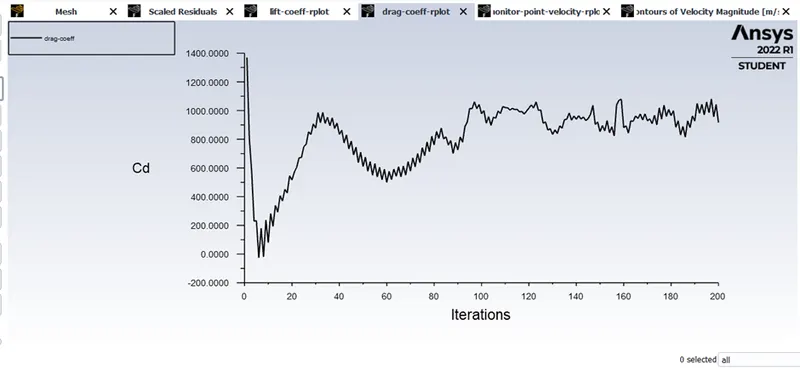
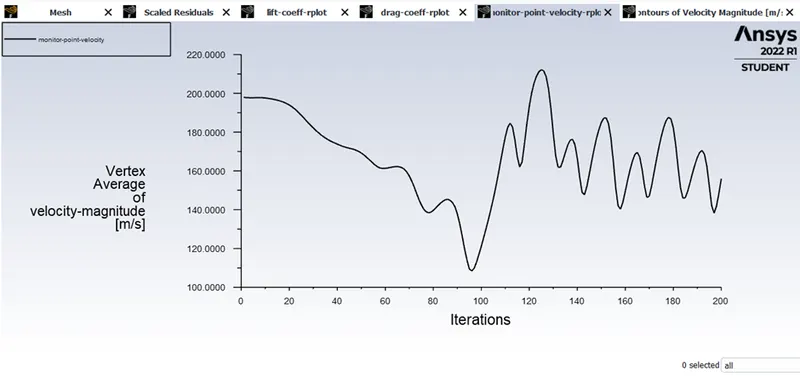
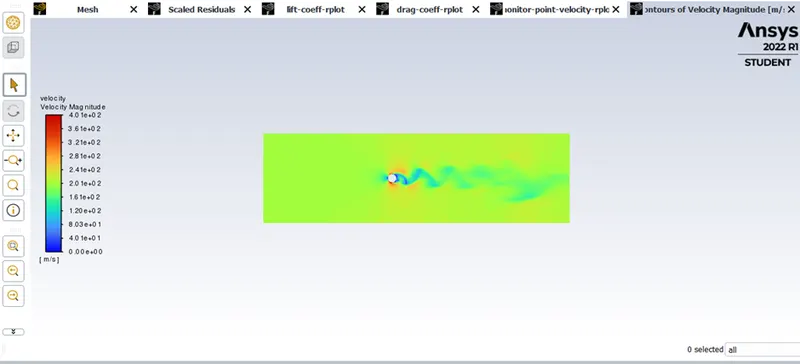
STEADY STATE for Re = 100000, density =1, viscosity = 0.02, inlet velocity = 2000m/s
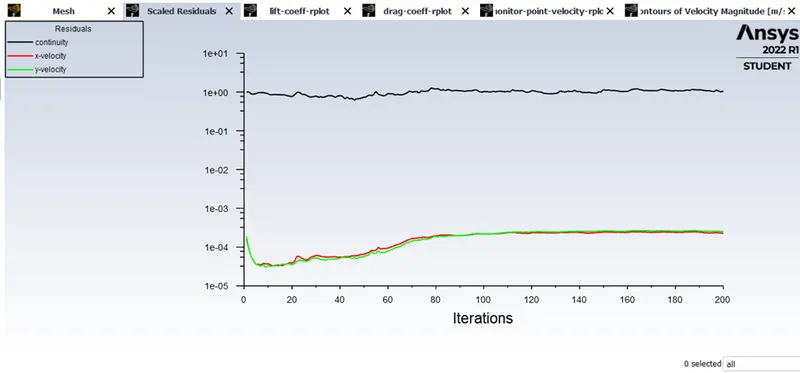
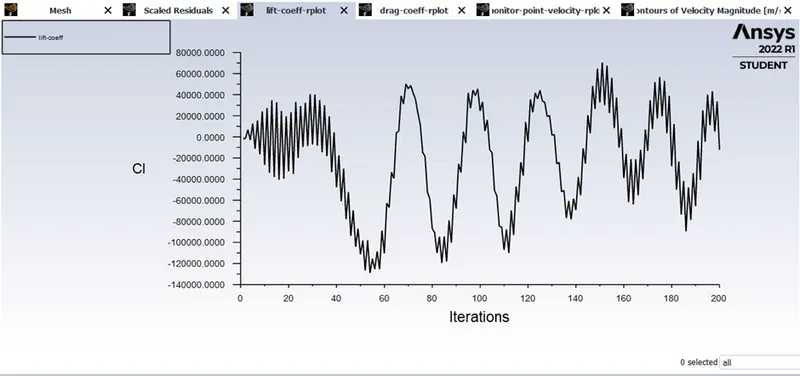
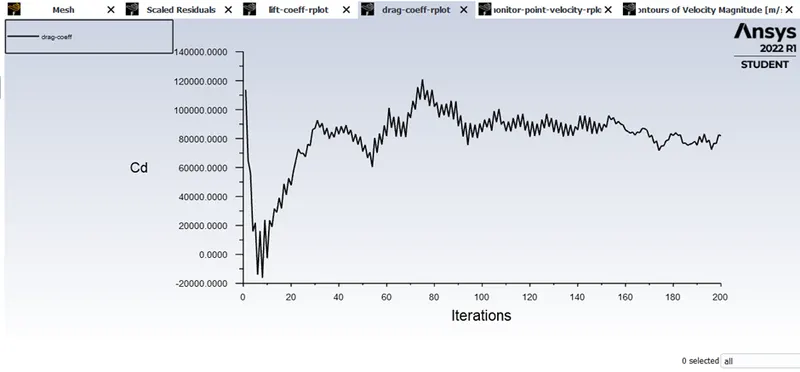
CONCLUSIONS:To see the effect of Reynolds number on the coefficient of drag, we took the case of steady state simulation with Re of 100 wherewe can see that the drag-coefficient value settles around 1.40 and from the reference paper titled "Numerical simulation of laminar flow past a circular cylinder" we find the values to be 1.335 which are about 4.8% varying from our value hence ours results are fine.
When Reynolds number increases the coefficient of drag decreases.