Week - 2 - Explicit and Implicit Analysis
*Aim:-
-To understand concept and solve non-linear equation of implicit and explicit analysis method.
*Introduction of Explicit & implicit method:-
The implicit & explicit methods are used for the solving ODES & PDES equaction.
-The explicit method is used the value from present time step to calculate the value of the next time step.
-The implicit method is used calculate the value of next time step by using the present value & expresing the source term as a function of the next time step.Due to that we need to inversion of matrix in this sceme.
-This two approches are two different method for solving the same problem.
-A fundamental difference between the two schemes is the explicit scheme assumes convergence for all time steps and thus doesn't check for convergence after each time step.
-On the other hand, the implicit scheme checks for convergence after every time step before proceeding to the next.
-Due to that implicit method is stable but require more time require.
*Explicit method:-
-It is use in crash-worthiness, drop test and other such dynamic analysis where deformation is very large.
-It is very suitable compare to implicit method for complex problem with number of components and elements.
`u(n+1)=u(n)+∆t×f(u(n))`
We take a one example for explicit analysis.
Force function:- `F(u)=u^3+9u^2+4u`
-Differtenial of the f(u) is:-
Stiffnes:- `k(u)=f^' (u)=3u^2+18u+4`
Displacement =Force/stiffness=F/k
Force increment=dF=1
Displacement increment=, dU=dF/k
Displacement:- `u_(i+1)=u_i+du_i`
Step:1:-
dF=1
`k(u)_0=3(u_0)^2+18u_0+4``=3×0^2+18×0+4` =4
`du_1=dF/(k(u_0))= 1/4=0.25`
`u_1=u_0+du_1=0+0.25=0.25`
`F(u_1)=(u_1)^3+9(u_1)^2+4u_1`
`F(u_1)=0.25^3+9×0.25^2+4×0.25=1.578`
`F_ext=dF=1`
-By solving this equation:-
`F_ext=(u_exact)^3+9(u_exact)^2+4u_exact`
`u_exact=0.177`
step:2:-
dF=1
`k(u_1 )=3(u_1)^2+18(u_1 )+4=3×0.25^2+18×0.25+4=8.688`
`du_2=dF/(k(u_1))=1/8.688=0.115`
`u_2=u_1+du_2=0.25+0.115=0.365`
`F(u_2 )=(u_2)^3+9(u_2)^2+4u_2=0.365^3+9×0.365^2+4×0.365=2.709`
`F_ext=dF+dF=1+1=2`
-By solving this equation:-
`F_ext=(u_exact)^3+9×(u_exact)^2+4×u_exact`
`u_exact=0.296`
step:3:-
dF=1
`k(u_2 )=3(u_2)^2+18(u_2 )+4=3×0.365^2+18×0.365+4=10.972`
`du_3=dF/(k(u_2))=1/10.972=0.091`
`u_3=u_2+du_3=0.365+0.091=0.456`
`F(u_3 )=(u_3)^3+9(u_3)^2+4u_3=0.456^3+9×0.456^2+4×0.456=3.793`
`F_ext=dF+dF+dF=1+1+1=3`
`F_ext=(u_exact)^3+9×(u_exact)^2+4×u_exact`
`u_exact=0.391`
|
Step i |
`u_i` |
dF |
`k(u_i)` |
`du_i=dF/(k(u_i))` | `u_(i+1)` | `F_ext` | `F_int` | `R= F_int-F_ext` | `u_exact` |
|
0 |
0 |
0 |
4 |
0 |
0.25 |
0 |
0 |
0 |
0 |
|
1 |
0.25 |
1 |
8.688 |
0.25 |
0.365 |
1 |
1.578 |
0.578 |
0.177 |
|
2 |
0.365 |
1 |
10.972 |
0.111 |
0.456 |
2 |
2.709 |
0.709 |
0.296 |
|
3 |
0.456 |
1 |
12.837 |
0.091 |
0.534 |
3 |
3.793 |
0.793 |
0.391 |
*implicit method:-
--The implicit scheme that checks convergence after each time step and then only moves in to the calulation of variables.
-The convergence is brought about by Newton-raphson iterations.
-For the convergence the `F_ext` should be equal to F or the residual `R=F-F_ext=0`
After each time step , the residual need to be brought within the tolerance value.(here we assume tolerance=0.01)
-This is done by using the nowton-rapshon interation to calculate the correction value until required tolerance reached.
-Expanding the residual , R as a taylor series about the current displacement `u^j` gives:-
`R^(j+1)=R^j u^j+(dR(u^j))/du δu^(j+1)+⋯=R^j+k(u^j )δu^(j+1)+⋯`
-By neglecting higher order terms in the series, `R^(j+1)=0`
and solving for `δu^(j+1)`
-The following correction obtain:-
`δu^(j+1)=-[ k(u^j )]^(-1) R^j`
-Differtenial of the f(u) is:-
Stiffnes:- `k(u)=f^' (u)=3u^2+18u+4`
Displacement =Force/stiffness=F/k
Force increment=dF=1
Displacement increment=, dU=dF/k
Displacement:- `u_(i+1)=u_i+du_i`
step:1:-
dF=1
`k(u_0 )=3(u_0)^2+18(u_0 )+4=3×0^2+18×0+4=4`
`du_1=dF/(k(u_0))=1/4=0.25`
`u_1=u_0+du_1=0+0.25=0.25`
`F(u_1)=0.25^3+9×0.25^2+4×0.25=1.578`
`F_ext=dF=1`
`R=F(u_1 )-F_ext=1.578-1=0.578`
*interation:-
`u_1=0.25`
`k(u_1^0 )=k(u_1 )=3×0.25^2+18×0.25+4=8.688`
`R^0=0.578`
correction factor:- `δu^(1)=-[ k(u^0 )]^(-0) R^0`
`δu^1=-[8.688]^(-1) *0.578`
`δu^1=-0.06653`
`corrected value:- `u_1=u_1+δu_1^1=0.25+(-0.06653)=0.183`
`F^1=(u_1^1)^3+9×(u_1^1)^2+4×u_1^1`
`F^1=0.183^3+9×0.183^2+4×0.183=1.039`
`updated residual:- `R^1=F^1-F_ext=1.039-1=0.039`
||R||>0.01 , proceed in the next interation because ||R|| is not withing the tolerance limit.
2.
`k(u_1^1 )=3×0.183^2+18*0.183+4`
`k(u_1^1 )=7.394`
`R^1=0.039`
corrected factor `δu^(2)=-[ k(u^1 )]^(-1) R^1`
`δu^2=-0.06653-[7.394]^(-1) *0.039`
`δu^2=-0.0718`
`k(u_1^1 )=3×0.183^2+18*0.183+4`
corrected`u_1`:- `u_1=u_1+δu_1^2=0.25+(-0.0718)=0.1782`
`F^2=(u_1^2)^3+9×(u_1^2)^2+4×u_1^2`
`F^2=0.1782^3+9×0.1782^2+4×0.1782=1.004`
updated residual:- `R^2=F^2-F_ext=1.004-1=0.004`
`||R||<0.01 , it has reached withing the tolerance limit.so no need to further interation`
step:2:-
dF=1
`k(u_1 )=3(u_1)^2+18(u_1 )+4=3×〖0.1782〗^2+18×0.1782+4=7.302`
`du_2=dF/(k(u_1))=1/7.302=0.137`
`u_2=u_1+du_2=0.1782+0.137=0.315`
`F(u_2 )=(u_2)^3+9(u_2)^2+4u_2=0.315^3+9×0.315^2+4×0.315=2.184`
`F_ext=dF+dF=1+1=2`
`R=F(u_2 )-F_ext=2.184-2=0.184`
interation:-
`k(u_2)=9.967`
`R^0=0.184`
-Correction factor for `u_2` is:-
`δu_2^(1)=-[ k(u_2^0 )]^(-0) R^0`
`δu_2^1=-[9.967]^(-1) *0.184=-0.0185`
correted `u_2`:- `u_2=u_2+δu_2^1=0.315+(-0.0185)=0.296`
`F^1=(u_2^1)^3+9×(u_2^1)^2+4×u_2^1`
`F^1=0.296^3+9×0.296^2+4×0.296=1.998`
updated residual:- `R^1=F^1-F_ext=1.998-2=-0.002`
||R||<0.01 , it has reached withing the tolerance limit.so no need to further interation.
step:3:-
`k(u_2 )=3(u_2)^2+18(u_2 )+4=3×0.296^2+18×0.296+4=9.59`
`du_3=dF/(k(u_2))=1/9.59=0.104`
`u_3=u_2+du_3=0.296+0.104=0.4`
`F(u_3 )=(u_3)^3+9(u_3)^2+4u_3=0.4^3+9×0.4^2+4×0.4=3.104`
`F_ext=dF+dF+dF=1+1+1=3`
`R=F(u_3 )-F_ext=3.104-3=0.104`
Iteration:-
`u_3=0.4`
`k(u_3^0 )=3*0.4^2+18*0.4+4=11.68`
`R_0=0.104`
`δu_3^(1)=-[ k(u_3^0 )]^(-0) R^0`
`δu_2^1=-[11.68]^(-1) *0.104=-0.0089`
`u_3=u_3+δu_3^1=0.4+(-0.0089)=0.3911`
`F^1=(u_3^1)^3+9×(u_3^1)^2+4×u_3^1`
`F^1=0.3911^3+9×0.3911^2+4×0.3911=3.0008`
`R^1=F^1-F_ext=3.0008-3=-0.0008`
||R||<0.01, it has reached withing the tolerance limit.so no need to further interation.
*Results and discusion:-
-The results from both explicit & implicit method has been listed below:-
|
steps |
Force |
explicit |
implicit |
Exact |
|
Step 0 |
0 |
0 |
0 |
0 |
|
Step 1 |
1 |
0.25 |
0.178 |
0.177 |
|
Step 2 |
2 |
0.365 |
0.296 |
0.296 |
|
Step 3 |
3 |
0.456 |
0.391 |
0.391 |
-A graph has been plotted to visualize the variation in displacements calculated by two methods.
-Displacement is exist on y-axis & force exist on x-axis.
- 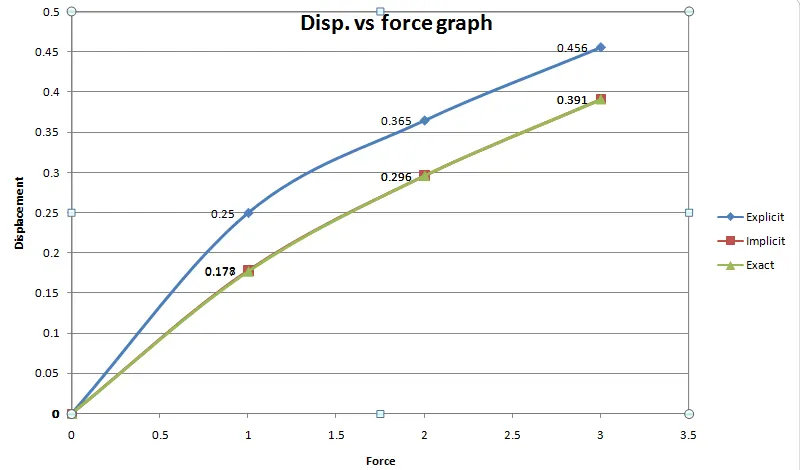
-It can be observed that the explicit solution are deviating more and more load is being applied.
-The implicit solution & exact solution are overlaping on eachother.
-The newton-raphson interations have corrected the intremental steps so they land on the exast solution according to the specific tolerence.