Week - 2 - Explicit and Implicit Analysis
Objective :
To differentiate the explicit and implicit analysing using the given question and solving them to understand both analysis.
Given equation F(u) = u3+9u2+4u
Theory :
Time dependent and time independent analysis :
Non linear and non static problems are analysed using displacement step to solve two types of problems i. Time dependent ii. Time independent.
I. Time dependent : These are the problems whenever there is effect of acceleration is considered to the given problem and these can not be neglected then we will use time dependent analysis.
Ex: Drop test.
II. Time independent : these are the problems when load is applied slowly to the body and acceleration are negligable then we use time independent analysis.
Ex : Monitor on the desk
FEM Implicit analysis :
This a method when problem is solved by number of steps and the solution for the current step is based on the solution from the previous step. For large models, inverting the matrix is highly expensive and will require advanced iterative solvers. These analysis can give unconditionally stable and facilitate larger time steps but to solve this type of problems require huge amount of time.
FEM Explicit analysis :
Explicit analyses aim to solve for acceleration. In most cases, the mass matrix is considered as “lumped” and thus a diagonal matrix. Inversion of a diagonal matrix is straightforward and includes inversion of the terms on the diagonal only. In these calculations, the scheme is not unconditionally stable and thus smaller time steps are required.
Difference odf Explicit and Implicit :
Explicit FEM is used to calculate the state of a given system at a different time from the current time. Where an implicit analysis finds a solution by solving an equation that includes both the current and later states of the given system. This method requires additional computation and can be harder to implement.
Calculations :
Solving Explicit analysis :
In this method we are going to solve the given non linear equation F(u) = u3+9u2+4u withe help of
△F = k△u -> (i)
where F = external force, k = stiffness, u = displacement, f = internal force and △u = incremental displacement.
Here we are going to find the three incremental displacements and find the both external force and internal force and also plot the graph using force vs displacement values.
we know that k = df/ du = 3u2+18u+4 -> (ii) and
assume initial displacement u0 = 0.0 and the incremental force △F = 1 for all three steps.
Step 1: From equation (ii) we can substitute 'u0' value to find the 'k' value,
k = 3u0^2+18u0+4 = 3(0)^2+18(0)+4 = 4
now we have to substituke 'k'and '△F' in euation (i)
△u1 = △F1/k1 = 1/4 = 0.25
∴ u1=u0+△u1 = 0+0.25 = 0.25
Like this we have to find out another two diaplacements.
Step 2: k2 = 3u1^2+18u1+4 = 3(0.25)^2+18(0.25)+4 = 8.6875
now, △u2 = △F2/k2 = 1/8.6875 = 0.11510
∴ u2=u1+△u2 = 0.25+0.11510 = 0.36510
Step 3: k3 = 3u2^2+18u2+4 = 3(0.36510)^2+18(0,36510)+4 = 10.97171
now, △u3 = △F3/k3 = 1/10.97171 = 0.091143
∴ u3=u2+△u3 = 0.36510+0.091143 = 0.45624
Thus we know final displacement value now we can calculate internal and external forces.
△F = △F1+△F2+△F3 = 1+1+1 = 3
f = u3^3+9u3^2+4u3 = 3.7928 like this we have to calculate another two forces i.e, f1 = 1.5781 and f2 = 2.7087 internal forces.
Here we can conclude that F(ext) is not equals to f(int) and we have to find residuals using R = f(int) - F(ext)
Now all values are going to fill in the table which will help to plot the graph easily.
Table I :
| S.No | △F | △u | u | F(ext) | f(int) | R |
| 1. | 1.0 | 0.25 | 0.25 | 1.0 | 1.5781 | 0.5781 |
| 2. | 1.0 | 0.1151 | 0.36510 | 2.0 | 2.7087 | 0.7087 |
| 3. | 1.0 | 0.091143 | 0.45624 | 3.0 | 3.7928 | 0.7928 |
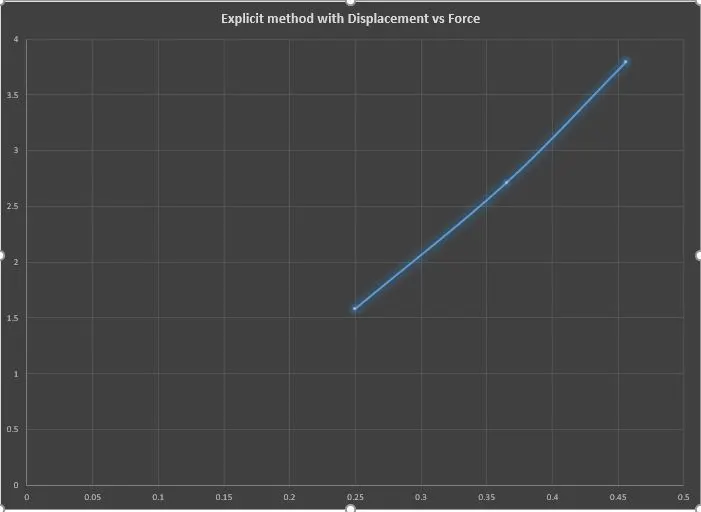
From the graph we can see that the values is going far from the original value.
Solving Implicit analysis :
Here we are using the same method used explicit analysis but we need to keep the forces in the equilibrium state where explicit analysis does not give equilibrium state. In order to achieve the equilibrium state we will use Newton - Raphson method to minimize the residuals and these residuals are expanded throuhg Taylor series. Here we are taking the residual tolerance as
R > `10^(-2)`
Taylor series in residual form :
`R j+1 = R j (u j ) + dR(u_j)//du (δu)^(j+1) + ... = R j + k(u j )δuj+1 + ...`
Here we have to neglect the high orders and solving for the
`deltau ^(j+1) = - [k(u_j)]^(-1) R^j`-> (i)
Step 1: As we mentioned that initial steps are same as the explicit analysis in order to keep in equilibrium we have to solve the equation. So we are directly taking the values of 'u', 'F', 'f', 'R' from the table (I)
i.e, u = 0.25, F = 1.0, f = 1.5781 and residual R = 0.5781
now we can see that given residual is not satsifying the taken value
i.e, `R^0 > 10^(-2)` so we are going for iterations with Newton Raphson method to satisy this condition.
Iteration 1: In order to find updated displacement value we need to find taylor series correction factor from the equation (i)
`deltau^1 = -k(u_1^0)^(-1) R^0` { k(u_1^0) = 8.6875}
deltau^1 = - `[8.6875^(-1)] 0.5781` = -0.06654
now the updated value `u_1 = u_1^0 + deltau^1`
u_1 = 0.25 - 0.06654 = 0.1834
now we have to check for the residual so, `F_(ext)` = 1,
`f_(i)` = `u_1^3 + 9u_1^2 +4u_1` = 1.0429
∴ R = `f_(i)` - `F_(ext)` = 0.0429 > `10^(-2)` we need another iteration.
Iteration 2: Here we are following same steps but the correction factor equation changes
i.e, `deltau^2 = deltau^1 - k[u_1^1]^-1 R^1`= -0.0723 { k[u_1^1] = 7.8514}
updated value `u_2 = deltau^1 + u_1`= 0.1777`
again check for residual `F_(ext)` = 1,
`f_(i)` = `u_2^3 + 9u_2^2 +4u_2` = 1.000606
∴ R = `f_(i)` - `F_(ext)` = 0.00060689 < `10^(-2) here condition is satisfied and no need for another iteration.
Step 2: Here for second internal forces and external forces has to be in equilibrium to do that again we have to follow step 1 process.
so, we are taking the updated displacement value from above step to find the 'k' value
k(u_2) = `3u_2^2 + 18u_2 +4`= 7.2933
`triangleu_2 = F/k` = 1/7.2933 = 0.1311
`u_3 = triangleu_2 + u_2`= 0.3148
substitute the u_3 value in main equation to find internal force
`f_1 = u_3^3 + 9u_3^2 + 4u_3`= 2.18228
residual R = `f_1 - F_1` = 0.18228 > `10^(-2) we need to for iterations.
Iteration 1: `deltau_3 = -k[u_3^0]^-1 R^0` = -0.01829 {`k[u_3^0] = 9.96369}
updated displacement value `u_3^1 = u_3 + deltau_3^0`= 0.29651
check for residual `F_(ext)` = 2.0
`f_2 = (u_3^1)^3 + 9(u_3^1)^2 + 4u_3^1` = 2.003372
∴ R = `f_(i)` - `F_(ext)` = 0.0033 < `10^(-2) here condition is satisfied no iterations are required.
Step 3: `k(u_3) = 3(u_3)^2 + 18(u_3) +4`= 9.6009 {u_3 = 0.29651}
`triangleu_3 = F/k` = 0.104156
`u_4 = triangleu_3 + u_3` = 0.4007
`f_1 = (u_4)^3 + 9(u_4)^2 +4u_4` = 3.1127`
`R = f_1 - F_1`= 0.1127 > 10^-2 we need to go for iteration`
Iteration 1: `deltau_4 = -k[u_4]^-1 R^0` = -0.00968 {`k(u_4) = 10.46199`}
updated displacement value `u_4^' = deltau_4 + u_4` = 0.39102
we know that F = 3.0, `f = (u_4^')^3 + 9(u_4^')^2 + 4u_4^'` = 3.0009
residual `R^1 = f - F` = 0.0009 < 10^-2 no iterations are required condition is satisfied.
Now we are going to form a table to plot the graph easily
Table 2:
| S.no | `triangleF_i` | `u_i` | F | f | R |
| 1 | 1.0 | 0.1777 | 1.0 | 1.000606 | 0.0006 |
| 2 | 1.0 | 0.29651 | 2.0 | 2.003372 | 0.00337 |
| 3 | 1.0 | 0.39102 | 3.0 | 3.0009 | 0.0009 |
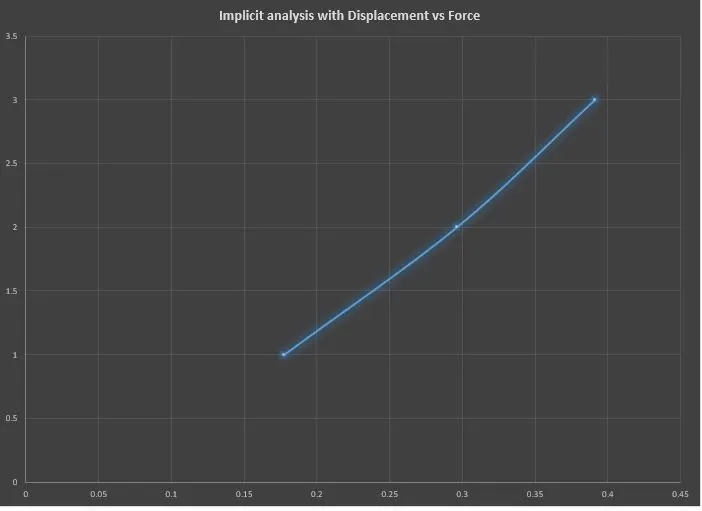
From the graph we can see that values are closer to the original values this is due to the Newton - Raphson iteration method.
Conclusion : Thus we have solved the euation in both explicit and implicit methods and we can clearly see that implicit analyse gives the exact values when compared to the explicit analysis but when a problem has more number of boundary conditions like d.o.f e.t.c implicit analysis takes huge time to solve the problem and sometimes it is harder to achieve the right solutions.