Week - 2 - Explicit and Implicit Analysis
Aim : Analytical solution for given equation using explicit and emplicit technique.
Equation : F(u) = U3+9u2+4u
Explicit method:
The equation for explicit method is as given below
u(n+1) = u(n)+ Δt. F(u(n))
equation to be solved as below
M (d2u / dt2) +k(u)= F(t)
where du /dt = F(u)
at t=0 we know thw value of u & v and then to compute M & k and then use them to compute the acceleration , from which velocity and displacement can be calculated at Δt.
a = [ M]-1[F(t) - k(u)
v( Δt) = v(0) + a.(Δt)
u( Δt) = u(0) + v(0). (Δt) + 1/2. a.(Δt2)
in explicit mostly dynamic analysis, nodal accelerations are solved directly (not iteratively) as the inverse of the diagonal mass matrix times the net nodal force vector where net nodal force includes contributions from exterior sources (body forces, applied pressure, contact, etc.), element stress, damping, bulk viscosity, and hourglass control. Once accelerations are known at time n, velocities are calculated at time n+1/2, and displacements at time n+1. From displacements comes strain. From strain comes stress and the cycle is repeated.
Explicit analysis handles nonlinearities with relative ease as compared to implicit analysis. This would include treatment of contact and Material nonlinearities. With this method is that you do need many small increments for good accuracy and it is time consuming.
k(u)= (df)/(du) = d (U3+9u2+4u) / du
= 3u2 + 18u +4
u= displacement
f= internal force
F=external force
k= stiffness
Δu= increamental displacement
ΔF= increamental external force applied
for 1st step :
ΔF = 1;
U0=0.0
using stiffnerss equantion at u =u0
k(u0 )= 3u2 + 18u +4
=4.0
now , we know that,
Δu0 = ΔF / k(u0 )
= 1 / 4
= 0.25
now,
u1 = u0 + Δu0
= 0 + 0.25
= 0.25
now calculate,
fint = u3+9u2+4u
= 0.253+9*0.252+4*0.25
= 1.578125
Fext = 1.
now find residue
R1 = fint - Fext
= 1.578125 - 1
= 0.578125
for 2nd step :
u1 = 0.25
k(u1 )= 3u12 + 18u1 +4
= 3* 0.252 + 18*0.25 +4
= 8.6875
ΔF = 1
Δu1 = ΔF / k(u1 )
= 1 / 8.6875
= 0.1151
NOw update the value for u.
u2 = u1 + Δu1
= 0.25 + 0.1151
= 0.3651
now calculate
fint = u23+9u22+4u2
= 0.36513+9*0.36512+4*0.3651
= 2.7087
Fext = 1+1 =2
now find residue.
R2 = fint - Fext
= 2.7087 - 2
= 0.7087
for 3rd step
u2 = 0.3651
k(u2 )= 3u22 + 18u2 +4
= 3* 0.36512 + 18*0.3651 +4
= 10.97169
ΔF = 1
Δu3 = ΔF / k(u2 )
=1 / 10.97169
= 0.0911436
u3 = u2 + Δu3
=0.3651 + 0.0911436
= 0.45624
now calculate ,
fint = u23+9u22+4u2
= 0.456243+9*0.456242+4*0.45624
= 3.793325
Fext = 2+1 =3
now find residue.
R2 = fint - Fext
= 3.793325 - 3
= 0.793325
Table summrised the main result for explicit analysis method
|
Stepi |
ΔFi |
Δui |
ui | fint | Fext | Ri = fint - Fext |
| 1 | 1 | 0.25 | 0.25 | 1.578125 | 1 | 0.578125 |
| 2 | 1 | 0.1151 | 0.3651 | 2.7087 | 2 | 0.7087 |
| 3 | 1 | 0.09114 | 0.45624 | 3.793325 | 3 | 0.793325 |
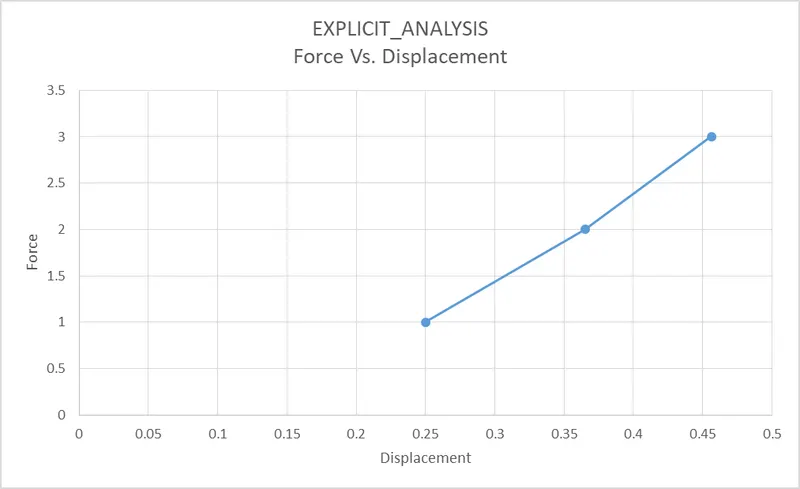
it is evident from the result that the external and internal forces are not in equillibrilium because
fint not equal to Fext.
2. implicit method
Equation for implicit method is as given below,
u(n+1) = u(n)+Δt . F(u(n+1))
= (I-A). Δt. u(n+1) = u(n).... where I is identity matrix
in implicit method we compute M and k not at Δt =0 , but at Δt and then proceed as above.
Required mpre calculation and cost of computing is large compare to explicit method.
forword and backword Euler mehtod are the example of explicit and implicit method to solve a differential equation .
each time step in explicit method is very fast, but the method is stable only when time step delta_t is small. courant condition dictates that the time step ,ust be smaller then the elastic wave to propogate from one side of element to the other
Courant fredrichs lavy criteria
Δt < sqrt( ρ(1-2nu) / 2μ ((1-nu)
here μ is shear modulus of material.
Implicit analysis requires a numerical solver to invert the stiffness matrix once or even several times over the course of a load/time step. This matrix inversion is an expensive operation, especially for large models. It is mostly used for static analysis. Implicit uses Newton-Raphson iterations to enforce equilibrium. If done correctly the Newton-Raphson iterations will have a quadratic rate of convergence which is very desireable.
Implicit transient analysis has no inherent limit on the size of the time step. As such, implicit time steps are generally several orders of magnitude larger than explicit time steps.
u= displacement ,
f= internal force in bar,
F= external force in bar
∆u = incremental displacements,
∆F = incremental external applied forces.
using relation,
∆F = k∆u,
Tolerance= 10^-2
we know that residual (R) = fint - Fext
Step 1:
ΔF = 1;
U0=0.0
using stiffnerss equantion at u =u0
k(u0 )= 3u2 + 18u +4
=4.0
now , we know that,
Δu1 = ΔF / k(u0 )
= 1 / 4
= 0.25
u1 = u0 + Δu1
= 0 +0.25
= 0.25
now calculate,
fint = u3+9u2+4u
= 0.253+9*0.252+4*0.25
= 1.578125
Fext = 1.
now check for the resudual,
R0 = fint - Fext
= 1.578125 - 1
= 0.578125
| R0 | > 0.01 .... thus Newton Raphson iteration are neccessary
now, calculate the correction at u1 = (u1)0
δu1= -[ k(u0)0]-1 x R
= -[ 3u2 + 18u +4]-1 x 0.578125 .... u = 0.25
= -[ 3 x 0.252 + 18x 0.25 +4]-1 x 0.578125
= - 0.0665
The uodated value for u11 is
u11 = u01 + δu1
= 0.25 + (- 0.0665)
= 0.1835
now, check the residual again
Fext = 1.
fint = u3+9u2+4u ---- u = 0.1835
= 0.18353+9*0.18352+4*0.1835
= 1.04322
R1 = fint - Fext
= 1.04322 - 1
= 0.04322
|R1 | > 0.01... thus another newton raphson iteration are neccessary
calculate the new total correction u1 = (u1)1
δu2= δu1 -[ k(u1)1]-1 x R
= - 0.0665 - [ 3u2 + 18u +4]-1 x 0.04322 .... u= 0.1835
= - 0.0665 - [ 3x 0.18352 + 18x 0.1835 +4]-1 x 0.04322
= -0.072373
the updated value of (u1)2
(u1)2 = u01 + δu2
= 0.25 + ( -0.072373)
= 0.177662
check the residual again
Fext = 1.
fint = u3+9u2+4u ---- u = 0.177662
= 0.1776623+9*0.1776622+4*0.177662
= 1.00032
R2 = fint - Fext
= 1.00032 - 1
= 0.00032
|R2 | < 0.01 ... so no further iteration required
therefore the final value is
(u1)= (u1)2 = 0.177662
Step 2:
ΔF = 1;
U1=0.177662
k(u1 )= 3u2 + 18u +4 ... u= 0.177662
= 3x 0.1776622 + 18x0.177662 +4
= 7.292607
Δu2 = ΔF / k(u1 )
= 1 / 7.292607
= 0.1371251
now ,
u2 = u1 + Δu2
= 0.177662 + 0.1371251
= 0.314787
now calculate,
fint = u3+9u2+4u ..... u= 0.314787
= 0.3147873+9*0.3147872+4*0.314787
= 2.182159
Fext = 1+1 = 2.
check for the residual,
R0 = fint - Fext
= 2.182159 - 2
= 0.182159
|R0 | > 0.01... thus another newton raphson iteration are neccessary
Calculate the correction u2 = (u2)0
δu21= -[ k(u2)0]-1 x R
= -[ 3u2 + 18u +4]-1 x 0.182159 .... u = 0.314787
= -[ 3x 0.3147872 + 18 x 0.314787 +4]-1 x 0.182159
= -0.018326
The updated value for (u2)1
(u2)1= u2 + δu21
= 0.314787 + (-0.018326)
= 0.29646
check for the residual again
fint = u3+9u2+4u ..... u= 0.29646
= 0.296463+9*0.296462+4*0.29646
= 2.0028992
Fext = 2.
R1 = fint - Fext
= 2.0028992 - 2
= 0.0028992
|R1 | < 0.01 ... so no further iteration required
therefore the final value for u2 = (u2)1 = 0.2964
Step 3:
ΔF = 1;
U2= 0.2964
k(u2 )= 3u2 + 18u +4 ... u=0.2964
= 3x 0.29642 + 18x0.2964 +4
= 6.93115888
Δu3 = ΔF / k(u2 )
= 1 / 6.93115888
= 0.144276
now ,
u3 = u2 + Δu3
= 0.2964 + 0.144276
= 0.440676
check for the residual
fint = u3+9u2+4u ..... u=0.440676
= 0.4406763+9*0.4406762+4*0.440676
= 3.59603922
Fext = 2+1 =3.
R0 = fint - Fext
= 3.59603922 - 3
= 0.59603922
|R0 | > 0.01... thus another newton raphson iteration are neccessary
now Calculate the correction u3 = (u3)0
δu31= -[ k(u3)0]-1 x R
= - [ 3u2 + 18u +4]-1 x 0.182159 .... u = 0.440676
= - [ 3 x 0.4406762 + 18x0.440676 +4]-1 x 0.182159
= -0.04762378
updated value of (u3)1
(u3)1= u3 + δu31
= 0.440676 -0.04762378
= 0.3930522
check for the residual
fint = u3+9u2+4u ..... u=0.3930522
= 0.39305223+9*0.39305222+4*0.3930522
= 3.0233
Fext = 3.
R0 = fint - Fext
= 3.0233 - 3
= 0.0233
|R0 | > 0.01... thus another newton raphson iteration are neccessary
now Calculate the correction u3 = (u3)0
δu32= δu31 -[ k(u3)1]-1 xR0
= -0.04762378 - [ 3u2 + 18u +4]-1 x 0.0233 .... u = 0.3930522
=-0.04762378 - [ 3x 0.39305222 + 18x 0.3930522 +4]-1 x 0.0233
= -0.0067817
updated value of (u3)2
(u3)2= u3 + δu32
= 0.3930522 + (-0.0067817)
= 0.38627
now check for the residual
fint = u3+9u2+4u ..... u=0.38627
= 0.386273+9*0.386272+4*0.38627
= 2.9465
Fext = 3.
R2 = fint - Fext
= 2.9465 - 3
= -0.005
|R2| < 0.01 ... thus no further newton raphson iteration are required.
therefore the final value for (u3)2 = (u3)2 = 0.38627
the summary of implicit analysis is given below
| Stepi | ΔFi | Δui | ui | fint | Fext | Ri = fint - Fext |
| 1 | 1 | 0.25 | 0.177662 | 1.00032 | 1 | 0.00032 |
| 2 | 1 | 0.1371251 | 0.2964 | 2.002899 | 2 | 0.00289 |
| 3 | 1 | 0.744276 | 0.38627 | 2.9465 | 3 | 0.005 |
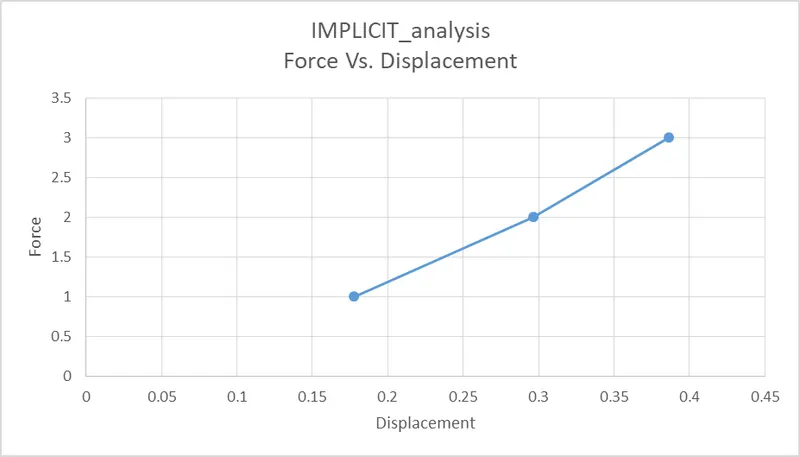
conclusion : The Implicit and Explicit numerical analysis is carried out for given equation.
Implicit method is more accurate but time consuming and solemnly depends on element size and timestep whereas explicit deviates slightly from exact result and needs more iterations to obtain good result.