Week - 2 - Explicit and Implicit Analysis
AIM :
TO DEMONSTRATE THE IMPLICIT AND EXPLICIT METHODS USING THE EQUATION F(u) = u3+9u2+4u.
PROCEDURE AND CALCULATION:
f(u)=`u^3+9u^2+4u`---------------(1)
k(u)=`(df)/(du)`=`3u^2+18u+4`--------------(2)
ΔF=kΔu
time-dependent or time-independent problems. To solve these problems, we commonly use ‘implicit’ or ‘explicit’ methods.
EXPLICIT METHOD:
The explicit method is the method of incremental procedure and at the end of each increment updates the stiffness matrix. Used to solve the equation and derives points approximately equal to the exact v. If the increments are more then, the results will be more accurate. The time step is very fast and done only when the time step is small. It is a conditioning method. When there are more force and acceleration go for the explicit method because the inversion of the diagonal matrices is easy.
Step:1:
u0=0,0=k(u0)=3u^2+18u+4=0+0+4=4,
ΔF=1,
Δu1=ΔF/k(u0)=1/4
u1=u0+Δu1=0+`1/4`=1/4=0.25
Fext=1
fint=u1^3+9u1^2+4u1= 1.578125
step:2:
k(u1)=`3*(0.25)^3+18(0.25)+4`=0.8675
ΔF=1,
Δu2=ΔF/k(u1)=1/0.8675=0.11510
u2=u1+Δu2=0.11510+0.25=0.3651
step:3:
k(u2)=`3*(0.3651)^3+18(0.3651)+4`=10.9716
Δu3=ΔF/k(u2)=1/10.9716=0.091144
u3=u2+Δu3=0.3651+0.091144=0.456244
| step | ΔF(i) | Δu(i) | ui | F(ext) | f(internal) | f(int)-Fext=R |
| 1 | 1 | 0.25 | 0.25 | 1 | 1.578125 | 0.578125 |
| 2 | 1 | 0.11510 | 0.3651 | 2 | 2.708 | 0.708 |
| 3 | 1 | 0.09114 | 0.4562 | 3 | 3.790 | 0.790 |
Thus the forces are not in equilibrium.
Implicit method:
It is the same as explicit but in the end, we apply the newton raphson iteration to get the result more accurately even up to the tolerance given. This method is unconditional. R(u) = fint − Fext.
where R is the residual as Taylor series
STEP:1:
u0=0,0=k(u0)=3u^2+18u+4=0+0+4=4,
ΔF=1,
Δu1=ΔF/k(u0)=1/4
u1=u0+Δu1=0+`1/4`=1/4=0.25
Fext=1
fint=u1^3+9u1^2+4u1= 1.578125
R(0)= fint-Fext=0.578
R(0)>10^-3= newton raphson iteration is necessary, calculation u1=u1^0
∂u'=-[k(u1^(0))]^-1x(R(0))
k(u1^(0))=(3u^2+18u+4)=3(0.25)2+18(0.25)+4=8.6875
∂u'1=-[k(u1^(0))]^-1x(R(0))=(8.6875)^-1*0.578=0.11510*0.578=-0.0665278
update the value of u(1)1=u(0)1+∂u'1=0.184
checking the residual again,
Fext=ΔF=1
fint=(0.1835)^3+9(0.1835)^2+4(0.1835)=1.042
R1=1.042-1=0.0428>10^-3
*
u1=u1^1
∂u'=-[k(u1^(0))]^-1x(R(0))
k(u1^(1))=(3u^2+18u+4)=3(0.1835)2+18(0.1835)+4=7.40401675
∂u'2=-[k(u1^(0))]^-1x(R(0))=(7.40401675)^-1*0.578=0.13506*0.578=-0.0780
update the value of u(1)2=u(0)1+∂u'2=0.25-0.0780= 0.1786
checking the residual again,
Fext=ΔF=1
fint=(0.1786)^3+9(0.1786)^2+4(0.1786)=1.00032
R2=1.00032-1=0.00032<10^-3
u1=0.177,k(u1)=7.2933,ΔF=1,Δu2=ΔFk(u1)=0.1371,u2=u1+Δu2=0.3148u1=0.1777
|
Step i |
∆Fi |
∆ui |
ui |
Fi |
fi |
f – F = R |
|
1 |
1 |
0.25 |
0.1786 |
1 |
1.0006 |
0.0006 |
|
2 |
1 |
0.1374 |
0.2966 |
2 |
2.0042 |
0.0042 |
|
3 |
1 |
0.1041 |
0.3911 |
3 |
3.0008 |
0.0008 |
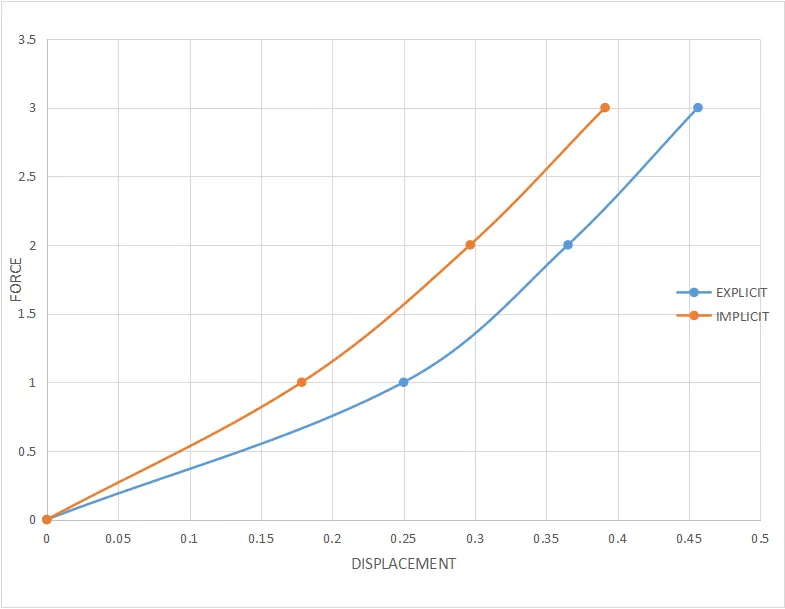
THUS THE GRAPH SHOWS IMPLICIT HAVE MORE ACCURATE THAN THE EXPLICIT METHODS.
RESULT:
THE LEARNING OUTCOMES ARE THE METHODS USED TO SOLVE THE PDE BY ITERATION USING EXPLICIT AND IMPLICIT METHODS.