Week - 2 - Explicit and Implicit Analysis
AIM- To study about implicit andexplicit method to solve engineering problems.
OBJECTIVES- To solve the given equation F(U)=U^3+9U^2+4U by using both Implicit and Explicit method with tolerance 0.001.
EXPLICIT METHOD- Explicite method is a function of time, being a function of time, the velocity and acceleraation as well as the mass and damping coefficient needs to be consider here. In this method Central Difference Time Integration is used to calculate field variables at respective nodal points. Since only a numerical solution is possible for a non linear problems. It requires inversion of the lumped mass matrix as opposed to that of the global stiffness matrix in the implicit methods. In Central Differential Time Integration, the equation of motion is evaluted at the previous time step (tn -1, where tn is the current time step).
Explicite method works in time increments that is the displacements are calculated as the time proceeds. Consider the simulation of a crash analysis. At time step 1 (t=0 ms), there is no deformation since the impact is yet to be happen. Gradually as time would increase the deformation will also take place. Now we will assume time step 2 (t=5 ms), now the explicit algorithm will calculate the values of field variables at time t=5 ms. This is the way in which the solution proceeds.
IMPLICIT METHOD- Implicit method the displacement is not a function of time (i.e. X=Constant). Hence the velocities and accelerations which are time derivative of displacement turn out to be zero and the mass and damping factor can be neglected. The implicit method can be based on Newmark's Beta Method, Newton Raphson Method and other methods. In order to solve an FEM problem using implicit method , inversion of stiffness matrix (K) is required. Very Large deformation problems such as crash analysis can result in millions of degree of freedom effectively increasing the size of stiffness matrix. Larger the stiffnesss matrix longer the comutational time required. Hence there is need for an explicit method which will prevent the inversion of stiffness matrix.
PROBLEM SOLVING BY EXPLICIT AND IMPLICIT METHOD-
The variable used are u for displacement, f for internal force in the bar, F for external force applied to the bar and K for stiffness. Incremental displacement or Incremental externally applied forces are represented as △u or △F respectively. We will also use relation △F=K△u.
EXPLICIT METHOD-
F(u)=u^3+9u^2+4u------- (1)
K(u)= dF/du= 3u^2+18u+4---------- (2)
Step-1
Take u=0 in eqn. 2
K(u0)=3x0^2+18x0+4=4
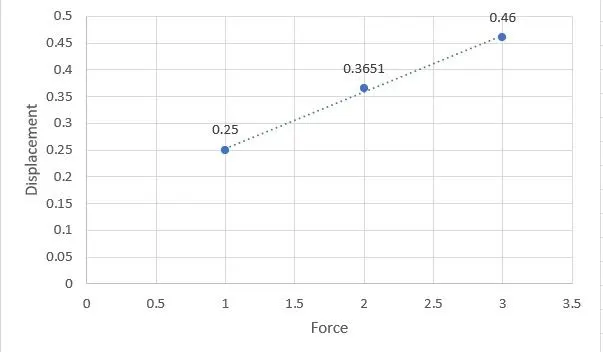
now, △u1=△F/k(u0)=1/4=0.25
u1=u0+△u1=0.25
Step-2
Taking u1=0.25
k(u1)=3x0.25^2+18x0.25+4=8.6875
now, △u1=△F/k(u1)=1/8.6875=0.1151
u2=u1+△u2=0.3651
Step-3
Take u2=0.3651
k(u2)=3x0.3651^2+18x0.3651+4=10.9716
now,△u2=△F/k(u2)=1/10.9716=0.09114
u3=u2+△u3=0.46
Finally, to determine wheather the analysis is in equilibrium,
F(external)=△F+△F+△F=3
f(internal)=(1) => (0.46)^3+9x(0.46)^2+4x0.46=3.841
F(ext)≠ f(int), so they are not in equilibrium.
Step i △Fi △ui ui F(ext)i f(int)i R=f(int)i-F(ext)i
1 1 0.2500 0.25 1 1.578 0.578
2 1 0.1151 0.3651 2 2.708 0.708
3 1 0.09114 0.46 3 3.841 0.841
IMPLICIT METHOD-
F(u)=u^3+9Xu^2+4u-------- (1)
k(u)=(dF)/(du)=3Xu^2+18u+4--------- (2)
Step-1
Take u=0 in eqn.(2)
k(u0)=3x0^2+18X0+4=4
△u1=△f/k(u0)=1/4=0.25
Checking residual,R
F(ext)=△F=1
f(int)=1 => (0.25)^3+(9X(0.25)^2)+(4x0.25)=1.578
R0=1.578 - 1 = 0.578 > 10^-2
So, now after above condition newtons raphson iteration is necessary here.
Calculate the correction to u1=u1(0)
δu(1)=-[k(u1(0))]^-1xR0=-[(3x0.25^2)+(18x0.25)+4]^-1x0.587=-0.0665
Updated, u1(1)=u1(0)+δu(1)=0.25-0.0665=0.1835
Check residual again,R1
F(ext)=1, f(int)=(0.1835)^3+(9x0.1835)^2+(4x0.1835)=1.0432
R1=1.0432 -1=0.0432> 10^-2
As again it is not satisfying the condition so we will again go for another Newton Raphson iteration.
Calculate the correction to u1=u1(1)
`δu(2)=δu(1)-[k(u1(1))]`^-1 X R1= (-0.0665)-(8.6875)^-1x(0.0432)= -0.0714
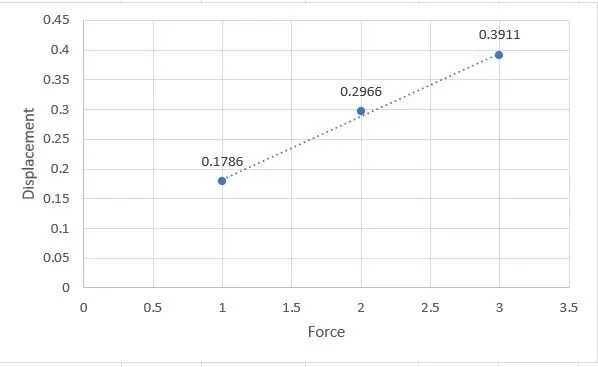
updated, u1(2)= u1(1)+δu(2)= 0.25-0.0714=0.1786
Checking Residual again R2,
F(ext)=1, f(int)=(1) => (0.1786)^3+(9x0.1786^2)+(4X0.1786)= 1.0071
R2= 1.0071-1=0.0071 < 10^-2
Above condition is satisfied.Hence, no further iteration needed final u1= 0.1786.
Step-2 & 3
Similar to above we do the calculations, then we can get u2=0.2966 and u3=0.3911.
Step i △Fi △ui ui F(ext)i f(int)i f(int)i-F(ext)i=R
1 1 0.25 0.1786 1 1.0071 0.0071
2 1 0.1374 0.2966 2 2.0042 0.0042
3 1 0.1041 0.3911 3 3.0008 0.0008
CONCLUSION-
The Explicit and Implicit methods are carried out for the give equation.
Comparing both the results and graphs we can observe that Implicit method is more accurate but the time consumed for solving and solemnly depends on element size and time steps whereas explicit deviates slightly from exact result and needs more iteration to obtain good result.