Week - 2 - Explicit and Implicit Analysis
Aim:
To study difference in Implicit and Explicit Analysis by solving a problem.
Introduction:
Explicit Analysis:
- Calculate the state of given system at different time from current time.
- Generally, used when event occurs faster. {sum of all forces = mass X acceleration}
Implicit Analysis:
- Find a solution by solving an equation that include both the current and later states of the given system.
- Used when the events occur much slower. {sum of all forces = 0}
Solution:
Consider, the case of a simple bar in tension. suppose that the force in the bar is non-linear of displacement.
f(u)= u3 + 9u2 + 4u ________________(1)
from (1) it follows that stiffness of the matrix is;
k(u)= 2u2 + 18u + 4 ________________(2)
Explicit Analysis:
Using Incremental Explicit load control method to solve this equation. For this example, three equal load increment (or step) of ΔF=1 unit each are used to load the tension bar. The variable used are u for displacement, f for internal force in the bar, F for external force applied to the bar and k for stiffness.
Incremental displacement or Incremental externally applied forces are represented as Δu & ΔF respectively. Use is made of relationship ΔF=k Δu. The analysis proceed as follows;
Step 1:
u0 = 0 ; ΔF = 1 ; k(u0) =4 ; Δu1 = ΔF / k(u0) = 1/4 = 0.25
u1 = u0 + Δu1 = 0.25
Step 2:
u1 = 0.25 ; ΔF = 1 ; k(u1) =8.625 ; Δu2 = ΔF / k(u1) = 1/8.625 = 0.1159
u2 = u1 + Δu2 = 0.365
Step 3:
u2 = 0.365 ; ΔF = 1 ; k(u2) =10.84 ; Δu3 = ΔF / k(u2) = 1/10.84 = 0.092
u3 = u2 + Δu3 = 0.457
finally, from three steps the following results are obtained;
Fext = ΔF + ΔF + ΔF = 3
fint = u3 + 9u2 + 4u = (0.457)3 + 9 (0.457)2 + 4 (0.457) = 3.79
It is evident from the results that External and Internal forces are not in equilibrium because Fext ≠ fint
|
Step i |
ΔFi |
Δui |
(Fext)i |
(fint)i |
fint - Fext = R |
|
1 |
1 |
0.25 |
1 |
1.578 |
0.578 |
|
2 |
1 |
0.1159 |
2 |
2.70 |
0.70 |
|
3 |
1 |
0.092 |
3 |
3.79 |
0.79 |
Implicit Analysis:
An implicit analysis is the same as the explicit analysis, expect that at the end of each step Newton-Raphson Iteration are used to enforce equilibrium before moving to the next step. Basically, an incremental force is applied to advance the solution forward at the beginning of a step. However, internal forces and external forces will not be in equilibrium unless the stiffness is linear for the given step. Hence, in order to achieve equilibrium, corrections must be made to the displacement. This is accomplished by using Newton-Raphson iterations to minimize the residuals.
R(u) = fint - Fext
Rj+1 = Rj (uj) + d R(uj) δ uj+1 + _ _ _ _
d (u)
= Rj + k (uj) δ uj+1 + _ _ _ _ (3)
By, neglecting higher order terms in the series, setting Rj+1 = 0 & solving for δ uj+1 the following correction factor is obtained.
δ uj+1 = - [k (uj)]-1 Rj
here, the iteration variable is j and it may take several iterations for the norm of the residual, || R || to be reduce below the chosen tolerance criteria of 0.01.
Step 1:
u0 = 0 ; ΔF = 1 ; k(u0) =4 ; Δu1 = ΔF / k(u0) = 1/4 = 0.25
u1 = u0 + Δu1 = 0.25
Fext = 1
fint = u3 + 9u2 + 4u = (0.25)3 + 9 (0.25)2 + 4 (0.25) = 1.5781
R0 = fint - Fext = 1.5781 – 1 = 0.5781
|| R0 || > 10-2
Newton-Raphson Method are necessary;
Calculate the correction u1 = u10
δ u1 = - [k (u10)]-1 R0
k (u10) = 8.625 ; R0 = 0.5781
δ u1 = - [ 8.625 ]-1 x 0.5781
δ u1 = - 0.0665467
Now, updating the value,
u11 = u10 + δ u1 = 0.25 + (-0.06654) = 0.1835
Now checking residuals,
Fext = 1
fint = u3 + 9u2 + 4u = (0.1835)3 + 9 (0.1835)2 + 4 (0.1835) = 1.0373
now,
R1 = fint - Fext = 1.0373 – 1 = 0.0373
|| R1 || > 10-2
Now, calculating new total correction to u1 = u11
δ u2 = δ u1 - [k (u11)]-1 R1
k (u11) = 7.4032 ; R1 = 0.0373
δ u2 =(-0.0665) - [ 7.4032 ]-1 x 0.0373
δ u2 = - 0.0715
u12 = u10 + δ u2 = 0.25 + (-0.0715) = 0.178
Now checking residuals,
Fext = 1
fint = u3 + 9u2 + 4u = (0.178)3 + 9 (0.178)2 + 4 (0.178) = 1.0028
now,
R2 = fint - Fext = 1.0028 – 1 = 0.0028
|| R2 || < 10-2
So, Newton-Raphson Iteration not necessary.
So, final value is u1 = u12 = 0.178
Step 2 and Step 3:
Similarly, as step 1, we get u2 = 0.2966 & u3 = 0.3911
|
Step i |
ΔFi |
Δui |
(Fext)i |
(fint)i |
R = fint - Fext |
|
1 |
1 |
0.1784 |
1 |
1.0057 |
0.0057 |
|
2 |
1 |
0.2966 |
2 |
2.0035 |
0.0035 |
|
3 |
1 |
0.3911 |
3 |
3.0009 |
0.0009 |
It is evident from the table that External forces and Internal Forces are coming into equilibrium.
Calculation of Exact Value:
f(u)= u3 + 9u2 + 4u
If f(u)= u3 + 9u2 + 4u =1
u1 = 0.177
If f(u)= u3 + 9u2 + 4u =2
u1 = 0.296
If f(u)= u3 + 9u2 + 4u =3
u1 = 0.3910
Graph:
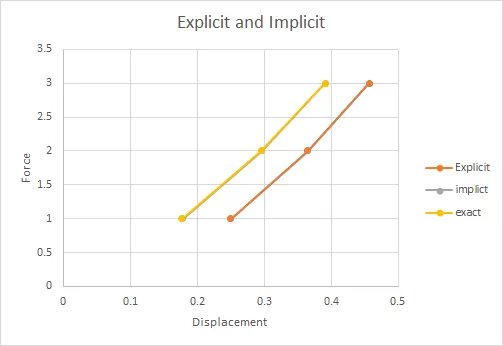
Conclusion:
- based on above calculation and graph, we can say that implicit analysis using Newton-Raphson method is closed to the exact solution and Explicit analysis is apart from Exact solution.
- Implicit analysis is more accurate than Explicit analysis but it is time consuming.