Project - Vehicular Crash safety Systems
Introduction:
Tesla is an electric vehicle (EV) company founded by Elon musk, JB Straubel, Martin Eberhard, Marc Tarpenning and Ian Wright in 2003. The company specialized in producing electric vehicles using lithium-ion battery for energy storage and subsiding the establishment of solar panels. Compared to the traditional vehicles that rely heavily on the combustion of fossil fuel gas to supply energy to vehicles, Tesla pioneered the use of renewable energy to generate scalable clean energy to power vehicles, laying out a strong foundation for the development of electric vehicles industry. Ever since its establishment in 2003, Tesla underwent rapid market development world wide due to its influential roles in electrical vehicle market and advanced technological innovations. In recent year, Tesla has turned out to be a $2.3 trillion automotive industry in the world.
Core sections of EV:
Electrical vehicle will be major growth segment in china and the US because the battery capacity of electrical vehicle going up and battery cost is going down. According to new International Environment Agency (IEA) Report, Tesla was the leading company to drive both of these trends. By 2030, IEA expects the average battery capacity to reach 1.5 TWh per year from 170 GWh per year, and battery costs will be expected to drop respectively. Eventually, the delivery of Tesla's new model will enhance the growth trend of EV market's development.
Battery:
Lithium-ion battery is a type of rechargeable battery that are used to power portable electronics and electric vehicle. A prototype Li-ion battery was first developed by Akira Yoshino in 1985 and was then advanced by Sony and Asahi to create a commercial Li-ion battery. Later in 2019, Yoshino, Goodenough and whittingham developed Lithium-ion battery. The Use of lithium-ion battery is common in EV market in the past. Although scientist are working on other innovative technologies (including lithium-sulphur, lithium-metal and sodium-ion) that can be used as a replacement of lithium-ion battery, IEA still expect the lithium-ion battery to remain as mainstream in EV Market for next couple years.
Meanwhile, Tesla is the leading company to be able to reduce the cost of cylindrical cell batteries for more USD 200 per KWh in 2019 and use cylindrical battery cells in as its battery packs. There are two major ways that enable tesla to do so; the use of more advanced form of engineering and establishment of more Giga factories to manufactures battery packs. Therefore, Tesla has revolutionized the batterie's industries by reducing the costs of using cylindrical battery as a battery cells in battery packs.
Because of Tesla dominating sucess in EV market worldwide, other automotive industries announce that they will spend billions of dollars to catch up to Tesla. Companies such as Toyota and Japanese battery firm Panasonic started to horizontally integrate with other popular EV industries in order to develop and build more powerful batteries pack to power electrical vehicles.
Automatic Driving:
Numerous investment have been made toward the development of technology in driverless vehicles. Autonomous vehicles (AV) are expected to be designed following the guidelines of ACES ( autonomous, connected, electrified and shared). In order for the AV to appear on the street, there is need for the substantial development for faster charging infrastructure, longer range, safer technology, battery durability and protection of personal or vehicle data. Meanwhile, electrical vehicles are the driving force for the growth of adopting autonomous system in vehicle driving because of the special features of electric vehicles that matches the design of autonomous vehicle. There are few reasons that automation integrated better in EV. Firstly, the drive by wire-system built in EV is more compactible and flexible than traditional mechanical control system with electronic controls in gas powered vehicle. Secondly, wireless charging in electrical vehicle will integrate seamlessly with autonomy. Lastly, autonomous technology integrate better with electric engine as electrical cars are easier for the computer to drive. Therefore, it is very likely that EV will be automated or, vice versa.
Competition Analysis:
The development of electrical vehicles are facilitated by the traditional auto industry and EV industry such as Tesla, Daimler AG, Volkswagen, BYD, BMW, Mercedes-Benz, Nio and Others. Among those, the leading players include Tesla, Nio, Volkswagen and BYD, etc. Those leading players adopt different marketing strategies to compete for major market share in EV industries, which can potentially change investor's mind to invest into alternatives on the manufacturer of electrical vehicles. As more competitors flood into the EV market, Tesla has been pressured to turn to alternative profits, ramping up the production of its EV vehicles.
Despite the impressive influence of those auto industries on EV market, Tesla is still the leading player because of its technological innovations and market control. First of all, Tesla is the founding company to strengthen the self driving algorithm through machine learning for EV vehicle as it gathered almost 2 billion miles of data through its autopilot drive - assist features of EV vehicle. Secondly, Tesla is also first company to first achieve the production of powerful batteries at lower costs. Lastly, Tesla EV can travel further than electrical vehicles build in other industries, for that its model S can travel as long as 380 miles, which has much further travel range in miles than any of the EV cars. Because of those achievements, Tesla claims its undisputable dominance in EV market, making up almost 60% of electric vehicles sold in the US nowadays. Besides, its stock share risen by more than 500% in 2020 over the last 12 months. In response to Tesla global influence, companies such as Nikola, Rivian, Fiskar, Byton and Faraday future will join the competition, hoping to become "the next tesla" and gaining majority of Market control in terms of stocks.
Valuation:
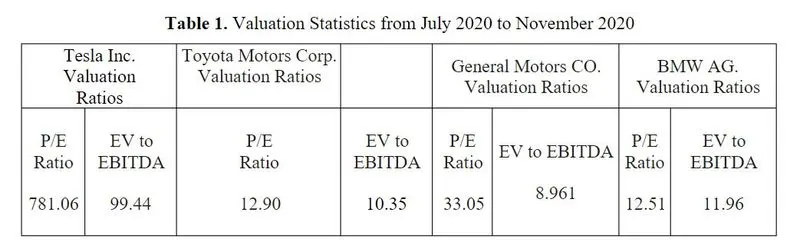
Currently, Tesla Inc. valuation ratios ( PE Ratio and EV/EBITDA Ratio) is much higher than the aggregate valuation ratios in other automobile industries in EV Market. Because of that shareholders may be inclined to capitalize on higher share price for higher investment return with the expected investment strategy. As shown in Figure 1, Tesla valuation metrics (PE Ratio and EBITDA Ratio) are between 9 to 23.6 times higher than that of the competitors for each metric despite those carmakers are selling much more vehicle than Tesla does. For instance, BMW AG , the smallest by market cap, has 6,75680 car sales in 2020, which is 5 times many as Tesla 139300. Furthermore, Tesla stock value is still growing. So, it is clear that Tesla's stock has been overvalued. Table 1 below present a valuation statistics of Tesla from July 2020 to November 2020.
Conclusion:
In conclusion,
- Tesla continues to develop internationally to accelerate the advent of clean transport and clean energy production around the world.
- Tesla has the edges over its competitors because of its dominant market control and technological innovations.
- Tesla will create broader customer base in near future because they are aiming to create more affordable electric car options.