Week - 2 - Explicit and Implicit Analysis
Explicit and implicit analysis
In explicit analysis, highly nonlinear dynamic problem is analyzed. While, implicit analysis, linear and nonlinear static is analyzed.
Explicit analysis, high frequency and high velocity problem is analyzed. Implicit analysis, low frequency and static problem is analyzed.
Explicit analysis will have large deformation with no way to avoid the inertial effects and time is considered to be important part of the analysis.
Implicit analysis will have small deformation, inertial and damping effects can be ignored, time is large and will not be taken into account.
Explicit is solved using the direct solver. In implicit the solution is iterative.
Aim: Find the solution to the given F(u)=u3+9u2+4 polynomial equation using the explicit and implicit method.
The explicit method:
One method is used to an incremental explicit load control scheme. Here a load step of three increments of ∆f=1, unit each are used to load the tension bar.
Consider the simple bar in tension. F(u)=u3+9u2+4u
The incremental displacement is given by k(u)=df/du=3u^2+18u+4, the analysis proceeds as follows:
Step 1:
When, u0=0, k(u0) = 4, ∆f=1, ∆u1 = ∆f/ k(u0) = 1/4=0.25, u1= u0+∆u1=0+1/4=0.25
Step 2:
When u1=0.25, k(u1) =8.6875, ∆u2=∆f/ k(u1) = 1/8.6875=0.1157, u2= u1+∆u2=0.25+0.1157=0.3657
Step 3:
When u2=0.3657, k(u2) =10.98, ∆u3=∆f/ k(u2) = 1/8.6875=0.1157, u3= u2+∆u3=0.3657+0.09107=0.4567
For F(int), substituting in F(u)=u3+9u2+4u
When, u1=0.25, F (int 1) = (0.25)3+9(0.25)2+4(0.25) =1.781
When, u2=0.3657, F (int 1) = (0.3657)3+9(0.3657)2+4(0.36557) =2.7153
When, u2=0.4567, F (int 1) = (0.4567)3+9(0.4567)2+4(0.4567) =3.7992
| Step | ∆fi | ∆ui | ui | F(ext)i | F(int)i | F(int)i- F(ext)i=R |
| 1 | 1 | 0.25 | 0.25 | 1 | 1.5781 | 0.5781 |
| 2 | 1 | 0.1157 | 0.3657 | 2 | 2.7153 | 0.7153 |
| 3 | 1 | 0.09107 | 0.4567 | 3 | 3.7992 | 0.7992 |
Table 1: Summary of Explicit Analysis Results
The implicit method:
The implicit analysis is same as the explicit analysis, except at end of each step newton-Raphson iterations are used to enforce equilibrium before moving to the next step. Basically, an incremental force is applied to advance the solution forward at the beginning of a step. To achieve the balance between the internal and external forces the Newton-Raphson iteration is used to reduce the residual. Given tolerance is 0.001
Step 1:
When, u0=0, k(u0) = 4, ∆f=1, ∆u1 = ∆f/ k(u0) = 1/4=0.25, u1= u0+∆u1=0+1/4=0.25
Check the residual, Fext=∆f=1, Fint= u3+9u2+4u= (0.25)3+9(0.25)2+4(0.25) =1.5781
R (0) = Fint- Fext=1.5781-1=0.5781
/ R(0)/>10-3, Newton-Raphson method is necessary
Calculate the correction to u1= u1(0),
δu1(1) = - [k u1(0)]-1* R (0) =-0.0665
Updated value of u1(1) = u1(0) + δu1(1) =0.1835
Check the residual again, Fext=∆f=1, Fint= u3+9u2+4u= (0.1835)3+9(0.1835)2+4(0.1835) =1.0432
R (1) = Fint- Fext=1.0432-1=0.0432
/ R (1)/>10-3, Newton-Raphson method is necessary
Calculate the new total correction to u1= u1(1),
δu1(2) = δu1(1)-[k u1(1)]-1* R(0)=-0.0723
Updated value of u1(2) = u1(0) + δu1(2) =0.1777
Check the residual again, Fext=∆f=1, Fint= u3+9u2+4u= (0.1777)3+9(0.1777)2+4(0.1777) =1.000606
R (2) = Fint- Fext=1.000606-1=0.000606
/ R (1)/<10-3, no further iteration is necessary.
Therefore, the value of u1(2) = u1=0.1777
Step 2:
When, u1=0.1777, k(u1) = 7.29, ∆f=1, ∆u2 = ∆f/ k(u1) = 1/7.29=0.1371, u2= u1+∆u2=0.3148
Check the residual, Fext=∆f=1, Fint= u3+9u2+4u= (0.3148)3+9(0.3148)2+4(0.3148) =2.1822
Fext =∆f=1+1=2
R (0) = Fint- Fext=2.1822-2=0.1822
/ R(0)/>10-3, Newton-Raphson method is necessary
Calculate the correction to u2= u2(0),
δu2(1) = - [k u2(0)]-1* R (0) =-0.01828
Updated value of u2(1) = u2(0) + δu2(1) =0.29652
Check the residual again, Fext=∆f=1+1=2, Fint= u3+9u2+4u= (0.29652)3+9(0.29652)2+4(0.29652) =2.003468
R (1) = Fint- Fext=2.003468-2=0.003468
/ R (1)/>10-3, Newton-Raphson method is necessary
Calculate the new total correction to u2= u2(1),
δu2(2) = δu2(1)-[k u2(1)]-1* R(1)=-0.01864
Updated value of u2(2) = u2(0) + δu2(2) =0.2961
Check the residual again, Fext=∆f=1+1=2, Fint= u3+9u2+4u= (0.2961)3+9(0.2961)2+4(0.2961) =1.99943
R (2) = Fint- Fext=1.99943-2=-0.0005
/ R (1)/<10-3, no further iteration is necessary.
Therefore, the value of u2(2) = u2=0.2961
Step 3
When, u2=0.2961, k(u2) = 9.5928, ∆f=1, ∆u3 = ∆f/ k(u2) = 1/9.5928=0.1042, u3= u2+∆u3=0.4003
Check the residual, Fext=∆f=1+2=3, Fint= u3+9u2+4u= (0.4003)3+9(0.4003)2+4(0.4003) =3.1075
R (0) = Fint- Fext=3.1075-3=0.1075
/ R(0)/>10-3, Newton-Raphson method is necessary
Calculate the correction to u3= u3(0),
δu3(1) = - [k u3(0)]-1* R (0) =-0.009198
Updated value of u3(1) = u3(0) + δu3(1) =0.391102
Check the residual again, Fext=∆f=1+2=3, Fint= u3+9u2+4u= (0.391102)3+9(0.391102)2+4(0.391002) =3.0008782
R (1) = Fint- Fext=3.0008782-3=0.0008782
/ R (1)/<10-3, no further iteration is necessary.
Therefore, the value of u2(3) = u2=0.391102
| Step | ∆Fi | ui | F(ext)i | F(int)i | F(int)i- F(ext)i=R |
| 1 | 1 | 0.25 | 1 | 1.5781 | 0.5781 |
| 1 | 1 | 0.3657 | 2 | 2.7153 | 0.27153 |
| 1 | 1 | 0.4567 | 3 | 3.7992 | 0.7992 |
Table 2: Summary of Implicit Analysis Results
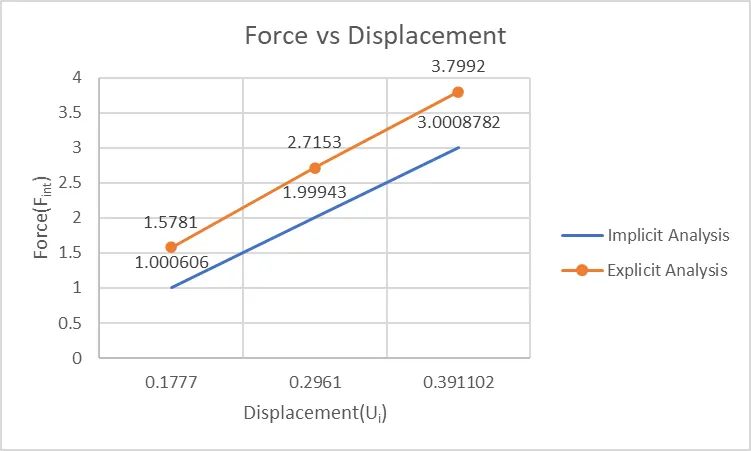
Figure 1: Force Vs displacement curve
Plot of the results
The figure 1 Shows that the explicit drifts from the exact solution. Therefore, implicit is required to correct the problem as shown in the figure 1. The Newton-Raphson iteration correct the incremental steps so that they land on the exact solution according to the specified tolerance.
Conclusion
The plot of the results explains clearly that the explicit analysis differs from the solution required therefore, we require implicit analysis to correct this difference. Hence, can conclude that the implicit is the better scheme.