Week - 2 - Explicit and Implicit Analysis
week - 2 - Explicit and Implicit Analysis:
objectives: To explain about the explicit and implicit method and to solve the basic problem by using explicit and implicit method to understand the working of this schemes in analysis .
Explicit and Implicit Analysis:
- Explicit and implicit are the methods to solve the dynamic problems.even it can solve the static problem but we have some limitation and disadvantage.
- Analysis can be divided into two:
- Static(Load is constant,deformation maybe linear or it can also be non-linear,time dependent or it may also be time independent)
- Dynamic(Load may constant or may not also be constant,deformation maybe linear or it can also be non-linear,time independent)
- Explicit and implicit are comes under dynamic analysis,but it can also solve static
- if we take the dynamic governing equation M[X'']+C[X']+K[X]=F(t)
here the [x'']-acceleration
[x;]-velocity
[x]-displacement
F- force
t-time
M-Mass matrix
C- damping matrix
K- stiffness matrix
- When we solve static problem using implicit scheme then the governing equation is reduced to M[X'']+C[X']+K[X]=F(t) same thing for the dynamic analysis,but one thing to keep in mind is whether it is linear or non-linear,because when solving static problem the dynamic govering equation M[X'']+C[X']+K[X]=F(t) in this the mass matrix we become null matrix(every value become zero) and the damping matrix also become zero and finally it reduced to equation K[X]=F(t).
- For linear K[X]=F(t) for non-linear K(x)[X]=F(t).
- Mostly they will use implict method to solve static and quasi static types of problem and explicit scheme is used to solve dynamic cases.
- We can solve static problem by using explcit analysis but the time it would take take to form stiffness matrix will take some time and the solving will not converged at each steps.
- lets take a brief diffrence between the explcit and implicit scheme:
| EXPLICIT | IMPLICIT |
|
|
|
|
|
|
|
|
|
|
|
|
|
|
|
|
|
|
|
|
|
|
|
|
- let understand this concepts by taking a simple problem,a bar in tension with one end is fixed ,the given equation is
F(u)=u3+9u2+4u---------(1)
- Diffrentiate the above equation to find out the stiffness
K(u)=3u2+18u+4---------(2)
---------------------------------------------------------------------------------------------------------------------------------
For explicit:
For solving this problem the external load is given in a increment at each step
△F-is the external force
△u-incremental displacement. And we will get a incremental displacement at each step for incremental load
Fint-internal force
k-stiffness, the stiffness matrix will be updated at the each steps
u-displacement, displacement is the output at the each step
step1:
- The initial displacement is zero when force is not applied on the body so u0=0
- In this step the stiffness matrix should be update so substitute the intial displacement in the stiffness equation
k(u0) = 3u2+18u+4
k(0)=3(0)2+18(0)+4
k(0)=4
the incremental load is △f=1
as we solving a static problem the governing equation is K[X]=F(t) by applying the know value to the governing equation we can find the incremental displacement in this step
x-->△u
substitute the k and △F=1 in that equation we get ‘△u’
△u=△f/k
=1/4
△u=0.25
now interpolate the two displacement to find the actaul displacement in this step
Now calculate the displacementu1=u0+△u
u1=0+0.25
u1=0.25.
internal force(Fint)=u13+9u12+4u1
=(0.25)3+9(0.25)2+4(0.25)
=1.578
residual=-△F+Fint
=-1+1.578
residual=0.578.
step2:
- now, u1=0.25 is the input in the step 2 and we have second load increment △f=1
now in this we have to update the stiffness matrix
k(u1) = 3u2+18u+4
k(0.25)=3(0.25)2+18(0.25)+4
k(0.25)=8.687
now use the governing equation to find the incremental displacement
△u=△f/k
=1/8.687
△u=0.115
The final displacement u2= u1+△u
u2= 0.25+0.115
u2=0.365.
internal force(Fint)=u23+9u22+4u2
=(0.365)3+9(0.365)2+4(0.365)
=2.707
residual=-△F+Fint
=-2+2.707
residual=0.707
steps3:
- Now, u2=0.365 is the input in the step 3 and we have second load increment △f=1
now in this we have update the stiffness matrix
k(u2) = 3u2+18u+4
k(0.365)=3(0.365)2+18(0.365)+4
k(0.365)=10.96
now use the governing equation to find the incremental displacement
△u=△f/k
=1/10.96
△u=0.0912.
The final displcement u3= u2+△u
U3= 0.365+0.0912
U3=0.4562
internal force(Fint)= U33+9 U32+4 U3
=(0.4562)3+9(0.4562)2+4(0.4562)
=3.792
residual=-△F+Fint
=-3+3.792
residual=0.792.
| step(increment) | △F | Fint | △u | U | △f | residual=-△F+Fint |
| 1 | 1 | 1.578 | 0 | 0.25. | 1 | 0.578. |
| 2 | 2 | 2.707 | 0.115 | 0.365 | 1 | 0.707 |
| 3 | 3 | 3.792 | 0.0912 | 0.4562 | 1 | 0.792. |
---------------------------------------------------------------------------------------------------------------------------------
implicit:
For solving this problem the external load is given in a increment at each step
△F-is the external force
△u-incremental displacement. And we will get a incremental displacement at each step for incremental load
Fint-internal force
k-stiffness, the stiffness matrix will be updated at the each steps
u-displacement, displacement is the output at the each step
the given tolerance is 0.001
steps1:
- The initial displacement is zero when force is not applied on the body so u0=0
- In this step the stiffness matrix should be update so substitute the intial displacement in the stiffness equation
k(u0) = 3u2+18u+4
k(0)=3(0)2+18(0)+4
k(0)=4
the incremental load is △F=1
as we solving a static problem the governing equation is K[X]=F(t) by applying the know value to the governing equation we can find the incremental displacement in this step
x-->△u
substitute the k and △F=1 in that equation we get ‘△u’
△u=△F/k
=1/4
△u=0.25
now interpolate the two displacement to find the actaul displacement in this step
Now calculate the displacementu1=u0+△u
u1=0+0.25
u1=0.25.
internal force(Fint)=u13+9u12+4u1
=(0.25)3+9(0.25)2+4(0.25)
=1.578
residual=-△F+Fint
=-1+1.578
residual=0.578.
Fint is not equal to △F
Newton-Raphson iterations are necessary,
k(u1(0)) = 3u2+18u+4
=3(0.25)2+18(0.25)+4
=8.68.
|R(0)|> 10−3
δu(1) = −[k(u1(0))]−1R(0)
= −[8.68]−10.578.
δu(1)=-0.0665.
u1(1) = u1(0)+ δu(1)
=0.25-0.0665.
u1(1) =0.1835.
.again check the internal force
internal force(Fint)=u1(1) 3+9u1(1) 2+4u1(1)
=(0.1835)3+9(0.1835)2+4(0.1835)
=1.0071>0.001
residual=-△f+Fint
=-1+ 1.0071
=0.0071<0.001
no residual needed
same thing we have to do for two load increments,u2=0.2966,u3=0.3911.
| step(increment) | △F | Fint | △u | U | △f | residual=-△F+Fint |
| 1 | 1 | 1.0071 | 0.25 | 0.1786 | 1 | 0.0071 |
| 2 | 2 | 2.0042 | 0.1374 | 0.2966 | 1 | 0.0042 |
| 3 | 3 | 3.008 | 0.1041 | 0.3911 | 1 | 0.008 |
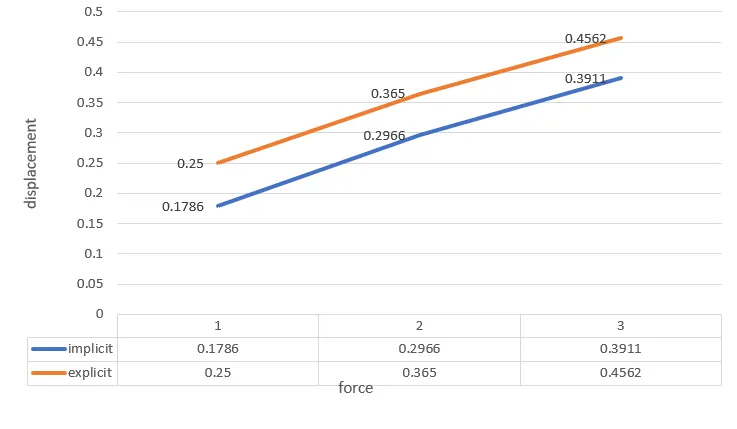
here when u solve the same problem using different scheme you can actual notice the solution convergence.
result:
- briefly explained about the implicit and explicit methods.
- solved the same problem using implicit and explicit method.
learning objectives:
- learned about the explcit and implcit methods