Week - 2 - Explicit and Implicit Analysis
f(u)=u^3+9u^2+4u
k(u)=df/du=3u^2+18u+4
Explicit Analysis:∆F=k∆u, ∆F=1, 3 steps
step 1
u0=0⇒k(u0) = 4, ∆F = 1, ∆u1 = ∆F/k(u0) = 0.25, u1 = u0 + ∆u1 = 0.25
step 2
k(u1) = k(0.25)=8.69, ∆F = 1, ∆u2 = ∆F/k(u1) = 1/8.69, u2 = u1 + ∆u2 = 0.25+0.12=0.37
step 3
k(u2) = k(0.37)=11.07, ∆F = 1, ∆u3 = ∆F/k(u2) = 1/11.07, u3 = 0.37+0.09=0.46
Fext = ∆F + ∆F + ∆F = 3.0
fint = 0.46^3+9*0.46^2+4*0.46=3.84
step i ∆F ∆ui ui (Fext)i (fint)i fint − Fext = R
1 1 0.25 0.25 1 1.58 0.58
2 1 0.04 0.37 2 2.76 0.76
3 1 0.02 0.46 3 3.84 0.84
Implicit Analysis:
δuj+1 = −[k(uj)]−1R
step 1
u0=0⇒ k(u0) = 4,∆F = 1,∆u1 = ∆F/k(u0) = 0.25, u1 = u0 + ∆u1 = 0.25
check the residual, Fext=∆F = 1, fint=0.25^3+9*0.25^2+4*0.25=1.578125,R0=fint-Fext=0.578125
R0>10^-2⇒ Newton-Raphson iterations are necessary.
Calculate the correction to u1 = u1(0)
δu(1) = −[k(u(0)1)]−1R(0)=-(8.6875)^-1*0.578125=-0.06655
⇒ The updated value of u(1)1 = u1(0) + δu(1)=0.25-0.06655=0.18345
Check the residual again, Fext = 1, fint=0.18345^3+9*0.18345^2+4*0.18345=1.043
R(1) = fint − Fext=1.043-1=0.043
||R(1)||> 10^−2 ⇒ another Newton-Raphson iteration is necessary.
Calculate the new total correction to u1 = u1(0)
δu(2) = δu(1) − [k(u(1)1)]−1R(1)=-0.06655-(3*0.18345^2+18*0.18345+4)^-1*0.043
=-0.06655-(0.043/7.4031)=-0.06655-0.0058=-0.07235
The updated value of u(2)1 = u(0)1 + δu(2)=0.25-0.07235=0.17765
Check the residual, Fext = 1,fint=0.17765^3+9*0.17765^2+4*0.17765=1.000246
R(2) = fint − Fext=0.000246
||R(2)||< 10−2 ⇒ no further iterations are necessary.
Therefore, the final value is u1 = u(2)1 = 0.17765.
step 2
K(u1)=3*0.17765^2+18*0.17765+4=7.2924
∆F = 1, ∆u2 = ∆F/k(u1) =0.13713
u2 = u1 + ∆u2 =0.17765+0.13713=0.31478
Check the residual, Fext = ∆F = 1, fint=0.31478^3+9*0.31478^2+4*0.31478=2.1821
R(0) = fint − Fext =0.1821>10−2 ⇒ Newton-Raphson iterations are necessary.
Calculate the correction to u2 = u2(0)
δu(1) = −[k(u(0)2)]−1R(0)=−[k(0.31478)]−1R(0)=−0.1821/9.9633=-0.0183
⇒ The updated value of u2(1) = u(0)2 + δu(1) =0.31478-0.0183=0.29648
Check the residual again, Fext = 1,fint=0.29648^3+9*0.29648^2+4*0.29648=2.00312
R(2) = fint − Fext = 0.00312<10^-2⇒ no further iterations are necessary.
Therefore, the final value is u2 = u2(1) = 0.29648
step 3
k(u2)=3*0.29648^2+18*0.29648+4=9.6
∆F = 1, ∆u3 = ∆F/k(u2)=0.1042
u3 = u2 + ∆u3=0.29648+0.1042=0.4
Check the residual, Fext = ∆F = 1, fint=0.4^3+9*0.4^2+4*0.4=3.104
R(0) = fint − Fext =0.104>10−2 ⇒ Newton-Raphson iterations are necessary.
Calculate the correction to u3 = u3(0)
δu(1) = −[k(u(0)3)]−1R(0)=-[k(0.4)]−1R(0)=-0.104/11.68=-0.009
⇒ The updated value of u3(1) = u(0)3 + δu(1)=0.391
Check the residual again, Fext = 1,fint=0.391^3+9*0.391^2+4*0.391=2.99967
||R(3)|| = ||fint − Fext|| = 0.00033<10^-2⇒ no further iterations are necessary.
Therefore, the final value is u3 = u3(1) = 0.4
step i ∆F ui (Fext)i (fint)i fint − Fext = R
1 1 0.17765 1 1.000246 0.000246
2 1 0.296482 2 2.00312 0.00312
3 1 0.46 3 2.99967 0.00033
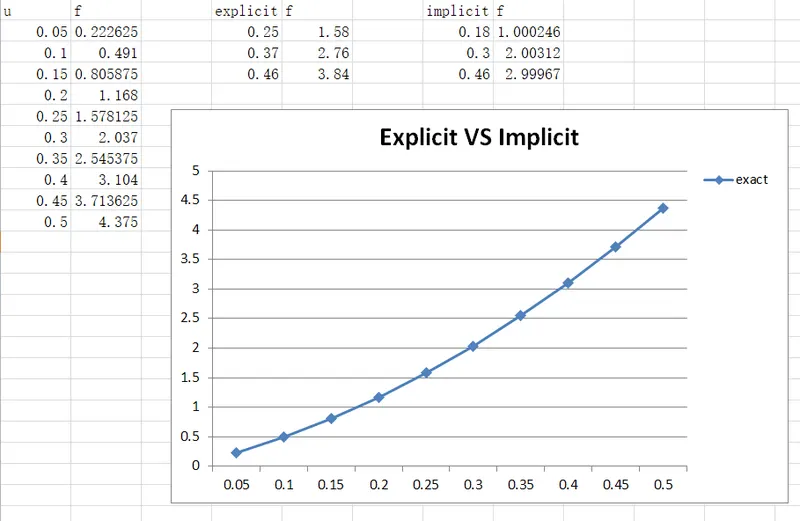
Aim of this challenge: write detailed calculation for this problem with Implicit and Explicit schemes, compare to each other, find advantages and disadvantages.
Conclusion: In this problem, it is evident from the plot that the explicit analysis drifts from the exact solution. Implicit method is more accurate compared to exact result. The reason is Newton-Raphson is used to make equilibrium between internal and external forces.
Plot: