Week 2 Challenge : Surface meshing on a Pressure valve
AIM: TO CHECK FOR GEOMETRIC ERRORS AND PERFORM TOPOLOGICAL CLEANUP FOR THE SUBSEQUENT MESHINGS WITH GIVEN TARGET LENGTHS TO BE 1mm, 3mm and 5mm.
PROCEDURE:
The received model had several holes, missing surfaces and single cons to solve for.
New faces were defined using the ‘COONS’ option. Smaller holes were filled using the ‘Fill hole’ option.
After some basic topo cleanup, I performed Geometric checks. The bottom surface of the valve created some triple cons, but apart from that I wasn’t expecting any other errors. But I still did not uncheck the triple cons option in the geometric checks as there could be other places where there could be triple cons that may require solving (like overlapping surfaces).
As expected, the only error was the triple cons that I mentioned earlier.
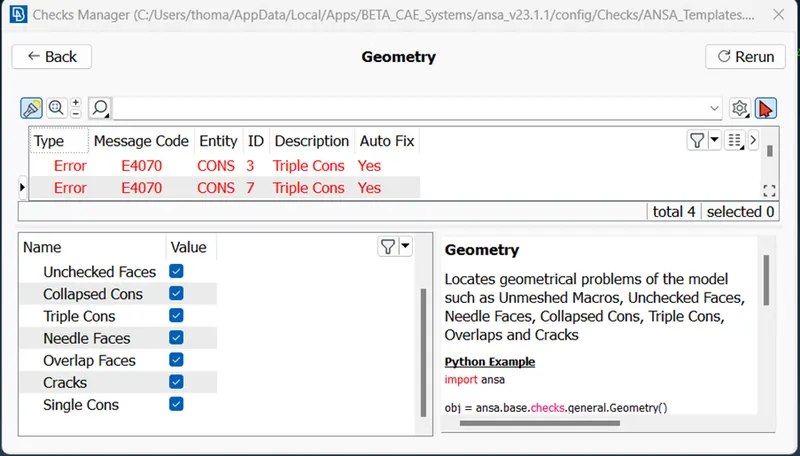
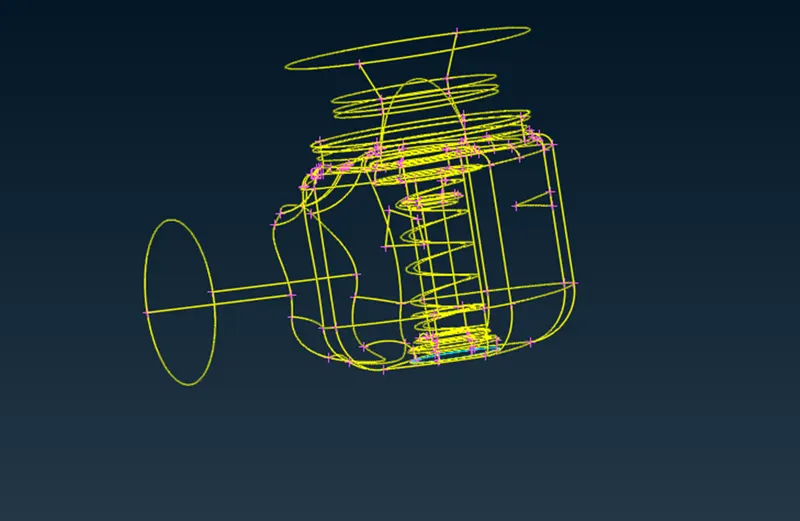
(After Topo cleanup)
At first, I saw a gap in one of the faces. On closer examinations, I did not see any cons along the gap and ascertained that it was a graphical error from ANSA’s part. This consumed a lot of my time.
I deleted some cuts on the faces that made small areas on the faces. I anticipated that these would cause issues while meshing as they would fit the quality criteria of only very small target lengths.
Then, I went on to assign PIDs for the different parts.
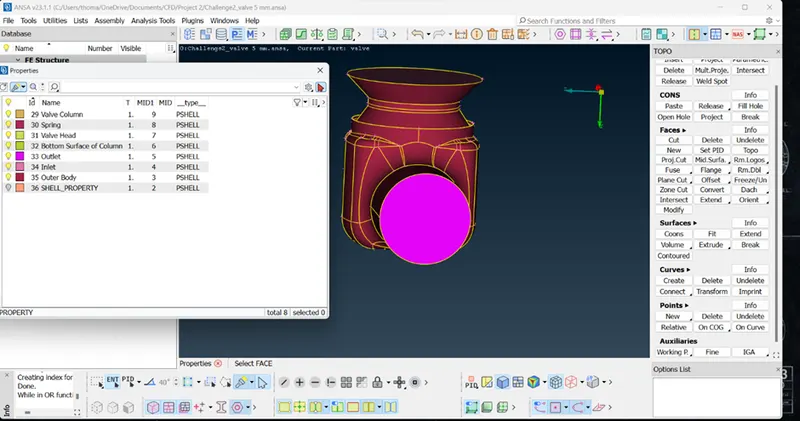
After this, I went ahead with the meshing. BY setting the required target lengths, quality criteria and selecting the ‘tria’ type of meshings.
I meshed the model PID by PID. Then also performed geometric checks again, this time also checking the ‘unmeshed macros’ option.
LEARNING OUTCOMES: The larger mesh targets lengths resulted in a smaller number of meshes and vice versa. More importantly, the larger mesh lengths were unable to properly capture the geometry of parts like the ‘Bottom Surface of the Column’ and the ‘Spring’ as they had finer/smaller dimensions.
The smaller the target lengths, the better it was for capturing the geometries.
Therefore, the finest mesh (target length of 1mm) did the best job.
If I had the option, I would mesh different PIDs with different target lengths. For example, I would mesh the ‘Spring’ with the 1mm target length and mesh the ‘Outer Body’ with 5mm target length.
RESULT: Topological cleanup was done. Different parts were assigned with PIDs and were meshed with the supplied target lengths.
CONCLUSION: Finer meshings (smaller target lengths) will better capture the geometry especially of those with smaller dimensions (as observed in the learning outcome).