Week 2 Challenge
1.
Fuel cells are classified primarily by the kind of electrolyte they employ. This classification determines the kind of electro chemical reactions that take place in the cell, the kind of catalysts required, the temperature range in which the cell operates, the fuel required and other factors.
1. Proton Exchange Membrane Fuel Cell (PEM)
PEM fuel cells deliver high power density and offer advantages of low weight and volume compared with other fuel cells. It use a solid polymer as an electrolyte and porous carbon electrodes containing a platinum or platinum alloy as catalyst. They need hydrogen from storage tanks, oxygen and water to operate. Due to their fast start up times and favourable weight to power ratio, they are suitable for transportation applications.
2. Solid Oxide Fuel Cell (SOFC)
SOFCs use a hard, non porous ceramic compound as the electrolyte. They are around 60% efficiency and they operate at high temperature (1000deg.) which eliminates the need for platinum catalyst. Thus reducing the cost. But because of this high operating temperature, it is not suitable for transportation applications.
3. Alkaline Fuel Cell (AFC)
AFCs were one of the first fuel cell technologies developed, and widely used in U.S. Except that they use alkaline membrane instead of an acid membrane, they are closely related to PEM fuel cell. The main challenge of this type of fuel cell is that a small amount of CO2 in the air affects the desired cell performance. Because of tolerance to Carbon dioxide, membrane conductivity and durability issues, its efficiency is less than PEM.
4. Direct Methanol Fuel Cell (DMFC)
Most of the fuel cells are powered by hydrogen, which can be fed to the fuel cell system directly. But DMFCs use pure methanol which is mixed with water and fed directly to anode. Methanol is easy to transport than hydrogen and can be supplied to public using current infrastructure. But carbon dioxide is one of the by product of this cell. Due to its sluggish response it is less popular in transportation systems.
The 4 main types of fuel cells, oprating conditions, Applications, Challenges and advantages are compared in the table given below.
| Fuel cell type |
Common Electrolyte |
Operating Temp. |
Typical stack size |
Electrical Efficiency |
Applications | Advantages | Challenges |
|
Proton Exchange Membrane (PEM) |
Perfluorosulfonic acid |
<120 deg. | <1kW - 100kW |
60% for direct Hydrogen. 40% for reformed fuel |
1. Back up power 2. Portable power 3. Distributed generation 4. Transportation 5. Speciality vehicles |
1. Solid electrolyte reduces corrosion and electrolyte management problems 2. It can operate i low temperatures (negative temp.) 3. Can start quickly and supply load. |
1. Expensive Catalyst 2. Sensitive to fuel impurities |
|
Solid Oxide Fuel cell (SOFC) |
Yttria stabilized zirconia | 500 - 1000 deg. | 1kW - 2MW | 60% |
1.Auxiliary power 2. Electric utility 3. Distributed generation |
1. High Efficiency 2. Fuel flexibility 3. Solid Electrolyte 4. Low cost due to the absensce of precious catalyst 5. Suitable for power generation and heating |
1. High operarating temperature leads to corrosion 2. Long start up time 3. Limited no.of shutdowns |
| Alkaline (AFC) | Aqueous potassium hydroxide soaked in a porous matrix, or alkaline polymer membrane | <100 deg. | 1-100 kW | 60% |
1. Military 2. Space 3. Backup power 4. Transportation |
1. Wider range of stable stable materials allows lower cost components 2. Low operating temperature 3. High efficiency and quick start up |
1. Sensitive to CO2 in fuel and air 2. The liquid electrolyte systems also suffer from additional concerns including wettability, increased corrosion, and difficulties handling differential pressures |
|
Direct Methanol Fuel cell (DMFC) |
Aqueous Sulphuric acid | 60-130 deg. | 1 - 100kW | 40% |
1. Porable power 2. Mobile phones and laptops 3. Traction |
1. Low cost 2. High energy density 3. Easy transportation and storage |
1. Emits CO2 2. Methanol crossover reduces cell voltage 3. Sluggish kinetics of methanol oxidation 4. Slow operation |
Apart from these there are two more fuel cells which are popular nowadays.
5. Molten carbonate fuel cells (MCFCs)
MCFCs use a molten carbonate salt suspended in a porous ceramic matrix as the electrolyte.
They operate at high temperatures typically 650 deg. So it is suitable for stationary applications such as
heat and power applications. The efficiencies can be 60-80%.
6. Phosphoric acid fuel cells (PAFCs)
PAFCs consist of an anode and cathode made of a finely dispersed platinum catalyst on carbon and silicon carbide structure that holds the phosphoric acid electrolyte.
They operate at moderately high temeperatures of around 180deg. and overall efficiency can be up to 80%. This type of fuel cell used in stationary power generation as well as large vehicle applications.
-----------------------------------------------------------------------------------
2.
It is the amount of energy that can be stored in a given mass of a system. It is expressed in two ways.
1. Volumetric Energy Density - Typically expressed in Wh/L
2. Gravimetric Energy Density (Specific Energy)- Typically expressed in Wh/kg
Power Density
Power density is a measure of power output per unit mass/volume and it is expressed in W/kg or W/L.
Energy and Power Density of Batteries and super capacitors are calculated as below.
Energy Density = 1/2 * C*V*V/ weight
where C is the capacitance and V is the nominal voltage.
Power Density is V*V/4/ESR/weight
where ESR is the equivalent series resistance.
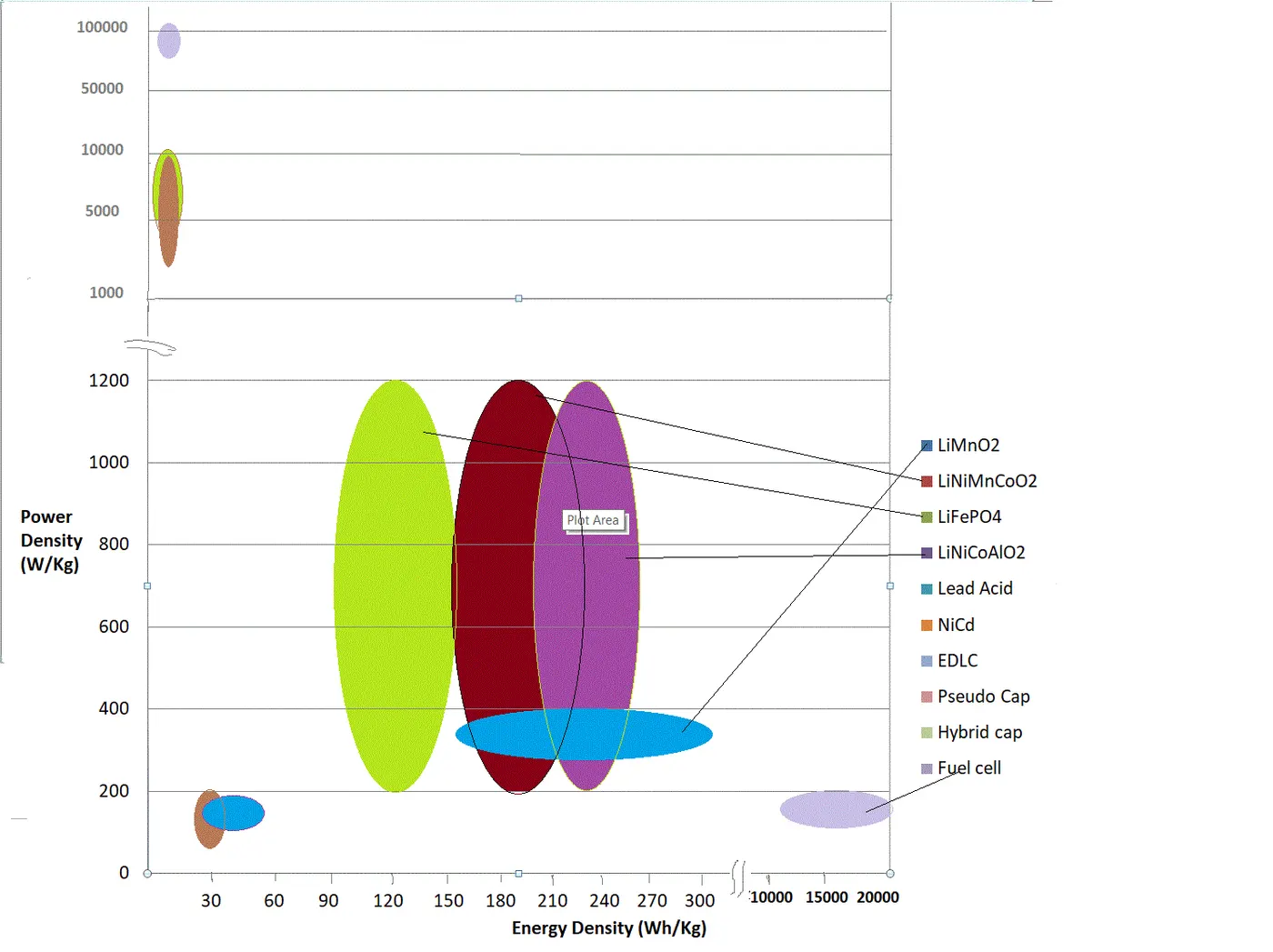
The Energy density and power density of various energy storage devices are given in table below.
|
SL. NO. |
Type of storage devise | Energy Density (Wh/Kg) | Power Density (W/Kg) |
| 1 | Lithium Manganese Oxide | 150-330 | 250-400 |
| 2 | Lithium Nickel Manganese Cobalt Oxide | 150-220 | 200-1200 |
| 3 | Lithium Iron Phosphate | 90-160 | 200-1200 |
| 4 | Lithium Nickel Cobalt Aluminium Dioxide | 200-260 | 200-1200 |
| 5 | Lead Acid | 30-40 | 180 |
| 6 | Nickel Cadmium | 30 | 150-200 |
| 7 | SC- Double Layer Capacitors (EDLCs) | 1.5 - 3.9 | >100000 |
| 8 | SC- Pseudo Capacitors | 4 - 9 | 2000 - 10000 |
| 9 | SC- Hybrid Capacitors (Li-Ion) | 10 - 15 | 3000 - 10000 |
| 10 | Fuel Cell | 13000-20000 | 150 - 250 |
Li-Ion Batteries
Li-Ion is named for its active materials used in the battery chemistry. There are many types of Li-Ion batteries according to battery chemistry. The energy and power densities also vary according to this. Among them mainly the following 4 types are suitable for automotive applications.
1. Lithium Manganese Oxide
2. Lithium Nickel Manganese Cobalt Oxide
3. Lithium Iron Phosphate
4. Lithium Nickel Cobalt Aluminium Dioxide
Super Capacitors or Ultra capacitors
There are three types of supercapacitors based on storage principle.
- Double-layer capacitors(EDLCs) — with activated carbon electrodes or derivatives with much higher electrostatic double-layer capacitance than electrochemical pseudocapacitance
- Pseudocapacitors— with transition metal oxide or conducting polymer electrodes with a high electrochemical pseudocapacitance
- Hybrid capacitors— with asymmetric electrodes, one of which exhibits mostly electrostatic and the other mostly electrochemical capacitance, such as lithium ion capacitor.
Calculation of Fuel cell Energy Density
Hydrogen gas has an energy density value of about 33kWh/kg
So at 100% Efficiency, (1/33)kg = 1kWh
The theoretical Efficiency of FC is 83% But the practical efficiency limited to 40-60%
The max efficiency of PEM is 60%. At this eff., 33*0.6= 19.8 appx. 20kWh/kg
Some times it may give 40% efficiency if we use reformed fuel other than pure hydrogen.
At this case 33*0.4= 13kWh/kg
The Plot of Energy density Vs Power Density of various storage devices are as shown below.