Week 2 Challenge
Aim and Introduction:
- To explain about loads, that is need to be applied in the abutment of the bridge as per IRC 6.
- And to check for overturning and sliding of the abutment.
- To design the section of stem, heel and toe. and to present the detailing of the steel in the foundation and wall.
- To explain about a selection of borehole location and its depth of exploration if it is the shallow foundation.
- To explain the parameters taken from a geotechnical investigation that is needed for the design of the foundation.
- To List five different types of soils or rocks and criteria that should be followed for selecting the foundation level of shallow foundation.
- Overturning occurs when the turning moment due to lateral forces exceeds than to the self-weight of the wall.
- Overturning failure is a result of excessive lateral earth pressures with relation to retaining wall resistance thereby causing the retaining wall system to topple or rotate.
- Sliding failure is the change in the position of the retaining wall far away from the backfill due to the forces from the backfill on the wall.
- The sliding failure will displace the base of the wall, which is mainly due to the shearing failure.
Elaboration:
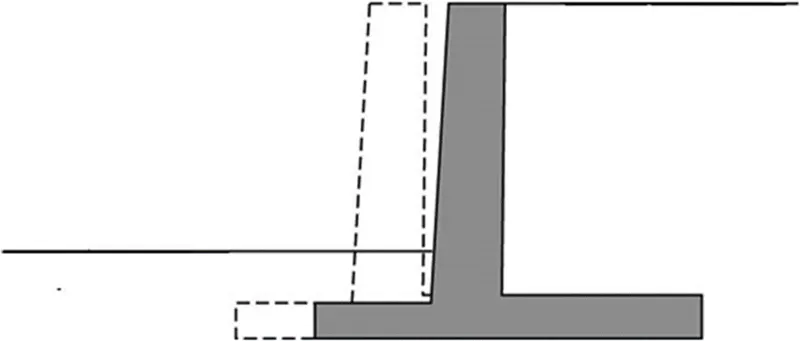
Fig. 1
- The above image shows the movement of wall from original position(dotted line) to final position(black line) due to the effect of the sliding of the wall and the pressure created on the wall from the backfill.
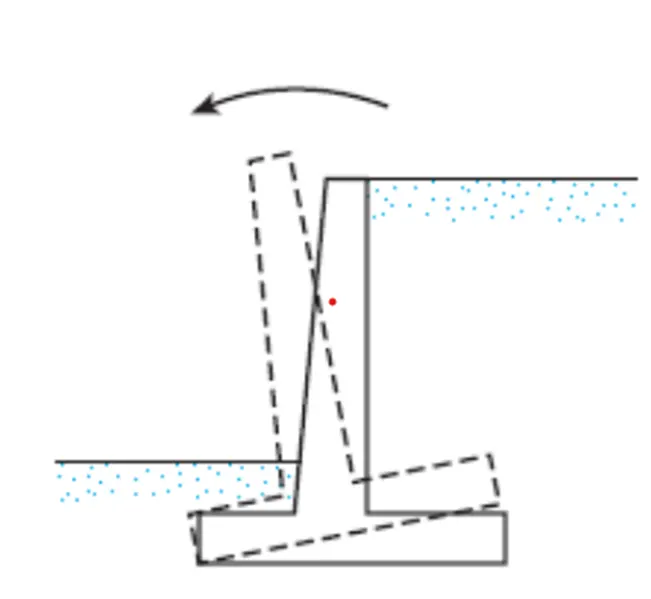
Fig. 2
- The above image shows the overturning failure.
Abutment :
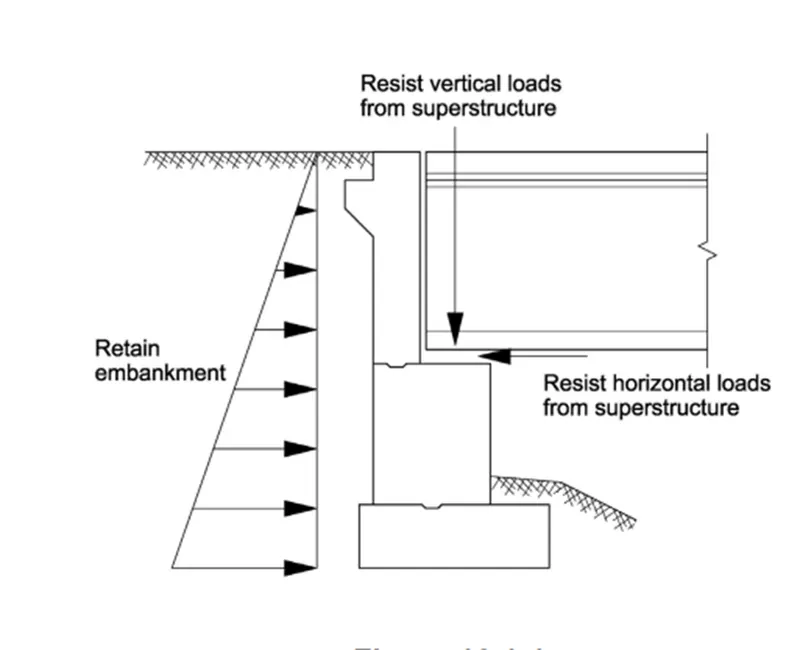
Fig. 3
- Abutments are constructed at the ends of bridges to retain the earthfill and to carry the vertical and horizontal loads from the superstructure to the foundation.
- The abutments designed must be stable against overturning and sliding.
- An abutment is subjected to both horizontal and vertical loads from the superstructure and also resists loads from the backfill material and any water that may be present.
Loads acting on abutment :
- Dead Load: The dead load carried by a member shall consist of the portion of the weight of the superstructure which is supported wholly or in part by the girder or member including its own weight.
- Live Load: The design live load shall consist of standard wheeled or tracked vehicles or trains of vehicles
- Vehicular braking force from live load: Tractive effort caused through the acceleration of the driving wheels, Braking force is due to the application of the brakes to braked wheels
- Wind load: The wind pressure acting on a bridge depends on the geographical location, the terrain of the surrounding area, the fetch of terrain upwind of the site location, the local topography, the height of the bridge above the ground, horizontal dimensions and cross-section of bridge or its element under consideration.
- Earth pressure: The pressure exerted by filled material over the abutment.
- Water load: Any part of a road bridge that may be submerged in running water shall be subjected to water load.
- Live load surcharge.
- Temperature and shrinkage: Daily and seasonal fluctuations in shade air temperature, solar radiation, cause the Temperature load.
- Earth surcharge.
-
Check for overturning and sliding:(Gravity retaining wall)
-
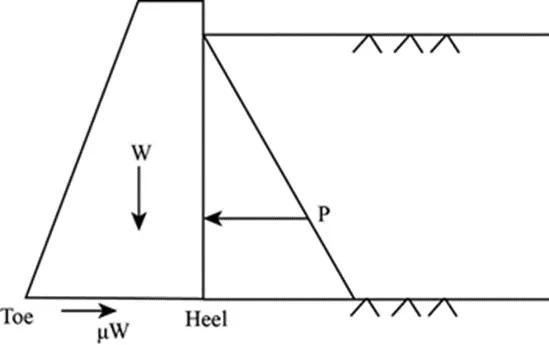
- Fig. 4
- The wall can slide along the bottom due to the lateral soil pressure. The factor of safety can be calculated using the formula.
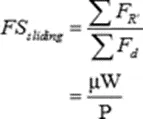
- The factor of safety against sliding is defined as forces preventing sliding along the bottom divided by the forces that will cause sliding along the bottom surface.
- The factor of safety should not be less than 1.5 for sliding conditions.
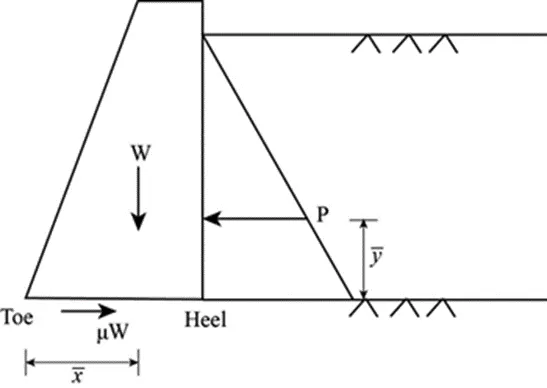
Fig. 5
- The moment about toe is induced from the lateral soil pressure causing it to overturn. The weight of the wall will have a moment resisting the overturn. The factor of Safety against Overturning is expressed using the formula.
- FS = FR/ \PH
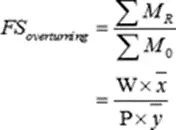
- ∑MR= Sum of resisting moment about toe
- ∑Mo= Sum of overturning moment about toe
- The Factor of Safety is defined as the sum of moments of forces preventing the rotation about (A) and (B) divided by the sum of the moment causing the rotation about the toe.
- FOS = Sum of moments that resist overturning(MR) / Sum of overturning moments(Mo).
- The Factor of Safety against Overturning should not be greater than 2.0
- Pa = Ka Ysoil h^2 /2
- For Gravel and coarse sandy backfill soil, φ= 33-36
- Height of wall = 4m
- Pa =1/2 x 18 x (4*4)x 1/3
- Pa=48 KN
- Ph = Pacos β =48 cos 15' = 46.36 kN / m
- Ph = v = Pasinβ = 48 sin 15'= 12.42 kN / m
overturning :
- The overturning moments are calculated by taking moments about point O, the whole section is divided into 5 parts. Let these forces be represented by w1, w2 and the corresponding lever arms asl1, l2, ... l5
- Assuming the weight of concrete as Yc = 24 kN/m3
- MR = W1l1 + w2I2 + ... w5I5
| Serial No. | Area(m^2) | Unit weight(KN/m) |
Weight(KN/m) (Area * Unit weight) |
Lever arm(m) |
Moment(KN-m) (Weight * Lever arm) |
| 1 | 1.20 | 18 | 21.6 | 3.75 | 81 |
| 2 | 18.75 | 18 | 337.5 | 3.25 | 1096.875 |
| 3 | 3.56 | 24 | 85.44 | 2.38 | 203.35 |
| 4 | 3.13 | 24 | 75.12 | 1.50 | 112.68 |
| 5 | 0.78 | 24 | 18.72 | 1.17 | 21.90 |
| Total | vertical= 538.38 | MR= 1515.8 |
- M0= 45.5x2.6 =118.3
- fos=1515.8/118.3 = 12.8, is greater than 2.0 hence safe.
Sliding:
- To find FR and PH (FD)
- Assume h = 4m, y= 19 kN/m3, c = 60 kN/m , total vertical force Iv = 538.38 kN
- Pp = 1/2 x 19 x 4 x 4 x 2.46 + 4 x 60 x 2 x (2.46)^1/2 =840kn/m
- FR = 60 x 4.75 + 596.9 tan 25° + 840 =1363.76
- PH = 181.2
- fos = 1363.76/181.2 = 7.52, is greater than 1.5 hence safe.
A borehole and Geotechnical investigation of the site:
Fig. 6
- Borehole investigations are done to get the properties of materials underneath soil layers, The type of foundations is given based on the condition of the soil layers.
- To perform a borehole investigation, we need to decide the number of boreholes to be drilled,
The borehole depends on factors:
- Area covered by the building.
- The scale of the project.
- Structural loading and load distribution arrangments.
- Condition of the ground(soil).
- Importance of the structure.
A borehole is a deep vertical hole with a small diameter drilled into the ground to obtain soil samples for soil investigation required for the construction of the suitable foundation for the planned structure.
The depth of Exploration carried out to a depth up to which the increase in pressure due to structural loading is likely to cause perceptible settlement or shear failure of the foundation, which depends upon the following factors,
- Type of structure
- Load on structure
- Size and shape of the foundation
- Position of loaded areas
- Soil profile and its properties
The depth of exploration should be one and half times to two times the estimated width of the footing, single or combined, from the base level of the foundation.
Site Investigation:
- Soil Exploration (Boring Holes)
- Collection of Soil Samples
- Conducting the in-situ tests
- Study of Groundwater conditions and Collection of water
sample for chemical analysis
- Preparation of Drawings, Charts, etc
- Analysis of Data Collected.
- Preparation of Report.
TYPES OF SOIL :
- Black cotton soil: It is a residual soil containing a high percentage of the clay mineral – montmorillonite. It has a very low bearing capacity and high swelling and shrinkage properties.
- Clay: It consists of microscopic and sub-microscopic particles derived from the chemical decomposition of rocks. It contains a large number of clay minerals. It can be made of plastic by adjusting the water content. It exhibits considerable strength when dry. Clay is a fine-grained soil. It is cohesive soil. The particle size is less than 0.002mm.
- Sand: Sandy soils are those that are generally coarse textured until 50cm depth and consequently retain few nutrients and have a lower water holding capacity. it is also called as cohesionless soil.
- Loam: Silt particles are medium sized and have properties in between those of sand and clay.
- Silt: Silty soil is slippery when wet, not grainy or rocky. If silt content is greater than 80 percent then the soil is called as silty soil.