Week 2 Challenge
Compare four different types of fuel cells and state their applications.
Alkaline fuel cell
Alkaline fuel cells (AFCs) were one of the first fuel cell technologies developed, and they were the first type widely used in the U.S. space program to produce electrical energy and water on-board spacecraft. These fuel cells use a solution of potassium hydroxide in water as the electrolyte and can use a variety of non-precious metals as a catalyst at the anode and cathode. In recent years, novel AFCs that use a polymer membrane as the electrolyte have been developed. These fuel cells are closely related to conventional PEM fuel cells, except that they use an alkaline membrane instead of an acid membrane. The high performance of AFCs is due to the rate at which electro-chemical reactions take place in the cell. They have also demonstrated efficiencies above 60% in space applications.
A key challenge for this fuel cell type is that it is susceptible to poisoning by carbon dioxide (CO2). In fact, even the small amount of CO2 in the air can dramatically affect cell performance and durability due to carbonate formation. Alkaline cells with liquid electrolytes can be run in a recirculating mode, which allows for electrolyte regeneration to help reduce the effects of carbonate formation in the electrolyte, but the recirculating mode introduces issues with shunt currents. The liquid electrolyte systems also suffer from additional concerns including wettability, increased corrosion, and difficulties handling differential pressures. Alkaline membrane fuel cells (AMFCs) address these concerns and have lower susceptibility to CO2 poisoning than liquid-electrolyte AFCs do. However, CO2 still affects performance, and performance and durability of the AMFCs still lag that of PEMFCs. AMFCs are being considered for applications in the W to kW scale. Challenges for AMFCs include tolerance to carbon dioxide, membrane conductivity and durability, higher temperature operation, water management, power density, and anode electrocatalysis.
Direct methanol fuel cells
Most fuel cells are powered by hydrogen, which can be fed to the fuel cell system directly or can be generated within the fuel cell system by reforming hydrogen-rich fuels such as methanol, ethanol, and hydrocarbon fuels. Direct methanol fuel cells (DMFCs), however, are powered by pure methanol, which is usually mixed with water and fed directly to the fuel cell anode.
Direct methanol fuel cells do not have many of the fuel storage problems typical of some fuel cell systems because methanol has a higher energy density than hydrogen—though less than gasoline or diesel fuel. Methanol is also easier to transport and supply to the public using our current infrastructure because it is a liquid, like gasoline. DMFCs are often used to provide power for portable fuel cell applications such as cell phones or laptop computers.
Phosphoric acid fuel cells (PAFCs) use liquid phosphoric acid as an electrolyte—the acid is contained in a Teflon-bonded silicon carbide matrix—and porous carbon electrodes containing a platinum catalyst. The electro-chemical reactions that take place in the cell are shown in the diagram to the right.
The PAFC is considered the "first generation" of modern fuel cells. It is one of the most mature cell types and the first to be used commercially. This type of fuel cell is typically used for stationary power generation, but some PAFCs have been used to power large vehicles such as city buses.
Phosphoric acid fuel cell
PAFCs are more tolerant of impurities in fossil fuels that have been reformed into hydrogen than PEM cells, which are easily "poisoned" by carbon monoxide because carbon monoxide binds to the platinum catalyst at the anode, decreasing the fuel cell's efficiency. PAFCs are more than 85% efficient when used for the co-generation of electricity and heat but they are less efficient at generating electricity alone (37%–42%). PAFC efficiency is only slightly more than that of combustion-based power plants, which typically operate at around 33% efficiency. PAFCs are also less powerful than other fuel cells, given the same weight and volume. As a result, these fuel cells are typically large and heavy. PAFCs are also expensive. They require much higher loadings of expensive platinum catalyst than other types of fuel cells do, which raises the cost.
Molten carbonate fuel cells
Molten carbonate fuel cells (MCFCs) are currently being developed for natural gas and coal-based power plants for electrical utility, industrial, and military applications. MCFCs are high-temperature fuel cells that use an electrolyte composed of a molten carbonate salt mixture suspended in a porous, chemically inert ceramic lithium aluminum oxide matrix. Because they operate at high temperatures of 650°C (roughly 1,200°F), non-precious metals can be used as catalysts at the anode and cathode, reducing costs.
Improved efficiency is another reason MCFCs offer significant cost reductions over phosphoric acid fuel cells. Molten carbonate fuel cells, when coupled with a turbine, can reach efficiencies approaching 65%, considerably higher than the 37%–42% efficiencies of a phosphoric acid fuel cell plant. When the waste heat is captured and used, overall fuel efficiencies can be over 85%.
Unlike alkaline, phosphoric acid, and PEM fuel cells, MCFCs do not require an external reformer to convert fuels such as natural gas and biogas to hydrogen. At the high temperatures at which MCFCs operate, methane and other light hydrocarbons in these fuels are converted to hydrogen within the fuel cell itself by a process called internal reforming, which also reduces cost.
The primary disadvantage of current MCFC technology is durability. The high temperatures at which these cells operate and the corrosive electrolyte used accelerate component breakdown and corrosion, decreasing cell life. Scientists are currently exploring corrosion-resistant materials for components as well as fuel cell designs that double cell life from the current 40,000 hours (~5 years) without decreasing performance.
Solid oxide fuel cells
Solid oxide fuel cells (SOFCs) use a hard, non-porous ceramic compound as the electrolyte. SOFCs are around 60% efficient at converting fuel to electricity. In applications designed to capture and utilize the system's waste heat (co-generation), overall fuel use efficiencies could top 85%.
SOFCs operate at very high temperatures—as high as 1,000°C (1,830°F). High-temperature operation removes the need for precious-metal catalyst, thereby reducing cost. It also allows SOFCs to reform fuels internally, which enables the use of a variety of fuels and reduces the cost associated with adding a reformer to the system.
SOFCs are also the most sulfur-resistant fuel cell type; they can tolerate several orders of magnitude more sulfur than other cell types can. In addition, they are not poisoned by carbon monoxide, which can even be used as fuel. This property allows SOFCs to use natural gas, biogas, and gases made from coal. High-temperature operation has disadvantages. It results in a slow startup and requires significant thermal shielding to retain heat and protect personnel, which may be acceptable for utility applications but not for transportation. The high operating temperatures also place stringent durability requirements on materials. The development of low-cost materials with high durability at cell operating temperatures is the key technical challenge facing this technology.
Scientists are currently exploring the potential for developing lower-temperature SOFCs operating at or below 700°C that have fewer durability problems and cost less. Lower-temperature SOFCs have not yet matched the performance of the higher temperature systems, however, and stack materials that will function in this lower temperature range are still under development.
Applications of fuel cells
- warehouse logistics
- Global distribution
- Buses
- Trains
- Personal vehicles
- Planes
- Bckup power generation
- Mobile power generation
- unmanned arial vehicles
- boats and submarines
Using a plot with energy density and power density on the X and Y axis, arrange various battery types like lithium ion, lead acid, Nickel Cadmium, Ultracapacitor, fuel cell.
Energy density describes how much energy the device can store for a given mass/volume. Therefore a device with a higher energy density can supply an electronic load for longer than one with a low energy density and the same mass/volume.
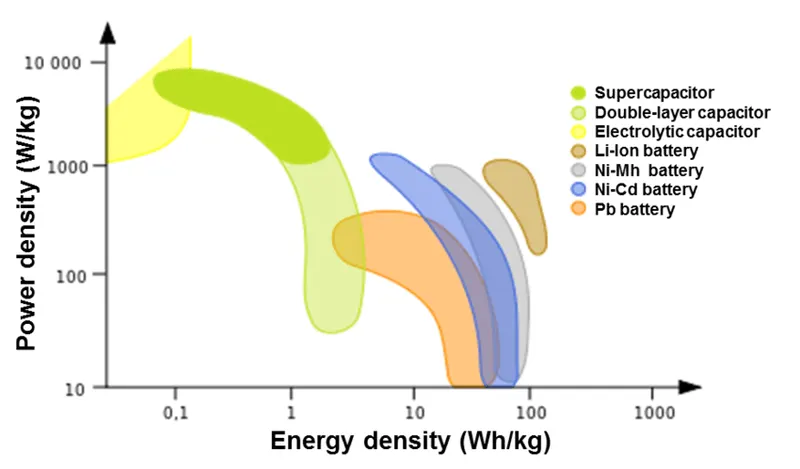
A battery with high energy density has a longer battery run time in relation to the battery size. Alternately, a battery with high energy density can deliver the same amount of energy, but in a smaller footprint compared to a battery with lower energy density. This greatly expands the possibilities for battery applications. In factory or warehouse settings, forklift batteries can weigh thousands of pounds. A lightweight battery for forklifts offers some advantages in safety and handling. If the energy density of a battery is too high, it could present a safety issue. When there’s more active material packed into a cell, it increases the risk of a thermal event.