Week 2 Challenge
1)
Fuel Cell:
A fuel cell uses the chemical energy of hydrogen or other fuels to cleanly and efficiently produce electricity. If hydrogen is the fuel, the only products are electricity, water, and heat. Fuel cells are unique in terms of the variety of their potential applications; they can use a wide range of fuels and feedstocks and can provide power for systems as large as a utility power station and as small as a laptop computer.
Why Fuel Cell:
Fuel cells can be used in a wide range of applications, providing power for applications across multiple sectors, including transportation, industrial/commercial/residential buildings, and long-term energy storage for the grid in reversible systems.
Fuel cells have several benefits over conventional combustion-based technologies currently used in many power plants and vehicles. Fuel cells can operate at higher efficiencies than combustion engines and can convert the chemical energy in the fuel directly to electrical energy with efficiencies capable of exceeding 60%. Fuel cells have lower or zero emissions compared to combustion engines. Hydrogen fuel cells emit only water, addressing critical climate challenges as there are no carbon dioxide emissions. There also are no air pollutants that create smog and cause health problems at the point of operation. Fuel cells are quiet during operation as they have few moving parts.
Working of Fuel Cell:
Fuel cells work like batteries, but they do not run down or need recharging. They produce electricity and heat as long as fuel is supplied. A fuel cell consists of two electrodes—a negative electrode (or anode) and a positive electrode (or cathode)—sandwiched around an electrolyte. A fuel, such as hydrogen, is fed to the anode, and the air is fed to the cathode. In a hydrogen fuel cell, a catalyst at the anode separates hydrogen molecules into protons and electrons, which take different paths to the cathode. The electrons go through an external circuit, creating a flow of electricity. The protons migrate through the electrolyte to the cathode, where they unite with oxygen and electrons to produce water and heat.
Some types of Fuel Cells:
Polymer Electrolyte Membrane Fuel Cells:
Polymer electrolyte membrane (PEM) fuel cells—also called proton exchange membrane fuel cells—deliver high power density and offer the advantages of low weight and volume compared with other fuel cells.
PEM fuel cells operate at relatively low temperatures, around 80°C (176°F). The low-temperature operation allows them to start quickly (less warm-up time) and results in less wear on system components, resulting in better durability. However, it requires that a noble-metal catalyst (typically platinum) be used to separate the hydrogen's electrons and protons, adding to the system cost. The platinum catalyst is also extremely sensitive to carbon monoxide poisoning, making it necessary to employ an additional reactor to reduce carbon monoxide in the fuel gas if the hydrogen is derived from a hydrocarbon fuel.
Solid Oxide Fuel Cells:
SOFCs are also the most sulfur-resistant fuel cell type; they can tolerate several orders of magnitude more sulfur than other cell types can. In addition, they are not poisoned by carbon monoxide, which can even be used as fuel. This property allows SOFCs to use natural gas, biogas, and gases made from coal. The high-temperature operation has disadvantages. It results in a slow startup and requires significant thermal shielding to retain heat and protect personnel, which may be acceptable for utility applications but not for transportation. The high operating temperatures also place stringent durability requirements on materials. The development of low-cost materials with high durability at cell operating temperatures is the key technical challenge facing this technology.
Scientists are currently exploring the potential for developing lower-temperature SOFCs operating at or below 700°C that have fewer durability problems and cost less. Lower-temperature SOFCs have not yet matched the performance of the higher temperature systems, however, stack materials that will function in this lower temperature range are still under development.
Molten Carbonate Fuel Cells:
Molten carbonate fuel cells (MCFCs) are currently being developed for natural gas and coal-based power plants for electrical utility, industrial, and military applications. MCFCs are high-temperature fuel cells that use an electrolyte composed of a molten carbonate salt mixture suspended in a porous, chemically inert ceramic lithium aluminum oxide matrix.
Unlike alkaline, phosphoric acid, and PEM fuel cells, MCFCs do not require an external reformer to convert fuels such as natural gas and biogas to hydrogen. At the high temperatures at which MCFCs operate, methane and other light hydrocarbons in these fuels are converted to hydrogen within the fuel cell itself by a process called internal reforming, which also reduces cost.
Scientists are currently exploring corrosion-resistant materials for components as well as fuel cell designs that double cell life from the current 40,000 hours (~5 years) without decreasing performance.
Phosphoric Acid Fuel Cells:
The PAFC is considered the "first generation" of modern fuel cells. It is one of the most mature cell types and the first to be used commercially. This type of fuel cell is typically used for stationary power generation, but some PAFCs have been used to power large vehicles such as city buses.
PAFCs are more tolerant of impurities in fossil fuels that have been reformed into hydrogen than PEM cells, which are easily "poisoned" by carbon monoxide because carbon monoxide binds to the platinum catalyst at the anode, decreasing the fuel cell's efficiency. PAFCs are more than 85% efficient when used for the co-generation of electricity and heat but they are less efficient at generating electricity alone (37%–42%). PAFC efficiency is only slightly more than that of combustion-based power plants, which typically operate at around 33% efficiency. PAFCs are also less powerful than other fuel cells, given the same weight and volume.
| FUEL CELL TYPE | COMMON ELECTROLYTE | OPERATING TEMPERATURE | TYPICAL STACK SIZE | ELECTRICAL EFFICIENCY (LHV) | APPLICATIONS | ADVANTAGES | CHALLENGES |
|---|---|---|---|---|---|---|---|
| Polymer electrolyte membrane (PEM) | Perfluorosulfonic acid | <120°C | <1 kW–100 kW | 60% direct H2; a 40% reformed fuel b |
Backup power Portable power Distributed generation Transportation Specialty vehicles |
Solid electrolyte reduces corrosion and electrolyte management problems Low temperature Quick start-up and load following |
Expensive catalysts Sensitive to fuel impurities |
| Alkaline (AFC) | Aqueous potassium hydroxide soaked in a porous matrix, or alkaline polymer membrane | <100°C | 1–100 kW | 60% c |
Military Space Backup power Transportation |
A wider range of stable materials allows lower-cost components Low temperature Quick start-up |
Sensitive to CO2 in fuel and air Electrolyte management (aqueous) Electrolyte conductivity (polymer) |
| Phosphoric acid (PAFC) | Phosphoric acid soaked in a porous matrix or imbibed in a polymer membrane | 150°–200°C |
5–400 kW, 100 kW module (liquid PAFC) <10 kW (polymer membrane) |
40% d | Distributed generation |
Suitable for CHP Increased tolerance to fuel impurities |
Expensive catalysts Long start-up time Sulfur sensitivity |
| Molten carbonate (MCFC) | Molten lithium, sodium, and/or potassium carbonates, soaked in a porous matrix | 600°–700°C | 300 kW–3 MW, 300 kW module |
50% e |
Electric utility Distributed generation |
High efficiency Fuel flexibility Suitable for CHP Hybrid/gas turbine cycle |
High-temperature corrosion and breakdown of cell components Long start-up time Low power density |
| Solid oxide (SOFC) | Yttria stabilized zirconia | 500°–1,000°C | 1 kW–2 MW | 60% f |
Auxiliary power Electric utility Distributed generation |
High efficiency Fuel flexibility Solid electrolyte Suitable for CHP Hybrid/gas turbine cycle |
High-temperature corrosion and breakdown of cell components Long start-up time A limited number of shutdowns |
2)
Li-ion Batteries:
(LIBs) are the best source for a wide range of electric vehicles. The working principle of LIBs is the exchange of lithium ions between a cathode and an anode.LIBs have higher specific energies than batteries made from other materials, such as zinc and lead, due to them being low-density and relatively lightweight. Lithium is silver in color and is a very soft metal. It is softer than lead and has a body-centered cubic crystal structure. It is so light, with a specific density of approximately half of the water. Its density is 0.534 grams per cubic centimeter, and that of water is 1.000 grams per cubic centimeter. The melting point of lithium is 180.54 °C and the boiling point is 1342 °C.
 then
then 
Lead Acid Battery:
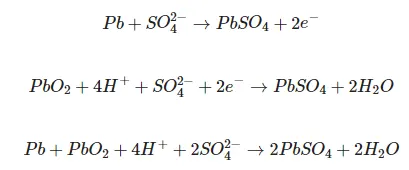
The application of lead-acid batteries has increased in recent years, for energy storage purposes. A battery consists of staked cells dipped into a diluted solution of sulfuric acid H2SO4, a positive electrode in each cell, consisting of lead dioxide, and the negative terminal made of porous lead. At discharge, both terminals transform to PbSO4 and return to their initial states at charging. The reactions at different electrodes are explained in the equations below, during charging:
Ni-Cd Battery:
These are the mature technology of the low-cost batteries and are famous for low-cost microelectronic devices, MEH and WSNs. The nickel-cadmium (Ni-Cd) battery contains nickel oxide, metallic cadmium as the cathode and anode, respectively, and potassium hydroxide as the electrolyte. Nickel is a silver-white metal, and one of the four elements that are magnetic at room temperature.
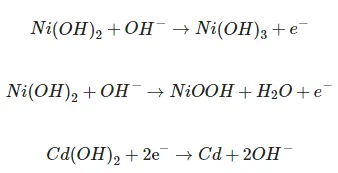
It has a good reputation for its low cost and powerfulness. On the basis of their powerfulness, these batteries can be charged at a higher rate in a short time. The main drawback of these batteries is the memory effect; they can lose capacity if they are recharged without completely discharging. In the start, Ni-Cd was preferred for medical equipment, two-way radios, video cameras, and power tools. The cells with more active material achieved 60% more capacity than the standard Ni-Cd, but result in a higher internal resistance and reduced cycle count. The battery chemical equations during charging are given below:
Ni-Cd batteries are used in portable electronic devices, toys, garden solar lights, etc. These are very useful batteries, but they have limitations, due to memory effects, periodic maintenance, relatively high discharging as compared to other batteries, and use of toxic materials.
Sodium-sulfur Battery:
The sodium-sulfur battery is a molten salt battery. Sodium is a very soft metal. It is both a mineral and an electrolyte. Its melting point is 97.81 °C, and its boiling point is 882.9 °C. On the other hand, sulfur is a non-metallic chemical element, with a yellow color at room temperature. The temperature and highly corrosive nature of the sodium polysulfide, and the increasing size of the cells, make it more uneconomical. The working operation of the NaS battery is explained in equations:
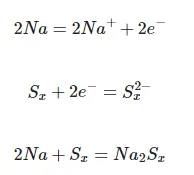
The reverse condition happens while it is charged; the sodium polysulfide decomposes into sodium and sulfur, which return to the electrodes.
Ultra Capacitors:
The ultra-supercapacitor is a double-layer capacitor with high capacitance. Supercapacitors have two key storage theories, as follows:
Double-layer capacitance: The storage that is achieved by the forces of charges over the Helmholtz double layer between the electrolyte and exterior of the electrode. The charge gap is 0.3–0.8 nm, which is much smaller than conventional capacitors.
Pseudo capacitance: The energy that is stored by the Faradic process. The charge transfer starts with a redox reaction, which is reversible electro-absorption. Electrostatic double-layer supercapacitors (EDLCs) do not have a conventional dielectric. Instead of an intervening insulator between two plates, these capacitors have virtual plates that have two similar films. The electrochemical properties of the electrical double layers result in the active separation of charges, instead of vanishingly thin physical separation of the layers.
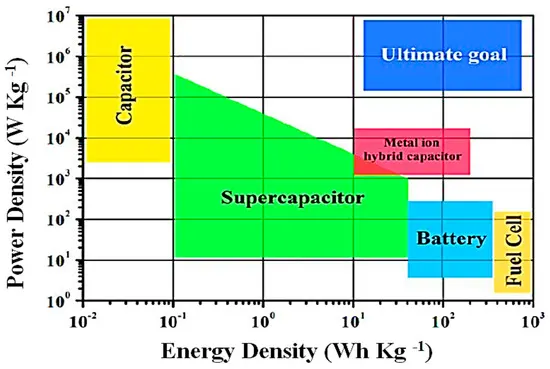
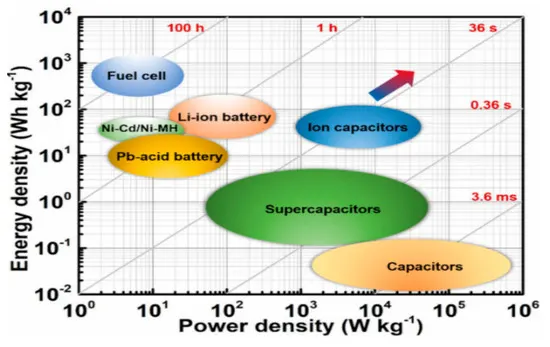
The power density of electrostatic capacitors is high with a low energy density, fuel cells have the highest energy density with a low power density, and the best option is electrochemical capacitors with better values of power and energy densities. The Ragone plot is very useful for estimating energy storage performance but ignores the critical features, such as cycle life, cost estimation, and safety for comparison between supercapacitors and batteries. For a better comparison and understanding of energy storage technology, it is important to consider safety, cost estimation, and cycle life. In supercapacitors, carbon nano-tubes, carbon nanofibers, and graphene are used. The main disadvantage of carbon nanotubes is the lack of solubility in aqueous media. The carbon nanofibers are toxic and graphene is bad for humans and the environment. Better electrode materials are required for the improvement of supercapacitors.
The cyclic life of a supercapacitor is 1 million to 30,000 h, i.e., extraordinarily higher than the batteries, which are 500 h, and the recharging time for the supercapacitor is remarkably low, i.e., 1–10 s vs. battery 10–60 min.
Below we have the comparison plot of different energy storage devices: