Week 2 Challenge
Losses in electric vehicles compared to IC engine vehicles and their test conditions:
In test condition UDDS:
Dynamometer time at EPA‟s test facility was critical, so a decision was made to run just the first 505 seconds of a UDDS several times in order to accurately capture the city driving power requirements for the VTREX. A trained EPA driver drove the cycle for the team.
The vehicle had no problem meeting and following the trace for the „505‟. Normally during vehicle operation, the team depends on a GM installed accelerometer to feed information on vehicle inertial forces to the controller to make decisions. Since the vehicle was strapped down to the dynamometer and stationary, the results for the accelerometer were not reliable. Because of this for validation, the vehicle acceleration was found from the derivate of velocity trace for the drive cycle. The cycle data was recorded at 10 Hz, which generated quite a bit of noise in the calculation of vehicle acceleration. This is the biggest limitation of all of the data collected at EPA. According to the certification data the max acceleration is close to 1.5 m/s2, however, using the derivate approach the max acceleration for a .1 s (10 Hz) time step was found to be 4 m/s2. While the scale of the inertial term is off, using this approach did lead to a total inertial force of 0 kN, which is to be expected. The result of the high accelerations and noise variations between acceleration and deceleration at constant speed has the effect of inflating the power required to overcome the inertial term, as well as peak motor power.
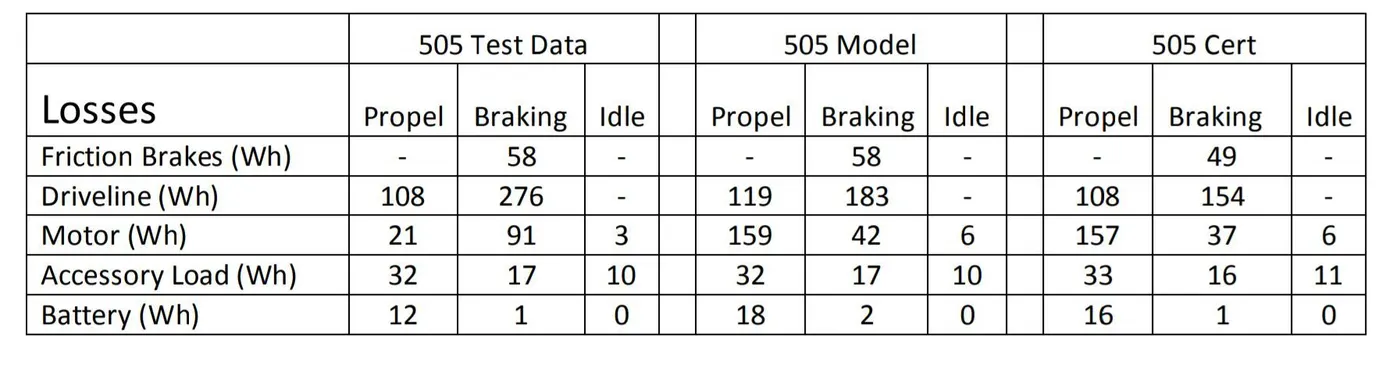
Fig: 505 Cycle energy losses at UDDS
In test condition HWFET:
Here data shows the same plots and tables as the section on the „505‟ but for the HWFET. The
results for DC Wh/km on the HWFET will be used in conjunction with modeling results for the
UDDS to determine combined, unadjusted energy consumption and vehicle range as a pure EV.
Here the tractive power required at the wheels and the mechanical output required from the electric motor to overcome braking and driveline losses is taken into consideration. Finally, the power at the terminals of the RESS is also taken and which overcomes the losses in the electric motor and supplies the accessory load. While the model does take into account the energy lost in the internals of the RESS using a fixed internal resistance, the energy quoted here is simply the energy at the terminal since that value is what is easily measured and reported.
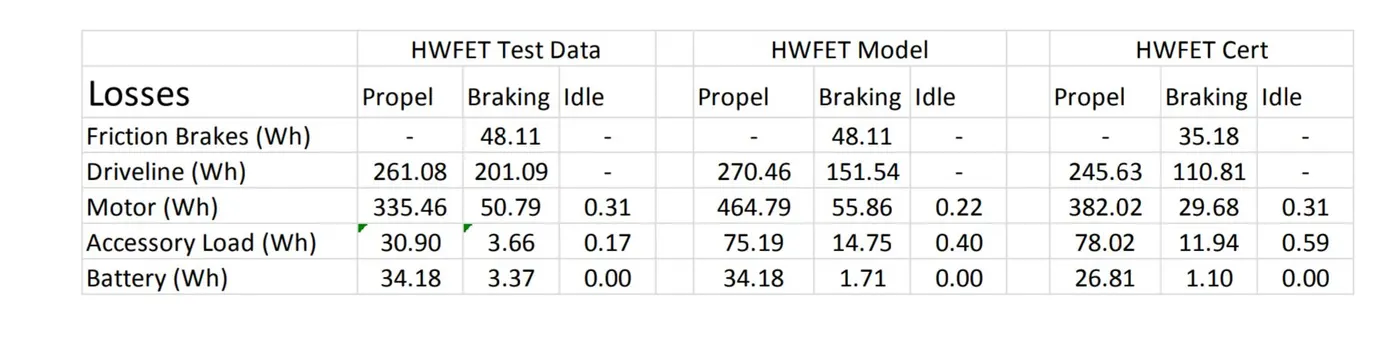
Fig 2: 505 Cycle energy losses at HWFET
Scenarios where the electric vehicles might be less efficient than I.C Engine Vehicles
The engine is far from dead then you saw the energy density comparison of gasoline cars versus electric cars so what we're looking at here is the same amount of energy by volume whether it's in the form of gasoline as one gallon this is representing 33.7 kilowatt-hours of energy or in the form of cans of Lucroy representing our lithium-ion battery cells 140 cans here used as an example of a battery cells
technically it should be 139 so mmm tangerines a close second now rightfully many of you pointed out that when I'm discussing energy density I should mention efficiency and while they are different it is absolutely a fair point because both of these while they represent the same amount of energy an electric car can go much further with
its energy so this 1 gallon of gasoline might get a gas car 40 miles where this 33.7 kilowatt-hours of electrical energy could get an electric car a hundred miles so a more fair comparison would look like this is 20.5 gallons so now both of these can travel the same distance but bringing efficiency into the equation isn't nearly as simple as it sounds so in this example, we're looking at a combustion engine operating at about thirty-five to forty percent efficiency Mazda Toyota probably others have gasoline engines that can operate above forty percent and then for the electric vehicle or assuming today's best energy density matched with about ninety percent plus energy efficiency this, in my opinion, is the fairest way of showing this comparison when taking efficiency into consideration however it is also fair to say that most gasoline engines aren't actually operating at thirty-five percent efficiency so you'd likely need a bit more fuel so let's
take this to the extreme if we were to compare a Bugatti Chiron capable of an impressive 11 miles per gallon combined to a Tesla Model S performance both with similar to zero to sixty times though very different top speeds the comparison would look more like this so the Bugatti needs a gallon to travel 11 miles and the Tesla alas only needs 16 soda cans to travel that same 11 miles so by volume the amount of energy they need is actually really close combustion engines can be embarrassingly inefficient when used outside of their the designated purpose which for the Sheerin is to go really fast a Tesla operates super efficiently under most circumstances but likewise not all batteries are equal and this represents today's best production lithium-ion. So at last energy density of electric vehicles is high and the volume ratio will be also high for an electric vehicle compared to the Ic engine vehicle.
References: