Week 2 Challenge
1.Define all loads to be applied in the abutment of the bridge as per IRC 6 and mention the clauses.
The type of loads to be applied in the abutment of any structure has been described below. These loads considered for shallow foundation.
- Dead loads: it includes weight of superstructure + (pier/abutment) + self weight of foundation.
- Live loads: The design live loads incase of railway bridges are considered as wagon load and For road bridges, the live loads may be specified via standard specifications and code of practice for road bridges i.e. IRC-6.
- Impact loads: The impact loads in the case of live load shall be considered.
- Wind loads: Wind loads on the shaft of the abutment to be considered. One side of the structure is retained with soil and the other is exposed for wind load. So the wind load on the abutment acts in the opposit direction to the earth pressure and i.e. very neglible compareed to the earth pressure.
- Wave pressure: The wave pressure due to wave of the stream the the shaft of abutment.
- Uplift Pressure: The uplift pressure in the bottom of the abutment due to presence of water table at shallow depth.
- Longitudinal forces: longitudinal forces results from tractive and braking forces. The longitudinal forces depend on the type of vehicles and bearing. These forces get transferred/transmitted into the substructure via fixed bearings and friction in movable bearings.
- Earth pressure: The earth pressure due to the the retained soil in abutment and the overburden soil has an major impact on the foundation. The overburden soil acts vertically and the retained soil pressure acts as laterally.
- Temperature stresses: The longitudinal forces are resulted because of the temperature changes.
- Seismic forces: seismic load according to the calculated magnitude as per different seismic zones and factors will act on the abutment.
2. Check overturning and sliding of 4 m height of Abutment (from ground level) , embedded 2 m in ground.
Data Given:-
SBC = 200 KN/m2
Eccentricity = 0.3m
Use co-ifficient of friction = 0.5
Soil Density = 18 KN/m3
Consider ϕ = 30'
The detail dimension of the structure
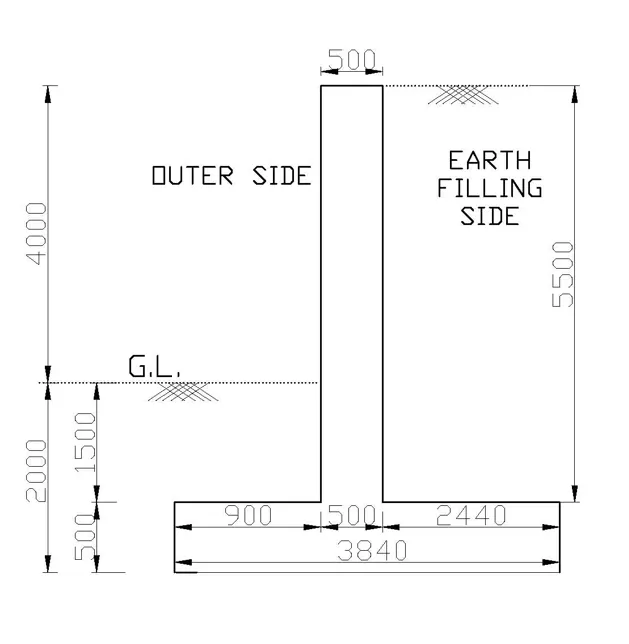
(a) Check against overturning - The various loads and thier moments about the toe slab (at D) are tabulated as under.
| Si No. | Description of Load | Magnitude of Load in Newton | Distance of C.G. "D" in meters | Moment about D in (Nm) |
| 1 | Wt. of Stem wall (W1) | 0.5 x 5.5 x 25000 = 68750 | 0.9 + (0.5/2)=1.15 | 79062.5 |
| 2 | Wt. of base slab (W2) | 3.84 x 0.50 x 25000 = 48000 | 3.8/2 = 1.9 | 91200 |
| 3 | Wt of earthfill over heel slab (W3) | 2.44 x 5.72 x 18000 = 251222 | 2.44/2 + 0.5+ 0.9 = 2.62 | 658201.64 |
| ∑W =367972 | ∑MR = 828464 |
Total horizontal earth pressure on the full height of the retaining wall tending to over turn the wall
P = (1/2) x w x H^2 x [(1 – Sinϕ) / (1 + Sinϕ)]
= (1/2) x 18000 x 6^2 x (1/3)
= 108000 N
acting at 4/3 from D
∴ Total overturning moment Mo = 108000 x (4/3) = 144000 Nm
Total stabilizing moment = 828464 Nm
∴ Factor of safety against overturning
= (828464/144000)
= 5.75 > 2, Hence safe.
(b) Check against sliding - Total horizontal force tending to slide the wall.
P = (1/2) x w x H^2 x [(1 – Sinϕ) / (1 + Sinϕ)]
= (1/2) x 18000 x 6^2 x (1/3)
= 108000 N
Total force opposing sliding
= μ x ∑W
= 0.5 x 367972
= 183986 N
∴ Factor of safety against sliding
= 183986/108000
= 1.70 > 1.5, Hence Safe.
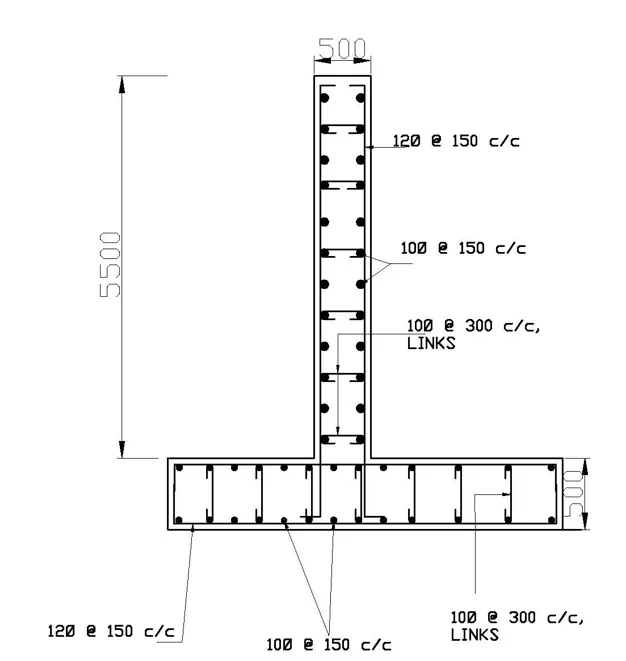
Reinforcement drawing-
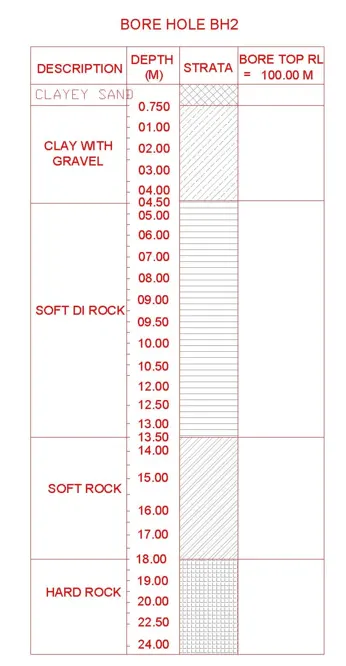
2.How to decide the boreholes location and its depth of exploration in case of shallow foundation? What all the parameters we need to get from the site/geotechnical investigation for design of the foundation.
The determination of adequate number and sufficient depth of boreholes is critical to gather enough data for the design and construction of geostructures such as foundations, bridges,retainign walls, cut slopes, and embankments.
- Borehole numbers should be enough to find out soil-layer variations at the construction site.
- If the location of loads is within the boundary of the structure, then at least one borehole should be drilled at the position of the heaviest load.
- That means in each pier and abutment location one bore hole should be done.
- The quantity and depth of boreholes should cover the soil zone that is affected by the load of the geostructure.
- Except in the case of very dense materials or bedrock, the minimum depth of borehole is 6m.
- Drill a borehole at least 3m into bedrock.
- For dense, coarse-grained soil and very stiff clays, extend boring depth up to a range of 5-6m to corroborate that soil layer thickness is sufficient.
- Primarily the depth of borehole must be 1.5 times of the width of the foundation.
Purpose of borehole
Boreholes are used to take soil samples which are then tested to get enough information about the construction site to enable engineers to set safe designs and execute construction processes properly.
Parameters from the site/geotechnical investigation
- Depth of soil starta
- Bulk density (γ-bulk)
- Dry Density (γd)
- moisture content
- Gradation of soil (IS Classification)
- silt factor
- Liquid limit
- Plastic Limit
- Plasticity Index
- Specific Gravity
- Swelling Index
- Cohession
- Void ratio & porosity
- Angle of internal friction
- Depth of water table
- SPT (N Value)
List different type of soils
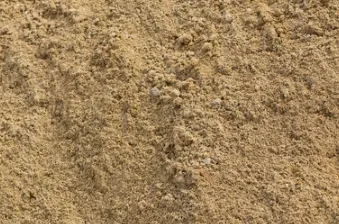
- Sandy soil-
- It consists of small particles of weathered rock.This type of soil is very good for the drainage system. Sandy soil is usually formed by the breakdown or fragmentation of rocks like granite, limestone and quartz.
- It has high porosity. Cohession value is 0. Strength is due to interlocking of granular particles.
- Soil particles ranges from 0.075 mm - 4.75mm
- Silt Soil-
- Silt, which is known to have much smaller particles compared to sandy soil and is made up of rock and other mineral particles, which are smaller than sand and larger than clay.
- This soil has cohession both C-ϕ value.
- Soil particles ranges from 0.075 mm - 0.002mm
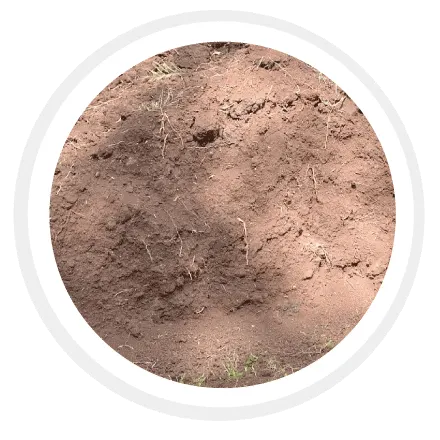
- Clay Soil-
- Clay is the smallest particle among the other two types of soil. The particles in this soil are tightly packed together with each other with very little or no airspace. This soil has very good water storage qualities and makes it hard for moisture and air to penetrate into it.
- The soil has high cohession and ϕ value is 0.
- Soil particles ranges less than 0.002mm.
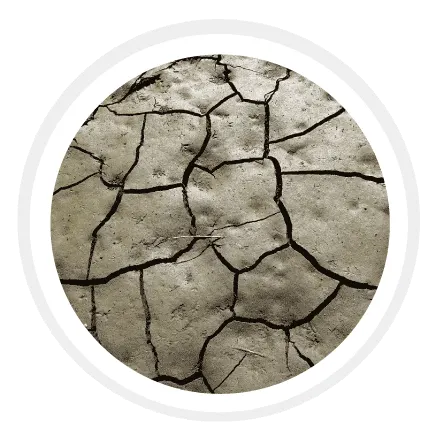
- Loamy Soil-
- Loam is the fourth type of soil. It is a combination of sand, silt and clay such that the beneficial properties of each are included. For instance, it has the ability to retain moisture and nutrients; hence, it is more suitable for farming.
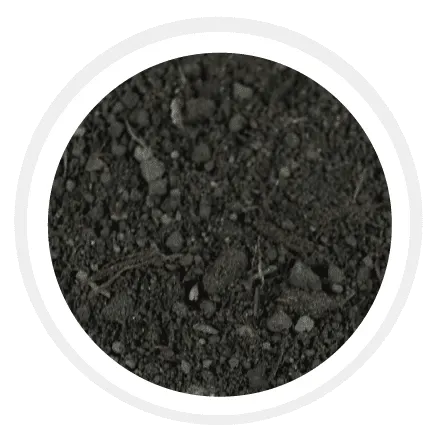
- Rocky Soil-
- Rocky soil is the result of the ground beneath your garden shifting and pushing rocks upwards toward the earth's surface. Generally, rocks such as limestone, bedrock, and sandstone have substantially high bearing capacities.
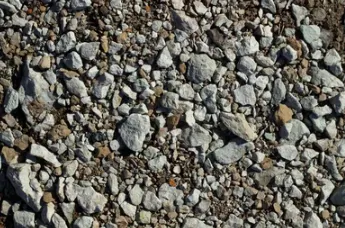
Criteria for selecting the shallow foundation.
- Selection criteria for foundation depend on two factors, i.e. factors related to ground (soil) conditions and factors related to loads from the structure.
-
Soil bearing capacity is one of the most crucial criteria that affect the selection of the appropriate type of foundation. Decision can be made to choose shallow or deep foundation based on the soil bearing pressure.
-
An allowable bearing pressure of at least 100kN/m^2 i.e 10 ton/m^2 shall be considered. However, higher structures can consider a raft foundation.
- For selecting the founding level of the foundation the SPT value also plays a major role. The N value should not be less than 10.
Typical borehole-