Week 2 Challenge
1) AIM : To find the net sectional areas for the given tension members.
INTRODUCTION : The Net Sectional area of tension members can be obtained from deducting sectional area of holes from gross sectional area.
PROCEDURE :
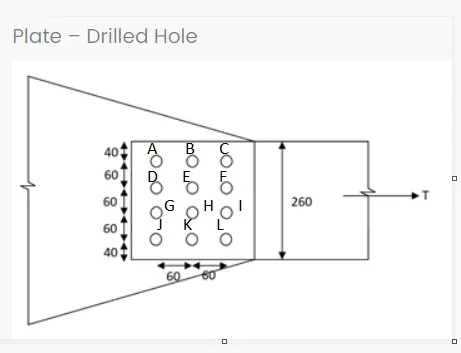
Net Section along A-D-G-J
Width of plate B = 260 mm.
Number of bolts n = 4.
Diameter of hole d = 20 mm.
Thickness of plate t = 20 mm.
RESULT
Net Sectional Area An = (B-nd)*t = (260-4*20)*20 = 3600 sq.mm
Net Section along B-D-H-L
Width of plate B = 260 mm.
Number of bolts n = 4.
Diameter of hole d = 20 mm.
Thickness of plate t = 20 mm.
Pitch p1 = p2 = p3 = 60 mm.
Gauge g1 = g2 = g3 = 60 mm.
RESULT
The Net Sectional Area = `(B - n*d + (p1)^2/(4g1) + (p2)^2/(4g2) + (p3)^2/(4g3)) * t` = 4500 sq.mm
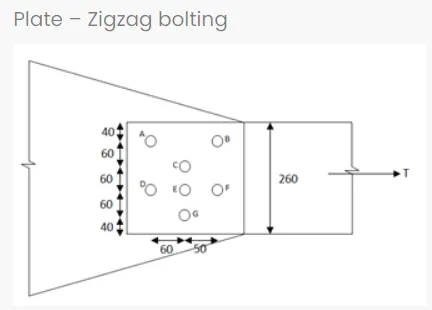
The above plate is staggered bolting.
The Net Sectional Area along the sections A-C-D and B-C-D were given below
The Net Sectional Area along A-C-D
Width of plate B = 260 mm.
Number of bolts n = 3.
Diameter of hole d = 20 mm.
Thickness of plate t = 20 mm.
Pitch p1 = p2 = 60 mm.
Gauge g1 = g2 = 60 mm.
RESULT
The Net Sectional Area = `(B - n*d + (p1)^2/(4g1) + (p2)^2/(4g2)) * t`
= 4600 sq.mm
The Net Sectional Area along B-C-D
Width of plate B = 260 mm.
Number of bolts n = 3.
Diameter of hole d = 20 mm.
Thickness of plate t = 20 mm.
Pitch p1 = 50, p2 = 60 mm.
Gauge g1 = g2 = 60 mm.
RESULT
The Net Sectional Area = `(B - n*d + (p1)^2/(4g1) + (p2)^2/(4g2)) * t`
= 4508.33 sq.mm
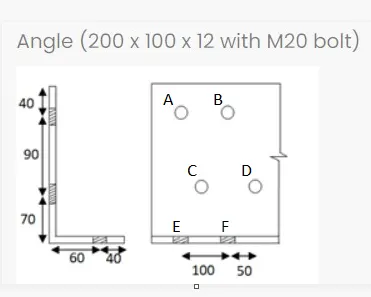
Let us consider that failure is along the section B-D-F
Width of plate B = 200+100-12 = 288 mm.
Number of bolts n = 3.
Diameter of hole d = 20 mm.
Thickness of angular section t = 12 mm.
Pitch p1 = 50, p2 = 50 mm.
Gauge g1 = 90, g2 = 70+60-12 = 118 mm.
RESULT
The Net Sectional Area = `(B - n*d + (p1)^2/(4g1) + (p2)^2/(4g2)) * t`
= 2546.84 sq.mm
Note : For the above problems, all possible failure sections needs to be considered to find out the least Net Sectional Area. Because least net sectional area of the member is used to calculate the stregth of the tension member against net section rupture.
2) AIM : To design the sag rod
INTRODUCTION :
Centre to Centre of Rafter = 8m.
spacing of purlin = 1.2m.
Self Weight of roofing = 60 kg/m2.
Wind pressure intensity = 150 kg/m2.
Slope of Rafter = 15 degrees
Live Load = 75 kg/m2
Self Weight of purlin = 100kg/m
PROCEDURE :
| Design of Sag Rod (one third problem) | ||||||
| Self Weight of purlin = | 100 | kg/m | ||||
| Self Weight of Roofing = | 60 | kg/m2 | ||||
| Live Load = | 75 | kg/m2 | ||||
| Spacing of purlin = | 1.2 | m | ||||
| Wind load on purlin = | 150 | kg/m2 | (Normal to roof) | |||
| Dead Load from Roofing = | 72 | kg/m | ||||
| Live Load on purlin= | 90 | kg/m | ||||
| Total gravity load on purlin = | 262 | kg/m | ||||
| Slope of Rafter = | 15 | degrees | ||||
| Component of gravity load along the roof = | 170.3754141 | kg/m | ||||
| Centre to Centre of Rafter = | 8 | m | ||||
| Pull on sag rod = | 454.33 | kg | ||||
| Factored Load = | 6678.71 | N | ||||
| Factor of safety against Net Section Rupture = | 1.25 | |||||
| Ultimate tensile strength of steel = | 410 | N/mm2 | ||||
| Net Section Area = | 22.62 | mm2 | ||||
| Diameter of Sag Rod = | 1.34 | <= | 16mm | |||
| RESULT : Hence provide Sag Rod of diameter 16 mm | ||||||
| Note : Minimum diameter of Sag Rod to be provided is 16 mm. | ||||||
3) AIM : To design the single angle member to resist tensile force
INTRODUCTION :
Length of member = 5m
Tensile force acting on the member = 500 KN
Yield Strength of member = 350 KN/m2
The remaining inputs were assumed.
| PROCEDURE | ||||||
| Step 1 : Find out the member to carry tensile force | ||||||
| Axial Tensile force = | 500 | KN | ||||
| Factored Tensile Force T = | 750 | KN | ||||
|
Partial factor of safety against yielding = |
||||||
| 1.1 | ||||||
| Yield Strength of member = | 350 | N/mm2 | ||||
| Area of cross section required = | 2946.42 | mm2 | =29.464 cm2 | |||
| Select single angle member based on the area of cross section required | ||||||
| The required angle member is 110*110*15 | ||||||
| Length of Connection Leg = | 110 | mm | ||||
| Length of Outstanding Leg w = | 110 | mm | ||||
| Thickness of single angle member = | 15 | mm | ||||
| Step 2 : Strength due to gross section yielding | ||||||
| Area of cross section = | 3081 | mm2 | ||||
| Tdy = | 980.31 | KN | ||||
| Step 3 : Strength due to net section rupture | ||||||
| Ultimate tensile strength = | 510 | N/mm2 | (Assumption) | |||
| Dia of bolt used = | 24 | mm | ||||
| Assume cover of bolt = | 2 | mm | ||||
| Dia of bolt including cover = | 26 | mm | ||||
| Area of connection leg Anc = | 1147.5 | mm2 | ||||
| Area of outstanding leg Ago = | 1537.5 | mm2 | ||||
| Partial factor of safety against rupture = | ||||||
| 1.25 | ||||||
| Edge distance = | 50 | mm | ||||
| Shear Lag bs = | 155 | mm | ||||
| Assume No. of bolts = | 5 | No | ||||
| Assume pitch distance = | 60 | mm | ||||
| Length of connection Lc = | 240 | mm | ||||
| Beta = | 1.152979303 | |||||
| Strength due to connection Leg = | 421.362 | KN | ||||
| Strength of outstanding Leg = | 564.0427158 | KN | ||||
| Tdn = | 985.4047158 | KN | ||||
| Step 4 : Strength against block shear | ||||||
| Minimum gross section area in shear Avg = | 4350 | mm2 | ||||
| Minimum net section area in shear Avn = | 2595 | mm2 | ||||
| Minimum gross section area in tension Atg = | 750 | mm2 | ||||
| Minimum net section area in tension Atn = | 555 | mm2 | ||||
| Strength against Shear yield = | 799.1287004 | KN | ||||
| Strength against Shear failure = | 550.1639723 | KN | ||||
| Strength agaist tension yield = | 238.6363636 | KN | ||||
| Strength against tension failure = | 203.796 | KN | ||||
| Strength against Shear yield + tension failure Tdb1 = | 1002.9247 | KN | ||||
| Strength against tension yield + shear failure Tdb2 = | 788.8003359 | KN | ||||
| Tdb = | 788.8003359 | KN | ||||
| Step 5 : Strength of 110*110*15 angle tension member | ||||||||
| Td = | 788.8003359 | KN | > T | 750 | KN | Hence Safe | ||
| Step 6 : Check Slenderness ratio | ||||||
| Length of member = | 5000 | mm | ||||
| Radius of gyration = | 33.1 | mm | ||||
| Slenderness ratio = | 151.05 | < 180 | Hence safe. | |||
| RESULT | The equal angle 110*110*15 can resist the factored tensile force of 750KN | |||||
Note : The excel sheets were attached to questions 2 & 3. Please go through the sheets to get idea about calculations.