Week 2 Challenge
1. Compare four different types of fuel cells and state their applications?
- This classification determines the kind of electro-chemical reactions that take place in the cell, the kind of catalysts required, the temperature range in which the cell operates, the fuel required, and other factors.
- Types of fuel cell are as follows :-
| FUEL CELL TYPE | COMMON ELECTROLYTE | OPERATING TEMPERATURE | TYPICAL STACK SIZE | ELECTRICAL EFFICIENCY (LHV) | APPLICATIONS | ADVANTAGES |
| Solid oxide (SOFC) | Yttria stabilized zirconia | 500°–1,000°C | 1 kW–2 MW | 60% f |
Auxiliary power Electric utility Distributed generation |
High efficiency Fuel flexibility Solid electrolyte Suitable for CHP Hybrid/gas turbine cycle |
| Phosphoric acid (PAFC) | Phosphoric acid soaked in a porous matrix or imbibed in a polymer membrane | 150°–200°C |
5–400 kW, 100 kW module (liquid PAFC) <10 kW (polymer membrane) |
40% d | Distributed generation |
Suitable for CHP Increased tolerance to fuel impurities |
| Alkaline (AFC) | Aqueous potassium hydroxide soaked in a porous matrix, or alkaline polymer membrane | <100°C | 1–100 kW | 60% c |
Military Space Backup power Transportation |
Wider range of stable materials allows lower cost components Low temperature Quick start-up |
| Polymer electrolyte membrane (PEM) | Perfluorosulfonic acid | <120°C | <1 kW–100 kW | 60% direct H2; a 40% reformed fuel b |
Backup power Portable power Distributed generation Transportation Specialty vehicles |
Solid electrolyte reduces corrosion and electrolyte management problems Low temperature Quick start-up and load following |
| Molten carbonate (MCFC) | Molten lithium, sodium, and/or potassium carbonates, soaked in a porous matrix | 600°–700°C | 300 kW–3 MW, 300 kW module |
50% e |
Electric utility Distributed generation |
High efficiency Fuel flexibility Suitable for CHP Hybrid/gas turbine cycle |
2. Using a plot with energy density and power density on the X and Y axis, arrange various battery types like lithium ion, lead acid, Nickel Cadmium, Ultracapacitor, fuel cell?
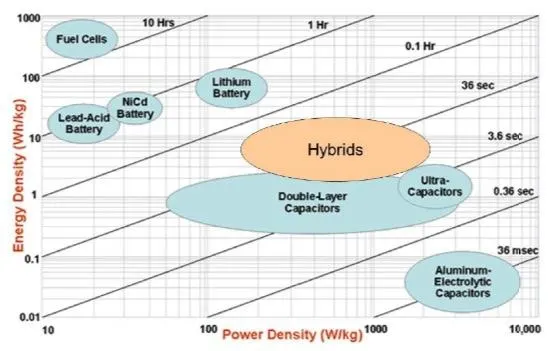
- A fuel cell is an electro-chemical cell that converts the chemical energy of a fuel (often hydrogen) and an oxdising agent (often oxygen) into electricity through a pair of redox reactions. Fuel cells are different from most batteries in requiring a continuous source of fuel and oxygen (usually from air) to sustain the chemical reaction, whereas in a battery the chemical energy usually comes from metals and their ions or oxides that are commonly already present in the battery, except in flow batteries. Fuel cells can produce electricity continuously for as long as fuel and oxygen are supplied.
- According to this graph the fuel cell has highest energy density which means it travel a long but lowest power density which result in slower accleration.
- Ultra capacitor :- ultracapacitor, is a high-capacity capacitor with a capacitance value much higher than other capacitors, but with lower voltage limits, that bridges the gap between electrolytic capacitor and rechargeable batteries. It typically stores 10 to 100 times more energy per volume and mass than electrolytic capacitors, can accept and deliver charge much faster than batteries, and tolerates many morecharge and discharge cycle than rechargeable batteries.
- According to this graph the ultra capacitor has lowest energy density which means it travel a long but highest power density which result in slower accleration. Totally opposite to fuel cell.
- Lead acid battery :- Compared to modern rechargeable batteries, lead-acid batteries have relatively low energy density. Despite this, their ability to supply high surge current means that the cells have a relatively large power to weight ratio. These features, along with their low cost, make them attractive for use in motor vehicles to provide the high current required by starter motor. the chemical energy of the battery is stored in the potential difference between the pure lead at the negative side and the PbO2 on the positive side, plus the aqueous sulfuric acid. The electrical energy produced by a discharging lead–acid battery can be attributed to the energy released when the strong chemical bonds of water molecules are formed from H+ of the and O2− ions of PbO2.
- According to this graph the Lead acid battery has highest energy density which means it travel a long but lowest power density which result in slower accleration.
- Lithium ion battery :- They have one of the highest energy densities of any battery technology today (100-265 Wh/kg or 250-670 Wh/L). In addition, Li-ion battery cells can deliver up to 3.6 Volts, 3 times higher than technologies such as Ni-Cd or Ni-MH.
- A Ni-Cd battery has a terminal voltage during discharge of around 1.2 volts which decreases little until nearly the end of discharge. The maximum electro-motive force offered by a Ni-Cd cell is 1.3 V. Ni-Cd batteries are made in a wide range of sizes and capacities, from portable sealed types interchangeable with carbon-zinc dry cells, to large ventilated cells used for standby power and motive power
- Observation :- Nickel cadmium are better than the lead acid battery but in comparison to lithium battery they are same. These battery are use in power tool , photographic equipment ,flash light.