Week 2 Challenge
Question 1:
Compare four different types of fuel cells and state their applications.
- An electrical current is produced via redox reactions occurring on the electrodes of the fuel cell. The most common fuel cell is the hydrogen fuel cell.
- On the anode, hydrogen molecules, which are fed to the anode from an external supply, dissociate to protons and electrons on catalytic material deposited on the anode (expensive noble metal Pt) and protons travel towards the cathode through the electrolyte, which in the most common cases is a polymer electrolyte membrane (PEMFC). The electrons travel in the external circuit, thus creating a current, eventually reaching the cathode. At the cathode protons, oxygen atoms from dissociated oxygen molecules and electrons combine to form water.
- The cathode also requests a suitable catalyst for the reactions there (oxygen reduction reaction, ORR). O2 (air) is supplied to the cathode from an external supply. Thus, a fuel cell generates a current by using energy-rich hydrogen molecules, i.e., converts chemical energy to electricity. It should be noted that it is the fuel cell together with its fuel tank and oxygen supply that constitutes an energy storage system, not the fuel cell alone.
| Types of Fuel Cell | Advantages | Disadvantages | Operating Temperature, Stack Size , Efficiency. |
Application |
|
Proton Exchange Membrane Fuel Cell (PEMFC) |
|
|
|
|
| Solid oxide Fuel Cell (SOFC) |
|
|
|
|
| Alkaline Fuel Cell (AFC) |
|
|
|
|
| Direct Methanol Fuel Cell (DMFC) |
|
|
|
|
Question 2:
Using a plot with energy density and power density on the X and Y axis, arrange various battery types like lithium ion, lead acid, Nickel Cadmium, Ultracapacitor, fuel cell.
Energy density:
- If a system has a high energy density then it is able to store a lot of energy in a small amount of mass. A high energy density does not necessarily mean a high power density. An object with a high energy density, but low power density can perform work for a relatively long period of time.An example of this type of energy storage is a mobile phone.
- Its power will last most of the day, but to recharge the device, it must be connected to another power source for an hour or more.
Power density:
- If a system has a high power density, than it can output large amounts of energy based on its mass. For example, a tiny Capacitor may have the same power output as a large battery.
- However, since the capacitor is so much smaller, it has a higher power density. Since they release their energy quickly, high power density systems can also recharge quickly.
- An example application of this type of energy storage is a camera flash. It has to be small enough to fit inside the camera (or cell phone) but have a high enough power output to light up the subject of your photo. this makes a system with a high power density ideal.
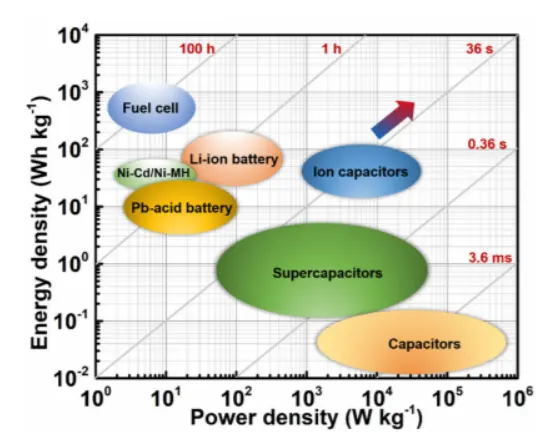
Thus from the above graph we found that,
- Lithium ion, lead acid, Nickel Cadmium batteries have a low power density and the moderate energy density.
- Ultra Capacitor or Super Capacitor have a moderate power density and moderate energy density.
- Fuel cell have low power density and the high energy density.