Week 2 : Basic Calibration of Single cylinder SI-Engine
Case I
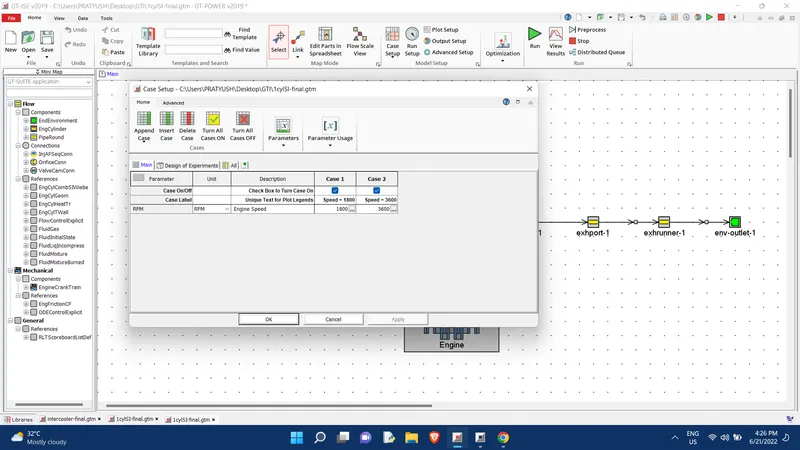
Aim: To change the engine speed to 1800 rmp and observe the change in parameters like:
- air flow rate
- BMEP
- BSFC
- In-cylinder pressure
Theory
SI engine is an internal combustion engine, where the fuel is burned with the help of spark plug. SI engine working the principle of the Otto cycle. As the name suggests, in a four-stroke engine, the one cycle of combustion operation is completed in four strokes. Each stroke consists of 180° rotation of the crankshaft and hence four stroke completed in 720° rotation of the crankshaft. The engine takes two revolutions of crankshaft to complete this four stroke. The four-stroke for a spark ignition engines are
- Suction/ intake stroke:This stroke starts when the piston is at top dead centre (TDC) and about to move downward. While the piston moves downward the intake valve is open and the exhaust valve is closed. The movement of piston produces a vacuum inside the cylinder and charge consisting of air-fuel mixture drawn into the cylinder from the carburetor. When the piston reaches the bottom dead centre (BDC), the inlet valves close. During this process, the volume increases but the pressure inside the cylinder remains constant (atmospheric pressure).
- Compression stroke:The piston moves from BDC to TDC. During this process, both the inlet and outlet valve is closed and the charge previously drawn into cylinder get compressed. At the end of this stroke, ie piston at TDC, the whole charge is compressed into clearance volume. The pressure increases with a decrease in volume. The compression ratio of SI engine is between 6 and 10
- Combustion/ Expansion/ power stroke: At the end of compression stroke, the charge is burned using spark plug at the cylinder head. In ideal SI engine, it is considered as the instantaneous process. The temperature and pressure inside the cylinder increase dramatically at constant volume due to the burning of fuel. This is the only stroke in which actual power is produced. The high pressure burnt gases push the piston from TDC to BDC. During this process, both intake and exhaust valves remain closed. In this process, temperature and pressure decrease while the volume of gas increases. At the end of the power stroke, the exhaust valve is open, the pressure drops to atmospheric pressure.
- Exhaust stroke:The piston moves from BDC to TDC while the inlet valve is closed and the exhaust valve is open. The piston pushes out the burnt gas from the cylinder to the atmosphere. At the end of exhaust stroke, some residual gases get trapped in clearance volume. This residual gas gets mixed with fresh charge drawn into the cylinder during the following cycle.
Air flow rate : It is the amount of air that is entering the engine and it is important because it decides how the fuel combustion takes place. A low air flow produces incomplete combustion leading to Co emissions whereas a higher air flow leads to NOx emissions. Therefore, an air flow close to stochiometry is desired.
Brake Mean Effective Pressure : It is the ratio of gross work done per cycle to the volume displaced per cycle. It provides a valuable measure of the engine performance which is independent of the engine displacement.
Brake Specific Fuel Consumption :It is the amount of fuel consumed per unit power produced in a cycle. Low values of BFSC are desirable
In cylinder pressure :It is the maximum pressure that is developed inside the engine during a single cycle. It provides a measure of the work that can be extracted from the engine.
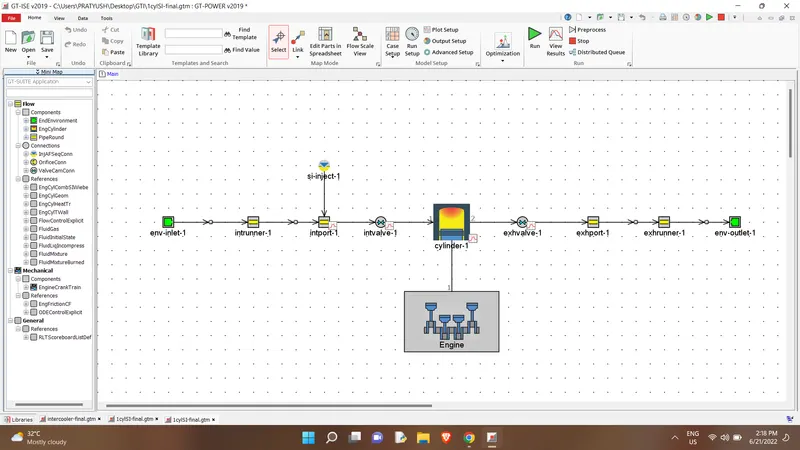
Layout
Changes in input parameter
Results
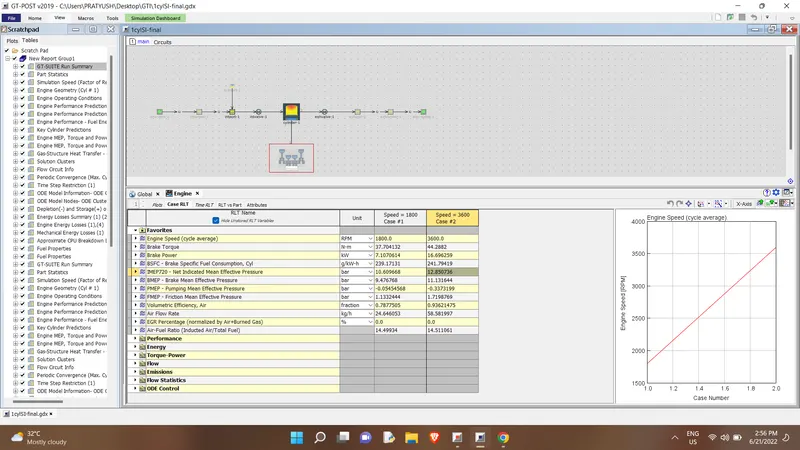
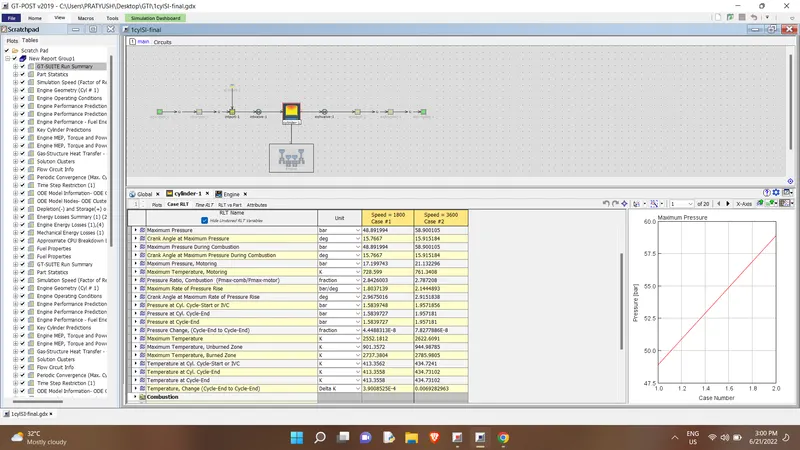
For 1800rpm speed:
BSFC-239.1719 g/kWh
BMEP- 9.4767 bar
Air flow rate- 24.6460 kg/h
In cylinder pressure-
- At start of cycle: 1.5839748 bar
- At end of cycle: 1.5839727 bar
- Maximum Pressure: 48.8919 bar
Case II
Aim: To fix the value of speed of engine as 3600 rpm and change other parameters to get desired value of 10% increament in Power output value
For 4 Stroke SI engine Power(P):
`P=(n_f.n_v.N.L.A.Q_(HV).rho_a.(F/A))/2`
`n_f`:fuel conversion efficiency
`n_v`:volumetric efficiency
L: length of stroke
A: bore area
`Q_(HV)`:heating value of fuel
`rho_a`: density of incoming air
`(F/A)`: fuel air ratio
N: rotation speed of crackshaft
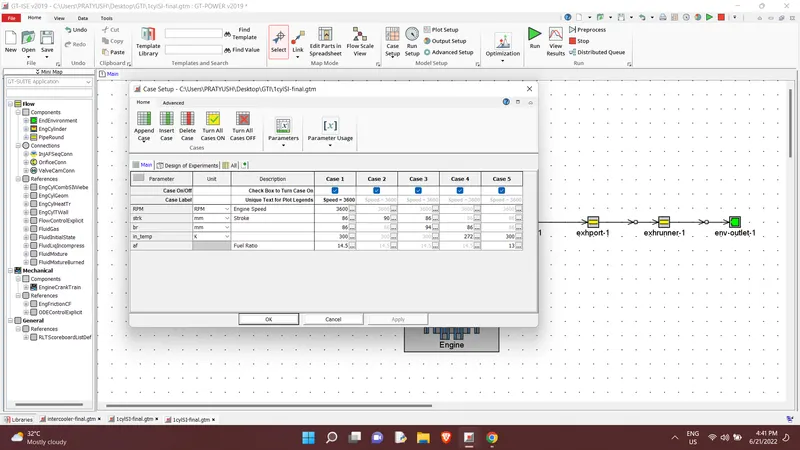
Factors that can be changed to get desired value(theoretically)-
- L can be changed to 1.1L
- A can be changed to 1.1A (d can be changed to `sqrt(1.1).d`)
- `rho_a` can be changed to `1.1.rho_a` ,which can be done by decreasing the temp by (1/1.1)
- (F/A) can be changed to 1.1 (F/A)
Changes made in input
Results
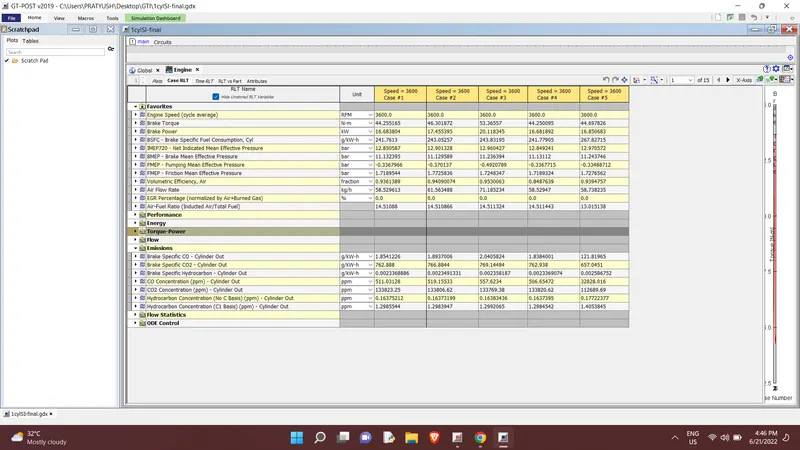
Conclusion : From the above results we can conclude that
- There is appreciable change in power output when bore dia is increased followed by stroke length.
- There is no change in power output with change in inlet temperature
- Insignificant changes can be observed in power with change in fuel air ratio as the the air is less so there will not be complete combustion and hence no extra power output can be seen
- With change in bore dia changes in emission characteritics can be observed and its very high in case of change in A/F ratio due to presence of unburnt fuel.
- Change in Air flow rate and brake torque is very high with change in bore dia.