Week 2 Air standard Cycle
Aim
Plot Pressure-Volume(PV) Diagram of Air Standard Cycle and Calculation of thermal efficiency using python.
Objective
- Plot Pressur-Volume (PV) Diagram of Air Standard Cycle
- Calculate Thermal Efficiency of Air Standard Cycle
Theory
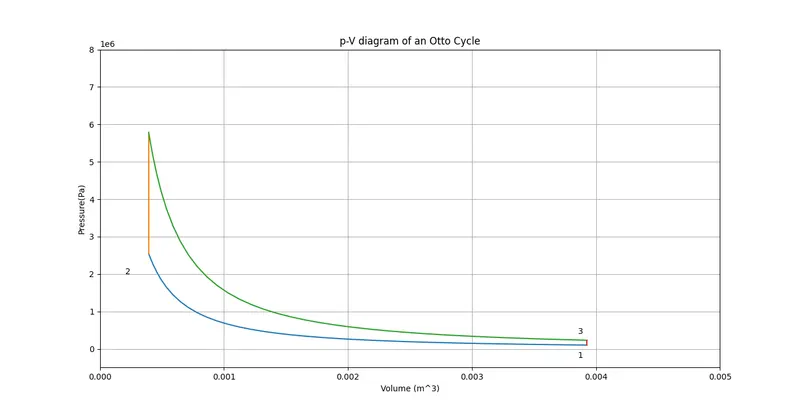
The otto-Cycle is an air standard cycle of the spark ignition engine.In most SI engine,the piston executes four complete strokes within the cyclinder and the crankshaft completes two revolution for each thermodynamic cycle.The processes involved are described in the PV -diagram.
- Process 0-1: Intake stroke
The inlet is open,the piston moves to the right,admiting fuel-air mixture into the cyclinder at constant pressuretial pressure
2.Process 1-2: Compression stroke
Both the valves are closed,the piston compresses the combustible mixture to minimum volume
3.Process 2-3: Combustion stroke
The mixture is then ignited by means of a spark,combustion takes place,and there is an increase in temperature and pressure
4.Process 3-4:Expansion stroke
The products of combustion do work on the piston which moves to the right,and the pressure and tempertaure of the gas decrease
5.Process4-1:Blow-down stroke
The exhaust valves open and the pressure drops to the initial pressure
6.Process1-0:Exhaust stroke
With the exhaust valves open,and the piston moves,inward to expel the combustion products from the cyclinder.
FORMULAS :
Swept Volume (Vs) - The volume by the piston during its motion.
Vs = pi/4*d^2*l Where, d=diameter or bore of thre piston ; l = height of the piston.
Clearence Volume (Vc) - The volume which is left between the piston and top dead center of the cyclinder during the combustion or exhaust stroke.
Vc = Vs/(rc-1) Where, rc = compression ratio ; Vs = swept volume.
Total Volume (Vt) - The total volume of the cyclinder is the summation of swept volume and clearence volume.
Vt = Vs +Vc Where, Vs = swept volume ; Vc = Clearence volume.
Adiabatic Process - The process which ocurs without transferring heat and mass between a thermodynamicsystem and its surroundings is called as adiabatic process.
(PV)^gamma = C Where, P= pressure of the system ; V = volume of the system ; gamma = ratio of specific heats of fluids.
Combined Gas Law - This law states that the volume of a given amount of gas is proportional to the ratio of its temperature and pressure.
PV/T = C Where, C = constant ; P = presure ; V =volume ; T = temperature.\
Change of volume inside the chamber is given by
Where, V = volume inside the cyclinder when piston is at an angle ; R = ratio of length of connecting rod to cranck pin radius(a) ; Crank pin radius(a)=stroke length(l)/2; Vc = clearence volume ; rc = compression ratio.
Thermal Efficiency of Otto Cycle = 1-(1/rc^gamma-1)
Python code:
import math
import matplotlib.pyplot as plt

def engine_kinematics(bore,stroke,connecting_rod,c_r,start_crank_angle,end_crank_angle):

#Engine geometry properties
	r=stroke/2
	n=connecting_rod/r

	#volume parameters

	v_swept = (math.pi/4)*pow(bore,2)*stroke
	v_clearance = v_swept/(c_r-1)

	theta_startcrank = math.radians(start_crank_angle)
	theta_endcrank = math.radians(end_crank_angle)

	num_val = 100
	dtheta = (theta_endcrank - theta_startcrank)/(num_val - 1)
	V=[]
	for i in range(0,num_val):
		theta=theta_startcrank + i*dtheta
		term_1 = 0.5*(c_r - 1)
		term_2 = n+1 - math.cos(theta)
		term_3 = (pow(n,2) - pow(math.sin(theta),2))
		term_3 = pow(term_3,0.5)
		V.append(1 + term_1*(term_2 -term_3)*v_clearance)
	return V


def engine_kinematics(bore,stroke,con_rod,cr,start_crank,end_crank):


	# Geometric Parameters
	a=stroke/2
	R=con_rod/a

	# Volume Parameters
	V_s= math.pi*(1/4)*pow(bore,2)*stroke
	V_c=V_s/(cr-1)

	sc=math.radians(start_crank)
	ec=math.radians(end_crank)

	num_values=50
	dtheta=(ec-sc)/(num_values-1)
	V=[]
	for i in range(0,num_values ):
		theta=sc+i*dtheta
		#print(theta)
		term1=0.5*(cr-1)
		term2=R+(1-math.cos(theta))
		term3=pow(R,2)-pow(math.sin(theta),2)
		term3=pow(term3,0.5)

		V.append((1+term1*(term2-term3))*V_c)

	return V

#Input variables

gamma = 1.4
T3 = 2000

#State variable
#ambient atmospheric conditions asssumed
p1 = 101325
T1 = 350

#Egine geometry properties

bore=0.15
stroke = 0.2
connecting_rod = 0.8
c_r = 10

#calculating swept volume and clearence volume

v_swept = (math.pi/4)*pow(bore,2)*stroke
v_clearence = v_swept/(c_r-1)
v1 = v_swept + v_clearence
v2 = v_clearence

#stae variables at state point 2
#p2*v2^gamma = p1*v1^gamma

p2 = p1*pow(c_r,gamma)

#(p1*v1)/T1 = (p2*v2)/T2 = p2*v2*T1/(p1*v1)

T2 = p2*v2*T1/(p1*v1)

V_comp = engine_kinematics(bore,stroke,connecting_rod,c_r,180,0)
C_const = p1*pow(v1,gamma)
P_const = []
for v in V_comp:
	P_const.append(C_const/pow(v,gamma))

#State variables at state point 3

v3=v2

rhs=p2*v2/T2
p3=rhs*T3/v3

V_exp = engine_kinematics(bore,stroke,connecting_rod,c_r,0,180)
C_const = p3*pow(v3,gamma)
P_exp =[]
for v in V_exp:
	P_exp.append(C_const/pow(v,gamma))

#State variables at state point 4
v4=v1

p4=p3*pow(v3,gamma)/pow(v4,gamma)

T4= p4*v4*T3/(p3*v3)

plt.plot(V_comp,P_const)
plt.plot([v2,v3],[p2,p3])
plt.plot(V_exp,P_exp)
plt.plot([v4,v1],[p4,p1])
plt.ylim([-500000,8000000])
plt.xlim([0,0.005])
plt.xlabel('Volume (m^3)')
plt.ylabel('Pressure(Pa)')
plt.title('p-V diagram of an Otto Cycle')
plt.text(0.00385,-250000,r'$ 1 $')
plt.text(0.0002,2000000,r'$ 2 $')
plt.text(0.00385,400000,r'$ 3 $')
plt.grid()
plt.show()

#calculating thermal efficieny

thermal_efficiency = 1-(1/pow((c_r),(gamma-1)))
print('Thermal efficiency of given Otto Cycle is :',thermal_efficiency)
Explanation of code :-
- First of all,we need to identify the variables of each point the Otto-cycle and how the volume and pressure changes from each state.
- The initial pressure ,volume ,temperature of atmospheric air is p1,v1 and t1.
- During Suction stroke,the inlet valve opens and teh air intake occurs and the state variable changes from p1v1 to p2v2.After the intake process the inlet valve closes,Compression stroke takes place during this stroke the charge compressed the state variable changes from p2v2 to p3v3.After the compression process Power stroke takes place the state variables change from p3v3 to p4v4 then exhaust stroke the exhaust stroke the exhaust valve opens and the burned gas is expelled the state variables from p4v4 to p1v1
- Then the state variables are calculated using thermodynamc relations of each process.
- Since the state change from p2v2 to p3v3 is not linear we havee to create the curve that relates to the process.In order to acheive theta,the code has a function call with function name"engine_kinematics" this function call is done for creating the curve of adiabatic compression and adiabatic expansion process process which they are not a straight line.With function call and thermodynamics relation,the v_compression and v_expansion are calculated.
- After calculating the values of the state variable use matplotlib(_) to plot the pv diagram of the otto cycle.pltshow() commands is used to display the plot.
- Add labels for axis ad give a title to the pv diagram by using plt.xlabel('_').plt.ylabel('_') and.
Result:
P-v diagram obtained
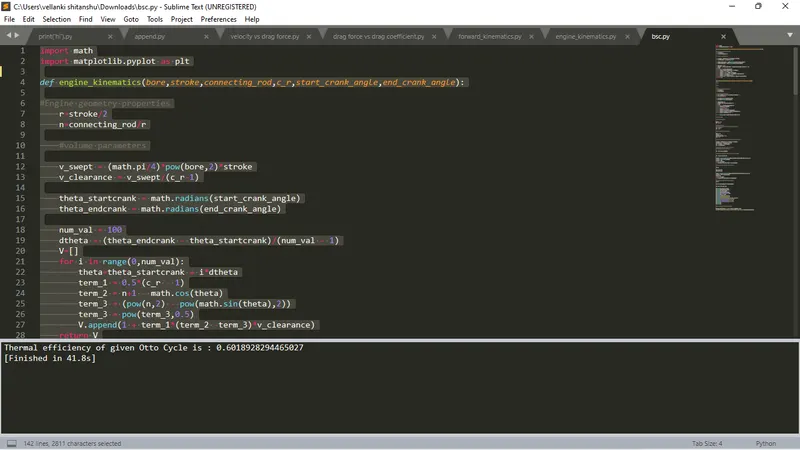
Thermal Efficiency:
Conculsion:
- P-V diagram obtained.
- Thermal Efficiency - 60%