Week 2 Air standard Cycle
Air Standard Cycle
AIM- To write the program for the otto cycle ,to create pv diagram and also find thermal efficiency from the given limitations.
THEORY-
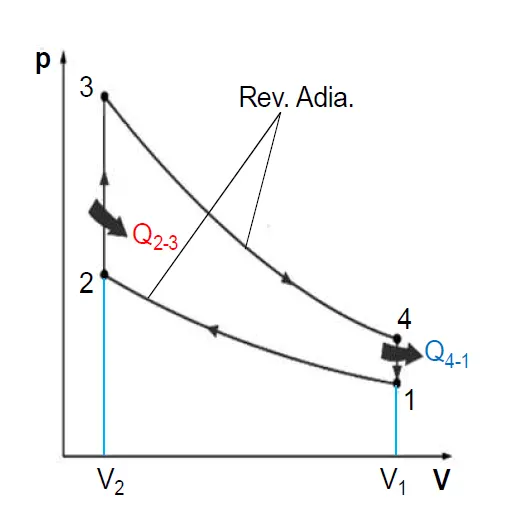
Process 1-2:Isentropic Compression(reversible adiabatic)- Air is compressed isentropically from its initial pressure p1 and volume v1 to p2 and v2 respectively.The temperatures increases from T1 and T2.
Process 2-3:Isochoric(reversible constant volume)heat addition-At the end of isentropic compression,heat is supplied to the air from an external source at constant volume .The temperature of the air rises to T3 and the pressure increases to p3.
Process 3-4: Isentropic (reversible adiabatic) expansion-The high pressure and temperature is now allowed to expand isentropically thus doing the work.The pressure and temperature decreases to p4 and T4 respectively.
Process 4-1: Isochoric (reversible constant volume) heat rejection-At the end of the isentropic expansion, the heat is rejected by the air thus attaining the initial pressure and temperature p1 and T1 respectively. This completes the Otto cycle.
IMPORTANT FORMULA-
Variation of volume in cylinder:

Thermal efficiency of otto cycle:
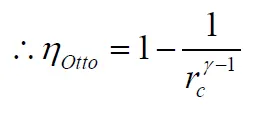
where γ=1.4
PYTHON PROGRAM-
"""
otto cycle simulator by Abhishek M B
"""

import math
import matplotlib.pyplot as plt

#Geometric Parameters
bore = 0.1
stroke = 0.1
con_rod = 0.15
cr = 8


def engine_kinematics(bore,stroke,con_rod,cr,start_crank,end_crank):
	"""
	Engine Kinematics
	"""

	#Geometric Parameters
	a = stroke/2
	R = con_rod/a

	#Volume Parameters
	v_s = (math.pi/4)*pow(bore,2)*stroke
	v_c = v_s/(cr-1)


	sc = math.radians(start_crank)
	ec = math.radians(end_crank)

	num_values = 100

	dtheta = (ec - sc)/num_values

	v = []


	for i in range(0,num_values):
		theta = sc + i*dtheta
		term1 = 0.5*(cr-1)
		term2 = R + 1 - math.cos(theta)
		term3 = pow(R,2) - pow(math.sin(theta),2)
		term3 = pow(term3,0.5)

		v.append((1 + term1*(term2 - term3))*v_c)

	return v


#Inputs
p1 = 101325 #unit-pascal
t1 = 500
gamma = 1.4
t3 = 2300


#Volume Computation
v_s = (math.pi/4)*pow(bore,2)*stroke
v_c = v_s/(cr - 1)
v1 = v_c + v_s

#State Point 2
v2 = v_c
p2 = p1*pow(v1,gamma)/pow(v2,gamma)
rhs = p1*v1/t1
t2 = p2*v2/rhs
v_compression = engine_kinematics(bore,stroke,con_rod,cr,180,0)
constant = p1*pow(v1,gamma)
p_compression = []

for v in v_compression:
	p_compression.append(constant/pow(v,gamma))


#State Point 3
v3 = v2
rhs = p2*v2/t2
p3 = rhs*t3/v3
v_expansion = engine_kinematics(bore,stroke,con_rod,cr,0,180)
constant = p3*pow(v3,gamma)
p_expansion = []

for v in v_expansion:
	p_expansion.append(constant/pow(v,gamma))


#State Point 4
v4 = v1
p4 = p3*pow(v3,gamma)/pow(v4,gamma)
t4 = p4*v4/rhs

plt.plot([v2,v3],[p2,p3])
plt.plot(v_compression,p_compression)
plt.plot(v_expansion,p_expansion)
plt.plot([v4,v1],[p4,p1])
plt.xlabel('Volume(m^3)')
plt.ylabel('Pressure (10^5 Pa)')
plt.show()

#Thermal efficiency
Thermal_efficiency = 1 - (pow(cr,(1-gamma)))
print(Thermal_efficiency)
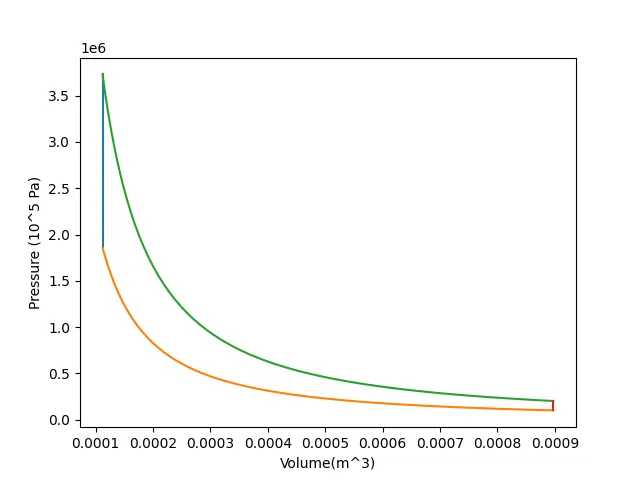
The above Figure is a P-V Diagram executed from the above program.
Thermal efficiency -
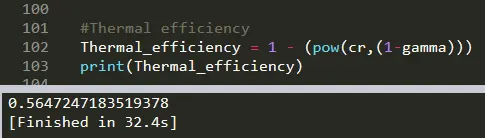
Thermal Efficiency = 56.47%