Week -2
1. Aim :-
- Making of a simulink model of a doorbell using solenoid block.
- And creating a situation where the switch is closed for 2 seconds and released. Observe the physical movement of the plunger.
Theory :-
We use a pulse generator to create the sequence of switch to be on and off after 2second interval. The pulse generator will create a square wave pulse at regular intervals. The pulse generator is connected to the physical system of the switch by the help of a simulink to PS converter. The positive terminal of the switch is connected to the electric power source(battery). And the negative terminal is connected to the positive terminal of the solenoid. An Electrical Reference is also connected to the circuit. Hence the Electrical components are connected and the electrical circuit is completed. Now the second part of the circuit is the mechanical part. The Plunger of the solenoid is connected to the ideal translational motion sensor which is further connected to the scope with the help of PS to Simulink converter. A mechanical translational reference is also connected to the circuit. And we connect a solver for completing the circuit as each PS represented by a connected simscape requires solver for simulation.
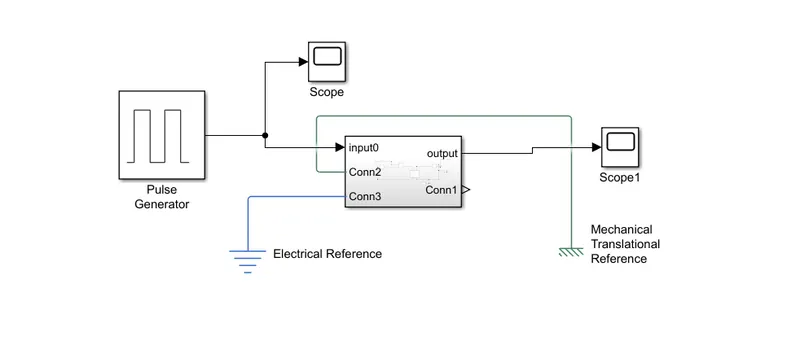
Door Bell
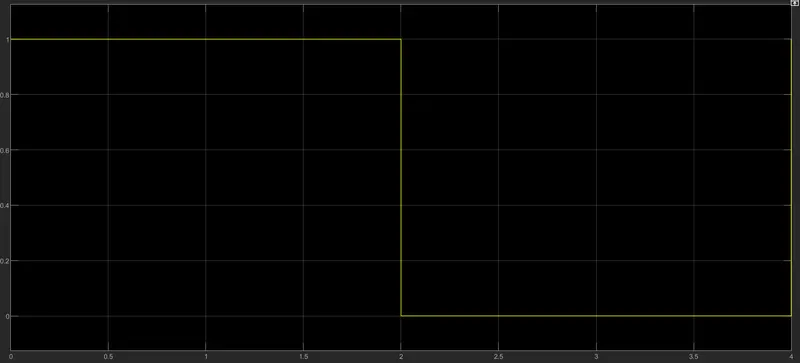
Output of the pulse Generator
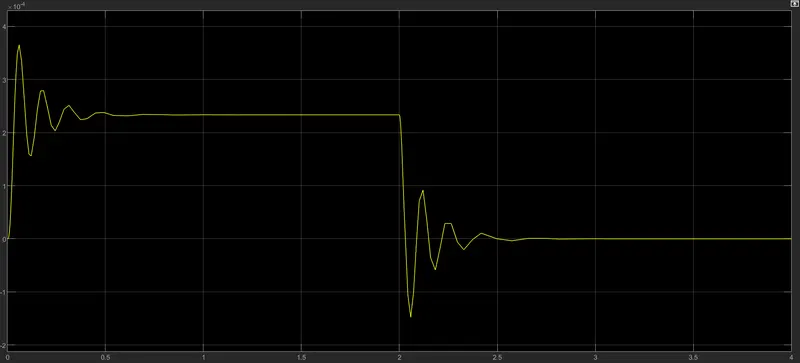
Movement of the Plunger
2. Aim :-
- To use the thermistor to sense the temperature of a heater and to turn on and off the fan accordingly.
- Given inputs are " 0 to 10 seconds - 20C(293K) : 10 to 30 seconds - 27C(300K) : 30 to 50 seconds - 25C(298K)
- Given condition is that when the temperature is above 25C(298K) , the fan should turn on automatically.
Theory :-
Here we use the signal builder to create the heating condition with respect to change in time. Note that the temperature input is taken in Kelvin. The output from the signal builder is connected to a controlled temperature source with the help of a simulink to Ps converter. We also need to configure the input handling of the Simulink to PS converter as the ordinary differential equation is running in the backend. The controlled temperature source maintains the temperature difference set by the signal builder. The controlled temperature source is also connected to the thermal reference. The output from the temperature source is provided as the input to the thermistor. The positive terminal of the thermistor is connected to the electrical power source ot the battery. Now we need to find the threshold voltage at 25C(298k) so that we can input the threshold voltage to the three mode switch in order to turn on or off the fan with respect to the change in temperature. The negative terminal of the thermistor is connected to the positive terminal of the voltage sensor and the resistor. The negative terminal of the voltage sensor and the resistor is connected to the positive terminal of the battery. And the whole circuit is connected to an electrical reference and the solver configuration. Thus completing the circuit. Now the voltage output from the voltage sensor is connected to the display in order to find the threshold voltage and a constant with the value 25C(298K) is given as the input of the controlled temperature source. And for the time being the signal builder is "Commented out". Now when we get the threshold voltage value we connect the circuit back in its original form. Then we connect the voltage output from the voltage sensor to the threshold voltage of the three mode switch. And we configure the three mode switch by entering the threshold voltage at which the fan needs to be turned on. Then we connect two constants to the remaing two inputs of the switch. The output of the switch is connected to the scope to determine the value.
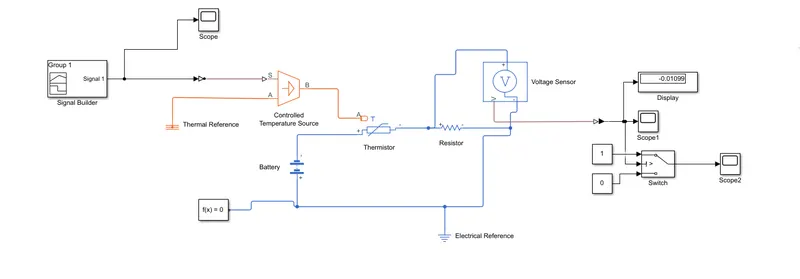
Thermistor
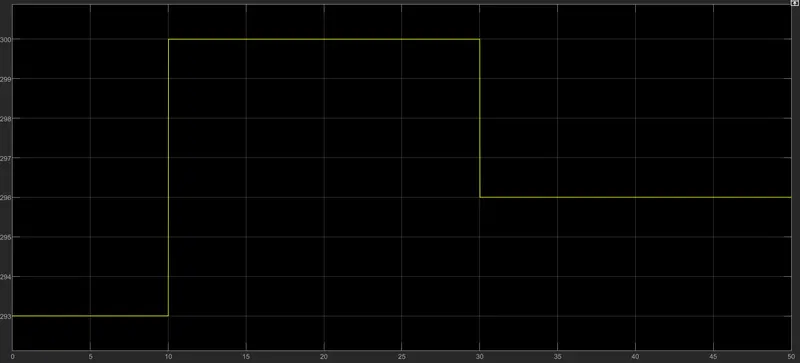
Output fron the Signal Builder
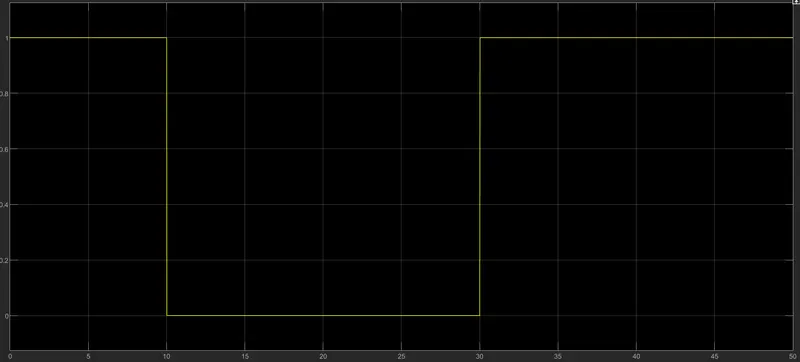
Output from the switch