Week -2
1. Simulink model of Doorbell using solenoid block -
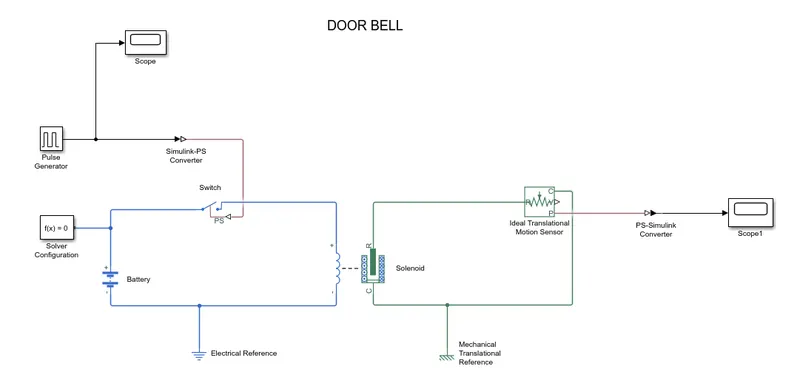
- The Simulink model contain - Pulse Generator, Scope, Switch, Battery, Solenoid, Ideal Translational Motion Sensor, Solver configuration, Simulink-PS/PS-Simulink Converter, Electrical & Mechanical Reference.
- The Solenoid block & Battery block connected to each other (Via Positive & Negative terminal through electric Ref block) & Switch is placed between this blocks.
- Solenoid Block haves two variables (R & C), which represent plunger & Fixed point. Now The R is connected to Ideal Translational Motion Sensor Block, which senses the position of the plunger in the 'Solenoid Block' & gives the output.
- Ideal Translational Motion Sensor Block output (V & P) represent as an Velocity & Position. As we are only dealing with Position thus the scope is connected to P Port through PS-Simulink Converter block, further C port is connected to each other through Mechnical Translation Ref.
- To meet the condition (ie Switch to be closed for 2 Sec & then get released), the Pulse Generator block is being used, where the input is set as below - Period Value given as 4 Sec with Phase delay of 2 Sec, Pulse width - 50 & Amplitude as 1.
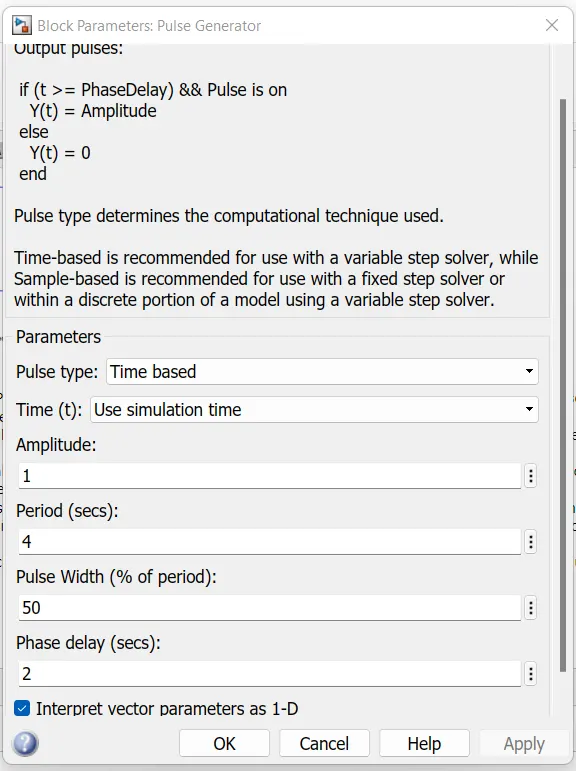
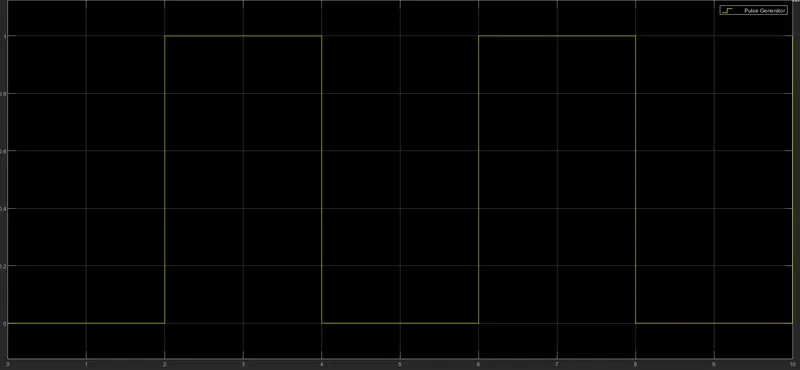
- Initially the Pulse value will zero, sinces the delay of 2 sec has been given it will be stay for 2 sec, further pulse will start from 0 to 1 as we have given the amplitude value as an 1.
- At 4th sec it will again come down to 0 for next 2 secs, thus it complete the period of 4 seconds. further the same cycle will continue (as shown above figure)
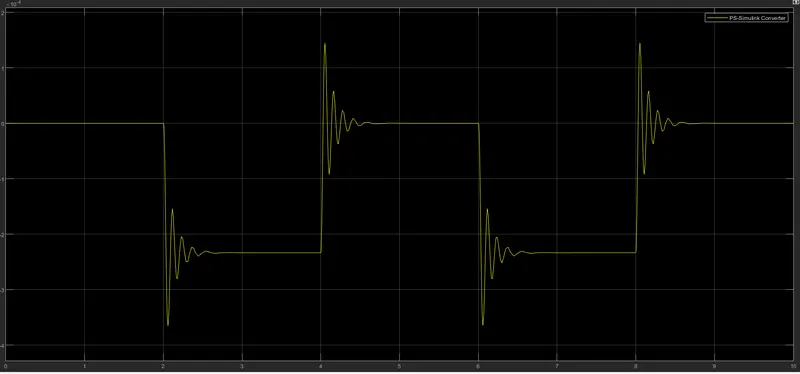
- Spikes/Vibration shown indicates ringing of bell at the interval of 2 second with phase delay of 2 seconds.
2. Use a thermistor to sense the temperature of a heater & turn on or turn off the fan -
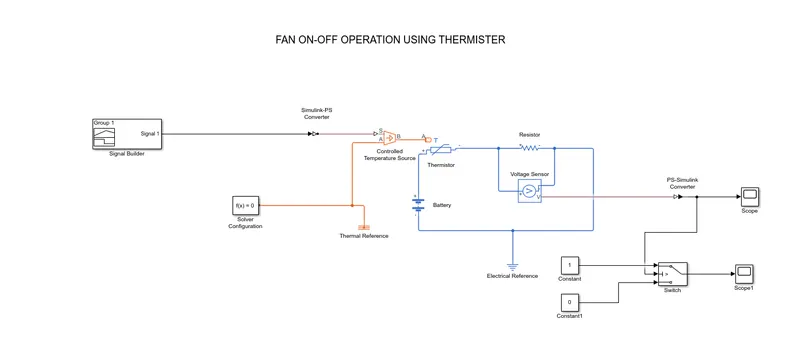
- The Simulink model contain - Signal Builder, Controller Temperature Sensor, Simulink-PS/PS-Simulink Converter, Electrical & Mechanical Reference, Solver Configuration, Thermistor, Resistor, Battery, Voltage Sensor, Switch, Constant.
- Physical module Content Thermistor (Type of Resistor whose resistance depands on temperature so its name is the combination of thermal & resistor), Battery block whose Positive (+ve) port is connected with thermistor Positive (+Ve) port, Resistor block whose +Ve port is connected to Negative (-Ve) port of themistor & its -Ve port is connected to -Ve port of Battery & the Electric Reference block (represent as a earthing of the circuit) near to battery -Ve Port.
- Also Voltage sensor block has been connected parallel to resistor, to measure the voltage across the resistor.
- Further we need a physical qauntities has a signal for thermistor to work & accordingly the Fan to get ON/OFF at different temperature.
- Thus we have used Signal Builder Block (X-axis represent Temperature in Kelvin & Y-axis Time in Seconds) & Output of Signal Builder Block is connected to Controlled Temperature Source block through Simulink-PS Converter (Convert Simulink signal into Physical signal).
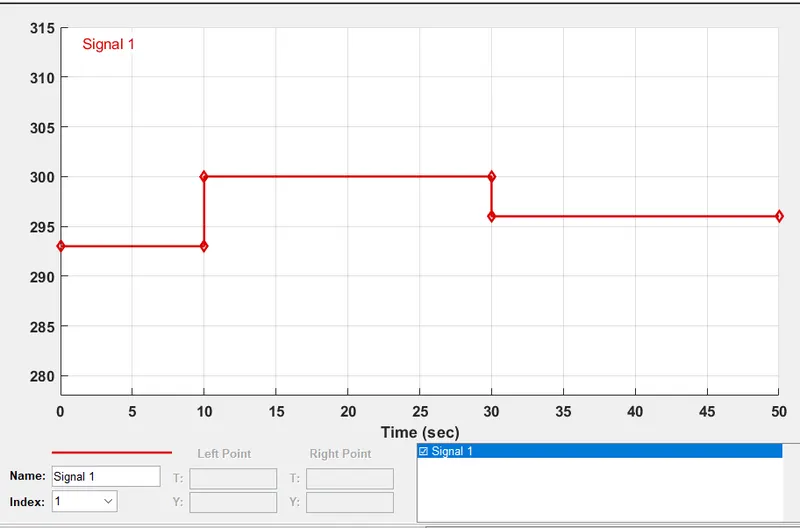
- So to meet the requirement of Objective where the FAN to get turn ON at 25 Degree Celsius, we need to convert Degree Celsius (25 Degree Celsius) into Kelvin (298K).
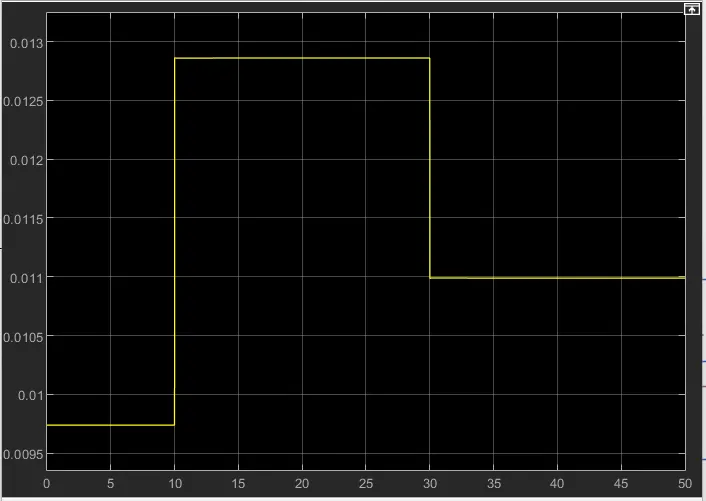
- Futher to find Thresold value of Switch (ON/OFF), the Signal Builder block is disconnected & Contant block (with value 298) is connected to Controlled Temperature Sensor. thus the value at output port of voltage sensor displayed (ie. 0.01189) which is added as Thresold value of Switch.
- Scope - 1 (Voltage Sensor)
Scope - 2 (Switch)
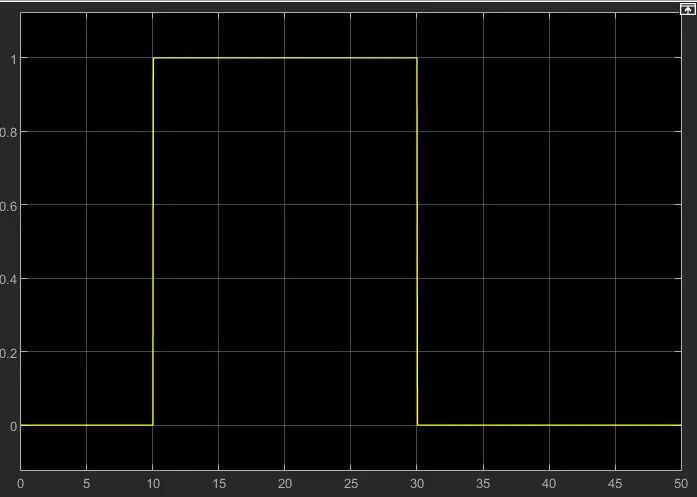
- So after run the module the graph shows that for 0 to 10 sec temperature is 293K & the voltage is in between 0.0095 & 0.01.
- From 10 to 30 sec temperature is 300K & voltage is in between 0.0125 & 0.013.
- And from 30 to 50 sec temperature is 296K & near to 0.011.
- Thus as per the objective FAN should get turn ON when temperature is above 25 degree Celsius (i.e. 298.15K), The FAN remains ON from 10 to 30 Seconds & OFF at 0 to 10 sec & 30 to 50 sec.