Week 14 challenge
BUTTERFLY VALVE:
Butterfly valves belong to the quarter-turn rotational motion valves family and are used primarily to stop, regulate, or start the flow. The term “butterfly” in a butterfly valve is actually a disk that is connected to a rod. When this rod rotates the disk by 90° the butterfly valve opens or closes. Butterfly valves are popular in the industry because of their lightweight, fast operation, and low costs. These valves use handles, gears, or automatic actuators for operation as per the requirement.
Butterfly Valve Uses
The use of Butterfly valves is broad and wide. Some typical applications of butterfly valves are in the water supply, wastewater treatment, slurry services, fire protection, air and gas supply, vacuum services, lubrication system, chemical and oil industries, fuel handling systems, power generation, compressed air and gas services, steam services, food processing, pharmaceutical, marine systems, and sanitary valve application.
Functions of a Butterfly Valve
The main functions of a butterfly valve are
- Flow regulation: Flow can be easily controlled or regulated simply by turning the valve wheel.Using a flow controller the process can be automated.
- Flow Isolation
- Prevention of Backflow: Butterfly valves can be used for backflow prevention in some situations.
Types of Butterfly Valves
Depending on disc closure design, connection design, and actuation method, Butterfly valves can be categorized into several types.
- Based on Disc Closure Design
- Concentric Butterfly Valve
- Eccentric Butterfly Valve
- Single-Offset
- Double Offset
- Triple Offset
- Based in Piping Connection
- Lug type
- Wafer Type
- Flanged Butterfly Valve
- Butt-welded Butterfly Valves for high-pressure applications
-
- Automatic Actuation
- Electric
- Pneumatic
- Hydraulic
- Automatic Actuation
- Based on Seat Material
- Soft Seated
- Metal Seated
Concentric Butterfly Valve
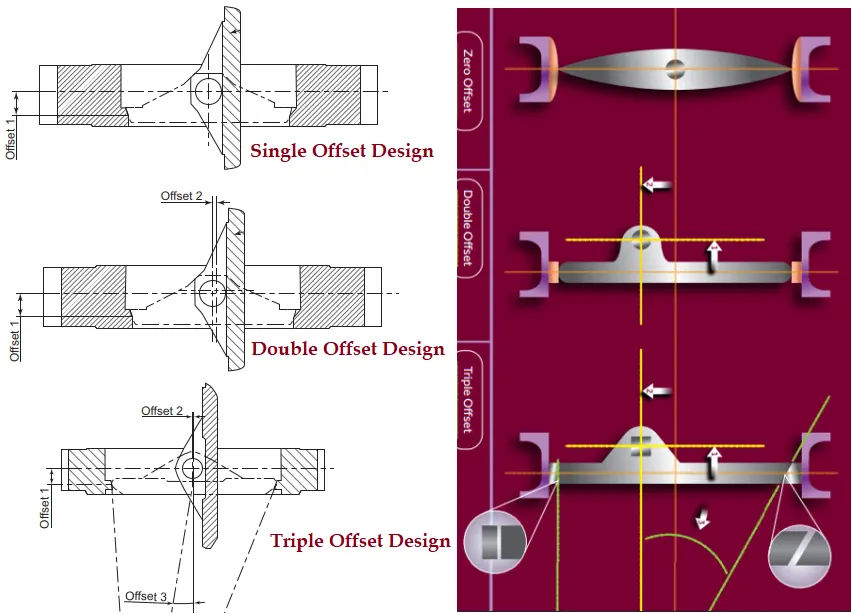
The concentric butterfly valve is the most basic type of butterfly valve design. In this design, the valve stem passes through the centreline of the disc. This is also known as a zero-offset valve. Concentric butterfly valves are used for low-pressure services.
Eccentric Butterfly Valve
In an eccentric butterfly valve, the stem does not pass through the centerline of the disc. There are three types of offset valves.
- A Single-offset valve is the butterfly valve where the stem is located right behind the centreline of the disc.
- In a double-offset butterfly valve design, the stem is located behind the disc with an additional offset to one side.
- For highly critical applications, a triple offset butterfly valve is used. The third offset is in between the disc and seat contact axis. This design results in minimal seat contact thus very less wear and highly efficient.
Lug Type Butterfly valve
The lug-style butterfly valve (Fig. 2) designs have threaded lugs outside the valve body. Using two sets of studs, the valve is connected with piping flanges. One end of the line can be disconnected without affecting the other side since each flange has its own bolts.
Wafer Type Butterfly Valve
A wafer-type butterfly valve is sandwiched between two pipe flanges and the flange bolts surround the valve body. This is the most economical butterfly valve. Long bolts are used covering both flanges and valve body. A wafer butterfly valve provides sealing against bi-directional pressure difference in the fluid flow. The wafer version of the butterfly valves is designed to protect against a tight seal and two-way pressure difference.
Butterfly Valve Advantages
Butterfly Valves provides many advantages as compared to other valve types.
- Improved energy efficiency
- Low-pressure drop and high-pressure recovery
- Long valve life
- Relatively inexpensive to build.
- Less number of parts; Hence, reduced maintenance.
- Butterfly valves are suitable for control purposes with linear flow characteristics between 300 and 700 of opening.
- Butterfly valve offer excellent rangeability from 30:1 to 100:1.
- Lightweight; easily supported by the piping system.
- Less raw material and less costly.
- Quick operation; less opening or closing time.
- Easy to Install.
- Simple operation due to low operation torque.
- Available in very large sizes
Disadvantages of Butterfly valve
However, there are few disadvantages of a butterfly valve as listed below
- Throttling service is limited to low differential pressure
- Disc movement is affected by flow turbulence.
- The valve disc is always under pressure and can interrupt the flow even in an open position.
- Possibility of Cavitation and choked flow is a concern
- Poor Sealing function.
- Not suitable for high differential pressure.