Week 12:Project-1-Meshing of Door Inner Panel Challenge
Project 1 Challenge: Meshing of the Door Inner Panel Challenge
Course: HyperMesh for FEA Plastics and Sheet Metal Applications
Submitted by: Amanpreet Singh Whan
Supervisor: David Nirmal Paul
May 16, 2021
List of Figures
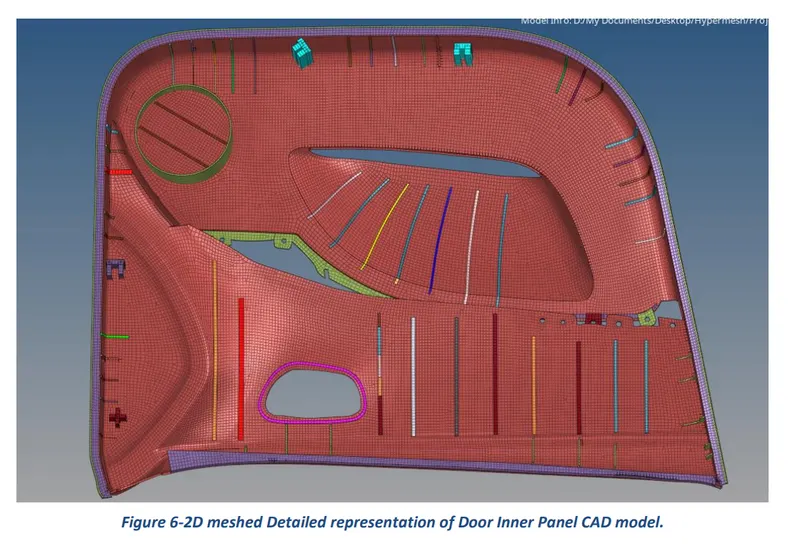
Figure 1-Imported given Door Inner Panel CAD Model.
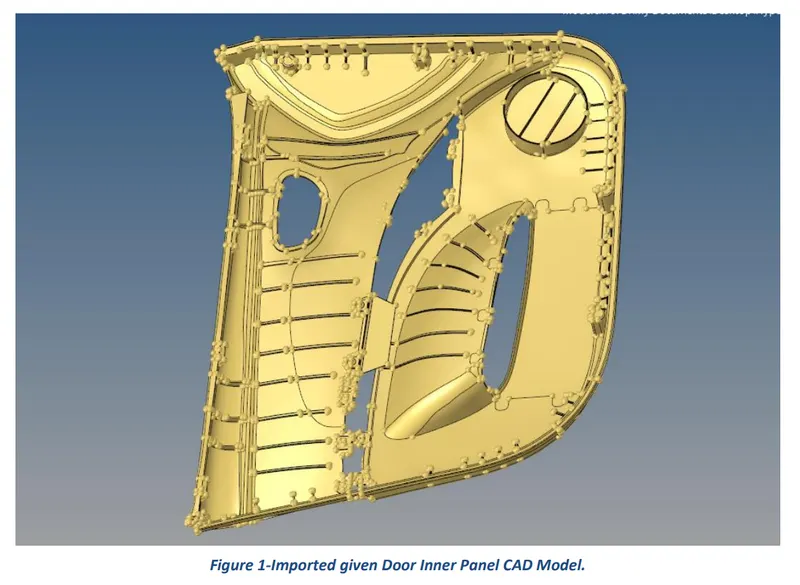
Figure 2- Extracted Mid Surface of Door Inner Panel Model.
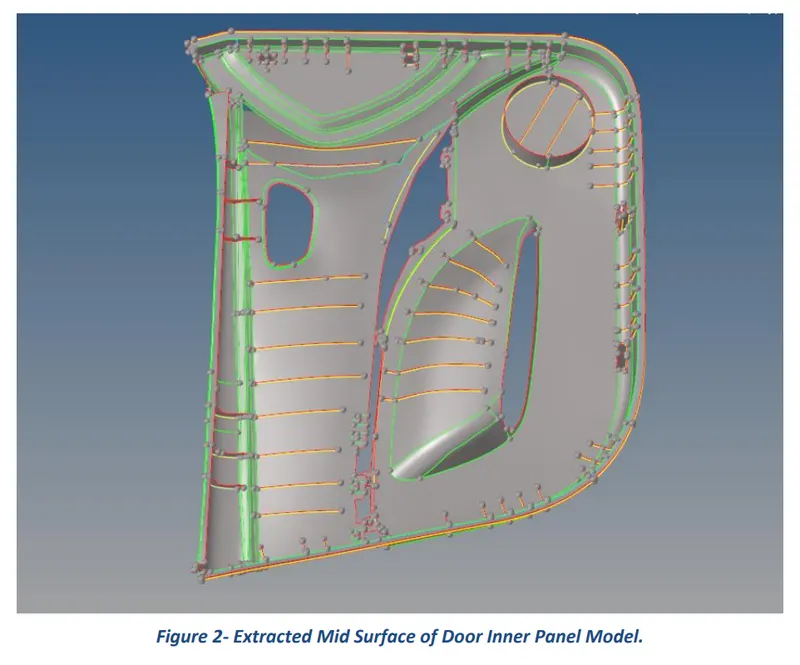
Figure 3-Quality criteria and Mesh parameters set as per challenge requirements.
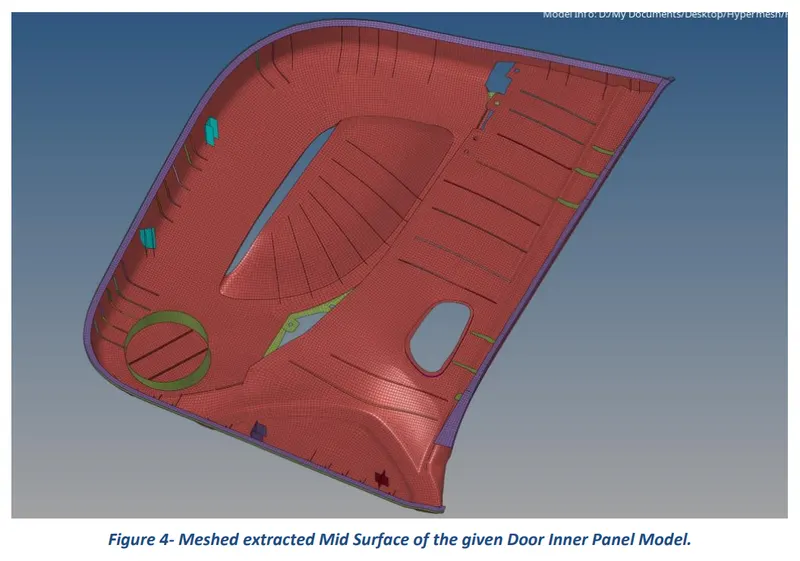
Figure 4- Meshed extracted Mid Surface of the given Door Inner Panel Model.
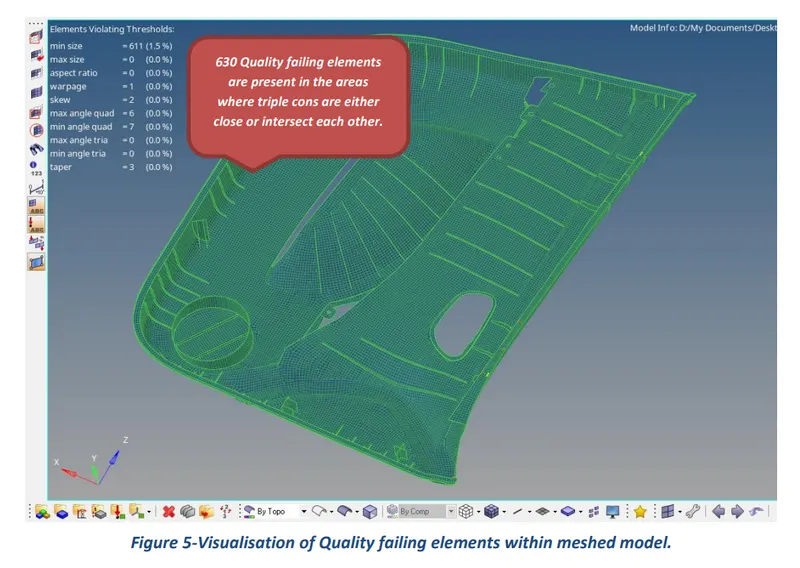
Figure 5-Visualisation of Quality failing elements within the meshed model.
Figure 6-2D meshed Detailed representation of Door Inner Panel CAD model.
Table of Contents
3.1 Geometry Clean-up of the given CAD Model
3.2 Extracting Mid Surface of Door Inner Panel Model
3.3 Shell Meshing of Extracted Mid Surfaces of the Door Inner Panel Model
1 Introduction
HyperMesh is the market-leading, multi-disciplinary finite element pre-processor which manages the generation of the largest, most complex models, starting with the import of CAD geometry to exporting a ready-to-run solver file. HyperMesh supports a wide variety of CAD and solver interfaces, making it a perfect solution for most industry verticals and domains. With its advanced geometry and meshing capabilities, HyperMesh provides an environment for rapid model generation. Generating high-quality mesh quickly is just one of Hyper Mesh’s core competencies. For complex sub-system generation and assembly, HyperMesh has advanced model assembly tools. Modeling of laminate composites is supported by advanced creation, editing, and visualization tools. Design changes can be made easily via mesh morphing and geometry dimensioning.
Door panels serve as an interface between the interior of the car and the inner workings of the door, and between vehicle occupants and the door. They are expected to meet a variety of design specifications regarding safety, aesthetics, and functionality. In addition, they are expected to continue the material theme of the dashboard and pillars while concealing intricate electrical and mechanical components for operating locks, windows, and other features. The door panel has evolved from a simple two-part system of the latch and simple winding mechanism to a more sophisticated enclosure. Doors currently have an inner full-width panel consisting of electronic windows, a central locking system, and speakers. These panels typically consist of a foamed core covered with either textiles or plastics. The following figure shows a conventional car door panel.
2 Aims
- Check and fix all the geometry errors of the given Model for Geometry Clean-up purposes.
- Extract/ Generate Middle Surface for the given model.
- Perform 2D or Shell Meshing of the components of the model as per given Mesh Quality Criterion to generate an overall good mesh flow for the entire model.
- Investigate and Improve the mesh quality wherever required.
3 Methodology and Results
The section describes the different stages that were performed using an engineering tool HyperWorks 2020 for the completion of the Project 1 Challenge task. These stages can be further broadly sub-categorised into three key steps, starting from importing of cad model to geometry clean-up for mid surface generation and finally carry out meshing of the extracted mid surfaces as per quality requirements.
3.1 Geometry Clean-up of the given CAD Model
After opening the HyperWorks software, the first and foremost step is to import the given Door CAD Inner Panel model and then patch up any of the free edges present highlighted in red lines or cons for the geometric clean-up purposes.
3.2 Extracting Mid Surface of Door Inner Panel Model
The mid surface of a CAD design can be generated both manually and automatically. To generate mid surface automatically, click on the Mid surface tool under Geometry Module buttons and use the auto midsurface-> Skin offset command to extract mid surface for the given Door Inner Panel CAD model.
The results of the mid surfaces obtained using the Offset-> Surface command for the different features of the given CAD model are presented in the following pictures.
3.3 Shell Meshing of Extracted Mid Surfaces of the Door Inner Panel Model
Meshing is a phase where the CAD geometry is discretized to represent the computational domain in which the solver will discover a solution. A refined mesh helps to achieve better results. Before proceeding with meshing, it is important to create a washer split across circular regions and can be deployed using the washer split command from quick edit options under Geometry Module buttons.
The Automesh command was used to mesh the given Door Inner Panel CAD model. The adopted meshing technique and obtained results are presented in the following pictures.
The meshing conducted for the given model is explained in the following steps:
- The target element size was set to 4 mm for the given CAD model. This will help to generate a mesh of constant element size.
- In the next step, the values of Quality Criteria and Mesh Parameters were entered as per challenge requirements to get a good flow of the mesh over the model. The values used for the quality criteria and mesh parameters are presented in the following tables.
|
Quality Criteria |
|
|
Criteria |
Value |
|
Target size |
4 |
|
Min length |
2 |
|
Max length |
6 |
|
Aspect Ratio |
5 |
|
Skewness |
45 |
|
Warping |
15 |
|
Taper |
0.50 |
|
Min angle Quad |
45 |
|
Max angle Quad |
135 |
|
Min angle Tria |
20 |
|
Max angle Tria |
120 |
|
Tria % |
10 |
- ‘Automesh’ command was used to produce 2D mesh for the model.
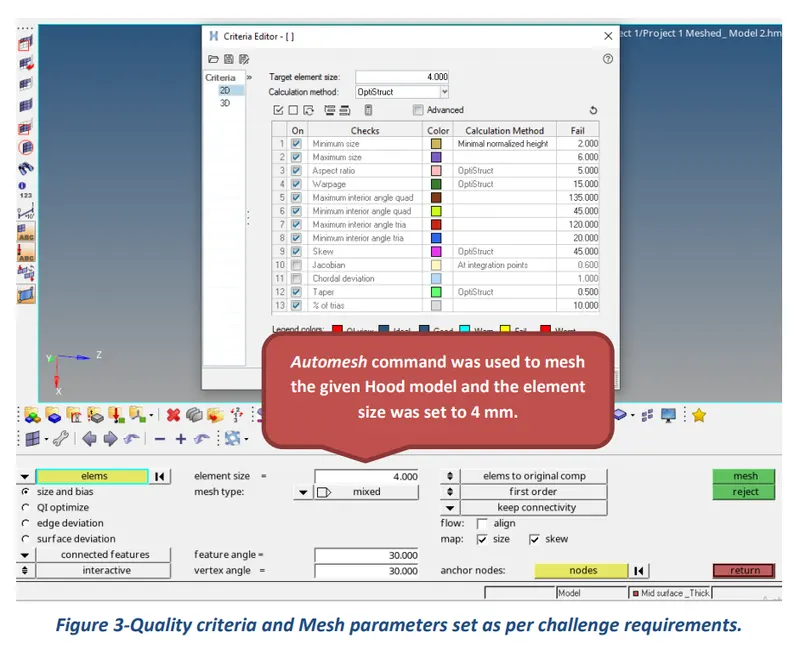
The results of the meshed Door Inner Panel CAD Model are presented in the following pictures.
4 Conclusion
In conclusion, the main aims of the Project 1 Challenge were to perform geometry clean-up, extract the middle surface for the different features of the door inner panel CAD model and finally perform shell meshing as per given quality requirements. However, a total of 630 quality errors are present in the areas where triple cons are either very close or intersect each other. Moreover, the average thickness value was assigned to the features which have variable thicknesses of the meshed Door Inner Panel Model.
5 Appendix