Week 12- Final project
OBJECTIVE:
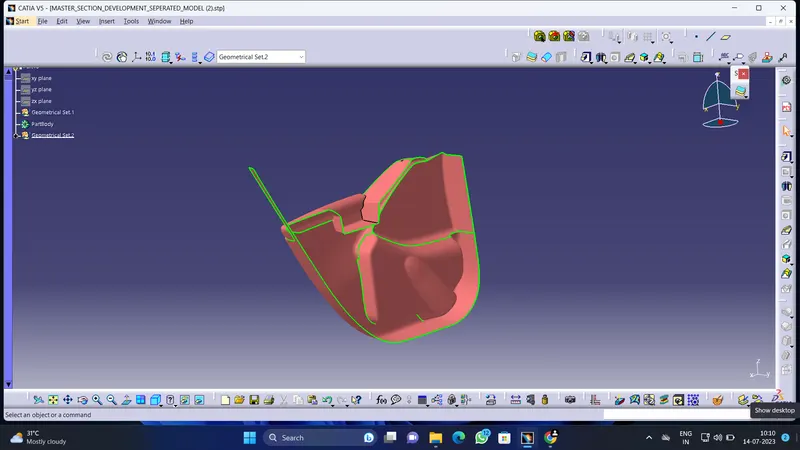
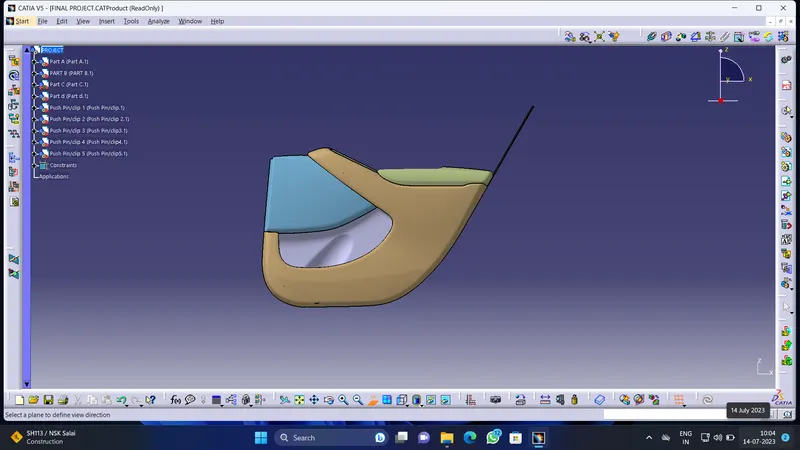
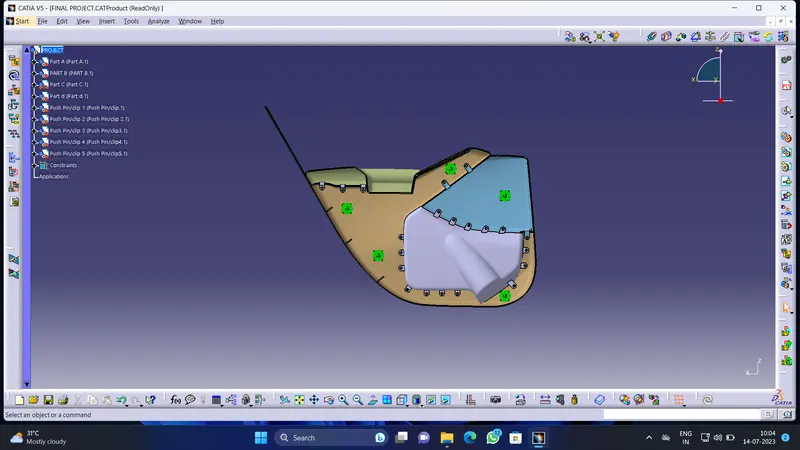
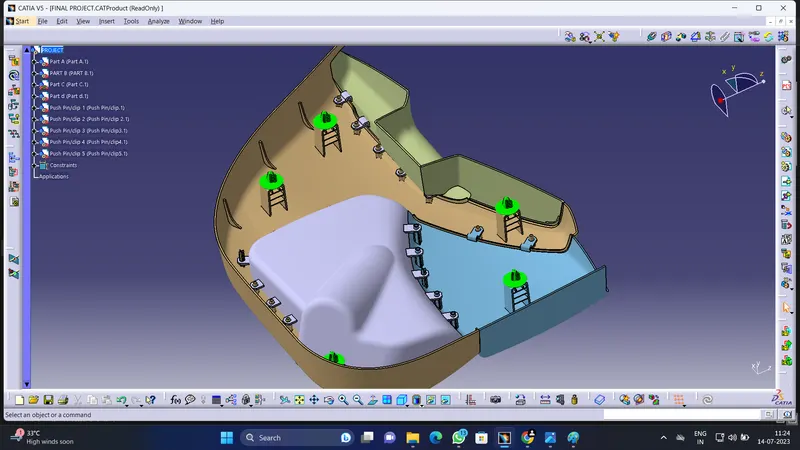
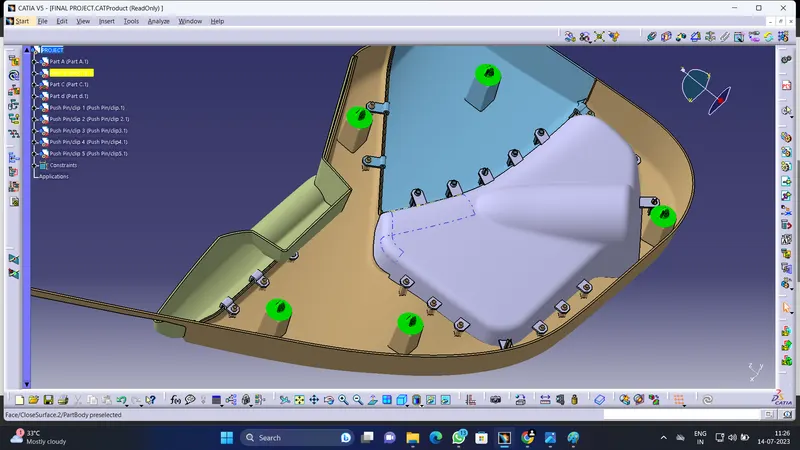
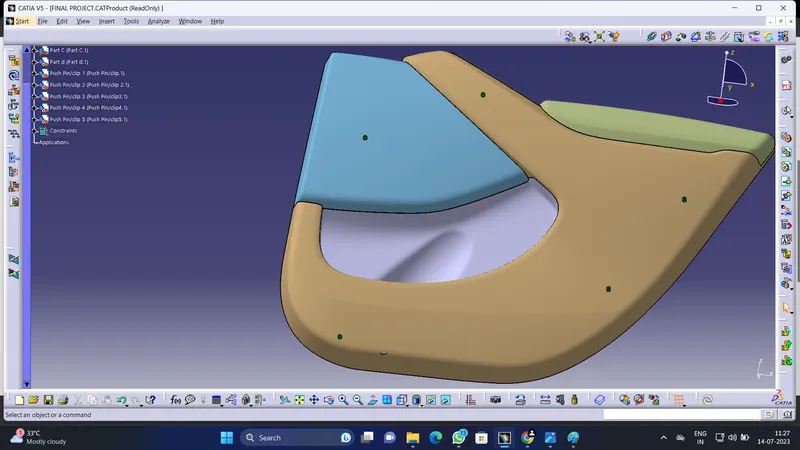
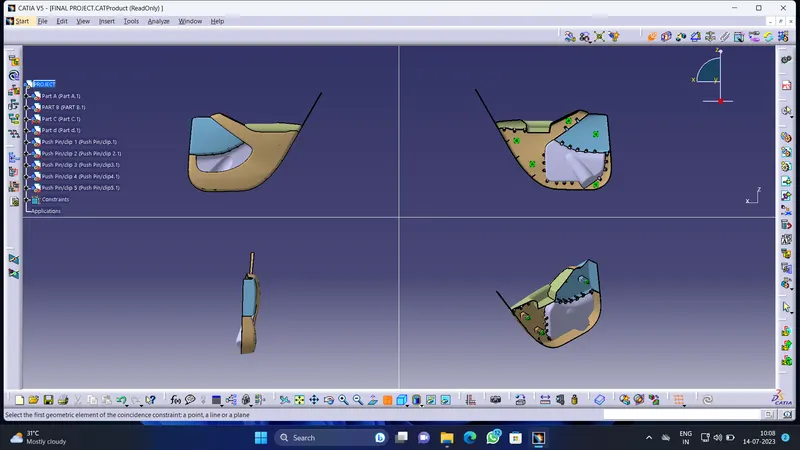
To make a solid body of a side door trim of a vehicle from the given class As of 4 parts of the door trim which are Lower Substrate, Bottle Holder, Map Pocket, and Door Armrest. Also, B side features like doghouse, heat stake and locator should be added, all obeying the design rules and guidelines.
INPUT FILE
OUTPUT PRODUCT
THEORY
Role of plastics in the Automotive industry
The automotive industry is the third most important consuming sector of polymers after packaging and building and construction.
The role of plastic in the design and manufacturing of automotive vehicles has never been more essential, with stringent regulations and changing consumer habits driving demand for more affordable, lightweight, and fuel-efficient vehicles. Fuel efficiency has become one of the most important features in automotive vehicle design due to the rising fuel prices and stricter environmental regulations.
There are about 30,000 parts in a vehicle, out of which 1/3 are made of plastic. In total, about 39 different types of basic plastics and polymers are used to make an automobile. More than 70% of the plastic used in automobiles comes from four polymers: polypropylene, polyurethane, polyamides and PVC. Plastic has become one of the key materials required for the structure, performance, and safety of automobiles in recent years, with growth in plastic consumption being driven by light-weighting trends for fuel efficiency and consequently lower greenhouse gas emissions.
Manufacturing Process:
Injection Moulding:
Injection moulding is one of the most commonly used production processes for plastics. It offers a viable solution for the mass production of high-quality injection automotive parts from a broad range of polymers. In the automotive industry, where consistency, safety, and quality are of utmost importance, automotive plastic injection moulding is an important manufacturing process.
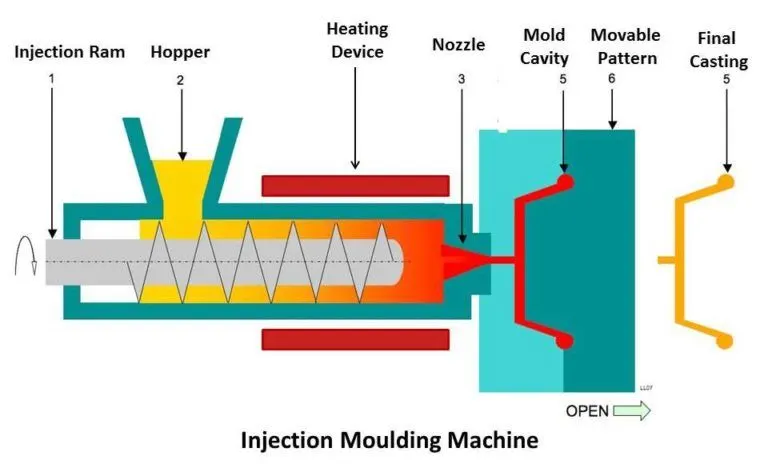
Plastic injection moulding is the process of melting plastic pellets that once malleable enough, are injected at pressure into a mould cavity, which fills and solidifies to produce the final product.
Tooling Direction
Tooling direction is the direction the mould takes to make the part. It is basically the direction that the mould pulls apart. The mould is built in two separate pieces, a cavity side and the core side. The core pulls apart from the cavity and that is the Tooling Direction.
Core is the male part which forms the internal shape of the moulding. Cavity is the female part that forms the external shape of moulding.
Parting line is the line of separation on the plastic part where the two halves of the plastic injection mould meet, i.e. where the core and cavity meet.
Design for Manufacturing & Assembly (DFMA)
Design for Manufacturing and Assembly is an engineering methodology that focuses on reducing time-to-market and total production costs by prioritizing both the ease of manufacture for the product’s parts and the simplified assembly of those parts into the final product – all during the early design phases of the product lifecycle.
Before becoming the singular philosophy it's known as today, DFMA used to be considered as two distinct methodologies: Design for Manufacturing (DFM) and Design for Assembly (DFA).
DFM is concerned with selecting cost-effective raw materials and attempting to minimize the complexity of manufacturing operations during the product design phase in order to reduce the overall manufacturing time and costs for product components. Similarly, DFA is concerned with reducing the product's assembly time, costs, and complexities by minimizing the number of individual parts, assembly steps, and the potential for variability in build quality.
Function of Heat Stake, Locator, Doghouse, and Ribs
Heat staking technology is quite simple in concept. Whenever two or more components need to be attached to one another, and at least one is made of a thermoplastic, a combination of heat and pressure can be used to reform the plastic to the many shapes or profiles to retain or join the parts together.
A 2-way locating pin restricts motion along 1 axis (or 2 degrees of Freedom). Likewise, a 4-way pin restricts 4 degrees of freedom along 2 axes.
Dog house is a 4 sided box attached to a flat surface which usually requires a riser/slider to mould. In other words, it has 3 sides and a roof, where the roof usually has a hole for attachment purposes.”
Ribs can be added to parts to add rigidity or stiffness. Adding ribs allows for a part to increase strength and bear a higher load.
PROCEDURE
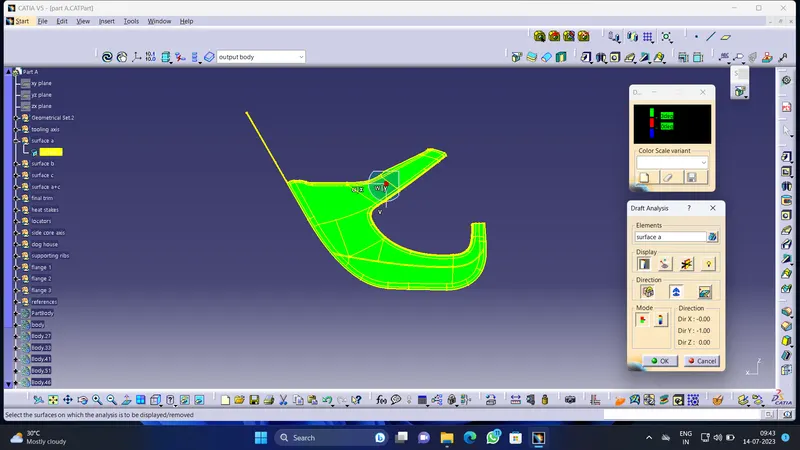
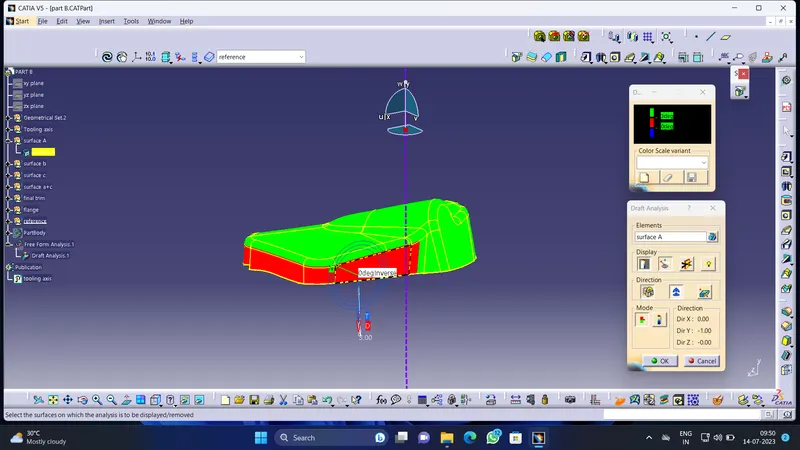
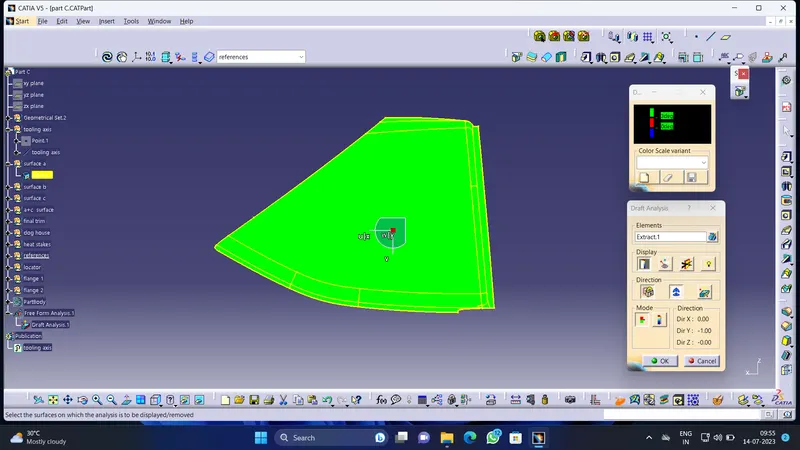
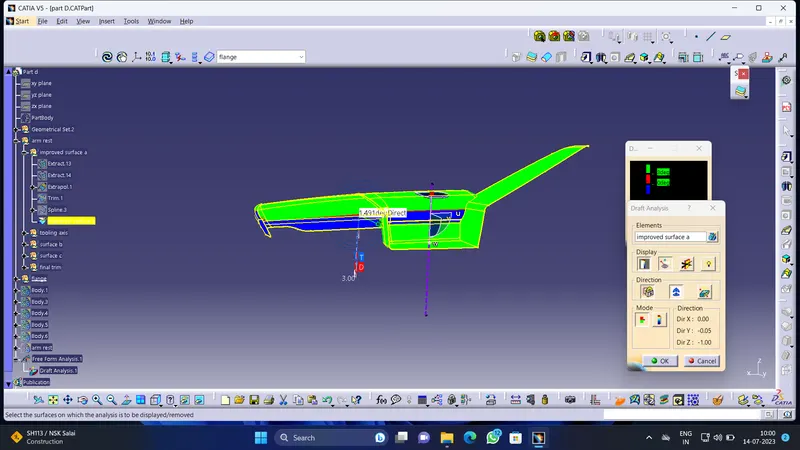
There are four surfaces with intersections are given in the input stp file .from that each surface is extracted and checked the draft analysys with the tooling axis that was created for each surfaces .
class A surfaces
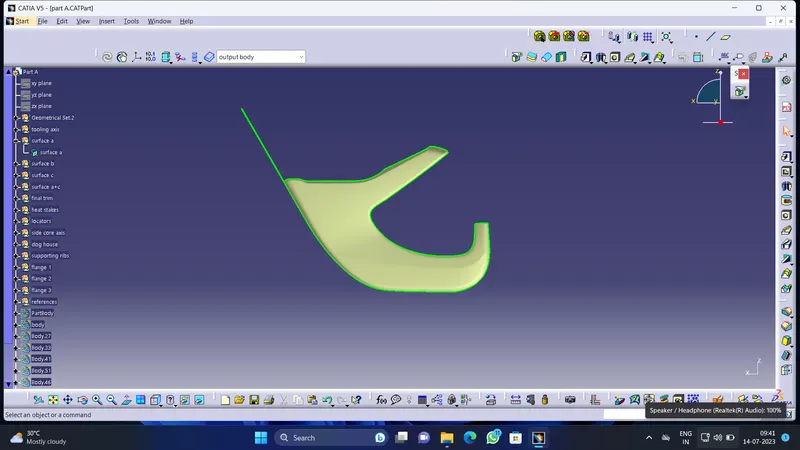
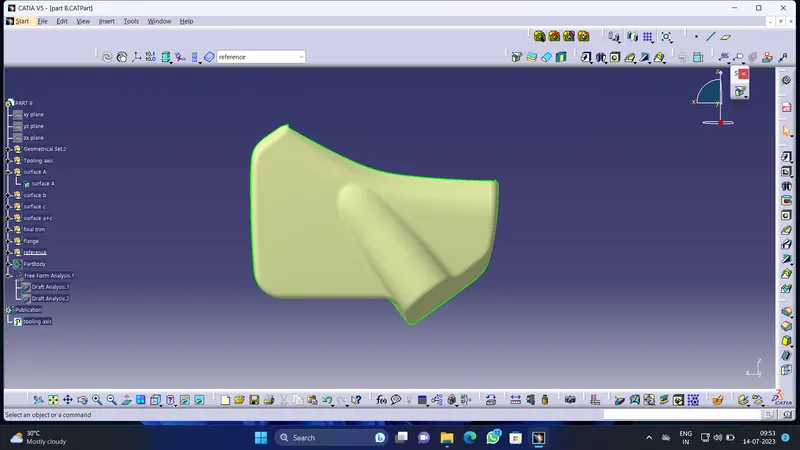
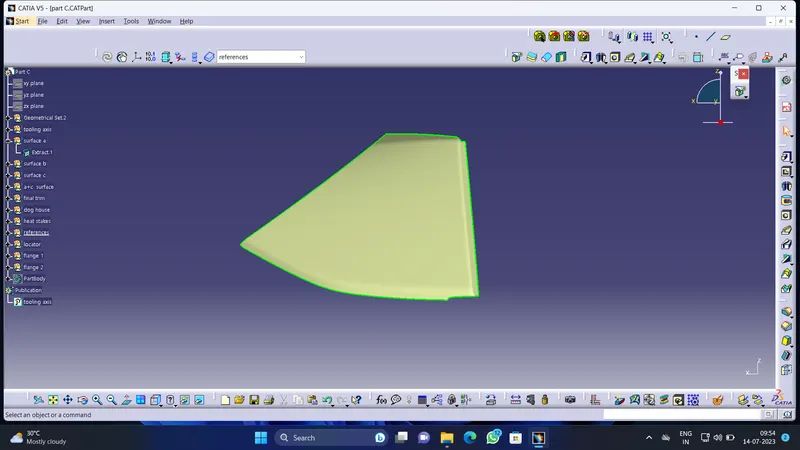
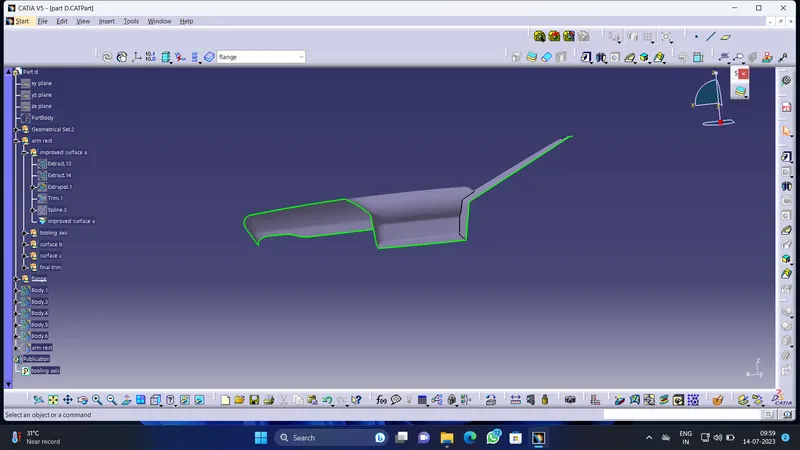
Draft analysis of class a surfaces
.
- After the tooling axis creation,checked the draft analysis of surface A .it is almost clearing the draft angles.but in some portions the draft angle is less than 3 degree whis is mentioned in the above images. it may be due to the errors in the surface A
- After that, started to create the B surface by the method of offseting.The surface B is extrapolated to a small distance for the final trim purpose.
- After that ,started to create the surface C with the sweep operation including the draft direction method and referance surface method
- after that the generated sweeps are joined together with the surface A
- the A+C surface is then trimmed with the extrapolated B surface and getted a final trim
- the final trim surface is closed by the closed surface method by using the part workbench.
FINAL PARTS WITH ATTATCHMENT FEATURES
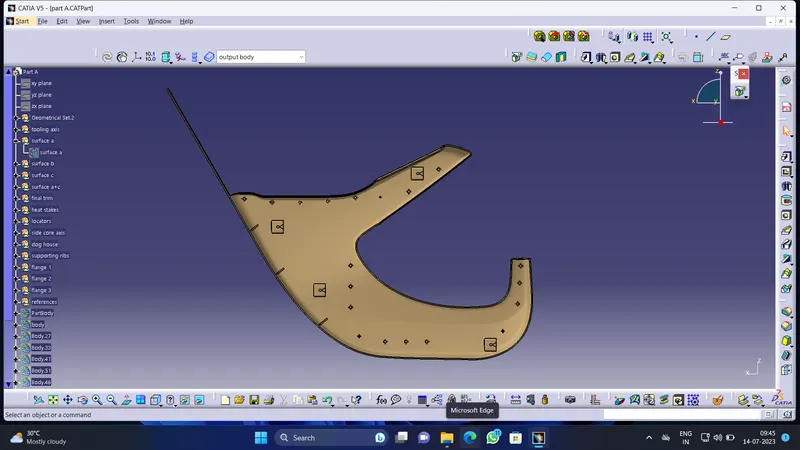
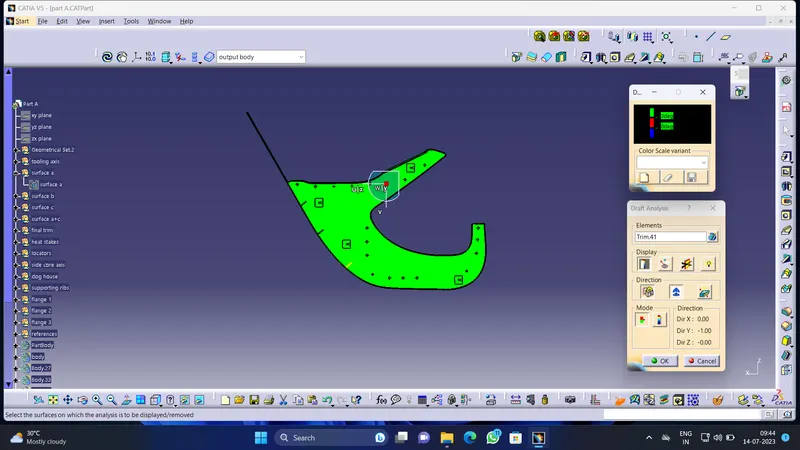
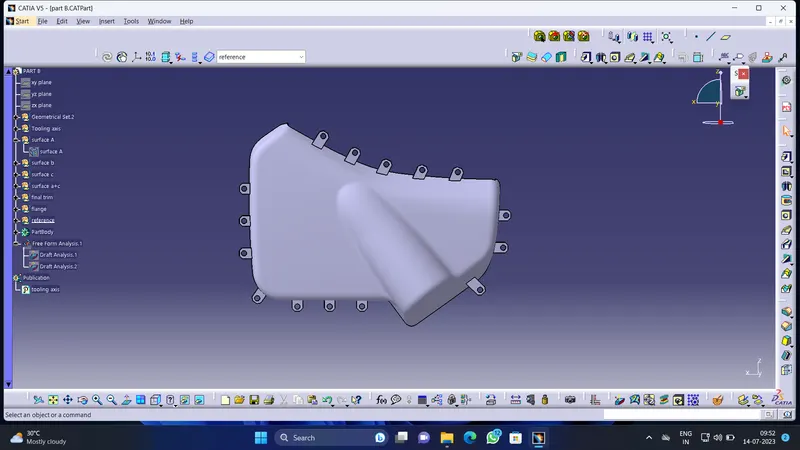
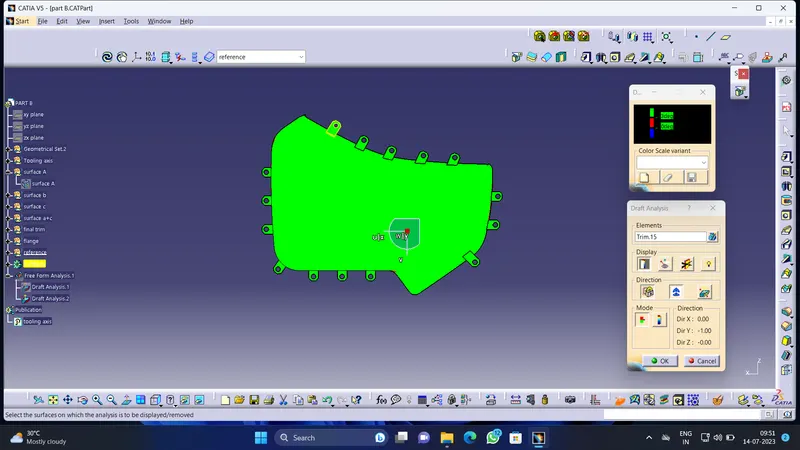
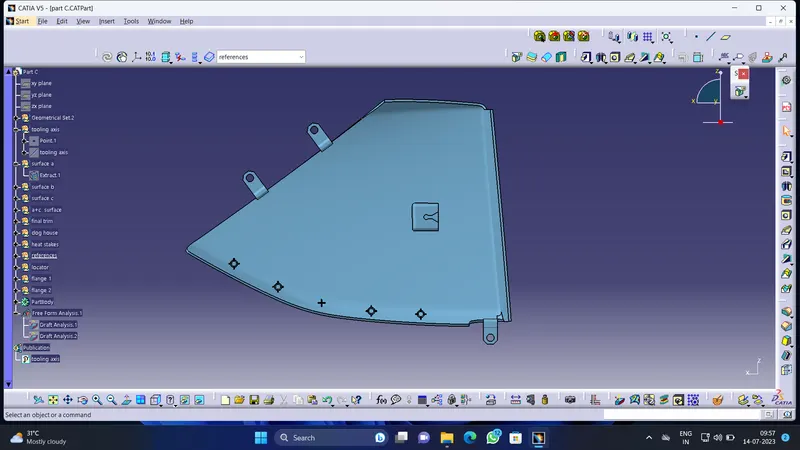
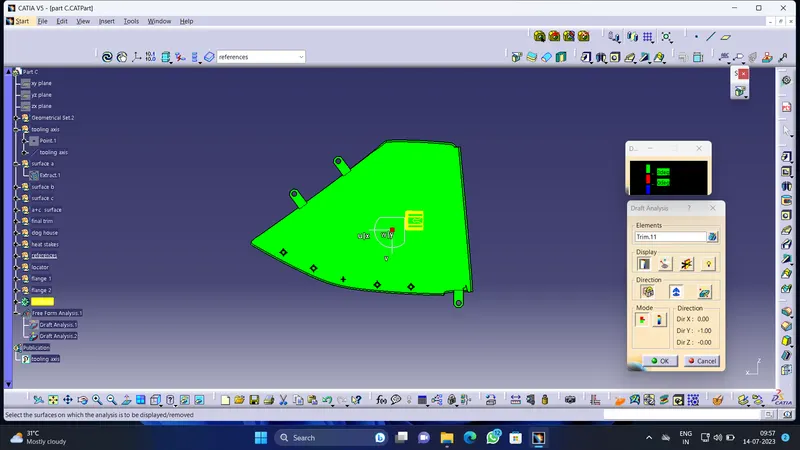
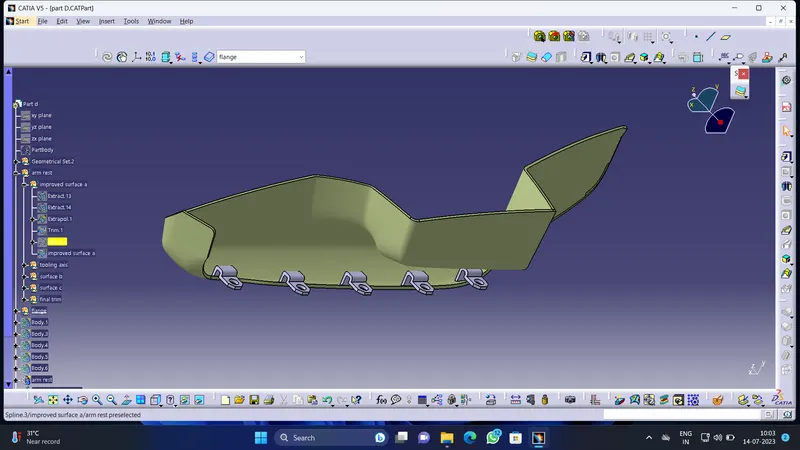
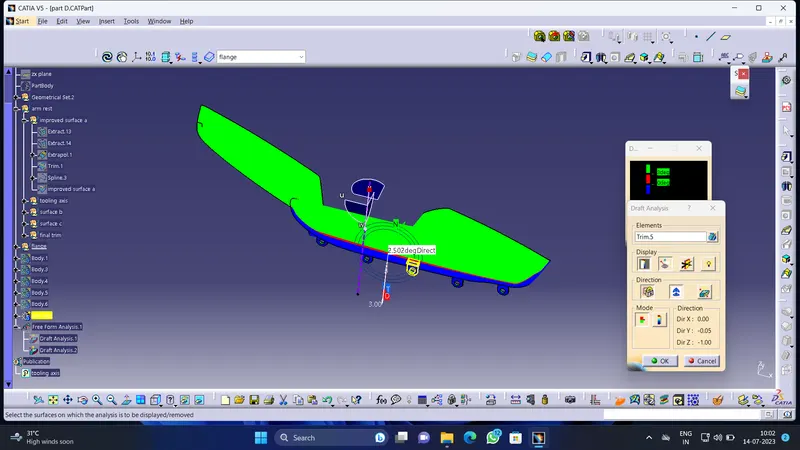
Draft analysis of attatchment features also done.it is clearing the tooling axis and the dog house clearing the side core axis also.
RULES FOR ATTATCHMENT CREATIONS
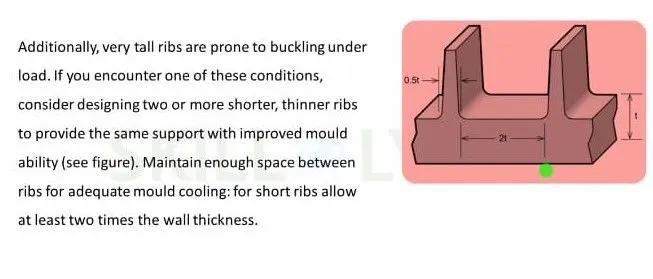
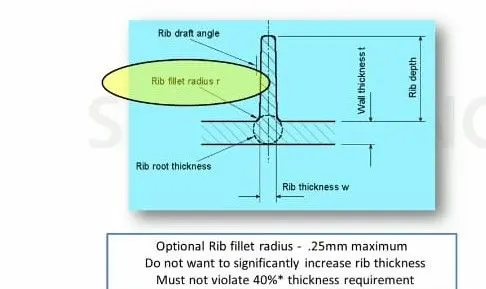
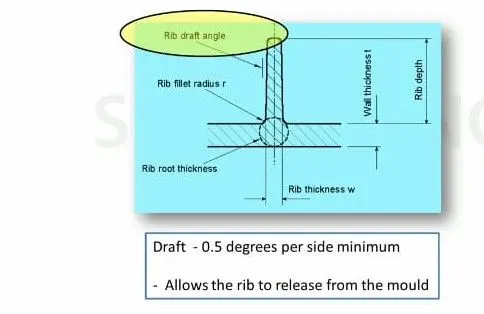
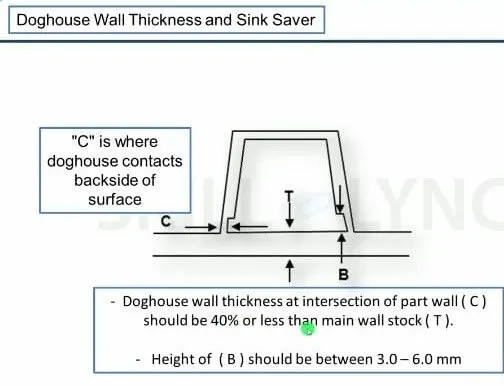
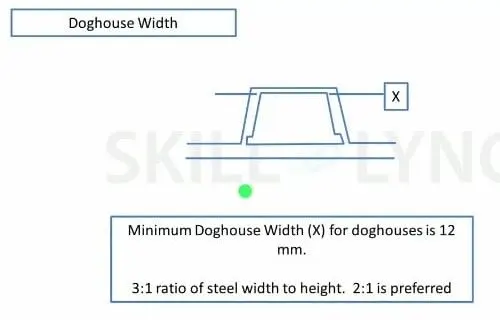
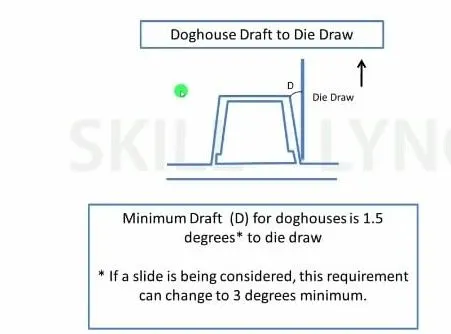
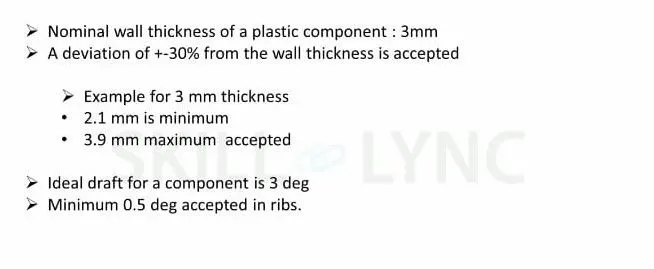
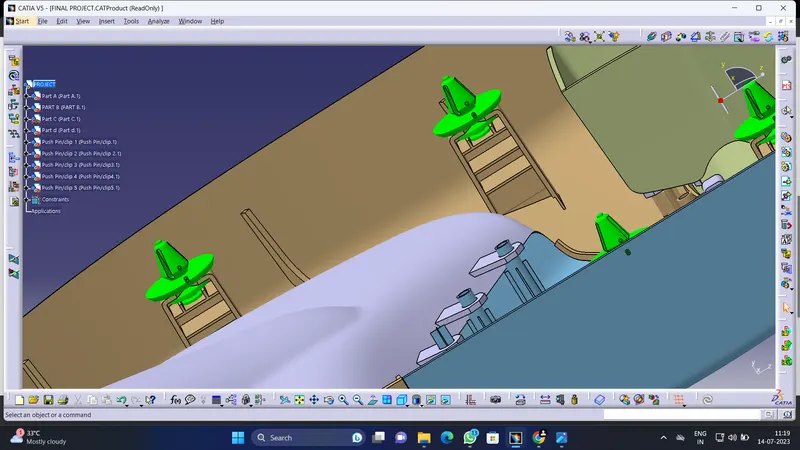
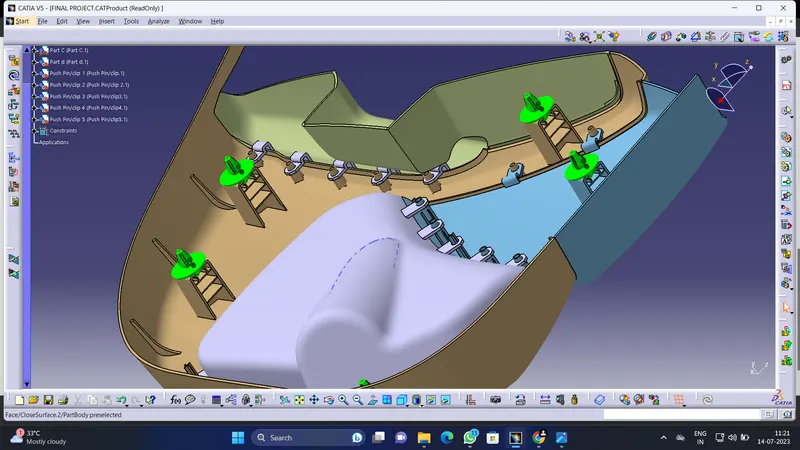
After creating each part and checking the draft analysis,the each part copied to the assembly work bench for assembling the push pin to the dog house.The push pin was given as input file
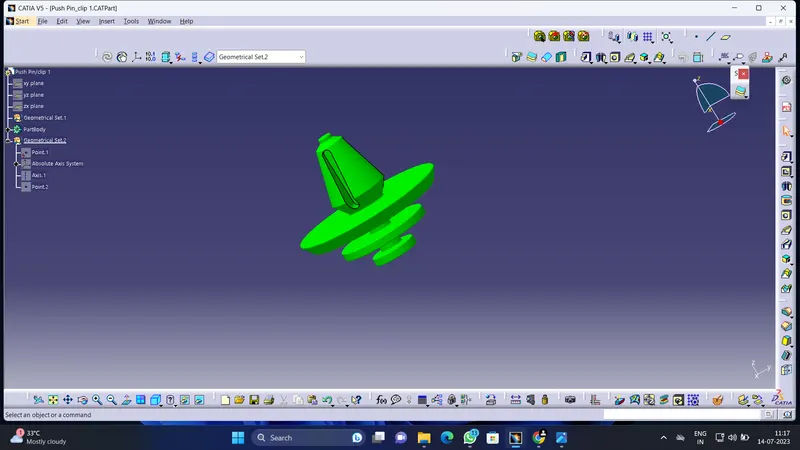
push pin attached to dog house for fixation purposes
CONCLUSION:
Hence the solid body of various parts of the door trim was made successfully with all necessary B-side features following all the design rules and guidelines.