Week 11 - Simulation of Flow through a pipe in OpenFoam
Hydrodynamic entrance length:
The hydrodynamic entrance region refers to the area of a pipe where fluid entering a pipe develops a velocity profile due to viscous forces spreading from a pipe's interior wall. This region has a non-uniform flow. The fluid enters a pipe at a constant speed, so fluid particles in the layer in contact with the pipe's surface come to a complete stop because of the no-slip rule. The layer in contact with the pipe surface is resistant to the acceleration of neighboring layers due to viscous forces within the fluid and slowly slows down adjacent layers of fluid, creating a velocity profile. To keep the mass true, the speed of the fluid layers in the center of the pipe increases to compensate for the reduced speed of the fluid layers near the surface of the pipe. It creates a gradient of velocity across the pipe cross-section.
Entry length for Laminar flow is `L_e=0.06*Re*D`
Hagen poiseuille's equation :
In non ideal fluid dynamics, Hagen-poiseuille equation is a physical law that gives pressure drop in an incompressible and newtonian fluid in a laminar flow through a long cylinder pipe of constant cross section.
Formulae:
Avarage Velocity `V_(avg)=(Re*mu)/(rho*D)`
Maximum Velocity `V_(max) = 2*V_(avg)`
Pressure Difference `DeltaP = (8*mu*L*V_(avg) )/(r^2)`
Kinematic Pressure Difference `DeltaP_k=(DeltaP)/rho`
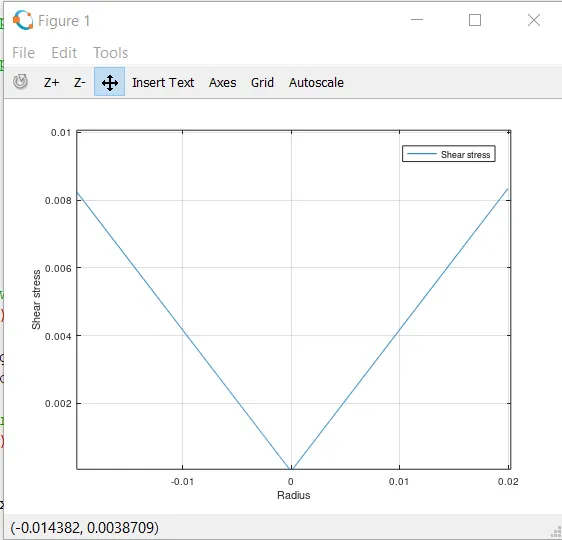
Shear Stress `tau=(2*mu*V_(max)*R)/r^2`
Matlab Program:
clear all
close all
clc

% The Reynolds number
Re = 2100
% The Diameter of pipe
D = 0.04
% The Entry length of pipe
L =0.06*Re*D
% The total length of pipe
L_p = L+0.7
% Radius of pipe
r = D/2
% Angle of wedge (less than 5)
theta = 4
% Dynamic viscosity
mu = 0.89e-3
% Density
rho = 997

% Hagen poiseuille flow equations
v_avg = (Re*mu)/(rho*D)
v_max = 2*(v_avg)
del_p = (8*mu*L_p*v_avg)/(r^2)
kinematic_p = del_p/rho

% calculating shear stress
R = linspace(0,r,1000)

for i = 1:length(R)
    tau(i) = 2*mu*v_max*(abs(R(i)))/r^2
end

plot(R,tau)
xlabel('Radius')
ylabel('Shear stress')
grid on
legend ('Shear stress')


header1='/*----------------------------------*- C++ -*------------------------------------*\'
header2='   =========                 |                                                    '
header3='   \\      /  F ield         | OpenFOAM: The Open Source CFD Toolbox      '
header4='    \\    /   O peration     | Website:  https://openfoam.org                 '
header5='     \\  /    A nd           | Version:  8                                 '
header6='      \\/     M anipulation  |                                                  '
header7='\*----------------------------------------------------------------------------------*/'

f1 = fopen('blockMeshDict.txt','w')
fprintf(f1, '%s\n', header1)
fprintf(f1, '%s\n', header2)
fprintf(f1, '%s\n', header3)
fprintf(f1, '%s\n', header4)
fprintf(f1, '%s\n', header5)
fprintf(f1, '%s\n', header6)
fprintf(f1, '%s\n', header7)

fprintf(f1, 'FoamFile\n{\n')
fprintf(f1, '%12s \t 2.0;\n','version')
fprintf(f1, '%12s \t ascii;\n','format')
fprintf(f1, '%12s \t dictionary;\n','class')
fprintf(f1, '%12s \t blockMeshDict;\n','object')
fprintf(f1, '}\n')
header8='// * * * * * * * * * * * * * * * * * * * * * * * * * * * * * * * * * * * * * //'
fprintf(f1, '%s\n\n',header8)


fprintf(f1, 'convertToMeters 1;\n\n')

fprintf(f1, 'vertices\n')
fprintf(f1, '(\n')
fprintf(f1, '\t (%d  %d %d)\n',0,0,0)
fprintf(f1, '\t (%d  %d %d)\n',0,r*cosd(theta/2),r*sind(theta/2))
fprintf(f1, '\t (%d  %d %d)\n',0,r*cosd(theta/2),-r*sind(theta/2))
fprintf(f1, '\t (%d  %d %d)\n',L_p,0,0)
fprintf(f1, '\t (%d  %d %d)\n',L_p,r*cosd(theta/2),r*sind(theta/2))
fprintf(f1, '\t (%d  %d %d)\n',L_p,r*cosd(theta/2),-r*sind(theta/2))
fprintf(f1, ');\n\n')


fprintf(f1, 'blocks\n')
fprintf(f1, '(\n')
fprintf(f1, '\t hex (0 3 5 2 0 3 4 1) (%d %d %d)',300,30,1)
fprintf(f1, ' SimpleGrading (1 0.1 1)\n\n')
fprintf(f1, ');\n\n')

fprintf(f1, 'edges\n')
fprintf(f1, '(\n')
fprintf(f1, '\t arc %d %d (%d %d %d)\n',1,2,0,r,0)
fprintf(f1, '\t arc %d %d (%d %d %d)\n',4,5,L_p,r,0)
fprintf(f1, ');\n\n')

fprintf(f1, 'boundary\n')
fprintf(f1, '(\n')
fprintf(f1, '\t inlet \n')
fprintf(f1, '\t {\n')
fprintf(f1, '\t\t type patch;\n')
fprintf(f1, '\t\t faces\n')
fprintf(f1, '\t\t (\n')
fprintf(f1, '\t\t\t (0 1 2 0)\n')
fprintf(f1, '\t\t );\n')
fprintf(f1, '\t }\n')


fprintf(f1, '\t outlet\n')
fprintf(f1, '\t {\n')
fprintf(f1, '\t\t type patch;\n')
fprintf(f1, '\t\t faces\n')
fprintf(f1, '\t\t (\n')
fprintf(f1, '\t\t\t (3 5 4 3)\n')
fprintf(f1, '\t\t );\n')
fprintf(f1, '\t }\n')


fprintf(f1, '\t top\n')
fprintf(f1, '\t {\n')
fprintf(f1, '\t\t type wall;\n')
fprintf(f1, '\t\t faces\n')
fprintf(f1, '\t\t (\n')
fprintf(f1, '\t\t\t (1 4 5 2)\n')
fprintf(f1, '\t\t );\n')
fprintf(f1, '\t }\n')

fprintf(f1, '\t front\n')
fprintf(f1, '\t {\n')
fprintf(f1, '\t\t type wedge;\n')
fprintf(f1, '\t\t faces\n')
fprintf(f1, '\t\t (\n')
fprintf(f1, '\t\t\t (0 3 4 1)\n')
fprintf(f1, '\t\t );\n')
fprintf(f1, '\t }\n')

fprintf(f1, '\t back\n')
fprintf(f1, '\t {\n')
fprintf(f1, '\t\t type wedge;\n')
fprintf(f1, '\t\t faces\n')
fprintf(f1, '\t\t (\n')
fprintf(f1, '\t\t\t (0 2 5 3)\n')
fprintf(f1, '\t\t );\n')
fprintf(f1, '\t }\n')

fprintf(f1, '\t axis\n')
fprintf(f1, '\t {\n')
fprintf(f1, '\t\t type empty;\n')
fprintf(f1, '\t\t faces\n')
fprintf(f1, '\t\t (\n')
fprintf(f1, '\t\t\t (0 3 3 0)\n')
fprintf(f1, '\t\t );\n')
fprintf(f1, '\t }\n')
fprintf(f1, '); \n\n')

fprintf(f1, 'mergePatchPairs\n')
fprintf(f1, '(\n')
fprintf(f1, ');\n')

header9='// * * * * * * * * * * * * * * * * * * * * * * * * * * * * * * * * * * * * * //'
fprintf(f1, '%s\n',header9)

fclose(f1)
BlockMeshDict:
/*----------------------------------*- C++ -*------------------------------------*\
   =========                 |
   \\      /  F ield                | OpenFOAM: The Open Source CFD Toolbox
    \\    /   O peration        | Website:  https://openfoam.org
     \\  /    A nd                 | Version:  8
      \\/     M anipulation   |
\*----------------------------------------------------------------------------------*/
FoamFile
{
     version 	 2.0;
      format 	 ascii;
       class 	 dictionary;
      object 	 blockMeshDict;
}
// * * * * * * * * * * * * * * * * * * * * * * * * * * * * * * * * * * * * * //

convertToMeters 1;

vertices
(
	 (0  0 0)
	 (0  0.0199878 0.00069799)
	 (0  0.0199878 -0.00069799)
	 (5.74  0 0)
	 (5.74  0.0199878 0.00069799)
	 (5.74  0.0199878 -0.00069799)
);

blocks
(
	 hex (0 3 5 2 0 3 4 1) (300 30 1) SimpleGrading (1 0.1 1)

);

edges
(
	 arc 1 2 (0 0.02 0)
	 arc 4 5 (5.74 0.02 0)
);

boundary
(
	 inlet
	 {
		 type patch;
		 faces
		 (
			 (0 1 2 0)
		 );
	 }
	 outlet
	 {
		 type patch;
		 faces
		 (
			 (3 5 4 3)
		 );
	 }
	 top
	 {
		 type wall;
		 faces
		 (
			 (1 4 5 2)
		 );
	 }
	 front
	 {
		 type wedge;
		 faces
		 (
			 (0 3 4 1)
		 );
	 }
	 back
	 {
		 type wedge;
		 faces
		 (
			 (0 2 5 3)
		 );
	 }
	 axis
	 {
		 type empty;
		 faces
		 (
			 (0 3 3 0)
		 );
	 }
);

mergePatchPairs
(
);
// * * * * * * * * * * * * * * * * * * * * * * * * * * * * * * * * * * * * * //
ControlDict:
/*--------------------------------*- C++ -*----------------------------------*\
  =========                 |
  \\      /  F ield         | OpenFOAM: The Open Source CFD Toolbox
   \\    /   O peration     | Website:  https://openfoam.org
    \\  /    A nd           | Version:  8
     \\/     M anipulation  |
\*---------------------------------------------------------------------------*/
FoamFile
{
    version     2.0;
    format      ascii;
    class       dictionary;
    location    "system";
    object      controlDict;
}
// * * * * * * * * * * * * * * * * * * * * * * * * * * * * * * * * * * * * * //

application     icoFoam;

startFrom       startTime;

startTime       0;

stopAt          endTime;

endTime         1;

deltaT          0.001;

writeControl    timeStep;

writeInterval   20;

purgeWrite      0;

writeFormat     ascii;

writePrecision  6;

writeCompression off;

timeFormat      general;

timePrecision   6;

runTimeModifiable true;


// ************************************************************************* //
Velocity File:
/*--------------------------------*- C++ -*----------------------------------*\
  =========                 |
  \\      /  F ield         | OpenFOAM: The Open Source CFD Toolbox
   \\    /   O peration     | Website:  https://openfoam.org
    \\  /    A nd           | Version:  8
     \\/     M anipulation  |
\*---------------------------------------------------------------------------*/
FoamFile
{
    version     2.0;
    format      ascii;
    class       volVectorField;
    object      U;
}
// * * * * * * * * * * * * * * * * * * * * * * * * * * * * * * * * * * * * * //

dimensions      [0 1 -1 0 0 0 0];

internalField   uniform (0.04686 0 0);

boundaryField
{
    inlet
    {
       type             fixedValue;
       value uniform (0.04686 0 0);
    }

    outlet
    {
        type            zeroGradient;
    }

    axis
    {
        type            empty;
    }

    top
    {
       type             fixedValue;
       value uniform (0 0 0);
    }

    front
    {
        type            wedge;
    }

    back
    {
        type            wedge;
    }

}

// ************************************************************************* //
Pressure File:
/*--------------------------------*- C++ -*----------------------------------*\
  =========                 |
  \\      /  F ield         | OpenFOAM: The Open Source CFD Toolbox
   \\    /   O peration     | Website:  https://openfoam.org
    \\  /    A nd           | Version:  8
     \\/     M anipulation  |
\*---------------------------------------------------------------------------*/
FoamFile
{
    version     2.0;
    format      ascii;
    class       volScalarField;
    object      p;
}
// * * * * * * * * * * * * * * * * * * * * * * * * * * * * * * * * * * * * * //

dimensions      [0 2 -2 0 0 0 0];

internalField   uniform 0;

boundaryField
{
    inlet
    {
        type            zeroGradient;
    }

    outlet
    {
        type            fixedValue;
       value uniform 	0.0048028;
    }

    axis
    {
        type            empty;
    }

    top
    {
        type            zeroGradient;
    }

    front
    {
        type            wedge;
    }

    back
    {
        type            wedge;
    }

}

// ************************************************************************* //
TransportProperties:
/*--------------------------------*- C++ -*----------------------------------*\
  =========                 |
  \\      /  F ield         | OpenFOAM: The Open Source CFD Toolbox
   \\    /   O peration     | Website:  https://openfoam.org
    \\  /    A nd           | Version:  8
     \\/     M anipulation  |
\*---------------------------------------------------------------------------*/
FoamFile
{
    version     2.0;
    format      ascii;
    class       dictionary;
    location    "constant";
    object      transportProperties;
}
// * * * * * * * * * * * * * * * * * * * * * * * * * * * * * * * * * * * * * //

nu              [0 2 -1 0 0 0 0] 8.917e-7;


// ************************************************************************* //
Geometry and Mesh:
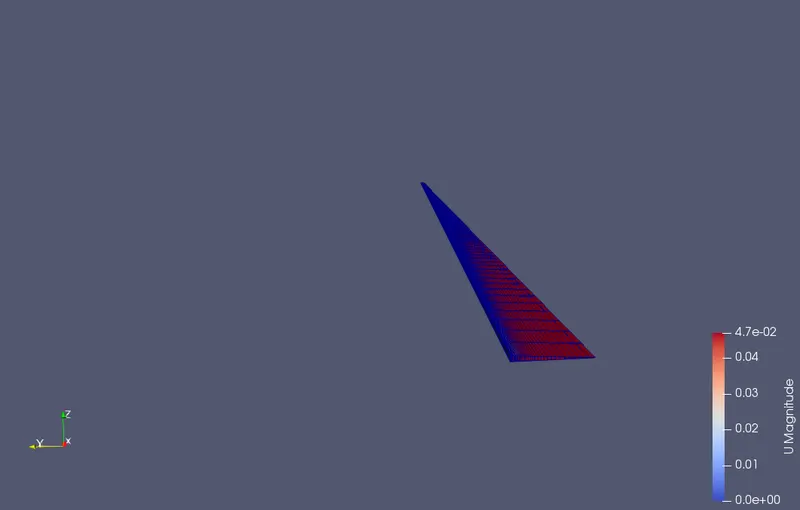
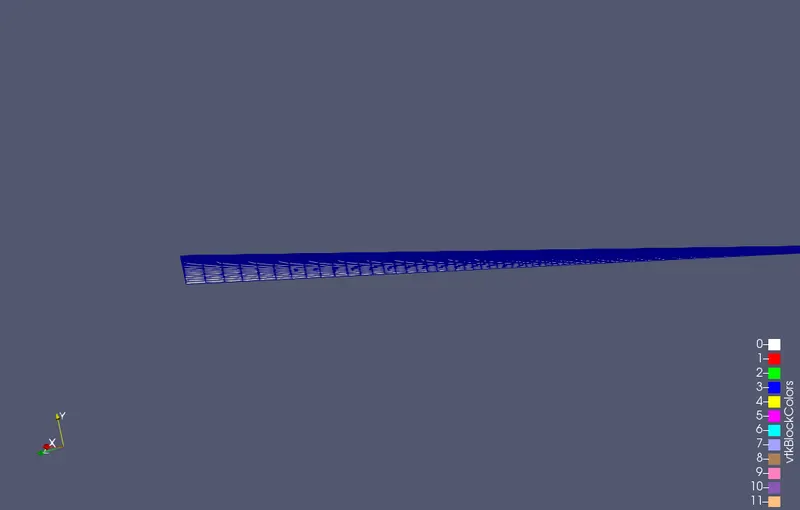
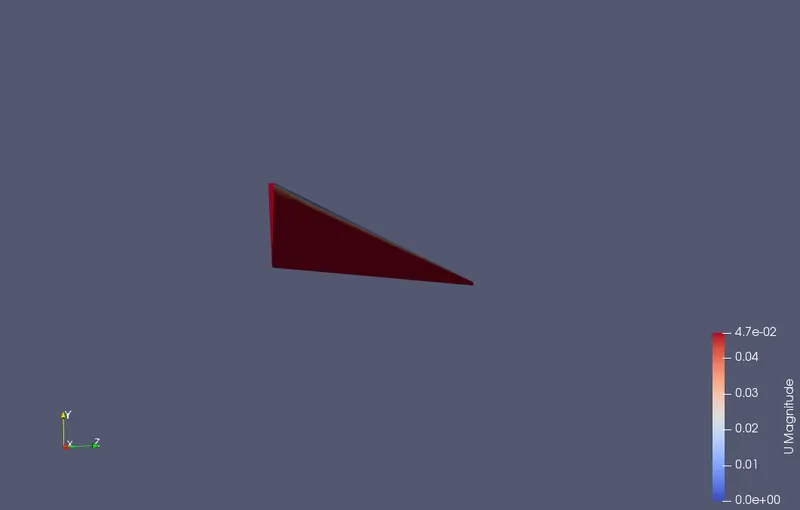
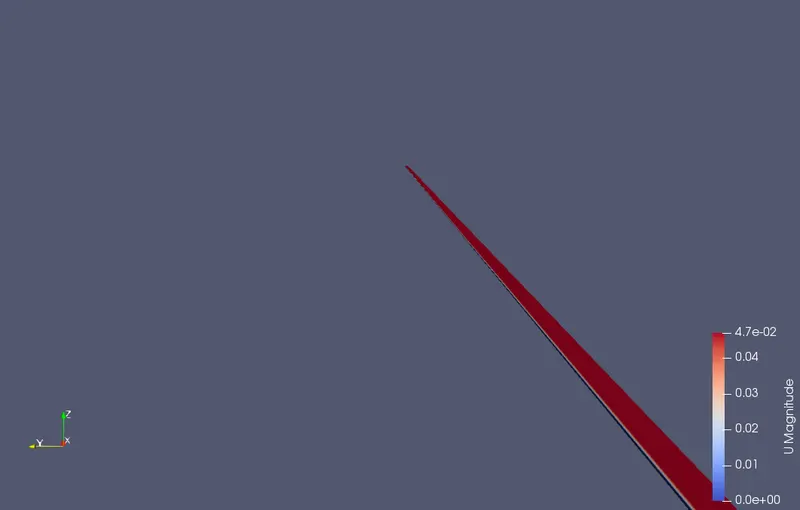
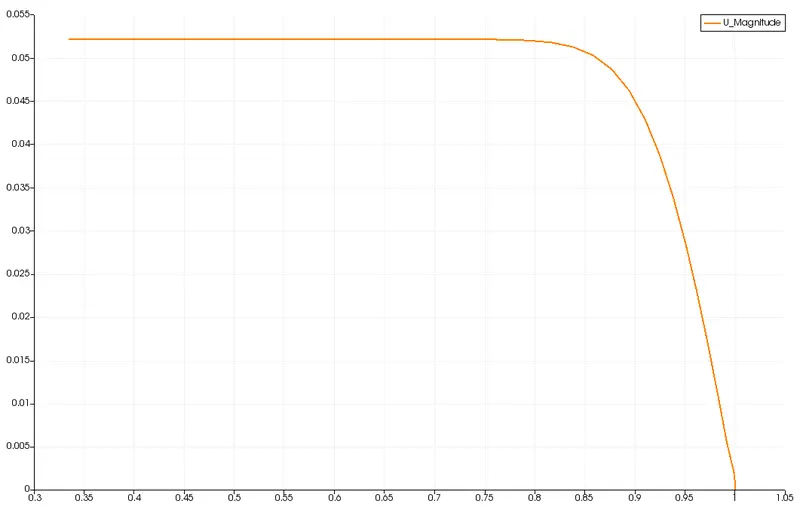
Velocity Profile for L=1m:
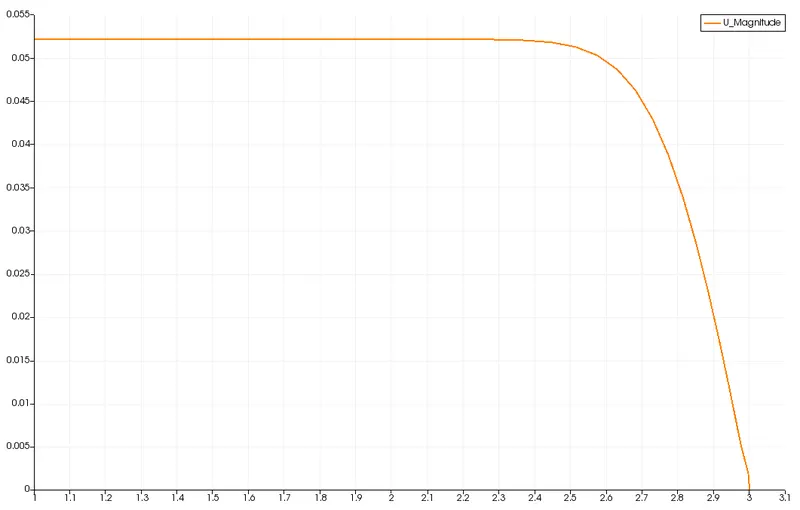
Velocity Profile for L=3m:
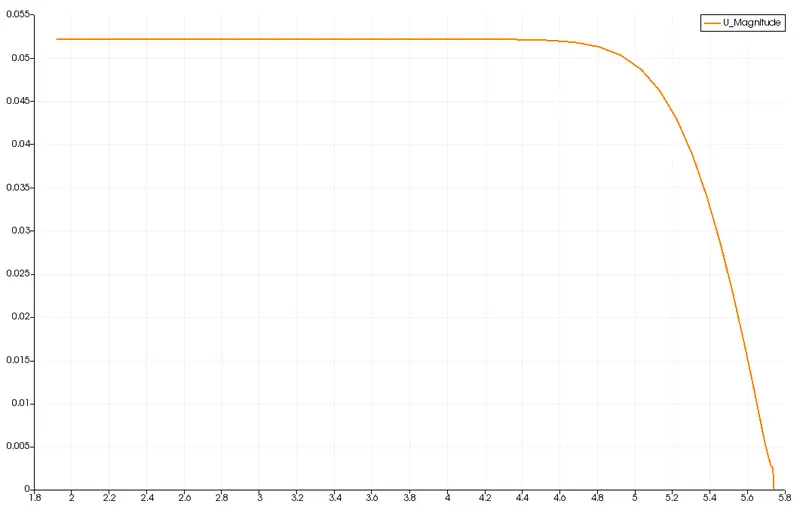
Velocity Profile for L=5.74m:
Shear stress Profile:
Conclusions:
>> From all the above plots it is observed that the velocity profile gradually increased from inlet to the outlet.The velocity profile is observed to increase slowly at different lengths of pipe and also it reached maximum velocity at the outlet. This region is called as a fully developed region as the velocity profile completely developes at the outlet.
>> When the fluid is moving, shear stresses are developed as the particles in the flow move relative to each other. For a fluif flowing in a pipe, the fluid velocity remains zero at the pipe wall. Shear force is generated because of the adjacent layer of the fluid that move with different velocities.
>> If value of mu is constant, the shear stress is linearly dependent on the velocity gradient. As the change in velocity is larger , more the shear stress near the walls.
>> Hence, the the computational mesh is generated for wedge angle = 4 degree. Also showed that the velocity profile matches the Hagen poiseuille's equation. From the above plotted velocity profiles it is proved that the profile is fully developed.