Week 11 - Project - A pillar Design with Master Section
Aim:
Create the A Pillar Plastic component through the given Class-A surface and master section and perform Draft analysis.
Objective:
The main aim of this challenge is to create a solid body of 'A PILLER' with the help of the closed surface method by using the 'Generative shape design' workbench in CATIA V5. Performing the 'Draft Analysis' on the solid part body of the Door trim.And to crate the mastersection of dog house given.
ABOUT A PILLER
- A-Pillars straddle the windshield, B-Pillars are in the middle of the passenger compartment (just behind the front doors) and C-Pillars are those at the rear of the passenger compartment.
MATERIAL USED FOR APILLER
ABS(Acrylonitrile butadiene styrene)
WHY ABS(Acrylonitrile butadiene styrene)
- COST EFFECTIVE
- LOW MELTING POINT
- HIGH IMPACT STRENGTH
COMPARISION OF MATERIAL TO CHOOSE FOR A PILLER LOWER
| Attributes | ABS | NYLON |
|---|---|---|
| Impact strength | High | low |
| Cost | Low | High |
| Melting point | low | High |
| Plastic Type | Thermoplastic | Thermoplastic |
| Properties | ABS | Nylon |
| Melting point | 190 -270 | 268.8oC |
| Density | 1.05 g/cm3 | 1.31 g/cm3 |
| Molecular weight | 211.3 g/mol | 224.3 g/mol |
| Ultimate tensile strength | 35MPa | 85MPa |
| Elongation at break | 30% | 90% |
Comparing ABS and Nylon
| Attributes | ABS | NYLON |
| Plastic class | Engineering | Engineering |
| Impact strength | High | low |
| Cost | Low | High |
| Melting point | low | High |
| Plastic Type | Thermoplastic | Thermoplastic |
| Surface | Smooth | Smooth low friction |
| Variant | Composites e.g. ABS/PVC | Chemical variants e.g. PA 6, PA 6,,6Glass-filled nylon etc |
| Rapid prototyping | Preferred for rapid prototyping. Works in 3D printing and CNC machining. | Less common for prototyping. But can also get 3D printed and CNC machined |
| Natural color | ivory | Off white |
| UV sensitivity | high | High |
| Flammability | moderate | High |
| Moisture absorption | Low | High |
| Dimensional stability | High | Prone to warpage |
| Acid/ Alkali resistance | Good | Poor |
MECHANICAL PROPERTIES OF ABS(Acrylonitrile butadiene styrene)
-
Key Properties of ABS
- High rigidity.
- Good impact resistance, even at low temperatures.
- Good insulating properties.
- Good weldability.
- Good abrasion and strain resistance.
- High dimensional stability (Mechanically strong and stable over time)
- High surface brightness and excellent surface aspect.
MANUFACTURING MACHING FOR APILLER LOWER
INJECTION MOLDING MACHINE
TOOLING AXIS
- The direction in which the mold or core and cavity opens is the tooling axis.
- Tooling Axis creation.
- Checking Draft analysis for created tooling Axis.
- Creating parting Surface.
- Creating Core Side.
- Creating cavity side.
LIFTER
- Lifters help to release internal undercuts or internal faces with no draft.
- After the part has cooled, the lifter pushes up at an angle,
- which removes the undercut section from the mold, and retracts from the undercut during ejection.
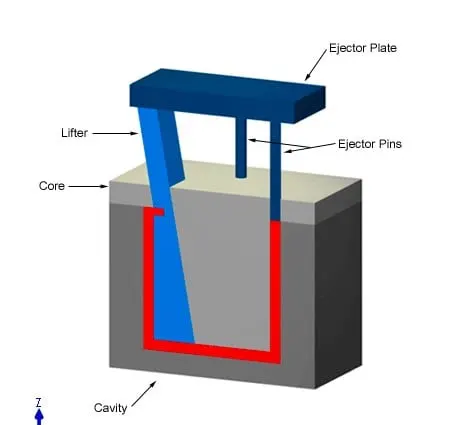
LIFETR TOOLING AXIS
CLASS A SURFACE
- Class-A (or 'Strak') is a term used in specifically in automotive design.
- It describes the final production surface data for the aesthetic parts of the car.
- The term 'Class A' is often misunderstood, but it's generally seen as the 'Holy Grail' of surface modeling.
- Class A surface is used to show to the customer visulization,and it is a aesthetic syurface.
CLASS B SURFACE
- The Class B finish is a quality finish with only minimal imperfections.
- A Class B finish is the most common finish for exterior surfaces.
- It is normally specified on surfaces such as external covers, panels, and parts that are fairly prominent.
- It is a offset surface of A,Which the surface were can not able to see Over the customer.
CLASS C SURFACE
- The Class C finish allows more imperfections than Class A or B.
- Class C is often specified for interior surfaces not readily visible, surfaces that will be covered by another part when assembled, or surfaces which the Customer feels do not need to meet a high cosmetic finish.
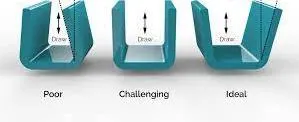
DRAFT ANALYSIS
- The draft analysis technique is used to analyze whether our part model created in CAD is manufacturable based on the draft condition applied.
- Here the part should get easily removed from the panel dies .
DRAFT ANALYSIS OF A PILLER CLASS A
DRAFT ANALYSIS OF A PILLER CLOSED COMPONENT
DRAFT ANALYSIS OF DOG HOUSE EXTERNAL
DRAFT ANALYSIS OF DOG HOUSE INTERNAL
DRAFT ANALYSIS OF CLOSED BODY APILLER WITH ENGINEERING FEATURES
SCREEEN SHOT OF SOLID BODY WITH PROPER COLOUR COATED OF CLASSES A,B&C WITH ENGINEERING FEATURES
ENGINNERING FEATURES
MATERIAL SELECTION FOR ENGINEERING FEATURES
POLYPROPYLENE
WHY POLYPROPYLENE
- which toughness,
- flexibility,
- light weight, and
- heat resistance .
DOG HOUSE
- Dog house is an engineering feature used in plastic trim design.
- Dog houses are used as supporting feature.
- Sometimes other engineering features like snaps; locators etc.
- are mounded on them to increase their strength.
DRAFT ANALYSIS OF DOG HOUSE (EXTERNAL)
DRAFT ANALYSIS OF DOG HOUSE (INTERNAL)
MASTER SECTION
- Master sections are the guides for design requirements which decide the component packaging after technical (Styling, Concept or Class-A) surfaces.
Conclusion:
1. The Door trim is created using a generative shape design, Part workbenches.
2. The model is designed with the nominal draft angle of 3 degrees for the component and
0.5 degrees for the Attachment features.
3. The Closed body of the model is created using close body command in part design
workbench.
4. The attachment features in the model are designed following the design rules.
5. The tree structure is maintained clearly.