Week 11: Project 2 - Emission characterization on a CAT3410 engine
Aim: Simulate two piston types Open W and Omega for a CAT3410 Diesel engine using converge and post process results using paraview.
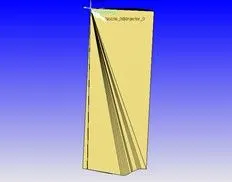
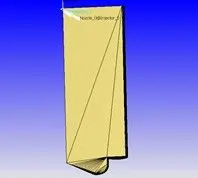
The geometry used in the simulation.
W piston geometry
Omega Piston Geometry
Setup-
Application Type-
Crank angle-based IC engine
Physical Parameters:
Bore =0.13716 m
Stroke = 0.1651 m
Connecting rod length = 0.263 m
RPM = 1600
Materials-
Gas Simulation- The therm.dat file was uploaded to import the thermodynamic properties of the fuel.
Reaction Mechanism – mech.dat file was imported for the simulation.
Parcel Simulation:
DIESEL2 was selected from predefined liquid data.
Species: DIESEL2 was selected from the parcel data.
Simulation Parameters:
Run Parameters:
Transient, Crank angle based engine simulation, full hydrodynamic solver, Compressible.
Simulation Time Parameters:
Start time : -147 deg
end time : 135 deg
initial time step/min time step: 1e-7/1e-8
max time step:0.0001
max convection/diffusion CFL limit: 1.0 / 2.0
Solver Parameters:
PISO Navier stokes solver scheme
Boundary Conditions:
Law of wall for velocity & temperature boundary conditions
- Piston- wall, translating, moving, temperature - 553K
- Front Face – Periodic, Stationary, Rotational, 45 deg
- Back Face – Periodic, Matching Boundary: Front Face
- Liner – wall, stationary, fixed, temperature - 433K
- Head - wall, stationary, fixed, temperature - 523K
Initial conditions and Events
Regions and Initial conditions:
- In Cylinder Region
Temperature - 355k
pressure – 197000pa
Turbulent Kinetic energy – 62.0271 m^2\/s^2
Turbulent Dissipation – 17183.4 m^2/s^2
Species – CO2(0.0014304), H2O(.0006296), N2(0.76765), O2(0.23029)
Passive – Hiroy Soot, NOx
Physical Models
Spray Modeling:
Turbulent Dispersion: O’rourke model, Wall Interaction>Spray-wall interaction-Film Splash model – O’Rourke Model
Injectors Addition, parcel species – DIESEL2, rate shape profile given
Cycle injection temporal type
Start Of injection - -9 deg
Injection Duration – 21 deg
Total Injected Mass – 2.70167e-05 kg
Total no of parcels: 50000
Temperature - 341K
Nozzles-
Nozzle diameter – 0.000259m
Circular Injection Radius - 0.0001295m
Location and orientation provided
Total no of nozzles – 1
Combustion Modeling:
Fuel Species Name: C7H16
Temporal type: Sequential
Start time: -10 deg
End time: 135 deg
Combustion temp cutoff: 600 k
SAGE detailed chemistry solver
Emissions Modeling:
NOx models
Thermal NOx Model(Extended Zeldovich)
Mass scaling factor converting NO to NOx: 1.533
Hiroyasu -NSC soot model
Soot diameter: 2.5e-06cm
Soot density: 2g/cm^3
Formation species>Use total HCs for formation species
Turbulence Modeling:
RANS k-epsilon RNG model
Grid Control
Base Grid:
dx=dy=dz=0.004m
Adaptive Mesh Refinement:
Active regions
In cylinder region
Max cells - 2000000
Velocity-
Embed type: Sub grid scale
Max embedding level: 2.0
Sub-grid criterion: 2.0
Time control: Permanent
Temperature-
Embed type: Sub grid scale
Max embedding level: 2.0
Sub-grid criterion: 5.0
Time Control: Sequential
Start: -12.0 deg
End: 180.0 deg
Cycle Period: 720 deg
Fixed Embedding:
Embedding 1
Entity: nozzle
Mode: sequential
Period: 720 deg
Scale: 2
Start: -12 deg
End: 15 deg
Radius 1: 0.001
Radius 2: 0.003
Length: 0.01
Embedding 2
Entity: Boundary
Mode: sequential
Scale: 1
Embed layers: 1
Start: -20 deg
End: 180 deg
Embedding 3
Mode: sequential
Scale: 1
Embed layers: 1
Start: -20 deg
End: 180 deg
Mesh
Graphs
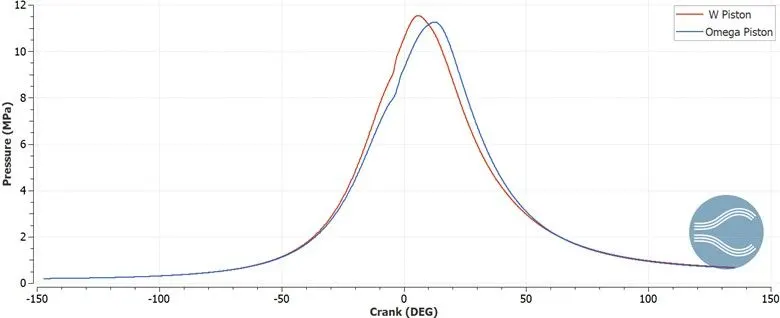
The graph shows the pressure achieved by both pistons type W and omega. The w pistons reaches higher pressure of 11.5 MPa and omega pistons reaches 11MPa pressure. Thus, the W pistons is able to achieve a higher peak pressure with respect to the crank degree. It can be noted the peak pressure is slightly delayed in Omega piston case.
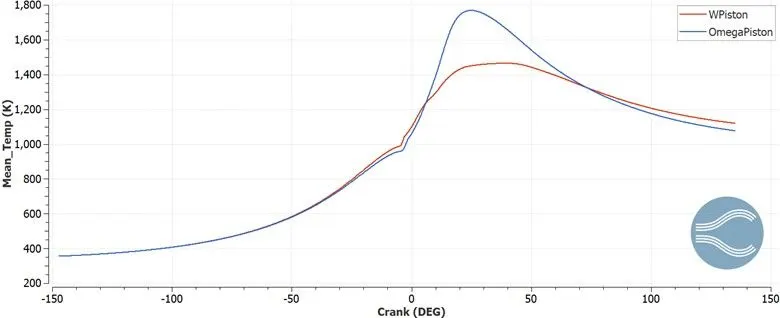
The graph shows the mean temperatures for both W piston and Omega pistons type against crank angle degree. It can be seen the omega piston reaches a higher mean temperature of about 1750K while the W piston reaches significantly lower temperature of 1430K. The difference is of 300K which is good sized difference.
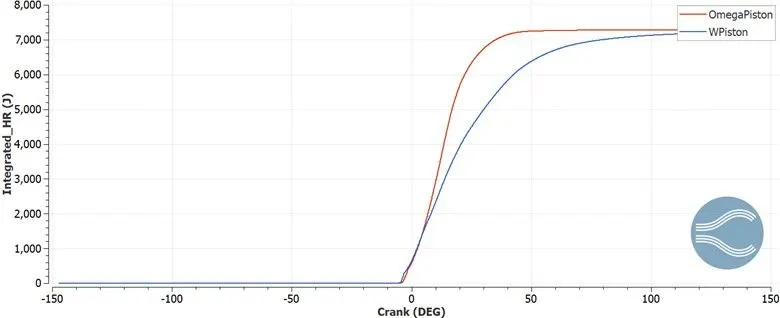
The Integrated Heat Release rate is integrated plot of heat release against crank angle degree for both the W and omega piston type. It can be seen the omega piston reaches a higher value of 7200J while the W piston reaches 7100J after a delay. By 30 deg, the Omega piston reaches 7200J while Wpiston is at 5500J.
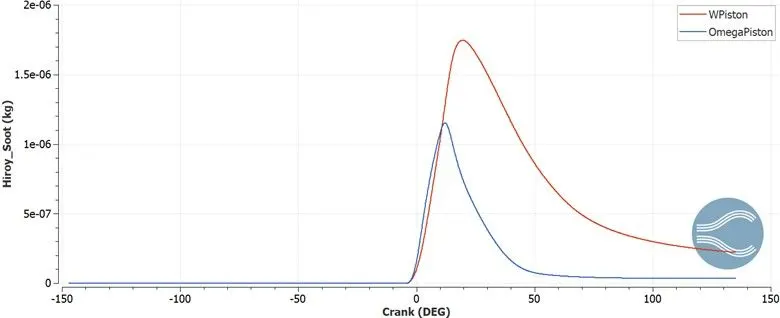
The graph shows the soot content (kg) with respect to crank angle degree for W piston and omega piston. The W piston produces higher peak soot amount of 1.7e-06kg. While the omega piston reaches low of about 1.2e-06kg. There is a 0.5 e-06 kg of difference in soot output which is a significant value.
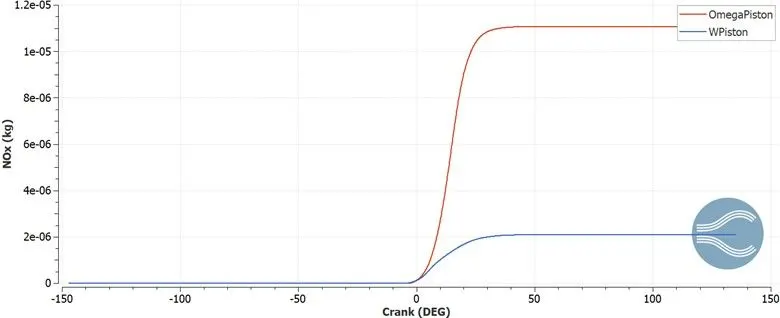
NOx emissions are dependent on temperature. The omega piston produces about 1.1e-05kg of NOx while W piston produces 2e-06kg. The difference is high of about 0.9e-06 kg indicating the w piston is more environmentally friendly.
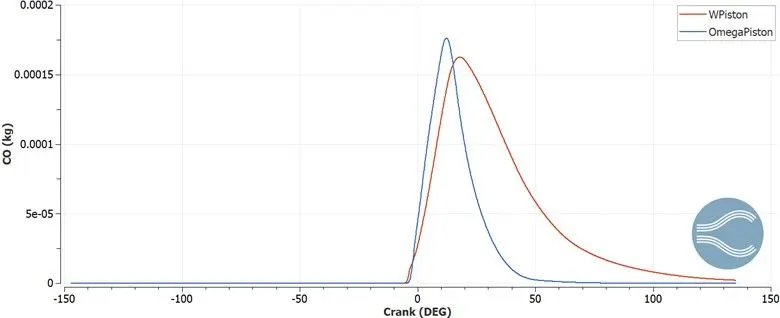
The CO emissions can indicate presence of unburnt fuel. The graph shows the CO content for both W piston and omega piston against crank angle degree. It can be seen the CO content for Omega piston reaches about 0.000175 kg while it reaches 0.00016 kg for W piston. The w piston seems to be better at combusting fuel in the chamber.
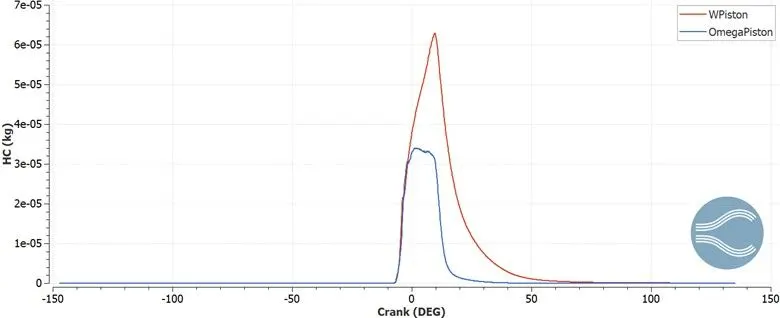
The graph shows the Hydrocarbon content for w piston and omega piston with the crank angle degrees. The W piston reaches about 6.2e-05kg while the it reaches 3.4e-05 kg for Omega piston. The difference is about 2.8e-05kg of HC which is of significant value. This shows the Omega piston is better as HC production is less.
IMEP and power:
For W piston

INDICATED MEAN EFFECTIVE PRESSURE (IMEP)=1.24+6 pa
Speed of engine=1600 rpm
-1600/60=26.66 rps
Speed in degree/second=360*26.66=9597.6 degree/s
270.156 deg duration in seconds=270.156/9597.6=0.0281 s
Gross Work=3028.53
Power=3028.53/0.0281=107.7 KW
For Omega Piston

INDICATED MEAN EFFECTIVE PRESSURE (IMEP)=1.39€+6 pa
Speed of engine=1600 rpm
=1600/60=26.66 rps
Speed in degree/second=360*26.66=9597.6 degree/s
270.156 deg duration in seconds=270.156/9597.6=0.0281 s
Gross Work=3409.28
Power=3409.28/0.0281=121.3 KW
Conclusion:
Simulations were performed for two pistons for diesel engine CAT3410 was performed.
The peak mean temperature was lower for open W piston and the omega piston is having a higher peak value of mean temperature.
The integrated heat release rate and power output is low in case of open W piston as compared to omega piston.
The Open W piston has lower NOx emissions as compared to Omega piston.
The Open W piston has more CO emissions which could be due to presence of unburnt fuel and it is confirmed as the soot is also higher in open W piston.
The CO2 emissions are more in case of Omega piston as compared to open w piston.
Youtube Animation Link: