Week 11: Project 2 - Emission characterization on a CAT3410 engine
Emission characterization on a CAT3410 engine:
Aim: The Aim of this project is to simulate the combustion process in a Diesel Engine using two different piston configurations, namely omega and open w piston. It is intended to compare the performance of the engine and emission characteristics of the engine with these two configurations.
Objectives:
1. Analyze two-piston bowl configuration (Open-W and Omega) of CAT3410 Engine.
2. Characterize their emission (Soot, NOx, and UHC).
3. Calculate the imep and power values graphically.
Theory: The diesel engine gains its energy by burning fuel injected or sprayed into the compressed, hot air charge within the cylinder. The air must be heated to a temperature greater than the temperature at which the injected fuel can ignite. Fuel sprayed into air that has a temperature higher than the "auto-ignition temperature of the fuel spontaneously reacts with the oxygen in the air and burns. Air temperatures are typically in excess of 526 °C (979 °F): however, at engine start-up, supplemental heating of the cylinders is sometimes employed, since the temperature of the air within the cylinders is determined by both the engine's compression ratio and its current operating temperature. Diesel engines are sometimes called compression-ignition engines because initiation of combustion relies on air heated by compression rather than on an electric spark.
Precise control of fuel injection is critical to the performance of a diesel engine. Since the entire combustion process is controlled by fuel injection, injection must begin at the correct piston position (i.e., crank angle). At first, the fuel is burned in a nearly constant-volume process while the piston is near top dead centre. As the piston moves away from this position, fuel injection is continued, and the combustion process then appears as a nearly constant pressure process.
Geometry Set up:
This project will be simulating a 60° sector geometry for a CAT3410 diesel engine with different piston profiles. The geometries are generated using the " make engine sector surface" tool available in CONVERGE Studio. The geometric parameters of the engine are as follow: Bore: 0.13716 m, Stroke: 0.1651 m, Squish height: 0.0001 m, Connecting Rod: 0.263 m, Compression Ratio: 17.5, RPM: 1600.
Configuration for omega piston:
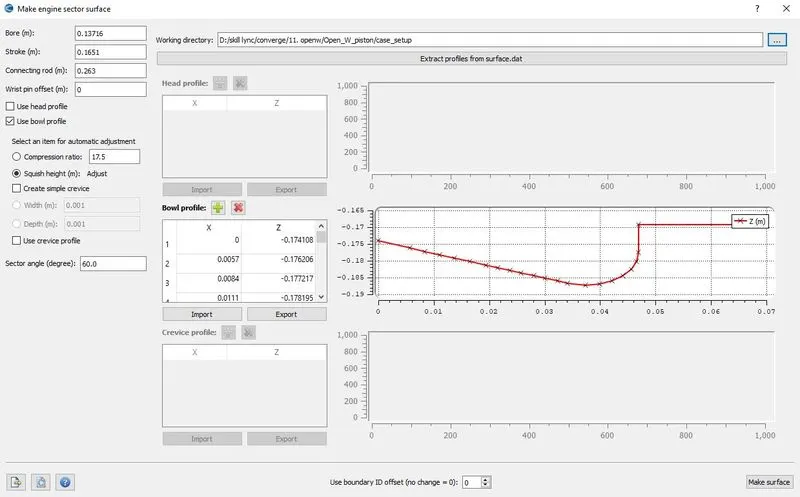
Surface geometries generated created:
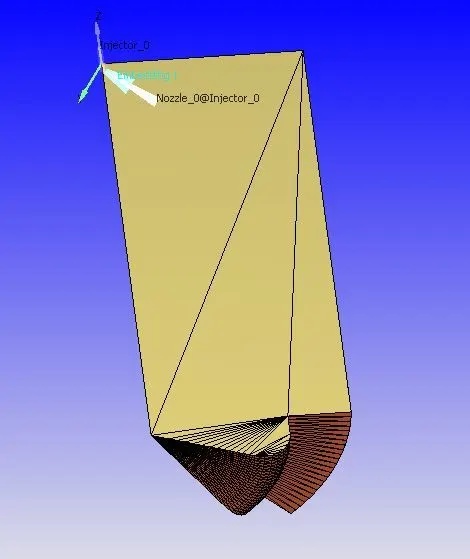 Omega
Omega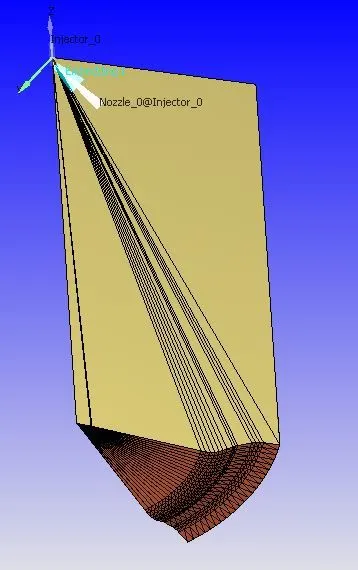 Open-w.
Sector geometries are useful in running quick simulations when there is an asymmetry in the model involved. This engine consist of 6 nozzles, hence the model can be decided into 360°/6 = 60° sectors.
Results:
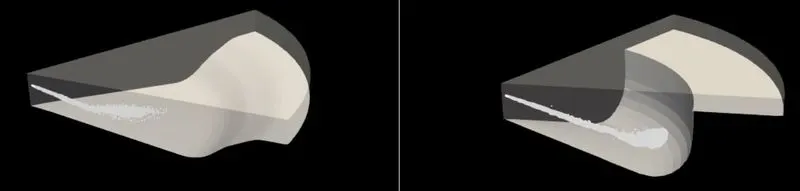
Spray:
Pressure:
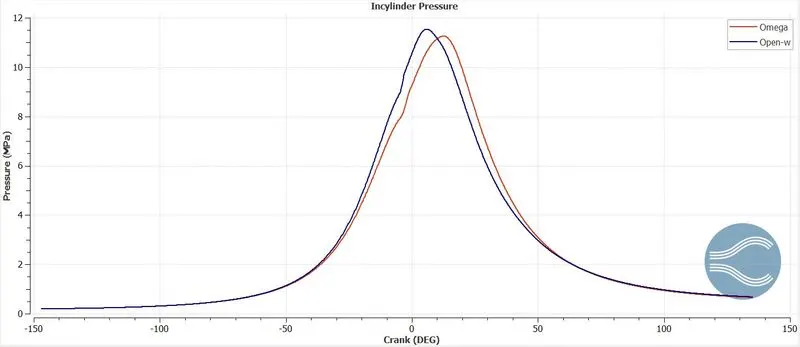
Crank angle corresponding pressure plots are shown. As you see Peak pressure of the Omega profile piston is slightly lower than the pressure of the Open-W profile one.
Temperature:
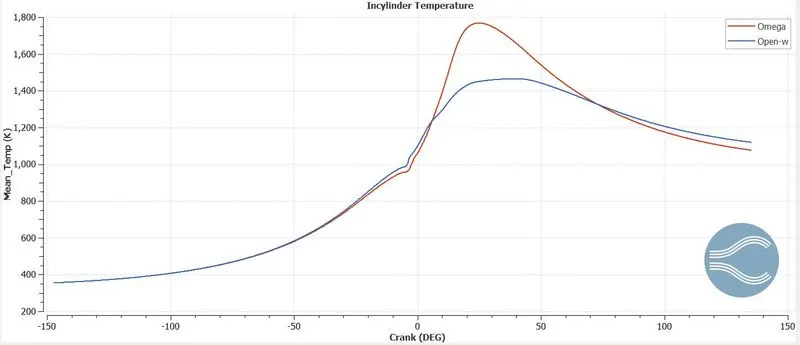
We see that the mean temperature in the Omega profile piston case is significantly higher, therefore in that case we will have a higher NO2 generation, thus we may say that the Open-W profile piston will be more eco-friendly, however, low temperature may be caused due to inappropriate fuel burning, which can be examined by looking at CO generation plots.
Integrated Heat Release Rate:
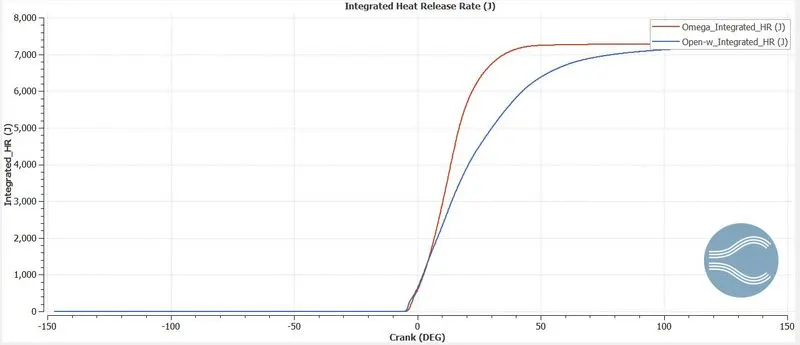
The integrated heat release denotes the amount of power generated from the combustion. From the given plot, a slight decrease in power is evident in the Open-W piston configuration. This can be due to factors such as Lesser fuel to burn or unburnt fuel, Incorrect timing, Insuffucuent air. The latter two points probably can't occur in this setup because this is a closed system simulation and given parameters are used to test the piston configuration bowl profile alone. We need to analyze further parameters to validate our conclusions.
Heat Release Rate:
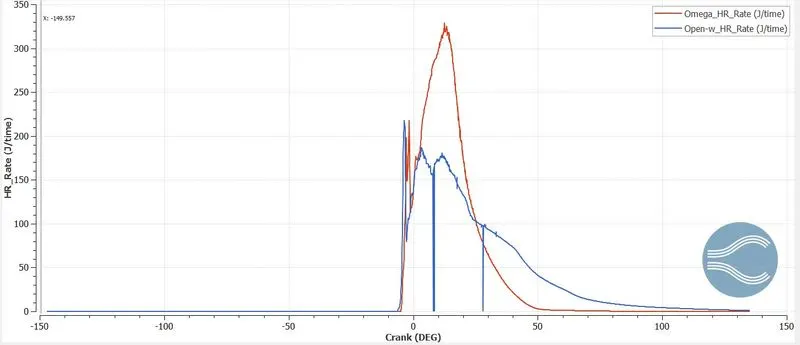
Due to more complete combustion in the cylinder with the omega piston, the magnitude of heat release rate in the piston with this configuration is marginally higher.
NOx Emission:
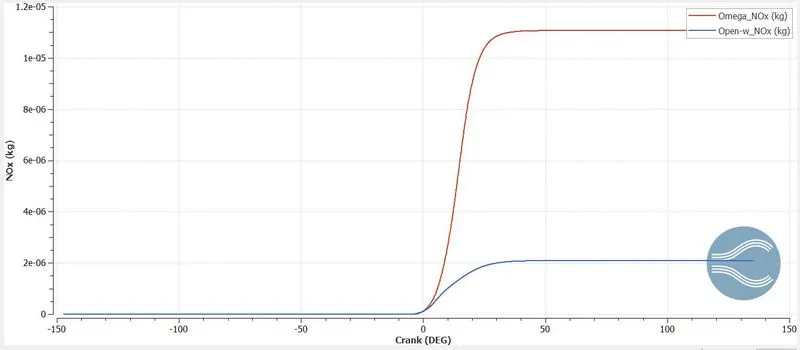
A compression ignition (diesel) engine runs all the time with a lean air-fuel mixture, the value of the equivalence factor (`lambda`) depending on the engine's operating point (speed and torque). The reason for this is the working principle of a diesel engine: controlling load not through air mass (which is always in excess) but through fuel mass (injection time). Since lean mixture denotes more oxygen and lesser fuel, the nitrogen present in the air is more likely to combine with excess oxygen and produce NOx. This happens under high pressure and high-temperature conditions, which are the operating conditions of a diesel engine where spontaneous ignition takes place without the need for a spark. Hence as we earlier saw the higher in-cylinder temperature in omega piston configuration, Nox emission is higher as a result of it.
This can be reduced using methods that lower operating temperatures in combustion chambers, including EGR (Exhaust Gas Recirculation), which allows heat transfer between flows having temperature differences and allows for some of the heat to be carried away from the combustion chamber. We can also utilize additives in the fuel itself to curtail the interaction of nitrogen with excess oxygen at the molecular level. Research is going on such methods and engineers must utilize whatever means to reduce harmful pollutants such as these from poisoning our environment.
Hiroy Soot:
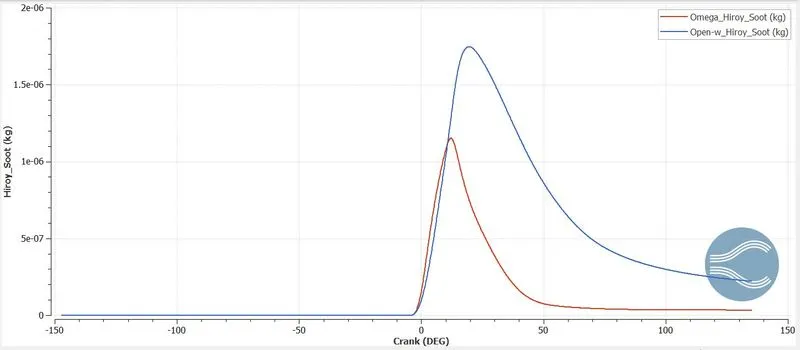
Internal combustion engines produce soot as a result of incomplete fuel combustion. Because of the way that fuel is injected and ignited, soot formation occurs more commonly in diesel than in gasoline engines. The fuel and air mixture in diesel engines typically do not mix as thoroughly as they do in gasoline engines. This creates fuel-dense pockets that produce soot when ignited. While the majority of soot easily escapes through the exhaust, some get past the piston rings and end up in the oil.
As soot builds to abnormal levels, engine problems begin. Soot thickness oil and negatively affect viscosity, which means the engine has to work harder to start and run during cold temperatures. Soot circulation also contributes to the formation of varnish and carbon deposits throughout the engine, which can wear down valves and seals, reducing efficiency and eventually causing failure. When excessive soot collects, it forms a congealed mass known as sludge, which is the leading cause of premature failure in diesel engines. Hence, from the plot itself, we can infer that the degree of unburnt fuel is way higher in the case of the Open-W piston than the Omega piston. Hiroy Soot is a harmful carcinogen and must be eradicated using suitable measures such as advanced three-way Catalytic convertors, or by perfecting the combustion process by reducing unburnt gaseous fuel.
CO Emissions:
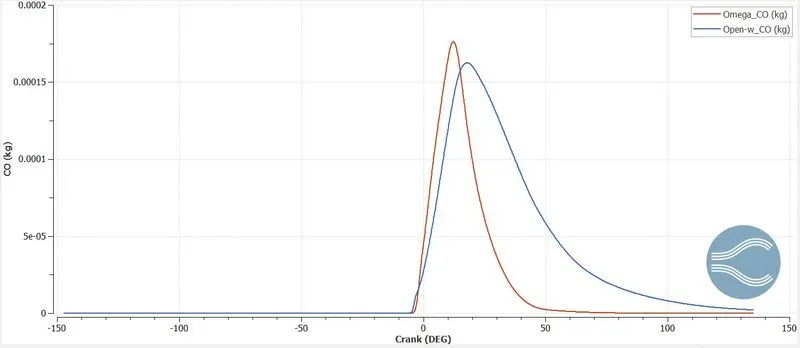
Even with higher values during combustion, the overall output values have decreased for Omega piston regarding the CO emissions. Open-W has an even slightly higher emission in this setup.
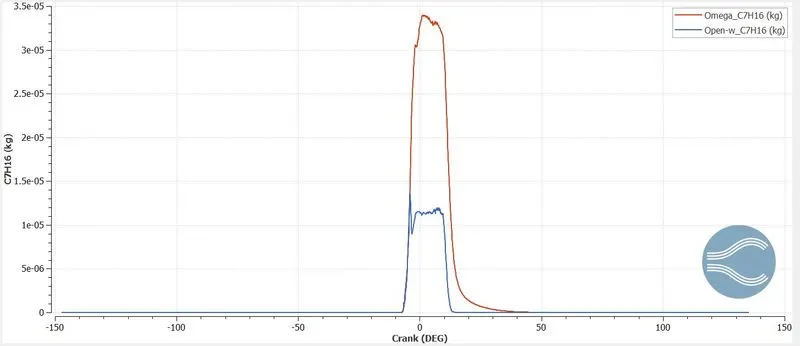
C7H16:
OPEN W PISTON CALCULATION:
IMEP= 1.24 x 10^6 Pa
Power= Work done / time
Work done= 3028.53 Nm
Duration= 270.156 deg
Crank speed= 1600 rpm
Degrees per second=`26.66xx360= 9597.6` deg/sec
Time for combustion= `270.156/9597.6`= 0.028 sec
Power= workdone / Time for combustion= 3028.53/0.02814= 107.62 KW
OMEGA PISTON CALCULATION:
IMEP= 1.396 x 10^6 Pa
Work done= 3409.28 Nm
Combustion Duration= 270.171 deg
Crank speed= 1600 RPM
Degrees per second=`26.66xx360= 9597.6` deg/sec
Time for combustion= `270.156/9597.6`= 0.028 sec
Power work done/time= 3409.28/0.02814= 121.33 KW
Conclusions:
From the analysis performed, the Omega piston configuration has significantly higher power output and lower soot and CO emissions. We found out that the Omega profile helps the fuel in the initial break-up, it leads to faster evaporation and afterward a more rapid and efficient combustion process. Hence, it is the most efficient of the two-piston bowl configurations and has far lesser fuel loss too. The only problem is that NOx emissions are higher in the Omega piston and that can be reduced by lowering the temperature values in the combustion chamber using methods such as Exhaust Gas Recirculation etc.